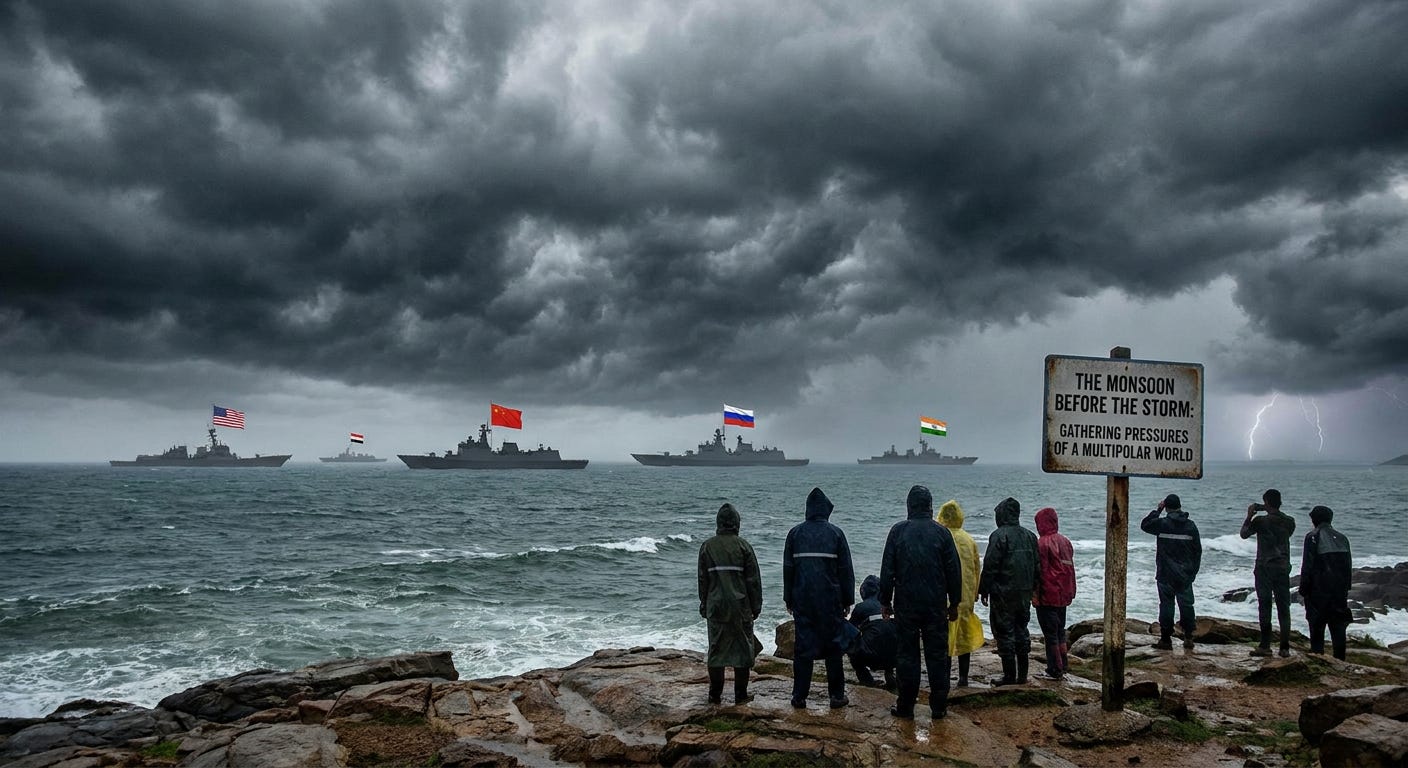
The air in Bangkok this week carries that noteworthy heaviness that precedes the monsoon—not much rain as yet, but the atmosphere is accumulating tension. You can feel it in the way motorcycle drivers pause at intersections, looking up at clouds that have not yet decided to break. It’s the sensation of waiting for a storm that everyone knows is coming, though no one can yet locate it.
This is the temporary nature of time we inhabit right now: not the frozen terror of the Cold War, with its binary certainties and its carefully negotiated standoffs, but something far more fluid and more treacherous. More like the years between 1890 and 1914. Then, as now, the old order had begun to smell of dust and irrelevance. Then, as now, a period of intensifying economic entanglement was curdling into suspicion, tariffs rising like antibodies against a system that no longer seemed to serve its creators. Joseph Chamberlain, that Birmingham radical with his imperial preference schemes, never became prime minister. Yet he managed to dismantle the faith in free trade that had made Britain rich—not through revolution, but through the patient erosion of confidence and the slow realisation among the Edwardian gilded class that the game was turning against them. Sound familiar? It should. The protectionist turn always arrives when the hegemon begins to doubt its own generosity.
We misremember the Cold War as danger. It was, in fact, a period of remarkable structural stability—two camps, one ideological divide, a conversation conducted through proxies and backchannels, ending not with apocalypse but with the dull thud of negotiated exhaustion. What we face now lacks that terrible clarity. We live instead in a multipolar fog: the United States, China, Russia, Iran, the fragmenting European project, and the rising southern tier all jostling for position without the shared logic that once allowed even enemies to misunderstand each other productively. The Cold War was a duet. This is a crowded room where everyone is shouting in different keys wanting to be heard.
The parallel with the years before the guns of August is not simply historical nostalgia. Take the unification of Germany then—the sudden emergence of a continental power that shattered the equilibrium of the Concert of Europe—and place it beside the restoration of China. Both represent the return of civilisational weight to the centre of a board game after a long absence. Both challenged a maritime empire accustomed to setting the terms of globalisation. Both triggered the kind of alliance rigidity that turns local accidents into systemic catastrophes. Then it was the Schlieffen Plan and the railway timetables; now it’s the first island chain and the semiconductor supply chain. The technologies differ. The physics of potential miscalculation remains ominously identical.
But here’s where the ground shifts beneath us, where the lens becomes the subject. We tell ourselves that we know how the story of 1914 ended, that this knowledge inoculates us against repetition. We possess nuclear arsenals that should, through the logic of deterrence, render great-power war unthinkable. We have international institutions—the United Nations, the WTO, the skeletal remains of multilateralism—that didn’t exist when Franz Ferdinand’s driver took that wrong turn in Sarajevo. These are the differences we cling to, the talismans we brandish against the darkness. History will not repeat itself.
Yet observe how these self-same safeguards have become part of the problem. The UN Security Council is paralysed because of multipolarity, not in spite of it. Without the discipline of the superpowers that created it, the veto has become a weapon of obstruction rather than management. Nuclear weapons, meanwhile, have not abolished risk but displaced it—into cyberspace, into economic warfare, and into the grey zones of state-sponsored assassination and drone strikes. We fight everywhere except where the missiles are pointed, which means we fight with fewer constraints, not more. The knowledge of 1914 doesn’t prevent war; it simply changes the regalia in which war arrives.
And then there’s Taiwan—the island that functions as our Sarajevo, the place where all these pressures find their focus. Unlike the Balkans in 1914, Taiwan is not a backwater but a technological aorta. Unlike Gavrilo Princip, the potential assassins here are not anarchists in cafés but nationalist algorithms and carrier strike groups. The logic of the situation is clear to any who care to look closely: a rising power that can’t secure what it considers its sovereign territory is a power that must either retreat or advance; a declining power that can’t abandon an ally without losing its alliance system is a power that must either bluff or be tested. Between these positions, the space for the kind of grand compromise that ended the Cold War has narrowed to a hair’s breadth. Nixon could fly to Beijing because both powers feared Moscow more than they feared each other. Today, the shared enemy is absent. The fear is both palpable and direct, and it is being stoked by paranoia.
What makes this moment more volatile than 1914 is not the absence of destruction but its promise. The technologies of the Edwardian age—dreadnoughts, poison gas, and aerial bombardment—were terrifying precisely because they were new, because they promised to break the stalemate of trench warfare with overwhelming speed. Our own innovations—artificial intelligence, autonomous weapons, and biological engineering—carry the same promissory note of decisive advantage. We’re building systems of mass slaughter that compress decision-making timelines from hours to milliseconds and that remove human hesitation from the escalation ladder. The cult of violence that characterised the early twentieth century, that wave of assassinations and anarchist bombs, has metastasised into something more intimate: the stochastic terrorism of the digital age, the erosion of the political centre, the transformation of inequality into grievance and grievance into identity.
So I return to the humidity in Bangkok and to the weight of the unshed rain. The Edwardians believed they were at the apex of progress, that the telegraph and the steamship had bound the world too tightly for general war to be profitable. We believe that our interdependence—our supply chains, our financial markets, our climate—binds us similarly. Both beliefs miss the point. Interdependence is no guarantee of peace. It’s just the terrain on which war, when it eventually comes, is catastrophic. The system doesn’t prevent the storm; it amplifies its effects.
Ironically, we don’t need solutions. The search for a solution is itself the pathology of the industrial mind, the belief that every problem has its corresponding lever, its policy fix, its stakeholder workshop. What we need, and what appears to be draining from the world like water from a cracked vessel, is the capacity for empathy and compromise. Not the tactical compromise of diplomats buying time, but the strategic compromise of powers willing to redefine their interests from first principles in order to preserve the possibility of a future. The Cold War ended because two exhausted empires decided, finally, that the game was not worth the candle. Our multipolar circus lacks even that exhaustion. Everyone is still fresh enough to fight.
So we wait, there in the humid afternoon, watching the clouds. The storm is not inevitable, especially given that conditions are forecast to be drier for the remainder of this year ahead of an El Nino. But the situations that make storms inevitable—the pressure gradients, the heat, the withheld moisture—are already here.
Whether we step back from the edge doesn’t depend on our knowledge of history but on whether we can still imagine a future that’s not simply a continuation of present grievances by other means. The Edwardians failed this test. Whether we will fail it too remains, like the weather, undecided—and terribly, exquisitely open.