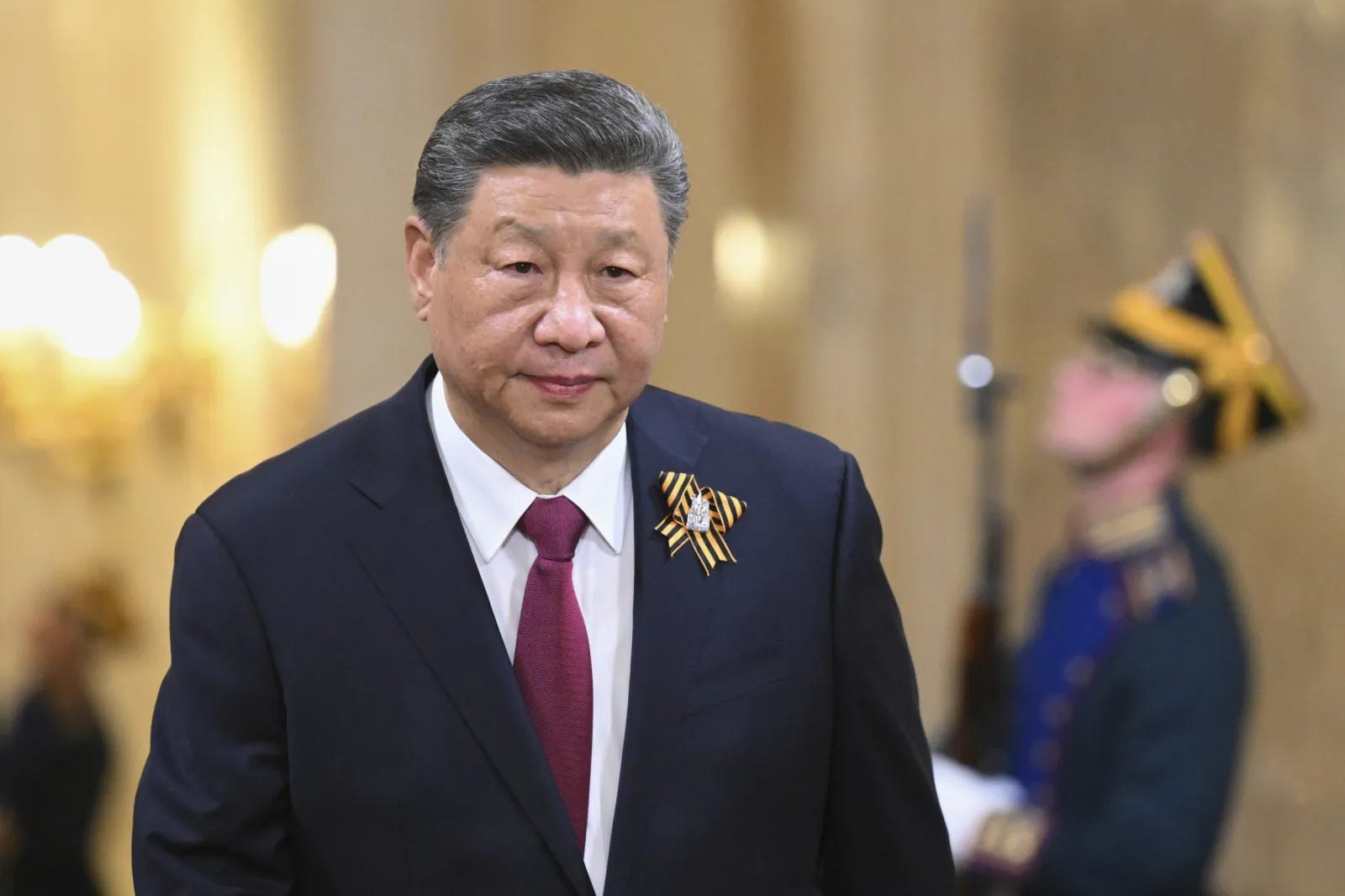
For at least five years I have watched the same word migrate across opinion pages, security briefings, and dinner-party certainties from Washington to Westminster to Canberra. The word is enemy. It arrives with the confidence of a settled finding, as though a full analysis were already done and only the alarm remained to be sounded.
The Governance of China, Xi Jinping’s curated archive of speeches and instructions, is interpreted in this register as a threat dossier — a field guide to the adversary, helpfully self-published. This reading fails. It fails in a way that tells us more about the West’s present paranoia than about Beijing’s intentions.
Xi’s governing philosophy is not organised around the destruction of the West. It is organised around something far less flattering to our sense of centrality: the consolidation of a distinct civilisational project, Party-led and Sinic in temper, indifferent to whether we approve or not. The peril for liberal democracies is not that this worldview is hostile. The peril is that it is different and that we keep forcing that difference through an anxious universalist lens that distorts China and, more damagingly, conceals our reasoning from ourselves.
To see why, we have to do the unfashionable thing. We have to take the man at his word.
What Xi actually says
The Governance of China is not a treatise. It’s an archive – a collection of speeches, talks, and marginal instructions – assembled across his years in power and extended now into multiple volumes. What strikes me on reading it is not menace but consistency. Three themes recur with the regularity of a tide.
The first is the absolute centrality of the Party. Xi presents the leadership of the Communist Party of China as the load-bearing wall of national stability, the one factor without which everything else collapses into the chaos the Party’s own historical narrative dreads. Security, economic direction, social management, military command — all are reorganised so that ultimate responsibility flows upward, toward coordinating bodies that answer to the centre. Strengthening the Party and securing Xi’s own position as its “core” are not two projects. They are one project wearing two faces.
The second is what he calls people-centred development, and what the official lexicon dresses up as Chinese-style modernisation. Xi returns again and again to the claim that the people are the foundation of the state and that development must be experienced rather than merely reported — housing, schooling, health, the eradication of poverty, safety, and the texture of an ordinary life. His economics marries the invisible hand of the market to the very visible hand of the state, both subordinated to long-horizon national goals. Modernisation, in this telling, is emphatically not Westernisation. It is socialism with Chinese characteristics: markets reduced to instruments inside a Party-directed design.
The third theme is the one that gives the other two their emotional charge. National rejuvenation. The Chinese Dream. Since the Eighteenth Party Congress, Xi has cast himself as the vehicle through which the great rejuvenation of the Chinese nation is finally accomplished — the restoration, by mid-century, of a great-power standing that the century of humiliation tore away. This is not an economic ambition donning patriotic colours. It is a civilisational claim. It seeks to put China back at the centre of world history, where Beijing believes it belongs by right and by length of memory.
Hold these three together and a coherent theory of legitimacy comes into focus, one entirely foreign to Western instincts. Legitimacy here is earned by outcome. A just order is one that delivers material improvement, stability, and national dignity to the majority under the disciplined hand of a vanguard. It is not one that maximises procedural competition or the autonomy of the individual. That single divergence is critical to appreciate.
The Sinic lens
Behind Xi’s programme and world-system sits a worldview, and the worldview is where Western analysis most reliably loses its footing. We read China through a liberal-individualist instrument and then express surprise that the readings come back strange. Approach it through three pillars, and the picture steadies.
Begin with the collective set above the individual. In Chinese political culture, as in a great many traditions outside the Atlantic world, the basic unit of moral concern is not the sovereign self but the group – the family, the community, and finally the nation under a legitimate authority. Hierarchy is not an embarrassment for which we should apologise; harmony is a good to be cultivated; obligation precedes entitlement. Western liberalism inverts every term in that sentence. It installs the rights-bearing individual as the baseline from which all legitimacy is measured, the figure to whom the state must ultimately answer. Xi’s speeches breathe the opposite tone. The protagonist of his discourse is the Chinese people as a single national family, and the apparatus that Western eyes read as the pure machinery of oppression — the pervasive social management and the digital watchfulness — is justified at home as the maintenance of order against the always-remembered latent alternative of collapse.
The second pillar is harmony set against adversarial democracy. Liberal democracy as it actually evolved is structurally a contest. Parties compete, factions collide, and public life organises itself around argument and debate. Liberalism’s defenders accept the friction as a sign of health — conflict routed through ballots and courts rather than through blood. From the vantage of a Party-centred order, that arrangement looks less like vitality than an inheritance nobody thought to update. Xi and the theorists in his orbit advance their model as the more competent answer to the governance of a vast and intricate society: planning where the West has paralysis, coordination where we have gridlock, and continuity where we have the stumble from one electoral mood to the next. A system that meets the majority’s needs and delivers steady, unglamorous improvement is held to be more just than one that lovingly protects a process while failing to produce a result.
The third pillar is exceptionalism shading into mission. China appears in Xi’s account as good, different, and singular — a civilisation-state with a mandate written across millennia rather than decades. The memory of humiliation at foreign hands is fused to the memory of astonishing recent success, and that fusion yields a conviction of real potency: that the Chinese model, sovereignty-obsessed and development-driven, is not only legitimate at home but also available for export, an alternative to liberalism especially attractive to states across the Global South. This conviction curdles, often enough, into a habit of laying both old wounds and present constraints at the West’s door. Yet it is not, at source, a summons to crusade against Western societies. It is a claim of the right to define China’s own path and increasingly to sit as an equal at the table where the world’s rules are written.
Read Xi’s vision through this lens, and the supposed plot to conquer the West dissolves. What remains is a bid to secure and extend a model of order whose internal logic simply never set out from liberal premises and feels no obligation to arrive at them.
The universalist reflex
Western commentary proceeds from a different starting point and rarely notices that it’s a starting point at all.
We understand ourselves through a familiar inventory: representative government, competing political parties, independent courts, the rule of law, civil liberties, and constitutional brakes on power. There’s a serious body of evidence linking this package to lower corruption, healthier human development, and firmer protection against arbitrary rule. Given that record, it is no mystery that Western publics and elites treat liberal norms not as one option among several but as the universal yardstick, valid wherever human beings happen to live.
That universalism is woven into the post-1945 order. The institutions, the treaties, the whole vocabulary of human rights and democracy promotion and rule-of-law reform encode a single assumption — that liberal procedures are the proper measure of any polity whatsoever. So when the West looks outward, it sees not difference but deficit, a set of shortfalls awaiting correction on a timeline of our choosing.
The awkwardness is that the order doing the measuring is itself visibly fracturing. Inside the liberal democracies, populist surges, widening inequality, institutional seizure, and a corrosive public mistrust have settled from crisis into condition. From outside, critics, both principled and opportunistic, observe that liberalism’s biography is entangled with empire, with colonialism, with racial hierarchy, and with the language of rights deployed to license domination rather than to end it. The clean story of liberalism as the neutral custodian of freedom persuades less than it did in the bright, brief afternoon of the 1990s.
I am not announcing liberalism’s death. I am simply noting that its claim to universality now meets resistance with real structure behind it — and that China under Xi stands at the head of that resistance, unembarrassed.
Reassurance, and intent
Turn from domestic philosophy to the external rhetoric and the same doubled pattern appears: soothing words braided with programmatic ambition.
On the soothing side, Xi says the expected things and says them often — no hegemony, no new Cold War, a UN-centred multilateralism, no victors in a trade war, and isolation as the wage of bullying and unilateral sanctions — alongside the warm formulas of win-win cooperation and a community of a shared future. Western policymakers receive all this with a cocked eyebrow, and not without reason: the militarisation of the South China Sea, the hardening over Taiwan, the extinction of Hong Kong’s autonomy, the surveillance, and the willingness to make trade a lever – none of it composes easily into the self-portrait of a defensive power. Yet notice what we do with this catalogue. Each item arrives in our discourse pre-judged, its Beijing reading stripped away — the reefs as sovereign waters long held and lately defended; Hong Kong as the closing of a wound left open since 1997; and the economic leverage as the ordinary statecraft every great power practises, and only the hegemon gets to call ‘rules-based’. One need not accept those readings to see that the famous gap between China’s words and deeds is also a gap between two framings and that the tidy Western verdict — revisionist power in denial — is itself a framing wearing the costume of a finding.
But there is intent here worth weighing beyond the easy charge of hypocrisy, and three strands of it deserve our attention.
Regime security comes first. It’s the organising principle of China’s foreign policy in its entirety. Sovereignty, external relations, and security are all bent toward the single end of preserving Party rule. Blunting criticism of China’s domestic practices, keeping Taiwan out of the institutions of international life, insulating Beijing from any outside leverage over its internal authority — these are not incidental. They are the point.
Then comes contestation over the norms themselves. China supports the institutions that serve its purposes — the World Bank and the Paris Agreement — because they advance its development and its standing. Where the norms cut against it, conspicuously on human rights and democracy, it works to loosen the existing liberal standards and to seed alternatives. And where the rules are still wet, as in the governance of the internet, it labours alongside other authoritarian states to set the principle of cyber sovereignty into the foundations – the state’s firm hand over information and networks, naturalised as common sense.
Third is the patient construction of China-centred architecture. The Belt and Road Initiative is the emblem of this — a continental scheme of finance and engineering binding Eurasia, Africa, and Latin America into relationships where Beijing’s preferences carry the most weight. Paired with new banks and forums, it diffuses the model, deepens the leverage, and stitches portions of the Global South into a fabric of dependence whose threads all run back to one capital.
Here the Western concern is not paranoia. The figure who emerges from the speeches and the subsequent policy is a leader resolved to remodel parts of the global order in the image of his own priorities – regime security, civilisational plurality, and the strong state – and confident that history is at his back.
None of which means the ambition is to roll armour down the Champs-Élysées. It means Xi intends to inhabit, and to help build, a world in which Western liberal democracy is no longer the unchallenged standard of legitimacy and in which the Party-led model is treated as a co-equal way of organising a people’s life.
Where the fear collides with the worldview
This is the precise seam where Western dread and the Sinic vision grind against each other.
Western discourse has settled on China as a single enemy, a convenient surface onto which a whole decade’s anxieties — economic precarity, technological vertigo, political disarray — can be projected and thereby externalised. Inside that frame every Chinese act reads as a campaign move. A port becomes a beachhead. A telecoms contract becomes infiltration. A UN resolution becomes subversion. The contest is rendered zero-sum and then moralised: democracy against autocracy, us against them, with no remainder.
Xi’s discourse, run through its own lens, narrates the same relationship in another key. China is a major power pursuing its own development and its own governance, anticipating competition while insisting the competition need not be staged as an ideological holy war. He rejects the democracy-versus-authoritarianism binary as Cold War residue and asks instead for mutual respect between systems. He doesn’t pretend that the world-system rivalry with the United States is fictional. He presents it as something to be managed away from catastrophe rather than embraced as fate.
Strip away the diplomacy, and a genuine quarrel in political theory stands exposed — universal rights against civilisational plurality. Western liberalism assumes its rights and procedures are valid yardsticks for any polity, so that deviation of any kind invites pressure, censure, and, now and then, intervention. Xi’s worldview assumes that different histories generate different legitimate forms, that outcomes for the many outrank the elegance of the process, and that a regime like China’s, drawing on what it presents as a five-thousand-year civilisational continuity, has earned an equal hearing.
When Western analysis declares this position self-evidently illegitimate, it simply confirms what Beijing already suspects—that the West means to delegitimise China’s rise by definition, before any particular act is even weighed.
There is a second quarrel running beneath the first, between adversarial democracy and managed order. Western societies have accepted high tariffs of contestation and volatility as the inevitable price of liberty, even as the volatility increasingly imperils the capacity to govern at all. Xi’s system trades much of that contestation away; it buys predictability, continuity, and control with the proceeds instead. To many Western observers the exchange is unacceptable in principle, full stop. To many elites elsewhere — and to no small part of their publics — the exchange looks shrewd when set against the visible dysfunction of the multi-party democracies they are invited to admire.
And here the dread turns self-fulfilling. Reduce China to a caricatured foe and you shrink the ground for the cooperation that climate, pandemics, and financial stability make structurally unavoidable. Let Chinese leaders read every Western hedge and coalition as one coordinated design to encircle and delegitimise them, and they harden; they tighten the domestic grip; they pour resources into counter-coalitions of their own. Each side then studies the other through the distorting lens of its own fears rather than through any honest reckoning with the other’s actual mindset.
Where the fear earns its keep
I am not arguing for serenity. There are domains where Western alarm, or at the very least sober concern, is fully warranted, and it’s not my task to soften them.
On human rights and civil liberties, the temptation is to recite a single charge sheet and let the gravest word on it do the work for all the rest. Resist that, and the picture grows more damning rather than less. The detention system is real, and its strongest documentation is not a Western assertion but the Party’s own filing cabinet — the China Cables and the Xinjiang Police Files, leaked from the inside: operations manuals, detainee spreadsheets, mug shots of the interned down to a fourteen-year-old girl, and transcripts in which a regional Party secretary traces his mandate to suppress a population directly to Xi. Journalists phoned the officials named in those files and heard them confirm their own roles; overseas Uyghurs found their missing relatives among the photographs. To wave this away as a smear is to commit the very sin this essay names, in reverse — refusing the evidence for the crime of who surfaced it. What is genuinely contested is the further step: the demographic-destruction claim and the legal word genocide, which independent scholars of that crime, owing Beijing nothing, have judged unproven on the record so far. And Beijing’s own rebuttal mostly answers a charge no careful critic is making — parading Uyghur population growth against an allegation about coerced birth rates in particular prefectures, issued, moreover, by the same state apparatus whose suppression of independent local reporting is part of what stands accused. Hold the three apart, and the honest verdict survives intact: a documented machinery of mass arbitrary detention, surveillance, and coercion, condemned without flinching — and the maximal label left where the evidence currently leaves it, contested, rather than deployed because it wounds most.
On the contest over norms, Beijing’s effort to reshape the language of rights, the standards of internet governance, and the terms of development finance could hollow out protections that took generations to install. But honesty requires noticing that the hollowing is not only being done to the liberal democracies from outside. It is well underway inside them, under their own governments and by their own hand — executive power slipping its constitutional leash, courts recast as obstacles, the press as an enemy, and the security state’s priorities raised above the individual’s as a matter of routine rather than emergency. Re-aligning the world’s rules around sovereignty and regime security rather than the person would alter, for a very long time, how power is exercised within states and between them — and on present evidence the West is not merely the object of that re-alignment but increasingly a participant in it. The convergence ought to disturb us more than the competition. Two systems we are told are opposites are, on precisely these axes, drifting toward each other.
On technology and security, the drive for self-reliance and military modernisation does bear on the strategic balance in East Asia, and it would be foolish to pretend otherwise. But here, more than anywhere, the prosecutorial frame collapses on contact with the evidence, because the escalation is plainly mutual and the West did not arrive late to it. The American campaign to choke China’s access to advanced semiconductors is not a countermeasure to Chinese aggression; it is itself a first-order act of economic warfare, an open attempt to arrest a rival’s development before it matures — and the drive for self-reliance we then read as menace is in good part the predictable answer to it. Each side calls its own move defence and the other’s provocation. What the spectacle actually shows is not Chinese intent bearing down on a passive West, but two powers locking an economic logic and a security logic together into something more combustible than either built alone — and doing it in concert, each supplying the other’s justification.
These are not small matters. They warrant vigorous argument, clear policy, and, where it comes to it, defence.
The error is to treat such concerns as proof that China is simply an enemy in the most elementary sense — a unitary, malign actor whose only intelligible aim is the ruin of the West. That move is seductive precisely because it excuses us from examining our own fractures. It lets the liberal democracies array themselves, yet again, as the eternal guardians of freedom set against the eternal forces of repression and so spares us the mirror we would rather not hold up. It also blinds us to China as it actually is: a civilisation-state whose governing class believes, with some material and historical warrant, that its model has been delivered and that the age of unchallenged liberal universality has closed. One need not share that belief to grasp that it drives a great deal of what Beijing does.
The wiser posture treats China as a strategic competitor and a formidable illiberal model, while refusing to compress that competitor into a monolithic foe. It invests in understanding how Xi and his intellectual circle actually conceive of order, of legitimacy, of global governance – so as to tell apart the moves that genuinely menace core liberal interests from the moves that simply express a different worldview carrying no inherent aggression. We have very nearly lost the capacity to draw that distinction, and the losing of it is its own kind of strategic failure.
Seeing clearly in a post-liberal world
The governance of China makes one matter plain. China under Xi has no intention of joining a liberal order that treats Western norms as the universal benchmark. It intends to live within, and to shape, a world where several civilisational models coexist and compete and haggle over the rules, with its own Party-led model standing among them as a confident equal.
For the West that prospect is profoundly uncomfortable, because it dissolves the familiar story of moral and institutional supremacy and obliges each liberal democracy to measure itself not against its own ideals alone but against external arrangements that strike some observers as steadier, even as more effective.
Yet the deeper discomfort is one the enemy story is designed to keep us from feeling. The post-liberal world is not only being built over there, in Beijing, by a rival we can hold at arm’s length and name on a map. It is arriving here, under our own hand — the executive slips its constraints, the courts are recast as obstacles, the security state’s priorities are raised above the person’s, and the slow migration of our own legitimacy from process toward outcome. We are drifting toward the very arrangement we claim to be defending civilisation against. To cast China as the singular author of a post-liberal age is, among everything else, a way of not noticing that we have become a co-author of it.
This is why fear, however intelligible, is the wrong instrument. It points outward by reflex, and the outward gaze is precisely what spares us the tougher reckoning. To understand Xi’s philosophy and the Sinic temper beneath it asks nothing so strenuous as total endorsement. It asks only that we surrender the consoling simplicity of the enemy story – and surrender with it the alibi that story provides, the assurance that whatever is dismantling the liberal settlement must be foreign. Only by seeing how China perceives and understands itself and how little distance now separates parts of its model from where our own systems are travelling can we respond with anything resembling intelligence to a future in which liberal universality has lost its monopoly everywhere at once, ours included.
If we misread Xi as the enemy of truths we imagine to be universal, we will misjudge the risks and squander the openings of his world alike — and we will go on mistaking our own drift for his design. Recognise him instead as the architect of a rival worldview, one with which, in some measure, we’re quietly converging, and we can finally begin the more demanding task: defending what we genuinely value, in our own houses first, without lying to ourselves about what we are up against, or about who is doing the dismantling.
A quick thank you
Thank you to those who have become paid subscribers in response to my recent note about The Hames Report.
I’m grateful. Paid subscriptions make the daily work sustainable and help keep the Report independent.
And to those who remain free subscribers: thank you too. Free readers help the Report travel, and I’m glad you’re here.
I’m still hoping to reach 100 paid subscribers. If The Hames Report is part of your regular reading, and if you’re in a position to support it, you can become a paid subscriber here:
https://richarddavidhames.substack.com/subscribe
Thank you, as always, for reading.