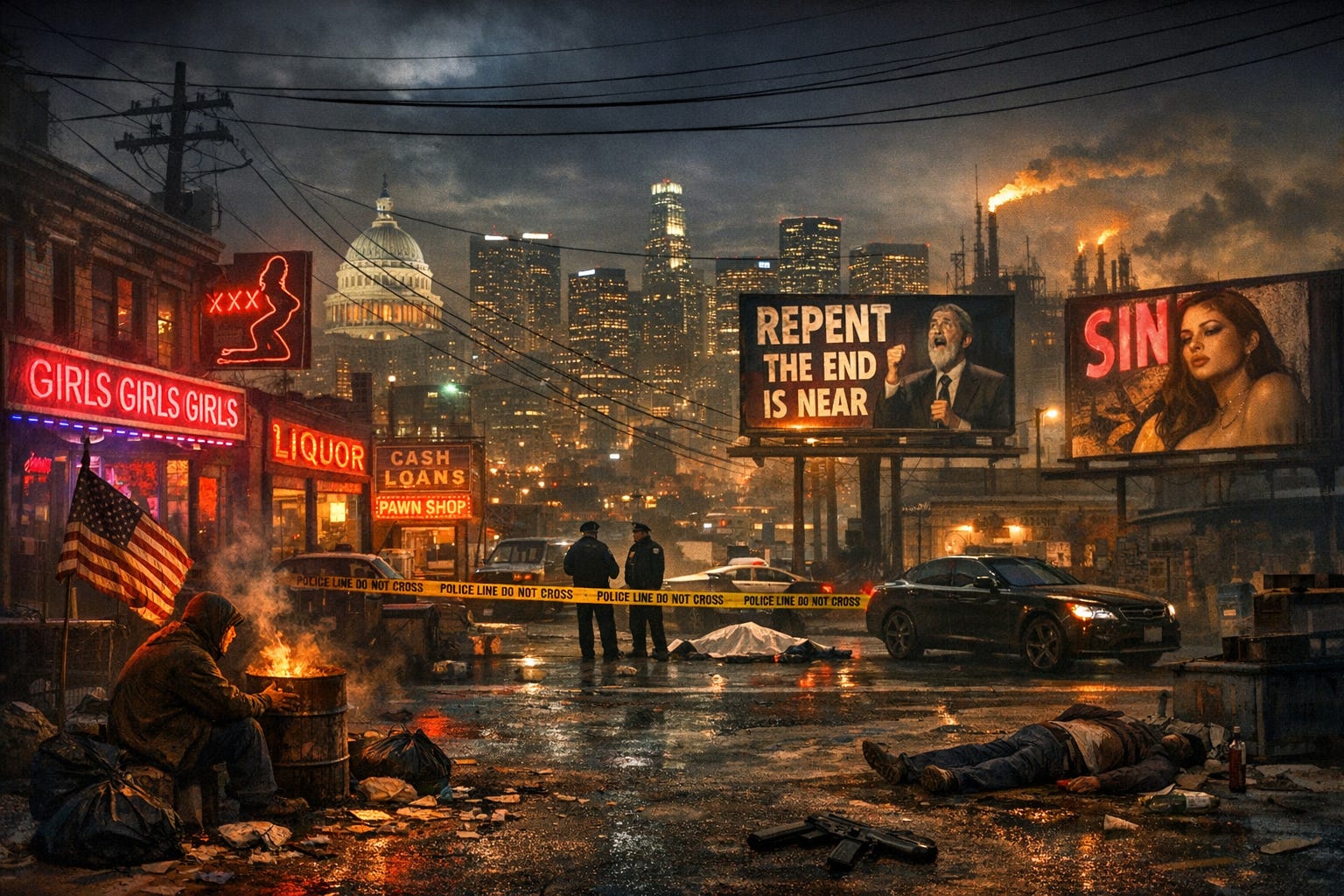
It’s a bizarre kind of anniversary that comes wearing the wrong countenance. The United States turns two hundred and fifty this year, and the celebration has the brittle cheer of a family gathering held in a house everyone privately knows is being sold. The bunting goes up. The speeches reach for Lincoln and the founding fathers. And underneath, audible to those who have stopped faking optimism, runs a subdued sound — the murmurs of citizens watching their own government commit to wars they didn’t want, threaten allies they spent eighty years nurturing, and stage acts of force whose aim nobody, including the people ordering them, can quite comprehend.
The standard analysis offers two frames. Decline or transition. Either the republic is in the early stages of decay — debt, overreach, infrastructure rotting, the familiar Gibbon-esque inventory — or it’s simply in the process of adjusting, normalising downward from a unipolar peak that was always going to end, becoming one great power among several. The commentators line up their evidence and invite you to choose a curve.
Both frames are wrong, and wrong in the same way. They both assume the country is somewhere on a line that runs from strong to weak. They argue only about which stage. And in doing so they miss what has become obvious to the average dismayed citizen, which is far more inexplicable and far more destabilising than any single weakness. The machine still works. That’s the problem.
Have you noticed how the experts reason? Paul Kennedy gave us the concept of ‘imperial overstretch’ — the idea that great powers fall when their commitments outrun their economic capacity. It’s an elegant thesis, and it has the comfort of all elegant theses: it tells you that what you’re seeing is a numbers issue. Too many bases, too much debt, too little growth to carry the load. On this reading the cure is arithmetic. Spend less, commit less, retrench, and rebalance, and the curve bends back toward health.
But arithmetic doesn’t explain what people are actually seeing. The United States isn’t failing because it has run out of capacity. By every structural measure the overstretch thesis treats as conclusive, the foundations remain formidable. It fields the most capable integrated military force in human history. It leads in artificial intelligence, in biotechnology, in advanced semiconductors, and in venture ecosystems that turn ideas into industries. Its universities still attract the world’s talent across oceans. The dollar still anchors global trade, and Treasury debt is still the asset everyone flees toward and embraces when they are frightened — including when they are frightened of America itself. A genuinely overstretched power can’t do these things. A genuinely declining power doesn’t have foreigners lending it money at a discount for the privilege of holding its paper.
The magazines, it’s true, are emptying — the munitions are burnt through arming other people’s wars faster than the industrial base can replace them. But notice what that is. You don’t exhaust an arsenal conserving strength. You exhaust yourself firing at nothing. Depletion is not the overstretch thesis, vindicated. It is force uncoupled from aim – which is the essence of what I am going to argue.
So the capacity is intact. What has vanished is something the curve can’t measure, because it’s not a quantity at all. What has gone is the mission.
A power is not only an accumulation of means. It is a means directed at something. For roughly seventy years the American endeavour was pointed, however imperfectly, however cynically at the edges, at an articulable project: a world ordered against a rival system, bound by alliances, lubricated by a reserve currency, and defended by a forward military presence that other nations tolerated because the project plausibly included them. You didn’t have to admire the enterprise to recognise it as one. It became the rationale for the bases, a logic for the treaties, and a destination for the spending. America understood what it was driving it. That’s what has dissolved. Not the capability but the purpose it served.
Just consider what the dismayed citizen is actually seeing. Wars entered into and abandoned with no discernible aim, the entering and the abandoning equally unmoored from any sane account of national interest a reasonable person could reconstruct. A peace deal with Iran was announced as historic yet breached within days, the breach producing neither strategic gain nor even the pretence of one. Threats issued against Canada, against Denmark over Greenland, against the very alliance architecture that constitutes the country’s actual source of leverage — threats that, if carried out, would dismantle the country’s own foundations. This is not the behaviour of a power husbanding diminishing strength. A declining power conserves. It picks its fights, hoards its credibility, and retreats with dignity to a defensible perimeter. What we’re watching is the exact opposite: a power with enormous strength expending it randomly, lavishly, on objectives that evaporate on contact. The technical term for a weapon that fires without a target is not weakness. It is malfunctioning.
Here is my epiphany, if you can call it that, and it runs against every instinct the literature on decline has trained into us.
The presidential bluff — the threats nobody intends to honour, the deals announced before they exist, and the theatre of force staged for a domestic audience — is read by critics as a symptom of fading power, the bluster of a man and a country that can no longer back its words. I think this interprets it precisely backward. You don’t bluff because you are weak. You bluff because the strength is still there and you no longer have a viable purpose to spend it on. Bluff is what power does when it has been decoupled from purpose. It goes through the motions of having a goal — the ultimatum, the deadline, the show of strength — because the motions are all that remain once the aim itself has gone. It is muscle memory twitching in a body whose nervous system has been cut.
This is why the bluffing feels so disorienting even to those who issue it. A threat tethered to a goal is comprehensible: do this, or that will follow. A threat tethered to nothing is pure expression, a force as a mood, and it lands on the world the way a two-year-old’s tantrum lands on a household — something to be suffered and worked around rather than negotiated with. Even long-standing allies have started to treat American commitments the way one treats the assurances of an unwell relative: with affection, with increasing alarm, and with discreet contingency planning. They are not responding to weakness. They are responding to unpredictability uncoupled from interest, which is a far more dangerous thing than weakness, because weakness at least follows discernible rules.
The decline thesis, for all its gloom, is somewhat consoling. It maintains the problem is structural and therefore repairable through structure. Renew the infrastructure. Stabilise the debt. Restructure the carceral system that cages a larger share of citizens than almost any society on earth and calls it justice. Restore universal provision so the polity has something binding it beyond a shared anxiety. Do the arithmetic and bend the curve. There’s a to-do list, and a to-do list offers a kind of forlorn hope.
What I am describing has no to-do list, because you can’t easily legislate a mission back into existence. Purpose is not a line item. The infrastructure rot, the carceral excess, the missing health care, and the fiscal drift are real. I would go further: they are not separate failures but a single one, refracted. They are what happens when a state stops being able to explain what it is “for” at home, just as the incoherence abroad is the same reticence turned outward — a power that can no longer say what it’s for beyond its borders. A government that can’t articulate a domestic purpose will not maintain the bridges, because maintaining the bridges is an act of faith in a shared future, and faith in a shared future is exactly that which has subsided. The bridges are not decaying because the money ran out. The amount of money in the economy is staggering. The bridges are decaying because no one in charge can any longer give a compelling answer to the question “For whom, and toward what end?”
This is also why the standard mass-incarceration framing — a symptom of decline or a correctable distortion — misses the point. Two million people held behind bars is not primarily a policy error to be improved at the margins. It’s a society administering, at vast expense, the management of a population it has given up on integrating. It is the carceral form of the same purposelessness: enormous capacity, deployed at scale, pointed at no shared end. The cage is the bluff turned inward.
So I would retire the question – is it decline or is it adaptation? – in order to invite an alternative.
What we’re living through is not the contraction of a great power but its automation. An apparatus of extraordinary capability, built for a purpose, has outlived that purpose and kept processing. The aircraft carriers still sail. The jets still fly. The labs still innovate. The dollar still reigns. The threats are still issued. Every component functions, but the assembly as a whole accomplishes nothing it could name, because there’s no longer a word to describe it. This is a condition the historical analogies don’t cover, because the empires we reach for as examples – Rome eroding, the Soviet Union imploding, Britain gracefully shrinking – all knew what they were becoming as they failed. They decayed toward an altered state. America is not declining toward anything. It is idling at full power.
And here’s the part that should genuinely frighten any American citizen who is paying attention, more than any debt figure: a machinery this powerful, this intact, and this detached from reality is not safe simply because it’s strong. It is dangerous because it is both strong and unmoored together. A weak power adrift does a limited amount of harm. A peerless power adrift — still able to sanction, to strike, to crash markets, to abandon allies on a whim — is the most volatile artefact within the international system. Why? Because nothing it does can be predicted from interest, the only language the rest of the world knows how to decipher.
The dismay so many Americans feel, then, is not misplaced sentiment to be soothed with reassurance about demographic youth and venture capital. It’s an accurate perception. They are watching the most capable imperial machine ever assembled run its routines with the operator’s chair empty, and they are justified in finding it terrifying, because they are correct about what they see.
The republic’s task at two hundred and fifty is not to bend a curve and not to recover the purpose it has lost — that errand was a project of dominance, and it’s not coming back, nor should it. The new task is to decide what a power of this size and ingenuity does with capability this vast once it can no longer be directed at the mastery of others. An instrument can serve more than one master. The danger is not that the old purpose has died. The danger is the machine running on alone, on autopilot, deciding the matter on its own terms, while no one does the work of commissioning a new one.