It might sound implausible, but a Patriot interceptor missile takes longer to build than a war takes to fight. That mismatch, unremarkable in a briefing document, is doing more to reshape the architecture of American primacy today than any single battlefield outcome in the current confrontation with Iran. Analysts tracking US munitions stockpiles report replacement timelines stretching from months into years for the standoff weapons, air-defence interceptors and counter-drone systems that a high-end conflict would demand. Direct-attack munitions remain plentiful at this stage. But the categories in short supply, the ones that would be critical in a confrontation with a peer competitor, are being drawn down faster than industrial capacity can restock them.
On its own, this fact shouldn’t be interpreted as a decline in the hegemonic status of the US. American forces retain the capacity to strike and to dominate a battlefield when they choose to engage one. What has changed is more subtle and, in the long run, far more consequential: the margin around that capacity, the slack that lets a global power absorb one shock while remaining ready for the next, is contracting.
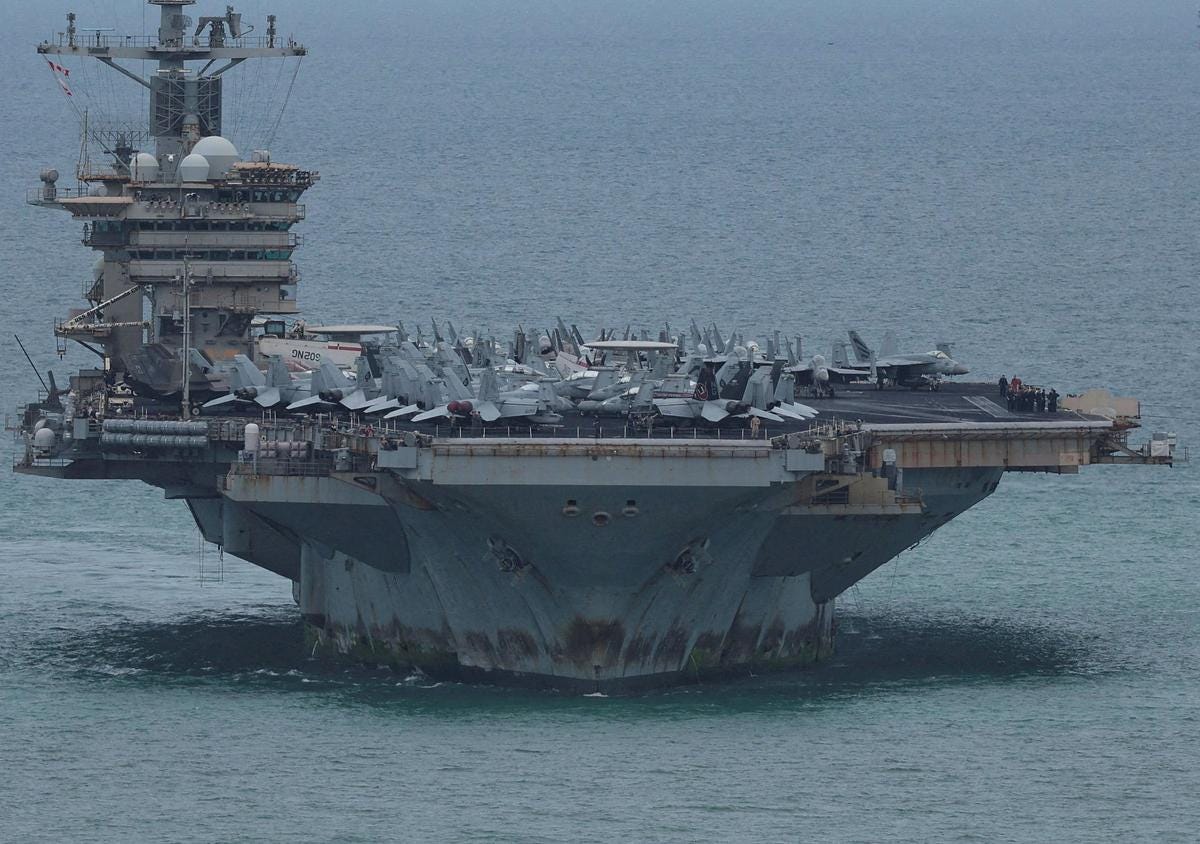
The nearest evidence sits closer to my home than any Pentagon leak. The USS Abraham Lincoln docked at Laem Chabang, near Pattaya, on 2 September after 286 days at sea, the longest carrier deployment in decades, its hull visibly rust-streaked from the extension. Its roughly 5,000 sailors and marines came ashore for several days of rest and recreation, filling Pattaya’s hotels and bars in a rhythm the town has followed since the Vietnam War. Seen from the pier, the visit reads as commerce and welcome, a boost to the local economy and a reminder of an old alliance. Seen from inside the carrier strike group, it reads as recovery time bought at the cost of nine months of continuous readiness elsewhere.
Carrier groups and destroyers across the US fleet are staying on station beyond their normal rotation cycles. Ship deliveries elsewhere are being delayed to keep other theatres supplied. Some air-defence assets have apparently been pulled from the Pacific to reinforce the Gulf, thinning cover in a region Washington has spent two decades designating its principal strategic priority. Read alone, each of these facts is a logistics problem. Taken together, they describe a system operating past its designed tempo.
Morale is not a separate issue. It reveals, with only a brief delay, precisely what the readiness numbers already show. Service members who are told to remain on indefinite alert, who watch deployment windows extend without a clear end point, begin to ask a question that has absolutely nothing to do with courage and everything to do with coherence. Does the institution asking this of them have a settled plan, or is it lurching from one crisis to another? Formal reporting on internal Pentagon dissent, as well as recent leaks published in the Washington Post, suggest that some senior commanders are raising exactly this concern. They have warned that continued prosecution of the Iran campaign risks eroding readiness for contingencies elsewhere, including the one that dominates long-range planning in Washington: that of a confrontation with China. This can’t be interpreted as insubordination. A professional military institution is doing precisely what it exists to do under duress, flagging to civilian leadership that a tactical choice is consuming a strategic reserve.
But here the argument widens somewhat. What’s being tested in the Gulf is not really about Iran, or at least not just about Iran. It has much more to do with the invisible substrate beneath American primacy since 1945: the assumption, held by allies and rivals alike, that Washington’s reach is effectively without limits. Not infinite in any literal sense, but elastic enough that no single crisis could reveal its confines. That single supposition has done more for American power over the past few decades than any carrier group. It meant a state weighing whether to defy Washington had to price in the possibility of simultaneous, impulsive responses across multiple theatres. Remove the assumption of elasticity and you don’t simply amputate American strength. You remove the fear premium making that military strength appear absolute.
Credibility deserves a closer examination too. The word is usually treated as a synonym for reputation. It’s closer to a form of psychological leverage extracted from ambiguity itself. A state’s credibility is not what others assume about its intentions. It’s what others believe about its spare capacity - the stockpile of force it might bring to a crisis it hasn’t yet chosen to enter. Spare capacity is almost impossible to observe directly. States infer it from second-order signals: munitions stockpiles looking thin; ships late to their next posting; troops sounding worn-out or desperate in leaked cables.
The Iran war is generating these signals in volume. This is why its strategic significance outruns its tactical scale. Adversaries and partners alike are recalculating America’s elasticity, not its raw power. What is lost this way takes longer to rebuild than a depleted missile inventory. A stockpile refills on a production schedule. Elasticity refills only once the world stops finding evidence for the old pattern, and evidence accumulates on its own timeline.
None of this hands the field to a rival architecture - at least not immediately. BRICS remains a loose coalition organised more around grievance with dollar-denominated finance than around any shared vision of what should replace it. The Shanghai Cooperation Organisation offers Eurasian states a forum for security cooperation, not a common defence pact. In any case, its members disagree with each other about as often as they agree with Beijing.
Neither grouping fields a military capable of contesting American power directly, but neither pretends to. Their significance lies elsewhere, in trade and stability rather than confrontation. A state joining either forum is not indicating an appetite for a rival bloc’s war. It’s signalling a preference for more than one route to the same commerce and security it already wants, which is exactly what makes the hedge cheap enough for so many governments to take it.
The same recalculation is under way inside the structure built specifically to prevent it. NATO members have spent the past several years raising defence budgets and reopening old arguments about European strategic autonomy, arguments that predate the Iran war but draw new urgency from it as well as the Russia-Ukraine conflict. A treaty ally does not need to doubt Washington’s word to start hedging. It only needs to notice that the reserve behind that word has a limit. Building its own capability before that limit is reached is simple prudence, not disloyalty.
An opposing reading exists, and I’m not about to dismiss it out of hand. A state that keeps troops on alert for months, that drains scarce interceptor stocks rather than withdraw short of its aims, could be advertising resolve rather than exhausting it. Realists have long argued that a willingness to absorb pain can persuade a wavering adversary more than any untouched stockpile ever could. Interpreted this way, it’s possible that Washington’s visible strain is the price of a commitment cheaper options could not have proven. Both readings fit the same set of facts. Which one turns out to be correct will not be settled by the current campaign, but by whether the states now hedging keep doing that once the campaign ends.
There’s a pattern here that recurs across every hegemonic transition on record, from Iberian maritime dominance through British imperial administration to the American order now under pressure: the visible instrument of power (fleets, garrisons, and missile inventories for example) is never what wears down first. What erodes before any other factor is the tacit belief, held simultaneously by dozens of governments that have never mentioned it to each other: namely, that defiance carries a cost and that cost is too unpredictable to risk. Such a belief is not measured in any economic indicator. It shows up only in the accumulation of small choices: a state that once would have deferred now hesitating, a purchase once made in dollars now settled in a different currency, a security guarantee once assumed now quietly hedged with a second option. No single decision here means much on its own. Together they are the terrain shifting beneath a structure that still looks, from the air, exactly as it did a decade ago.
What makes the current moment distinct is not that we’ve discovered a new pattern. It’s that the strain producing it is self-inflicted rather than imposed by a rising challenger. Iran did not defeat American military power and has shown no capacity to do so. The limits of US power are being exposed by a single decision taken in Washington: how long to sustain a campaign against a state that, by most conventional measures, poses a regional rather than a systemic threat.
Empires have exhausted themselves on wars they judged winnable and strategically minor more often than they have been toppled by wars they recognised as existential. The danger was never the adversary directly in front of the depleted stockpile. It was the adversary, or coalition of adversaries in this case, watching from beyond the theatre, updating their estimate of how much real capacity remains before the next crisis arrives and finds much-needed reserves already spent.
Whether those reserves get rebuilt in time to matter, and for which future crisis it will have been rebuilt, is not something that can be discerned from within the current campaign. It becomes visible only in retrospect, and usually to the historians of the power that assumed its elasticity was permanent.