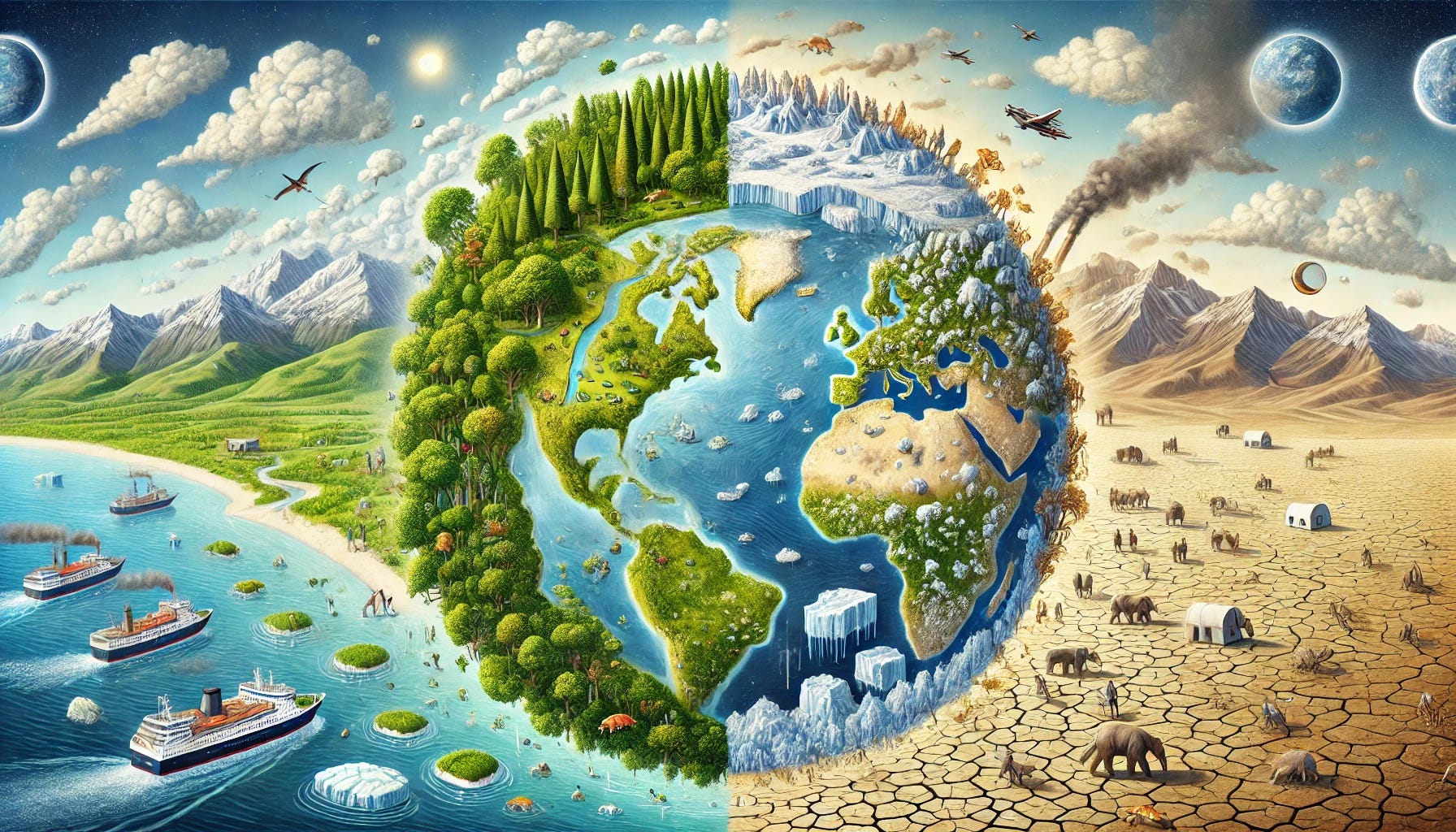
We seem confused with regard to the climate. And no wonder. Doomsters ring the alarm bells, repeatedly hollering "the end is nigh” while deniers look the other way as if nothing untoward is happening. Both stances are very unhelpful. And both are mistaken.
The climate crisis exposes one highly inconvenient truth, to paraphrase Al Gore. Western civilisation is not organised around science. Contrary to the usual Enlightenment narrative it's organised around capital and how individuals can benefit from that. Science is only embraced when it serves the interests of capital and is ignored when it does not. That's the main failure for almost all present-day policies to tackle the climate crisis and its consequences. And that's the main factor that needs to be understood.
The scientific consensus on climate change is unequivocal: the planet is experiencing a significant rise in temperatures. The IPCC projections of 1990 are still bang on the money. They suggest that we could see an increase of between 2.5 to 4 degrees Celsius by the close of the 21st century, with a 4-degree rise still considered a plausible scenario. Such an increase would likely result in a global sea-level rise of between 0.5 to 1 metre, fundamentally altering coastlines and ecosystems and implying the need for wise action.
What remains uncertain is the most effective way to address this change. Its effects are tangible, yet they vary geographically; some regions are more vulnerable than others, while some possess greater capacity for adaptation and risk mitigation. I seriously doubt that we need huge, costly, potentially hazardous, and unpredictable geoengineering projects, such as solar radiation management that deflects the sun's heat or ocean fertilization to stimulate phytoplankton growth.
Climate activists periodically call for limits on the activities of the most wealthy, reflecting the arguments in Limits to Growth, a report published by the Club of Rome in 1972, as well as recent research on planetary boundaries by Johan Rockstrom. So while the elimination of private jet flights by billionaires, for example, might lead to a significant reduction in individual carbon footprints, the overall impact on global heating would still be insignificant when viewed against the larger backdrop of global emissions.
Collective action across various sectors is essential for meaningful change. If we simply stopped polluting the oceans and the soils, practiced regenerative organic agriculture, consumed less and used what we made more efficiently, avoided throwing stuff away, and curbed our addiction for constant novelty, many of the potential impacts from heating could be reduced. Ironically, it's the simple act of collaboration that we find the most difficult.
These two elements—an inability to envisage how to take into account, least of all serve the best interests of capital—together with a reluctance to collaborate expansively across borders, most of them illusory—are the two most critical factors holding us back from tackling the climate crisis pragmatically. For example, if we were to ask how we could help the fossil fuel industry transition to renewables without incurring guilt, a loss of face, or indeed a death dive in profits, we would stand a better chance of getting its cooperation than constantly calling for its closure. The latter does not serve the interests of capital and goes out of its way to condemn rather than collaborate.
Regrettably, many of the strategies proposed by governments and activists alike fall far short of effectively curbing heating or advancing the innovations in energy, transport, and agriculture that would significantly reduce emissions, simply because these two pragmatic elements are disregarded. The polarized discourse surrounding climate change—between denial and alarmism—serves little purpose. Exaggerating risks or dismissing them entirely does not advance our collective understanding or response.
Entrenched interests have a pronounced influence on the climate debate, frequently distorting public discourse and obscuring the real issues (and real opportunities) at hand. The sheer complexity of the global climate system—or indeed even one component of it, like the role played by clouds in trapping heat, influencing precipitation, and reflecting solar radiation, which is known as the Albedo effect—makes it challenging for the average citizen to grasp, rendering them susceptible to the narratives spun by these vested interests.
Governments have a profound responsibility to ensure that the climate conversation remains anchored in scientific evidence, free from manipulation, and able to stimulate options that are pragmatically feasible. Unfortunately, most of the time, they are not able to distance themselves from the plutocrats who tell them what to think.
Core Principles for Climate Change Policy
In this world of confused introspection and misguided policy frameworks, we must embrace a pragmatic, science-based approach to all things related to the climate in ways that transcend ideology, invite impact investors and entrepreneurs to work together, empower local collaboration, and clear the path to easy application of new ideas.
That will take a policy framework broadly reflecting what Marvin Oka and myself often refer to as "RAISE" factors - responsiveness, adaptiveness, intelligence-informed integrity, sustainability, and ecority. These criteria are collectively able to "raise" our consciousness of how to deal with this global problematique. The following principles are most relevant for achieving that purpose:
1. Accepting Climate Science:
We must acknowledge the reality of global heating while avoiding futile and enervating debates about its very existence, which is akin to disputing the presence of gravity. The emphasis should be on mitigating negative impacts and enabling human societies and natural ecosystems to adapt effectively - and continuously. This requires constant scientific research and monitoring, along with the willingness to adapt and upgrade policies based on new findings.
2. Imaginative Responses:
Climate change is a genuine challenge, but it need not spell disaster unless we do nothing. By adopting a culture of experimentation and innovation, we can seek out inventive solutions that limit the most adverse effects. This includes exploring unconventional ideas, such as community-driven initiatives, and promoting pilot programs that test alternative approaches.
3. An Innovative Culture:
A spirit of innovation is essential. By harnessing entrepreneurial thinking and collaboration—particularly among younger generations—we can transform fear into informed action. Education systems must restore the capacity for critical thinking alongside problem-solving, encouraging students to engage with climate issues. History shows that societies rise to challenges through ingenuity and technological advancement, and this must remain a core guiding principle.
4. Technological Advancement:
The most impactful way to mitigate climate change lies in technological advancements across energy, transport, and agriculture. While personal lifestyle changes are important, their overall effect on long-term warming trends will be limited, unless adopted universally which is simply implausible. Therefore, we should prioritize large-scale innovations that can transform industries, such as renewable energy, ecological practices, automotive drones, and biomimicry.
5. Market-Driven Innovation:
Governments do not control innovation and should refrain from trying to dictate its pace and nature. Instead, they should create a conducive market environment that encourages new entrants and ideas. Policies imposing rigid targets or subsidies can misallocate resources and stifle genuine progress. A flexible, integral, but ethical regulatory framework able to adapt to emerging technologies is far more likely to generate more dynamic and innovative mindsets.
6. Empowering Localism:
Households, small businesses, and community organisations should be empowered to generate and sell energy to local grids without unnecessary restrictions or barriers to entry. Local entities can drive significant innovation and cost reductions. Support mechanisms, such as grants or training programs, can further enhance their capabilities, enabling them to contribute effectively to local and national energy solutions.
7. Facilitating Access to New Technologies:
Governments play a vital role in ensuring that new technologies can reach the market swiftly and equitably, without artificially inflating prices or favouring specific energy sources. This includes investing in infrastructure that supports the distribution of new technologies and providing incentives for their adoption across different sectors.
8. Global Context:
While larger nations contribute more to global warming, smaller nations are not absolved of responsibility. Every contribution matters, and proactive measures should be taken without undermining economic stability. International cooperation and frameworks that provide support to developing countries can enhance global efforts to combat climate change.
9. Nature-Based Solutions:
Large-scale tree planting can significantly mitigate warming. Initiatives like planting a billion trees annually can yield substantial ecological and climatic benefits. Additionally, other nature-based solutions, such as wetland restoration and sustainable land management practices, should be integrated into climate strategies to enhance biodiversity and ecosystem resilience.
10. Avoiding Panaceas:
There is no single solution that provides all the answers to climate problems. Pursuing numerous small, pilotable ideas that can be scaled up is preferable to spending on large, potentially harmful, big-ticket items (manufactured carbon sequestration for example) whose aims seem sensible but where the outcomes are uncertain. We should be encouraging experimentation and the fostering of diverse solutions.
11. Equity and Justice:
Addressing climate change must not avoid the need for social justice. We have to make sure that vulnerable populations are not disproportionately affected by climate impacts and have a voice in decision-making. This involves devising inclusive policies that engage marginalized communities and provide them with the resources to adapt appropriately. This is probably the most awkward principle for Western nations whose sense of superiority over previous colonises unfairly sets them apart.
Public Engagement
Effective public education and engagement are crucial for gaining support for climate initiatives and enabling individuals to make meaningful contributions. This involves clearly communicating climate science, inviting inputs from citizens, explaining the implications of policy decisions, and outlining ways for individuals and communities to take action. There is still much work to be done in order to bring society around to face the truth of the human condition.
13. Resilience Building:
Enhancing the resilience of communities and ecosystems is crucial for withstanding the impacts of global heating and species loss. This involves investing in infrastructure, encouraging sustainable habits, disaster preparedness, and adaptive management practices that allow societies to thrive even in the face of environmental challenges.
14. Long-Term Planning:
A long-term vision that transcends electoral cycles is necessary to ensure sustained commitment to climate initiatives. Allowing for adaptiveness, policies should be designed with an eye to future generations, promoting stability and continuity in climate action efforts that can withstand political fluctuations.
This framework provides a comprehensive and actionable approach to climate change policy, emphasizing collaboration, innovation, and social responsibility. An unwavering commitment to these principles gives us the best possible chance of forging a path that not only addresses the urgent and hugely complicated challenges we face through global heating but does it in a manner that is the least disruptive in achieving a sustainable and equitable future for all. Let it be so.