I read an opinion piece by Simon Tisdall in yesterday’s edition of The Guardian. It disturbed me, but probably for reasons other than that intended by the author. The title did its work by grabbing my attention: “President Xi never wastes a good crisis. As Iran, Ukraine and Palestine distract the world, he tightens his grip.”
The gist of Tisdall’s piece ran as follows. A man set himself on fire outside the United Nations in New York last month. Lobga Rangzen, a Tibetan activist, died protesting a law most of the people reading about his death will never read — China’s new “ethnic unity” statute. This law extends Mandarin-first education, tightens cultural controls across fifty-five minority groups, and, in an unusual reach, follows Chinese citizens who criticise it abroad.
The story ran for a day, cited alongside Xinjiang’s re-education camps and Tibet’s long occupation, and then it did what such stories do. It faded. What stayed behind — and what always stays behind — was the frame built around it: a comparison to Scotland losing its parliament, to Wales losing its language. Ethnic cleansing, the piece called it, without a qualifying clause in sight.
Every fact in that comparison can be defended. The law exists. The extraterritorial clause exists. The camps exist, the repression exists, the self-immolation happened exactly as described. And yet the piece is not quite honest, at least not in the way Simon Tisdall would recognise as dishonesty, because the dishonesty lives in the architecture rather than the bricks.
An analogy to Scotland is not evidence — it’s a decision about which emotions the reader should borrow before assessing evidence at all. A label like “ethnic cleansing” forecloses a debate that the underlying facts, serious as they are, have not yet settled. A prediction about Xi Jinping’s private timetable for Taiwan is dressed in the same declarative sentence as a verified law, so that speculation and record travel at the same weight through the reader’s mind. None of this required a malicious intent to deceive. It required only the ordinary reflex of a writer certain enough of the moral shape of the story to stop checking whether the story’s edges had been sandpapered to fit it.
This is the part that should trouble anyone who still cares what journalism is for. The genre doing this — outraged, well-sourced, morally confident commentary on an approved adversary — reads nothing like propaganda to the people producing it. Propaganda, in their mental model, is what happens in Beijing: state media insisting the camps are vocational schools, the purges are discipline, the missiles bound for Iran are routine trade. But a system that’s only capable of recognising manufactured certainty when it wears a foreign uniform has not escaped the trap. It has simply outsourced the noticing to whichever government currently tips the strategic scale against it — and Beijing, not London or Washington, is where that scale currently tips. The mechanism is identical in all three capitals: select the facts that indict, compress any chronology that might complicate matters, and then borrow the emotional charge of a comparison nobody will interrogate too closely. What differs is only which regime gets the compassion and which gets the verdict.
It would be simpler, but incorrect, to say the underlying facts don’t matter, that this is all just story and nothing is true. But they matter enormously. There’s documented evidence that the camps are real, the disappearances are real, the death outside the UN was real. The facts aren’t fabricated. What’s become unaccountable are the emotional and structural expedients constructed around the truth — machinery the reader has no practical way of stripping back from the load-bearing evidence underneath it.
Set beside that, look at what happens to a journalist who applies precisely this instrument — the demand that a comparison survive scrutiny, that a label be earned, that a chronology be honest — and points it at his own government instead of someone else’s. John Pilger spent five decades doing this: on Cambodia and the bombing that preceded Pol Pot, on East Timor and the Western governments that looked away, on Iraq’s sanctions regime and the children it killed, on Australia’s own buried history with its Indigenous population, delivered with the same forensic insistence on primary evidence that the Guardian columnist brings to Xinjiang.
Pilger wasn’t marginalised because his facts were wrong. Fact-checkers rarely caught him out; his critics attacked his conclusions, not his sourcing. He was marginalised because the same instrument, turned inward, tells a story nobody commissioning it wants told — and readers who’d rather have their existing loyalties flattered than their assumptions disturbed have no use for a journalist who keeps disturbing the wrong ones.
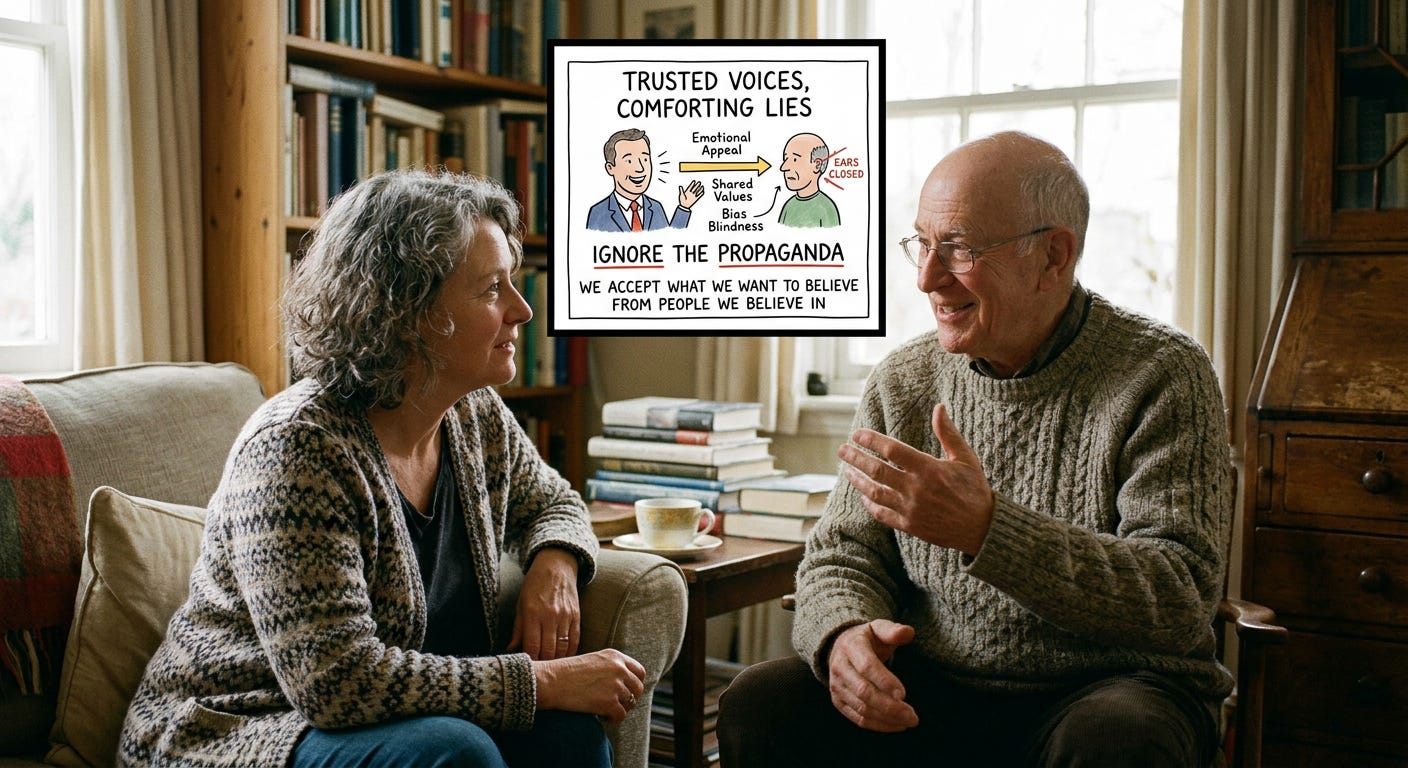
That is the actual mechanism at work here, underneath the specific dispute over China. Trust in a piece of journalism has stopped being a judgement about method — did the writer check the analogy, source the label, respect the chronology — and become a judgement about tribe. A reader trusts the writer who already agrees with them about which government is the villain of the century, and everything that writer subsequently asserts inherits that trust wholesale, undifferentiated, facts and framing bundled together as a single act of faith.
This is not a Chinese problem, or a British one, or a problem of any particular outlet. It’s what happens to the evidentiary commons once journalism is produced inside an economy that rewards the confirmation of belonging over the discomfort of complication — an economy that predates the internet but has been accelerated by it beyond anything a single newsroom’s editorial standards can correct.
Here’s an awkward personal admission: this essay, adjudicating another writer’s analogies and labels, is doing something structurally similar to that which it describes. I have decided, in advance, which claims deserve scrutiny — the comparison to Scotland, the word “cleansing,” the Taiwan deadline — and which can pass without the same interrogation — the camps, the death, the law itself. That selection is itself a form of curation. I made it, from my own settled view of where power currently sits and which powers currently deserve the benefit of the doubt. There’s no vantage point outside this problem from which to referee. I am judging from inside my own sympathies too, and I know roughly where my biases sit — but knowing that hasn’t cancelled them out.
Which leaves the reader roughly where Simon Tisdall’s readers were left after his column on Xi, and where Pilger’s readers were left after his reporting on Phnom Penh and Dili — holding a set of facts they can’t fully verify, delivered by a source they can’t fully trust, inside an argument they didn’t build.
Switching allegiance from one trusted commentator to his opposite number solves nothing; it only relocates the same unexamined faith to a different address. What remains, underneath both the Guardian’s confident prose and the state media it condemns, is the unglamorous residue neither side has yet found a way to fully colonise: the court filing, the leaked cable, the satellite image, the testimony given under oath rather than under deadline. That residue stays uncolonised only for as long as someone actually checks it, rather than skipping straight to the verdict it was meant to support.
Whoever hands you a finished verdict — Tisdall’s or Beijing’s, Pilger’s or the state broadcaster’s — is asking to be trusted at exactly the point trust should cost something — the point where you would otherwise go and check. The moment that transaction stops costing anything, the evidentiary commons finishes being colonised, and there is nothing left standing at all.