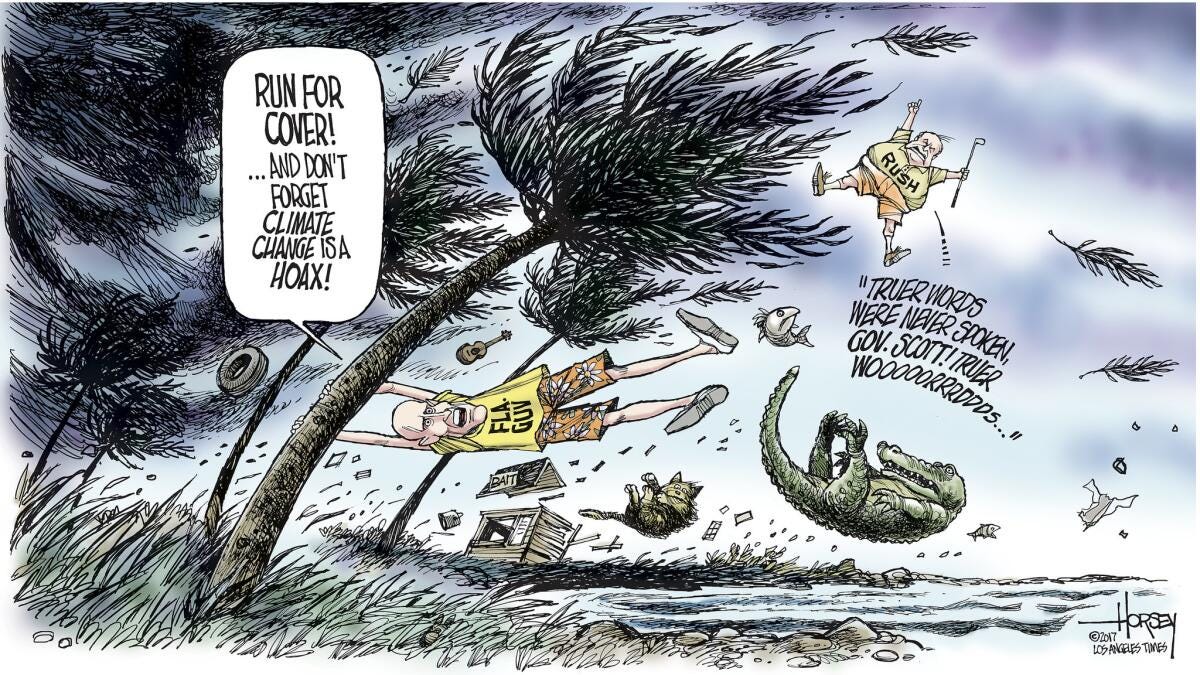
The voices of climate denial form a peculiar chorus - geologists, physicists, and economists who venture far from their expertise to challenge what atmospheric scientists have painstakingly and conclusively proven. Climate sceptics are not merely mistaken; they are promoters of doubt, peddling false comfort in a moment that demands urgent action. Ian Plimer with his unsupported claims about volcanic CO2 emissions, Richard Lindzen with his claims of negative feedback loops, Willie Soon with his solar obsessions, and Judith Curry with her emphasis on manufactured uncertainty - each offers a different flavour of the same misleading perspective.
The pattern is striking. These contrarians often prefer to present their climate claims in non-peer-reviewed outlets like popular books, podcasts, and testimony before politicians eager for excuses to delay action, though some do publish related work in peer-reviewed journals. Lindzen, once a respected atmospheric physicist at MIT, has spent decades arguing that the climate system has built-in stabilisers that will prevent catastrophic warming. His "iris" hypothesis - that tropical clouds will open like an eye to release excess heat - has been thoroughly debunked by observation and experiment. Yet he persists, a lone voice insisting that thousands of his colleagues have somehow missed this miraculous self-regulating mechanism.
Willie Soon, an astrophysicist, has made a career of blaming the sun for what humans have wrought. His papers, often funded by fossil fuel interests, cherry-pick data and ignore the fundamental fact that solar radiation has been declining while temperatures soar. The sun cannot explain warming nights, warming winters, or the cooling stratosphere - all fingerprints of greenhouse gas accumulation. Yet Soon continues his crusade, publishing in various journals and speaking at conferences sponsored by organisations with names like "The Heartland Institute" that sound academic but exist primarily to manufacture doubt.
Judith Curry presents perhaps the most subtle form of denial - the appeal to uncertainty. A former climate scientist herself, she doesn't deny warming outright but inflates every uncertainty in climate science into a reason for inaction. She speaks of natural variability as if it were some vast unknown, when in fact we understand it well enough to know it can't explain what we're seeing. Her blog posts and testimonies create the illusion of scientific debate where none exists, weaponising the inherent cautiousness of science against itself.
Then there are the economists turned climate experts - Bjørn Lomborg chief among them - who accept the science just enough to seem reasonable, then argue that addressing climate change would be too expensive. They perform cost-benefit analyses that discount future suffering and ignore tipping points, treating the climate as if it were a stock portfolio that can tolerate a bit of risk. Lomborg's "skeptical environmentalist" persona masks a fundamental misunderstanding of exponential change and system collapse. He shows genuine respect for innovation, advocating for investments in breakthroughs like advanced renewable technologies or efficient carbon capture, which he sees as smarter long-term solutions. However, by framing these as alternatives to immediate emission reductions, he downplays the risks of inaction in the interim. He calculates the cost of sea walls but not the cost of climate refugees, the price of air conditioning but not the price of ecosystem collapse — as if the solution were something absurd like subsidising designer sunglasses for heatwaves rather than curbing global heating.
If anything unites these figures it's ideological commitment rather than scientific rigour. They begin with the conclusion - that human-caused climate change either doesn't exist or doesn't matter - and work backwards to find evidence. When volcanoes don't suffice, they invoke the sun. When the sun fails them, they point to cosmic rays. When cosmic rays prove irrelevant, they retreat to uncertainty itself as their final fortress.
The tragedy of disproportionate attention given to climate contrarians is a sobering commentary on the misalignment between media practices, political agendas, and the public's limited understanding of science. This imbalance is not merely a quirk of modern discourse; it's a universal failure with profound consequences. It weaponises the strengths of science—its commitment to uncertainty, its openness to inquiry, and its self-correcting nature—against itself, undermining public trust in the process and delaying action on one of the most urgent issues of our time.
The media’s role in this distortion cannot be overstated. The principle of journalistic balance, which seeks to present opposing viewpoints in the interest of fairness, becomes profoundly misguided when applied to scientific consensus. In the case of climate change, the 97% agreement among climate scientists that human activity is the primary driver of global warming is not a matter of opinion—it's the conclusion of decades of rigorous research across multiple disciplines. Yet, by presenting one contrarian alongside one climate scientist, media outlets perpetuate a false equivalency, creating the impression that the scientific community is evenly divided. This falsification is not just misleading; it's dangerous. It gives undue legitimacy to fringe perspectives, enabling them to masquerade as credible alternatives to the overwhelming consensus.
The same principle has fuelled vaccine hesitancy, where media outlets have platformed discredited claims linking vaccines to autism—despite overwhelming evidence from studies like those in The Lancet showing no such connection—leading to reduced vaccination rates and preventable outbreaks of diseases like measles. Similarly, during the COVID-19 pandemic, false balance amplified unproven treatments or conspiracy theories alongside expert guidance from organisations like the WHO, contributing to public mistrust, delayed responses, and unnecessary deaths.
Despite such doubts—often fuelled by US figures like Robert F. Kennedy Jr. and pedalled on popular podcasts like The Joe Rogan Show—COVID-19 vaccines saved an estimated 20 million lives globally in their first year alone, underscoring how media-amplified misinformation can undermine life-saving interventions and exacerbate public health crises. To be clear, mRNA vaccines aren't risk-free—rare side effects include myocarditis and anaphylaxis. These were identified early on through rigorous monitoring and are far outweighed by benefits. Conspiracy theories often exaggerate or fabricate these to fit narratives, but they're not evidence of malice or cover-ups.
Politicians, too, exploit these manufactured doubts to justify inaction. For those with vested interests in maintaining the status quo—whether due to ties to fossil fuel industries, ideological commitments to deregulation, or fear of the economic implications of climate policy—the existence of dissenting voices, however marginal, provides convenient cover. By pointing to the so-called debate among scientists, these politicians can sidestep accountability, framing their inaction as prudence rather than negligence. This tactic not only stalls progress but also deepens public confusion, creating a feedback loop where inaction fosters further doubt. Perhaps it would be wiser to be following the precautionary principle. This established approach in both medical science and environmental policy dictates that, in the face of potential catastrophic harm, scientific uncertainty should prompt proactive measures rather than paralysis—turning doubt into a catalyst for responsible action.
The public’s confusion is understandable, though no less tragic. Science, by its very nature, is a process of refinement. It doesn't deal in absolutes but in probabilities, constantly updating its understanding based on new evidence. This iterative process, while a testament to the reliability of scientific inquiry, is often misconstrued as weakness. When the public hears that “the science is never settled,” they may mistakenly equate this with uncertainty about foundational conclusions, such as the human causes of climate change. In reality, the core findings of climate science—that greenhouse gases trap heat, that human activities are driving their rapid increase, and that this is causing global heating—are as robust as any scientific conclusion can be. What evolves are the details: how specific feedback loops operate, how regional climates are affected, the impact of the albedo effect, and how quickly changes will unfold. These refinements do not undermine the consensus; they strengthen it by filling in the gaps and reducing uncertainties.
The paradox is that science’s greatest strength—its capacity for self-correction and improvement—is often wielded as a weapon by those who seek to discredit it. Critics seize on the evolving nature of scientific understanding to argue that if knowledge changes, it cannot be trusted. Yet this is precisely why science is the most rigorous epistemology we have. Unlike dogma, science does not cling to outdated ideas; it abandons them when better evidence emerges. This iterative process is what allows science to so effectively describe and predict the natural world. It is the reason we can chart the trajectory of a warming planet and anticipate its consequences with such clarity.
What is perhaps most tragic is that this distortion of the public discourse on science is not an inevitable feature of modern life but a construct—an outcome of deliberate choices made by media organisations, political actors, and corporate interests. The fossil fuel industry, for example, has spent decades funding misinformation campaigns to sow doubt about climate science, borrowing tactics from the tobacco industry’s playbook. These campaigns exploit the public’s limited understanding of scientific methods and the media’s penchant for sensationalism to create a narrative of uncertainty where none exists.
The implications of this distortion extend far beyond climate change. By eroding trust in science, it undermines our ability to confront a host of interconnected challenges, from public health crises to biodiversity loss to technological innovation and the evolution of AI. If the public cannot distinguish between the consensus of experts and the noise of contrarians, society loses its most reliable compass for navigating a complex and rapidly changing world.
To address this setback, we must redouble our efforts in reconsidering how science is communicated and represented in public discourse. Media outlets have a responsibility to contextualise scientific debates, emphasising the weight of consensus rather than amplifying fringe views. Politicians must be held accountable for their reliance on bad-faith arguments to justify inaction. Educational systems need to prioritise scientific literacy, equipping the public with the tools to critically evaluate claims and counterclaims in order to understand the iterative nature of scientific inquiry. And scientists themselves have a role to play, not only by continuing their research but by engaging with the public in ways that demystify what appear to be arcane their methods and reinforce the credibility of their findings.
At its core, this issue is about more than climate change—it's about the relationship between society and truth. The tragedy of disproportionate attention to contrarian voices is not just that it delays action on an existential threat but that it erodes the very foundation of informed decision-making. In a world where challenges are increasingly complex and interconnected, restoring trust in science is not just desirable—it is an imperative.
But one factor stands out. There is no debate among those who actually study the climate. The consensus is not manufactured or enforced; it emerges from independent research conducted across continents and decades. When glaciologists in Greenland, coral specialists in Australia, atmospheric physicists in America, and oceanographers in Japan all reach the same conclusion, it is not groupthink. It is convergent evidence.
The contrarians want us to believe that thousands of scientists across dozens of disciplines have somehow coordinated a massive deception, or that they've all made the same fundamental error that only a handful of brave truth-tellers can see. This narrative appeals to our love of underdogs and our suspicion of authority, but it is unsubstantiated. The real conspiracy, if we must use that word, is the well-documented campaign by fossil fuel companies to fund doubt and delay action.
As Jessica Tierney reminds us, the speed of change is what makes our moment unprecedented and terrifying. We are compressing thousands to tens of thousands of years of warming into mere decades. The contrarians would have us believe this is natural, inevitable, or manageable. They are wrong on all counts. Their arguments have been examined, tested, and found wanting. They persist not because the evidence supports them but because doubt is profitable and delay is comfortable.
We no longer have the luxury of entertaining their diversions. The planet is heating, the ice is melting, the seas are rising, and ecosystems are collapsing with hub species most threatened. These are not projections or models. They are observations. The debate over causes ended decades ago in the scientific community. It persists in the public sphere only because we've allowed promoters of doubt to poison the discourse. The price of this manufactured confusion will be paid in lives, in species lost, in futures stolen. The contrarians will be forgotten footnotes in history, but the damage they've enabled will reverberate for millennia.