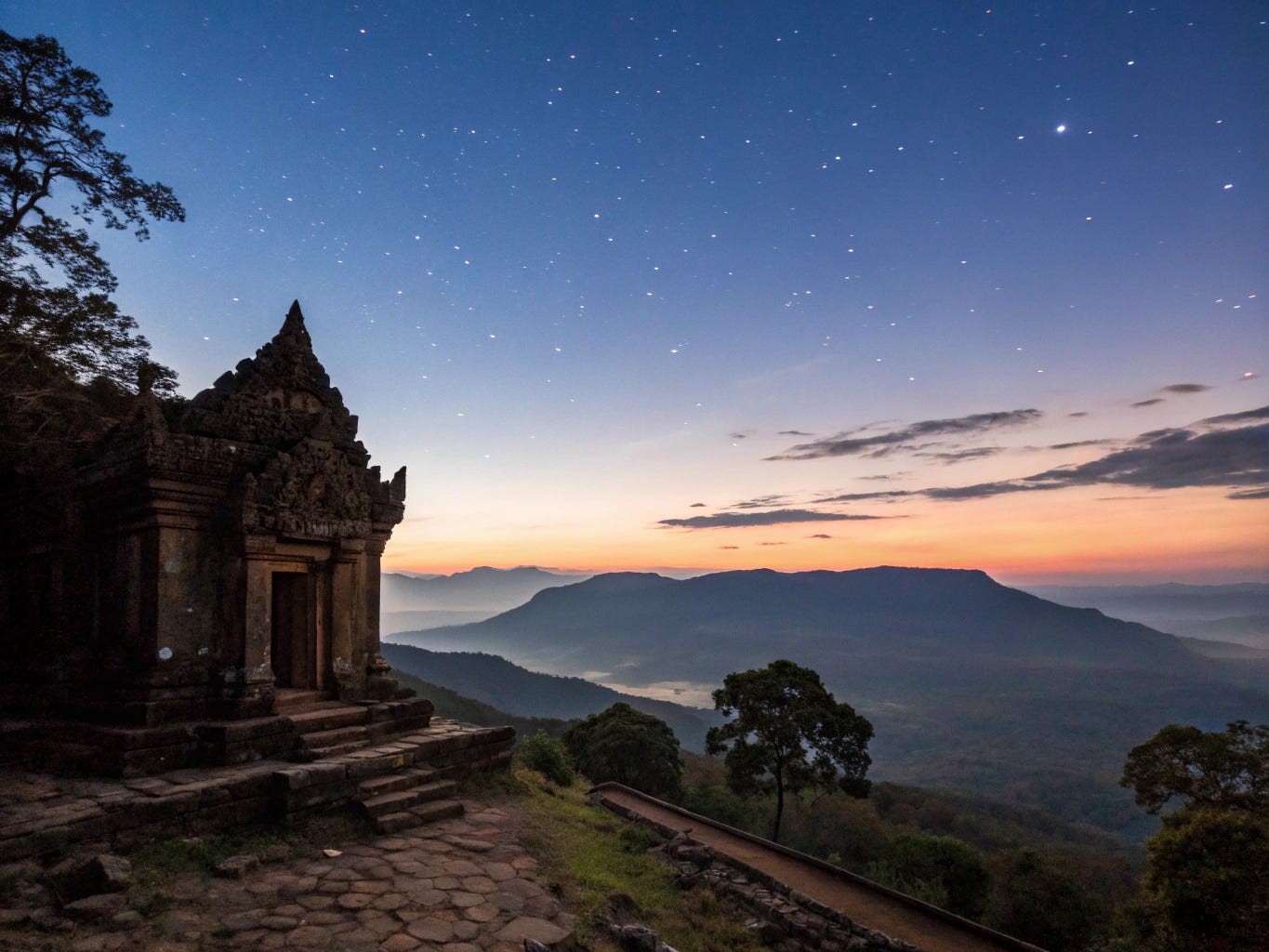
There's a moment, always just before dawn, when the sky forgets its own colour, and the world seems to inhale without exhaling. I often stand in that silence, trying to feel the weight of centuries pressing against me, and I am reminded that every border quarrel, every missile flash, and every whispered prayer in a refugee tent is just the present tense of a story whose opening lines were etched in stone and blood long before any of us arrived to read it aloud.
History is not a prologue we may skip; it's the ongoing sentence in which we are all subordinate clauses. The Thailand–Cambodia frontier, the scorched steppes of Ukraine, and the narrow alleys of Gaza and Jerusalem—these are not battlefields in any ordinary sense. They are geological strata of unresolved momentum, places where the tectonic plates of earlier choices still grind, still tremble, still decide for us what we will call inevitable. And so, as a futurist—one who must trade in the currencies of foresight and humility—I must insist that peace is not a summit one climbs but a choreography one relearns, step by aching step, in the valley of inherited consequences.
Let's pause, just for a moment, at the edge of the Dângrêk Mountains, where the silhouette of Preah Vihear cleaves the horizon like a blade of memory. In 1904 the stroke of a French pen drew a line across terrain it had never smelt after monsoon rain; the ink dried into treaty parchment, but the line itself kept moving, inch by inch, through schoolbooks, radio speeches, and election posters until it arrived inside the limbic systems of farmers who have never seen Paris. The map became the territory, and the territory became a canticle—sung in two keys at once, forever off-pitch. Each skirmish is less an act of policy than a ritual re-enactment of cartographic myth. The rifles are just punctuation marks in a sentence begun by bureaucrats who have long since decayed.
Move a thousand kilometres north, and the same pattern repeats, mutated yet unmistakable. In the Donbas, Soviet ghosts mine coal alongside living men, whispering slogans that no longer fit the grammar of the twenty-first century. The Soviet Union imploded three decades ago, but its collapse was not an ending; it was a dispersal, a shattering of radioactive isotopes that keep emitting half-lives of resentment. Moscow and Kyiv now rehearse an argument scripted in 1654, updated in 1917, footnoted in 1991, and livestreamed today in high resolution. Every missile launch is a citation of that original treaty, every trench a footnote.
Farther west, the Mediterranean itself seems to sweat history onto the limestone of Jerusalem. Here the past is not sedimentary but volcanic: partition plans, exoduses, and intifadas, each eruption reheating the same magma chamber of displacement. The stones of the Old City have absorbed so many supplications that they vibrate at the frequency of unmet longing. The conflict is no longer about who owns the stones; it's about who is allowed to continue being haunted by them.
Over a lifetime of observation and analysis, I have come to believe that what we call “conflict” is, at its core, a failure of metabolism. Societies consume trauma faster than they can process it; the undigested past is stored in borders, anthems, and nervous systems, where it ferments into rage. Path dependence, then, is the scar tissue of this indigestion. It is the river that, having once found a channel through soft earth, thereafter insists on returning to it, century after century, no matter how many dams we build or how many engineers draw new blueprints. The water remembers.
Yet if history is a river, complexity is the weather above it. A squall in the Gulf of Guinea can, three weeks later, tilt rainfall patterns over the Mekong Delta, which in turn shifts rice prices in Bangkok, which nudges a nationalist senator in Phnom Penh to rediscover the sacred urgency of Preah Vihear. The butterfly that flaps its wings is not a cliché; it's an indictment of our addiction to linear causality. Conflicts breathe, reproduce, and mutate. They learn faster than our institutions. A ceasefire signed in Minsk can be undercut by a viral TikTok in Lagos, weaponised by a bot farm in St Petersburg, and monetised by a cryptocurrency exchange in Dubai before the ink is dry.
To speak of “solving” such conflicts is therefore a category error. One does not solve weather; one adapts to it, learns to dance within its moods, to seed clouds when the crops thirst and to build sea walls when the surge rises. Peace, likewise, is not a static outcome but an attractor in the phase space of human possibility—a zone of dynamic equilibrium that must be renegotiated with every sunrise.
What might this renegotiation look like? Imagine, for a moment, that the Thailand–Cambodia frontier is not a line but a living membrane. Villagers on both sides co-steward the watershed; their children trade seeds across a creek that knows no passports, and the temple itself becomes a time-release capsule of shared heritage: holographic murals that shift depending on the viewer’s mother tongue, telling the same epic in Khmer and Thai, letting the past quarrel with itself until it grows tired and begins to chuckle. Imagine economic value flowing not through nationalist megaprojects but through microgrids of solar panels jointly owned by rice farmers and rubber tappers, their kilowatt-hours tokenised on a blockchain ledger transparent enough to starve corruption of shadows. Imagine restorative-justice circles in every district, where elders who once traded artillery coordinates now trade apologies, slowly, awkwardly, metabolising their undigested grief one sentence at a time.
Now scale the imagination. Picture a Black Sea where Ukrainian grain ships and Russian fishing fleets share satellite data to avoid the algae blooms that climate change keeps inflating, blooms that neither Moscow nor Kyiv can tame by themselves. Picture Israeli and Palestinian hydrologists jointly modelling aquifers beneath the West Bank, their laptops glowing side by side in a room cooled by the same desalinated water their grandchildren will drink. The hardware for such futures already exists; what is missing is the social firmware—a willingness to see identity not as a fortress but as a permeable narrative, constantly revised by encounter.
This, ultimately, is the futurist’s wager: that we are not condemned to repeat history but rather invited to re-script it in real time. The invitation is terrifying because it carries no guarantees. The river will keep trying to return to its ancient channel; the weather will keep surprising us. Yet the same non-linear dynamics that make conflict so stubborn also make transformation feasible. A single act of radical imagination—say, a joint Khmer-Thai youth orchestra performing at Preah Vihear at sunset—can, under the right resonance conditions, flip a nationalist narrative into a poem of love. The mathematics of phase transitions insist that such flips are not sentimental anomalies but systemic inevitabilities, given sufficient connectivity and perturbation.
And so I stand again in the pre-dawn hush, listening to the world inhale. I no longer ask when the fighting will stop; I ask how the remembering might begin. History is not a weight that presses us down—it is compost. If we keep piling it up without turning it, it rots and burns. But if we aerate it, if we let the worms of honest dialogue and the microbes of restorative justice do their quiet work, the pile becomes soil, and the soil becomes a garden. From that garden, futures sprout whose seeds we cannot yet name but whose fragrance we can almost smell.