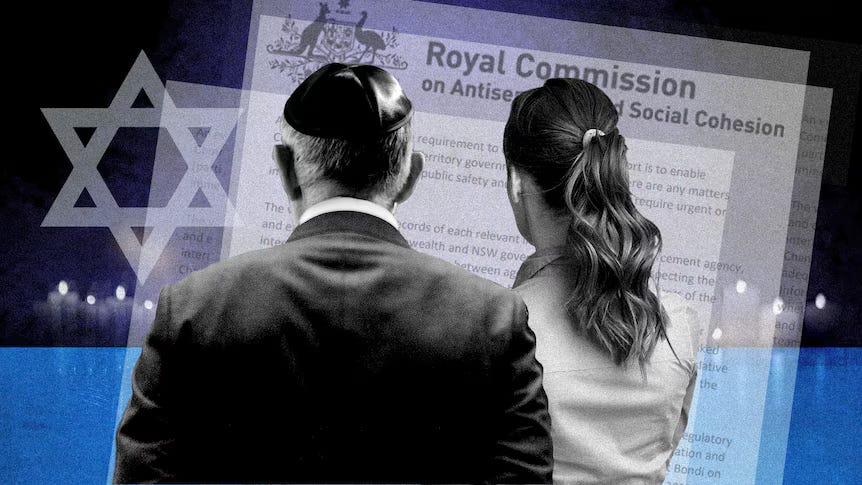
This essay was prompted by a report in The Guardian covering testimony from Australia’s Royal Commission into antisemitism and social cohesion. I have not been present at the proceedings. What follows is not a commentary on the evidence before the commission but rather a reflection on what such an instrument can and cannot, by its very nature, achieve — and what that limitation reveals about the civilisational moment we are all, without exception, trying to navigate.
Somewhere in Australia, people are bearing witness. They arrive from across the country, fill narrow benches, and speak of fear — of children who cry at the mention of Bondi Beach, of friends lost, of swastikas etched into school walls, of death threats absorbed in silence while bystanders look elsewhere. The commissioner leans forward. She listens. The testimony is real. The suffering documented is real. An eight-year-old associating a beach with massacre is not a policy problem. This is a child whose inner world has been permanently scarred, and that deserves every form of witness a society can offer.
But deserving witness, and being served by a Royal Commission are different orders of things. And Australia, in reaching for its most solemn forensic instrument, may be doing what wounded societies habitually do — treating the gravity of a problem as evidence that the response is proportionate, when in fact the instrument and the injury belong to entirely different categories of reality.
This is not a criticism of the commission’s existence. It is a question about what we imagine it can do.
The Wrong Tool for the Actual Job
W. Edwards Deming spent decades trying to teach manufacturers — and through them, anyone who would listen — a distinction so simple it should have been obvious and so overlooked it bordered on the wilful. He separated what he called special causes of failure from common causes. Special causes are local and assignable: a faulty component, a human error, or a process deviation. Find them, fix them, and you can return the system to its baseline. Common causes are different in kind. They are structural. They emerge not from failures within the system but from the normal operation of the system itself. You cannot eliminate them by locating the moment of breakdown, because there is no single moment. The system is the breakdown, operating precisely as designed.
Antisemitism — in its current Australian expression and in virtually every country where it is surging — is being approached as a special cause problem. Identifiable incidents. Assignable perpetrators. Documentable harm. And at that surface level, the forensic-legal instrument is not without utility. A man who threatens a Jewish pedestrian on Oxford Street while performing a Nazi salute can be categorised as a special cause. The algorithmic architecture that delivered the ideological substrate for that gesture to a generation of young Australians is not. The interfaith partner whose response to Jewish grief was “but look at Gaza” is not. The decades-long hollowing of civic education left an entire cohort unable to distinguish between criticising a government and targeting a people — not a special cause. Not assignable. Not correctable from within the system itself.
What a Royal Commission can do, it will do. It will document evidence. It will build a record that makes future inaction more difficult to defend. It will give individuals whose suffering has been dismissed a form of public dignity, which is not nothing. It may generate specific recommendations — tightened hate speech legislation, platform liability frameworks, and curriculum reform — that address how hatred travels, even if they cannot address why it keeps finding such ready passengers.
What it cannot do is reach the substrate. And the substrate is where the main problem lives.
What the Testimony Cannot Tell Us
There’s an epistemological trap built into the commission’s method that deserves direct examination, because it will shape every finding and every recommendation that emerges.
Testimony about how a community experiences its world is genuine data. It is also inherently partial data – not dishonest, but structurally incomplete in ways for which the format cannot correct. It tells us, with great precision and great emotional force, what it feels like to be Jewish in Australia right now. It does not tell us, and cannot tell us, what is actually happening across the broader social ecology from which these experiences emerge.
Those are related but non-identical questions. Treating them as the same question produces a picture that is morally compelling but analytically misleading — a portrait of one community’s phenomenology presented as the diagnosis of a society.
The commission will not hear from the young Australians who have absorbed anti-Israel sentiment as ambient political vocabulary, not out of hatred but out of an epistemic environment that never taught them the difference between a state’s conduct and a diaspora’s existence. This confusion does not excuse the harm it produces — confusion can wound as efficiently as malice — but it points toward a cause the commission has no capacity to address. It will not hear from communities whose silence after October the seventh was not hostility but a different, less examined failure: the failure to hold simultaneously the suffering of Gaza and the terror of Jewish Australians as claims of equal moral weight. It will not hear from the platforms whose recommendation engines are, at this moment, conducting a masterclass in radicalisation at a scale no government commission can meaningfully audit.
What gets built, then, is a comprehensive record of experienced suffering — and a set of recommendations calibrated to what governments can see and do rather than what’s actually there. The map and the territory diverge precisely where the territory matters most.
What Australia Is Avoiding About Itself
No society examines itself without blind spots arranged around its most protected myths, and Australia is no exception.
The official story of Australian multiculturalism — generous and genuinely well-intentioned — is a policy mistaken for a philosophy. It says, ‘Celebrate difference, extend welcome, and respect all cultures.’ What it does not say — because it has never worked out how to say it — is what happens when the cultures being welcomed carry worldviews that are, on particular questions, genuinely incompatible. The framework assumes that all differences are ultimately reconcilable through goodwill and education. Events keep testing that assumption with increasing impatience, and the institutional response is to reinforce the framework rather than interrogate its foundations.
The periodic political insistence that all Australians must embrace Australian “values” only deepens the confusion. Which values, precisely, and by whose inheritance? The demand is never examined with the rigour it would require, because examination would reveal that what passes for universal civic virtue is in fact the residue of a specific cultural tradition – Anglo-Protestant, Enlightenment-liberal, arriving on these shores already convinced of its own self-evidence. To invoke it as neutral common ground is not philosophy. It is unacknowledged parochialism dressed in the language of cohesion.
What is being sidestepped is the harder question of whether genuine pluralism requires not just procedural tolerance but something more like a shared cosmological floor – some common account of what persons are, what we owe one another across difference, and what the community is ultimately for. Australia inherited Enlightenment proceduralism — rights, laws, commissions, and processes — and has largely mistaken that inheritance for wisdom. Proceduralism adjudicates between competing claims with admirable efficiency. What it cannot do is generate the shared bedrock from which genuine cohesion actually grows. That has to come from somewhere older and deeper than legislation.
There is another avoidance operating here, less comfortable to name. A country that has not completed — has barely seriously begun — its reckoning with the dispossession of its First Nations peoples has, over generations, cultivated a practised capacity for not seeing structural violence when seeing it would disturb the national self-image. That trained “not-seeing” doesn’t stay contained to its original object. It becomes a general cultural habit, a kind of civic myopia available for deployment wherever inconvenient suffering presents itself. The moral muscles required to witness Jewish Australian fear fully and respond to it at the level of its actual causes are the same muscles required to witness Indigenous dispossession fully. They are not separate faculties. A commission that proceeds as though these are entirely unrelated matters is working from a deliberately reduced account of what Australia is.
And then there is the prosperity illusion — perhaps the deepest avoidance of all. For nearly three decades, Australia grew without serious interruption, and that growth did something insidious: it made social cohesion feel unnecessary. Why negotiate the hard questions of shared belonging when the rising tide was lifting most boats and the barbecue was always on? Other societies — less fortunate, or perhaps more honest — were forced to confront the brittleness of their civic architecture when the material conditions supporting it faltered. Australia was spared that confrontation long enough to forget it was possible.
Now the deferral is ending. Housing has become a form of inherited privilege rather than a reasonable aspiration. Employment is fragmenting in ways that no political party has found the vocabulary to address honestly. The life that one generation assembled almost without thinking — the deposit, the mortgage, the incremental stability — is visible to the next generation only as a kind of historical fiction, something that apparently happened to other people in a different country. What gets called a surge in antisemitism may be something both simpler and more alarming: one of the first audible cracks in a social architecture that was always held together by growth rather than by anything resembling genuine cohesion. The growth is leaving. What remains is the question Australia never thought it would have to answer.
The Paradox the Media Will Not Report
There is something worth sitting with in how this commission will be covered and how that coverage will function in the broader ecology of the problem.
Commission-style journalism — careful, testimony-led, humanising — performs an important service. It makes suffering visible. It creates a public record. The Guardian report that prompted this reflection does that work with genuine moral seriousness, and the testimonies it carries deserve wide attention.
But the same coverage simultaneously amplifies. Every account of antisemitic incident and communal fear, however compassionately framed, reaches audiences for whom it will function not as an invitation to reflection but as confirmation — evidence that the behaviour is prevalent, normalised, even in some obscure way permissible precisely because it is so widespread. This is not an argument against reporting. It is an observation about the ecology in which reporting operates, and the naive assumption that exposure automatically produces the response that exposure is intended to generate.
More broadly, the commission generates what might be called the sensation of accountability in motion — the public feeling that something serious is being done, that the machinery of consequence is turning, that the society is genuinely confronting what it has allowed to fester. This sensation carries real value. But it also carries a specific risk: that it consumes the public attention and political will that might otherwise press for the demanding, deliberate work the situation actually requires. A society can mistake the processing of grief for its resolution. Institutions are extraordinarily good at facilitating exactly that mistake — and extraordinarily reluctant to acknowledge they are doing so.
Three Tiers, Honestly Described
It’s worth being precise about the range of available responses, because conflating different tiers of intervention is itself part of what perpetuates the problem.
What governments and commissions can genuinely do: document incidents; tighten legislation where it is demonstrably deficient; create consequences for platforms that algorithmically amplify hatred; reform curricula to teach epistemic discernment rather than just sensitivity — the capacity to think carefully about language, about the relationship between a state and its diaspora, and about how ancient hatreds find contemporary vehicles. These are real interventions that address transmission mechanisms. They are worth doing, and worth doing well. They are not solutions to the underlying problem, and presenting them as such is a form of institutional bad faith toward the very community the commission is there to serve.
What governments claim they can do but cannot: change the cultural climate through legislation; resolve the conceptual confusion between anti-Zionism and antisemitism through definitional exercises; generate genuine social cohesion through multicultural frameworks that rest on no philosophical foundation. These interventions absorb most of the political energy and produce most of the eventual disappointment.
And then there is the third tier – the work that actually addresses root causes, that has no institutional champion, no commission, no ministerial portfolio, and no sunset clause. This is the slow, generational labour of civilisational substrate-building: developing the cultural, philosophical, and ethical foundations that make genuine pluralism possible rather than simply procedural. It asks what Australians understand themselves to be in relation to one another beneath the policy frameworks and the mythology of easy tolerance – what obligations they actually carry and what they share that is not merely administrative. It requires a different account of what persons are and what they owe one another across genuine difference – not the thin account provided by rights-based liberalism alone, however necessary that remains, but something with deeper roots, more capacity to hold communities together when the material conditions that have been substituting for genuine cohesion are no longer sufficient to do so.
This work happens outside government. It happens in the quality of how communities actually relate to one another when no one is watching, in what educational institutions genuinely transmit, in whether the arts and philosophy and civic discourse are treated as the essential infrastructure of a society capable of knowing itself or as decorative supplements to economic activity. It has no terms of reference because it cannot be commissioned. It belongs to everyone, which in practice has too often meant it belongs to no one in particular.
What the Proceedings Cannot Hold
Returning, finally, to the proceedings themselves. The narrow benches. The people who have come from all over the land. The commissioner leaning forward, close enough almost to reach out. That space matters. The testimony matters. The record being built matters. Dina’s daughter, who now associates Bondi with dying, deserves every form of witness a society can offer. Nothing in this reflection should be read as diminishing that.
But a gathering of witnesses to suffering is not the same as a society that understands what is generating that suffering and has developed the capacity to address it where it originates. Australia is not unusual in this regard. Across the Western world, the same pattern recurs with depressing regularity — reach for the forensic-legal instrument, produce the record, feel the accountability, and discover the conditions essentially unchanged. The instrument becomes the obstacle not through anyone’s bad faith but through a category error that has been institutionalised and repeated until it presents as the only available response.
The question the commission will not ask — because no commission of this kind can, because its terms of reference close precisely where the real territory begins — is this: what manner of society would Australia need to become for this suffering to be structurally impossible rather than simply illegal?
That question has no commissioner. It cannot be answered in a gathering, however full, however attentive. It belongs to the long, patient work of becoming a genuinely tolerant and compassionate society. This is the kind of work that civilisations either undertake deliberately or are eventually forced into by consequences they could have foreseen and chose, repeatedly, not to.
At some stage the proceedings will close. The record will be published. The recommendations will be noted. Some, no doubt, some will be implemented. And the underlying condition — a substrate that’s patient, indifferent to procedure, responsive only to the quality of what a society is actually willing to become — will remain exactly as it was.