Let’s begin with what international law actually says, because the law in this case is far from ambiguous.
Article 8 of the Rome Statute — the founding document of the International Criminal Court — explicitly identifies the use of starvation as a method of warfare as a war crime. The Genocide Convention of 1948, under Article II(c), defines genocide to include the deliberate infliction of conditions of life calculated to bring about the physical destruction of a group in whole or in part. The ICC’s own Elements of Crimes clarifies that these conditions include the deliberate deprivation of resources indispensable for survival, such as food or medical services. Rule 53 of the International Committee of the Red Cross’s Customary International Humanitarian Law explicitly bans starvation as a method of warfare. The prohibition is not contested, not qualified, not subject to interpretation. It’s one of the clearest and most foundational rules in the library of international humanitarian law.
This matters, because what has happened in Gaza is not a contested case at the level of evidence. It’s a contested case only at the level of consequence. And those are two very different things.
In the first three months of Israel’s military campaign in Gaza following 7 October 2023, four deaths were officially attributed to starvation. By 2024 that figure had risen to 49. In 2025 — the year the siege reached what observers described as its suffocating zenith — 422 people died of starvation in a single year, a 760 percent increase in twelve months. By August 2025, the UN-backed Integrated Food Security Phase Classification had formally declared famine occurring in northern Gaza, projecting its spread to central and southern areas. At least 132,000 children under five were at risk of death from acute malnutrition by June 2026. More than half a million people were in IPC Phase 5 — catastrophic conditions characterised by starvation, acute malnutrition, and mortality.
These are not figures from advocacy organisations. They are the outputs of the most rigorous technical food security assessment framework in existence, one whose thresholds are stringent and whose declarations are, if anything, delayed by the political caution of the institutions that govern it.
The evidentiary record of deliberate engineering is equally substantial. Israel’s Defence Minister Yoav Gallant ordered a total blockade of Gaza on 9 October 2023 — no electricity, food, or fuel. Before the war, 500 trucks per day sustained Gaza’s population. During the conflict this dropped to an average of 19 trucks per day — a 96 percent reduction. Water availability plummeted from 84 litres per person per day to 3 litres. By August 2025, Israeli forces had destroyed 90 percent of Gaza’s agricultural land and 2,500 chicken farms. The longstanding civilian aid infrastructure, led by UNRWA across 400 distribution points, was systematically dismantled and replaced with a militarised alternative — the Gaza Humanitarian Foundation — whose distribution sites, according to Forensic Architecture’s geolocated and satellite-verified investigation, used live ammunition and stun grenades on civilians seeking food. Aid seekers described reaching these sites as a death sentence. Doctors confirmed consistent patterns of injuries among those who arrived at hospitals having attempted the journey.
Famine expert Alex de Waal stated plainly that if Israel chose to act differently, every child in Gaza could eat breakfast the following morning. All that was required was opening the gates.
The UN Special Rapporteur on the Right to Food, Michael Fakhri, concluded that Israel had built what he described as the most efficient starvation machine imaginable, and that Israel had made its intentions explicit, implemented its plans, and predictably created a famine throughout Gaza.
B’Tselem and Physicians for Human Rights Israel — two of Israel’s own leading human rights organisations — accused their government of genocide. The UN Independent International Commission of Inquiry on the Occupied Palestinian Territory concluded in its September 2025 report that Israel had committed genocide against Palestinians in Gaza.
The Legal Architecture and Its Response
The International Court of Justice, in January 2024, found it plausible that Israel’s conduct amounted to a violation of the Genocide Convention — a finding of considerable legal significance, since plausibility at the ICJ is not a casual determination. The court issued provisional measures ordering Israel to ensure the unhindered provision of humanitarian aid. In March 2024, following further deterioration, it issued additional orders requiring Israel to ensure basic food supplies without delay. In October 2025, it found that Israel was obliged to guarantee sufficient food to Gazans and to allow UNRWA to operate.
Israel did not comply with these orders. It continued its offensive. It continued the blockade. And the court, as currently constituted, has no direct enforcement mechanism. Compliance depends on political pressure and the good faith of states — neither of which has been forthcoming from the states with the power to apply them.
The International Criminal Court issued arrest warrants in November 2024 for Prime Minister Benjamin Netanyahu and former Defence Minister Yoav Gallant for war crimes and crimes against humanity, explicitly including starvation as a method of warfare. All 124 ICC member states are legally obligated to arrest and surrender these individuals if they enter their territory. Netanyahu subsequently travelled freely to states that have not ratified the Rome Statute, including the United States, which has not only declined to facilitate accountability but has imposed sanctions on the ICC for the temerity of issuing the warrants.
This is the architecture of international law in operation: binding in theory, contingent in practice, and subject to political veto by the most powerful actors in the system — who are, not coincidentally, also the actors whose conduct it most urgently needs to govern.
The Question of Intent
The legal distinction between starvation as a war crime and starvation as an act of genocide turns on the question of intent. A war crime requires proof of conduct — the deliberate use of starvation as a method of warfare. Genocide requires something more: proof that the conduct was specifically designed to destroy a group in whole or in part.
The evidentiary record on intent is, by the standards of any honest legal analysis, unusually rich. Ten UN special rapporteurs stated in July 2024 that Israel had conducted a targeted starvation campaign constituting a form of genocidal violence. Before the war, Israeli officials had drafted mathematical formulae and caloric tables to calculate the minimum food intake required for Gaza’s population to survive. They entered the conflict with precise knowledge of what deprivation would cost, and made a conscious choice. The caloric tables are not an allegation. They are a documented policy instrument — evidence that the deprivation was calculated rather than incidental, targeted at one population and not another.
That asymmetry is not a footnote. It’s the centre of the argument. Israeli civilians have faced no equivalent constraint. Israel is a functioning economy with full agricultural capacity, open borders, and unimpeded food supply chains. There is no documented evidence — no IPC classification, no famine declaration, no destroyed agricultural infrastructure — suggesting that the Israeli civilian population has experienced anything approaching the conditions deliberately imposed on Gaza. The deprivation was applied with precision to one group and withheld from another. That is not the collateral damage of war. That is government policy. And policy applied selectively to a specific population, with the intent to alter the conditions of their survival, is precisely what the Genocide Convention was constructed to name.
The public statements of Israeli officials reinforce rather than complicate this reading. Gallant declared on 9 October 2023 that there would be no electricity, no food, no fuel — everything closed. Netanyahu stated in January 2024 that Israel provides minimal humanitarian aid because they want to achieve their war goals. A senior Israeli military officer stated, on camera, from inside Gaza: there is nothing left there. Those who come back here will find scorched earth. No houses. No agriculture. They have no future.
The question of whether this meets the legal threshold for genocide under the Genocide Convention will ultimately be determined by the ICJ — a process that may take years, whose outcome Israel has already indicated it does not regard as binding on its conduct, and whose enforcement will depend entirely on political will that has so far been conspicuously absent.
What the Failure of the Architecture Reveals
This is where the legal question becomes a civilisational one, and the one that most interests me.
Prohibition on starvation as a method of warfare was not invented in response to Gaza. It was built in response to the systematic atrocities of the twentieth century — the deliberate famines, the siege strategies, the calculated reduction of civilian populations to conditions of survival so degraded that resistance became physically impossible. The architects of international humanitarian law understood that hunger was one of the oldest and most efficient instruments of mass violence. They named it. They prohibited it. They encoded the prohibition into binding treaty law and customary international law and the founding documents of every institution created to prevent its recurrence.
And here, in plain sight, with documentation that would satisfy the evidentiary standards of any serious legal proceeding, with findings from the ICJ, the ICC, the UN Special Rapporteur, the Famine Review Committee, Forensic Architecture, Amnesty International, Human Rights Watch, and Israel’s own human rights organisations — the architecture has not enforced its own rules.
This is not a failure of evidence. It’s not a failure of law. It’s a failure of political will by states with the power to act, who have calculated that the costs of accountability exceed the costs of impunity. And in making that calculation, they have done something whose consequences extend far beyond Gaza: they have confirmed, in the most visible way possible, that the rules apply selectively, that the institutions are contingent, and that the architecture of international law is, in the end, only as strong as the weakest political commitment to enforce it.
As I have said many times before. The liberal world order does not collapse with a bang. It collapses one precedent at a time. And the precedent being set in Gaza — that a state may deliberately engineer famine against a civilian population, that binding ICJ orders may be ignored, that ICC warrants may be politically neutralised by the most powerful actors in the system — is a precedent that every future actor in every future conflict is watching being established in real time.
The Only Question That Remains
Does international law have any real power left? The honest answer is: it has precisely the power that states with the capacity to enforce it choose to give it. No more. No less.
That answer is not new. International law has always depended on political will for its enforcement. What’s new is the brazen nakedness of the gap — the distance between what the architecture asserts and what it actually does, made visible on screens across the world in real time, documented with a breadth that no previous atrocity has faced, and met with the most expensive form of silence: the silence of states that know, have been told, have been ordered by their own courts, and have chosen otherwise.
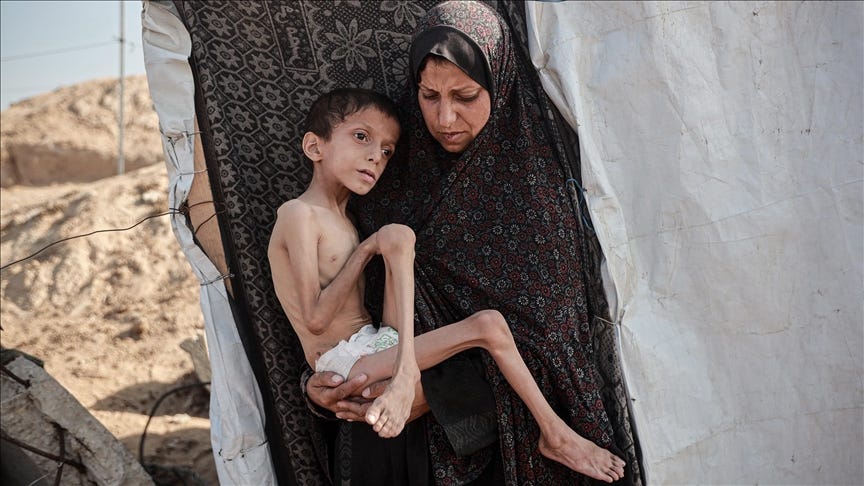
The woman in Gaza whose child is wasting in her arms is not a statistic. She is the test case for whether the architecture built in the name of humanity actually means what it says. And the answer, so far, is one that the architects of international law — had they lived to see it — would have recognised immediately. It is the same answer that has always come when power decides that the rules are for others and not them.