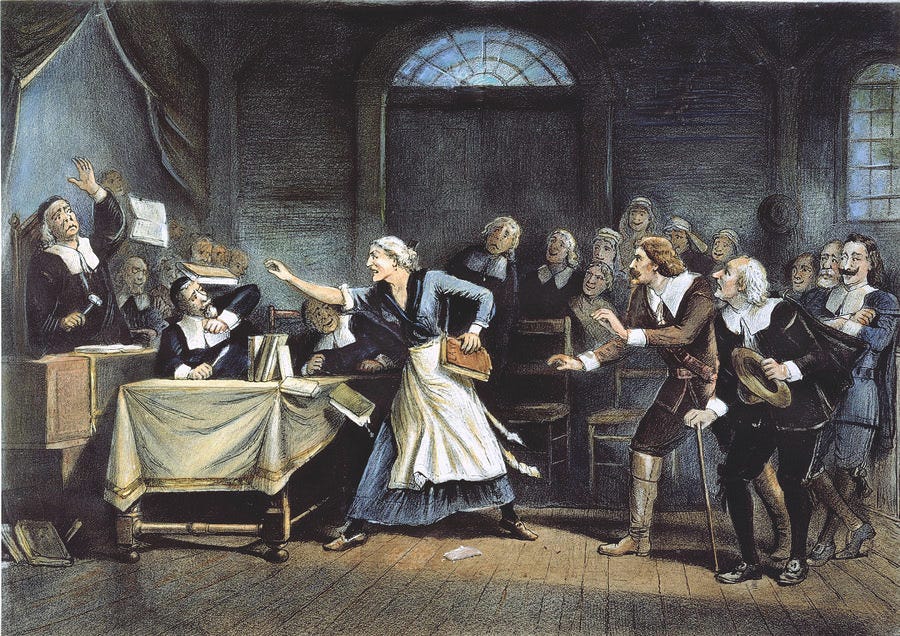
What can Salem teach us about human psychology? In that liminal moment where past anxieties and future terrors collapse into present reality, we discover the most insidious truth about human behaviour: we don't need real witches in order to burn each other alive. The Salem that lives within us requires no actual threat, supernatural or otherwise, only the whispered suggestion that danger walks among us, wearing familiar faces.
My model of "the expanded now" is not just the present moment stretched thin, but rather a multifocal lens through which the compression of temporal experience, where inherited fears from our collective past merge with projected anxieties about what might come to pass, can be clearly perceived. In this compressed reality, the Salem witch trials don't remain a historical aberration; they become an eternal template – a recurring pattern that emerges whenever communities are primed to see threat in the everyday.
Fear is an elegant weapon. Unlike conventional threats that require actual presence and capability, fear operates through pure psychological force. The politician or podcast show host who announces that enemies walk among us needs to produce no evidence of an actual threat – the announcement itself becomes the catalyst that transforms ordinary social dynamics into an engine of devastation. Joseph McCarthy understood this in 1950s America, wielding lists of supposed communist sympathisers that ruined careers without verification. But the pattern transcends borders: Rwanda's radio broadcasts warning of Tutsi 'cockroaches', Brexit campaigns targeting 'foreign influences', China's campaigns against 'Western spiritual pollution', and Hungary's fears of 'Soros networks' all follow an identical logic.
The Cultural Revolution's hunt for 'capitalist roaders', apartheid South Africa's obsession with 'communist terrorists', or contemporary warnings about 'foreign agents' in democratic institutions worldwide demonstrate how the mere suggestion of internal enemies creates its own destructive reality. Each announcement transforms neighbours into potential threats without requiring a single verified case of actual danger. This is the genius of phantom hunts: they weaponise our own protective instincts against us, turning the mechanisms designed to preserve community into forces that tear it apart.
Within the expanded now of human experience, the propagation of fear follows predictable trajectories. The initial suggestion – "there are enemies among you" – creates a suspicion field, a distortion in the social fabric that bends all subsequent interactions toward paranoia. Friends who moments before shared easy camaraderie suddenly view each other as potential threats. Normal behaviours acquire sinister dimensions. A nervous laugh becomes evidence of guilt; reluctance to participate becomes proof of allegiance to dark forces.
This transformation occurs because the temporal compression collapses any distinction between possibility and probability. In ordinary time and circumstances, we might rationally assess the likelihood that our fellow workers practise witchcraft and conclude it approaches zero. But within the suspicion field, past cultural memories of witch hunts and future fears of being deceived converge to make the impossible seem not just possible but highly likely. Our attention shifts from "Are there really witches?" to "Which of these people might be hiding something?"
The mechanics of division reveal themselves with startling clarity once we understand this dynamic. The moment the game requires forming groups "without witches", it activates what we might call the loyalty paradox. To prove ourselves safe, we must demonstrate our ability to identify the unsafe. To show we belong, we must show others do not. The very act of group formation becomes an exercise in exclusion, creating an us-versus-them dynamic that grows more virulent with each iteration.
This temporal compression becomes particularly destructive when past experiences of betrayal, even those not our own but inherited through cultural memory, merge with future anxieties about being excluded or harmed. We find ourselves not just playing a game but unconsciously reenacting centuries of human suspicion and violence. Every accusation feels both ancient and urgently contemporary.
Labels function as the primary technology of exclusion within these dynamics. Whether we speak of "witches" in 1692 Salem, "communists" in 1950s America, or any number of contemporary categories designed to separate the supposedly safe from the allegedly dangerous, the specific content matters less than the mechanism. Labels create cognitive shortcuts that allow us to process complex social environments quickly – but they also become weapons that reduce individuals to categories and categories to threats.
This compressed temporality amplifies the labelling process by collapsing the time needed for careful analysis and judgement. Under normal circumstances, we might take weeks or months to truly know someone's character. But within the urgency of the hunt, we must make instant determinations about who can be trusted. Labels provide false certainty in uncertain times, allowing us to make rapid decisions about complex people based on simple categories.
Perhaps most significantly, suspicion propagates faster than facts because it operates according to different temporal logics. Facts require verification, investigation, and the slow accumulation of evidence over time. Suspicion, however, feeds on compressed urgency, where immediate action feels necessary for survival. We begin interrogating each other not based on evidence but based on fear because waiting for proof feels like a luxury we can't afford.
This creates a surge of suspicion where each act of questioning generates more questions, and each expression of doubt breeds greater doubt. The process becomes self-reinforcing because within this state the absence of evidence begins to feel like evidence of concealment. If there are truly witches among us, the logic goes, wouldn't they be clever enough to hide their nature? Wouldn't the most dangerous ones be precisely those who seem most innocent?
The cruellest irony emerges in the recognition that the hunt itself becomes the primary source of harm. By the time we discover there were never any witches to find, the damage has already been done. Relationships have fractured, trust has eroded, and the community has learnt to see itself through the lens of threat and suspicion. The process of looking for danger creates the very danger it purports to protect against.
This reveals a fundamental truth about perception under pressure: the anticipation of future harm often generates more actual harm than the original threat ever could. We traumatise each other in the name of protection, destroy community in the name of preservation, and become the very thing we fear while hunting for something that never existed.
The position of those who instigate these hunts illustrates another crucial dimension of phantom hunts: those who benefit most from the chaos rarely participate directly in creating it. Like puppet masters pulling strings, they need only introduce the initial suggestion and then watch as the community tears itself apart according to its own internal logic. This temporal collapse makes manipulation particularly effective because it compresses the time between suggestion and action, between fear and response.
This pattern repeats throughout history precisely because it exploits fundamental features of human psychology operating within the compressed temporality of crisis. We are pattern-recognition entities who evolved to spot threats quickly, but these same capabilities become liabilities when deployed within phantom hunts. This compressed state hijacks our protective instincts and turns them into engines of destruction.
Understanding these dynamics points toward a crucial capability for navigating our perpetually crisis-laden world: the ability to recognise when we are being invited to participate in phantom hunts and to consciously choose non-participation. This requires developing temporal discernment – the capacity to step outside compressed urgency and ask whether the threat we're responding to actually exists.
Such discernment is not just intellectual but deeply practical. It means refusing to accept labels as adequate substitutes for individual judgement. It means insisting on evidence rather than responding to innuendo. It means maintaining relationships across lines of supposed division. Most importantly, it means recognising that in a world where fear operates as a weapon, our refusal to be weaponised becomes a radical act of both resistance and compassion.
Like the citizens of historical Salem, we're all of us caught within the phantom hunts of our own era, faced with a choice that transcends the particular content of any specific threat. That choice comes down to whether we allow compressed urgency to override our capacity for careful judgement or whether we sacrifice individual discernment for the false safety of group suspicion.
The witches were never real. They never are. But our capacity to hunt them – and to harm each other in the process – remains devastatingly, perpetually authentic. In recognising this pattern, in refusing to participate in its familiar rhythms, we begin to reclaim the expanded now of human experience as a space not for fear but for the more difficult and necessary work of sustaining community across difference and uncertainty. The deepest wisdom lies not in becoming better hunters but in learning when not to hunt at all.