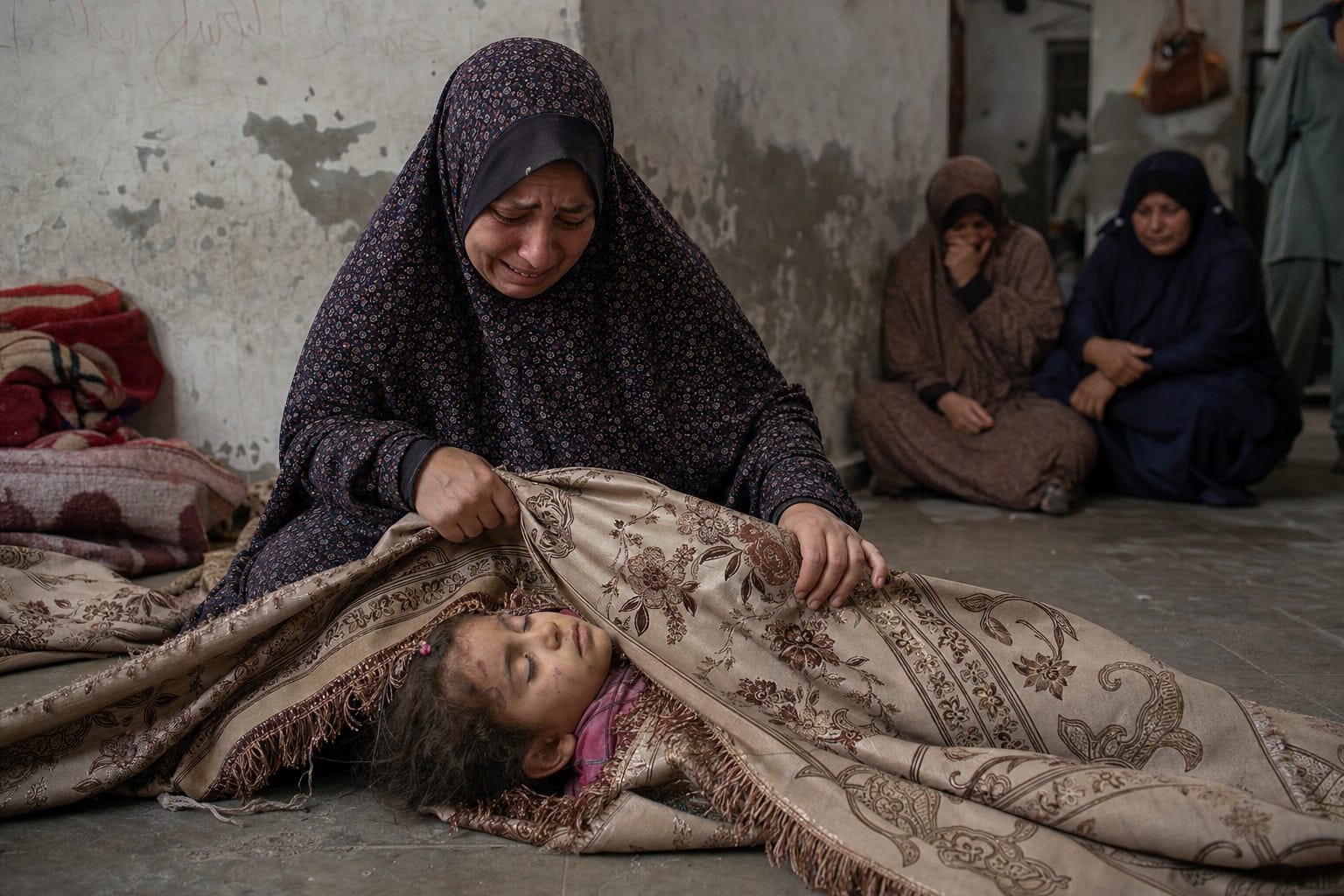
A woman in Rafah wraps her daughter’s body in a curtain because there are no more shrouds. Somewhere in Canberra, a press secretary drafts a statement about “the situation” and reaches instinctively for the word “concerning”. Between these two facts sits an entire civilisation’s capacity for self-deception, and it is built, brick by careful brick, out of vocabulary.
Meg O’Garvey-Schwarz named this mechanism plainly in a recent article that has stayed with me the way a tiny splinter stays with you — not dramatic, just present, insistent, impossible to ignore once you’ve felt it. Drawing on Ece Temelkuran’s description of Gaza as a wound spreading through the body of humanity itself, O’Garvey-Schwarz observes that no government will ever formally outlaw the word genocide. Nothing so direct as a ban is needed. The word will simply be allowed to fall into disuse, replaced by softer relatives — war, conflict, crisis, escalation — each one doing the quiet work of removing an actor from the sentence. Meg was responding to a piece by John Menadue in his blog Pearls and Irritations, on why Australia’s political leadership will not utter the word aloud. But the pattern she describes belongs to no single government. It’s the operating grammar of an entire order.
Passive construction is not a stylistic tic. It is a load-bearing wall. “Civilians died” asks nothing of anyone. “Hospitals were destroyed” summons no hand holding the detonator. Language of this kind is a salve; it allows a body to carry on functioning while the organ that would normally register pain has been switched off — the sentence survives, but nothing in it can hurt you, because nothing in it belongs to anyone.
The word was built to close this precise loophole, which is what makes its current erosion so bitter. Raphael Lemkin spent the years either side of 1944 constructing “genocide” out of Greek and Latin fragments precisely because no existing term could hold what he had watched happen to his own family and community, and because the absence of a name had let earlier campaigns of annihilation — the Armenians, the Herero — pass through history undesignated, filed under the much vaguer language of massacre or war. Lemkin understood something that every subsequent government has quietly relearned: a crime without a name is a crime without an obligation attached to it. He didn’t invent a description. He invented a trigger — a word engineered quite deliberately to activate a legal and moral response the moment it was spoken. What we’re watching now is that trigger being carefully, deliberately, left unpulled. The tool built to prevent this evasion has itself become evaded.
What strikes me most in O’Garvey-Schwarz’s essay is her refusal to hide behind the caveat that so often licenses silence — the reminder that she is not a lawyer, that genocide is a legal term with a legal home, that courts must decide. She makes that concession and then does the harder thing: she keeps going. The International Court of Justice is hearing the case. UN Special Rapporteurs and Commission of Inquiry members have used the word repeatedly. The International Association of Genocide Scholars, the body whose entire professional existence is built on distinguishing this crime from every lesser horror, has overwhelmingly concluded that the threshold has been met. These are not fringe voices reaching for provocation. They are the very people whose institutional purpose is to be precise about exactly this question, and precision is what they have delivered — an inconvenient kind, not a discardable one.
There’s a structural reason the legal caution feels so serviceable to political caution, and it is worth stating because it so rarely is. The Genocide Convention hinges on proving intent, and intent is usually only fully intelligible after the fact, once the archives are open and the perpetrators’ own words have surfaced. Bosnia’s genocide finding arrived years after Srebrenica’s dead were already in the ground. Courts, doing their job properly, are almost always retrospective. Governments then borrow that retrospection and wear it as a shield in the present tense — we cannot know yet, so we will not say yet — as though the slowness of justice were a reason for the slowness of conscience, rather than the precise gap conscience exists to fill while the law catches up.
The reluctance to say the word is presented, almost everywhere, as a dispute about language. It never has been. It is a dispute about what a government, a citizenry, an era, is prepared to be responsible for once the naming has occurred. This is the oldest trick in the administration of atrocity: keep the argument at the level of terminology, and the argument about action never has to start. Rwanda’s radio broadcasts spoke of “work” for a hundred days before the machetes matched the euphemism. Srebrenica was a “safe area” surrendered, not a massacre permitted. The pattern is not new, and genocide is only the most severe entry in a much longer glossary of softened crime. Starvation, when it is used as a weapon, becomes a “humanitarian access problem.” Ethnic cleansing becomes “population transfer” or, more recently, “voluntary relocation.” Invasions are rebranded as “special operations,” and the killing of civilians who were simply nearby becomes “collateral,” a word borrowed from banking, as though grief could be securitised and written off. Each euphemism performs the identical function: it keeps the sentence grammatically complete while surgically removing the part of it that would require a response. What is new, perhaps, is the sophistication with which a hyperconnected world can now watch a catastrophe unfold in real time and still manage, collectively, to look away through the simple expedient of choosing its nouns with care.
Australia’s particular reluctance deserves more than a passing mention, because it’s not an isolated failure of nerve. This is a country that has spent decades in its own unfinished argument over whether “genocide” is the correct word for what was done to Aboriginal peoples on this continent — the Bringing Them Home report used the term explicitly in 1997, and successive governments have spent the years since finding reasons the finding shouldn’t quite apply, shouldn’t quite be legislated, shouldn’t quite enter the national vocabulary in any form binding enough to matter. A government practised at deferring that reckoning domestically is always going to be fluent in deferring the equivalent reckoning abroad. The caution is not a coincidence of timing. It’s the same muscle, exercised twice.
None of this diminishes what happened on 7 October 2023, or the legitimate grief and fear it produced, or the right of any people to live without terror. O’Garvey-Schwarz is careful on this point and the care is vital. But a single day’s atrocity cannot be made to underwrite the flattening of a society across two years, any more than any historical grievance has ever justified the deaths of tens of thousands of children as its ledger entry. To hold both truths — the horror of the attacks and the horror of what has followed — is not equivocation. It is the minimum arithmetic that honesty requires, and it is precisely the arithmetic that softened language exists to avoid.
Underneath the vocabulary sits the machinery that actually converts caution into policy, and it is worth being blunt about what that machinery is made of. Arms contracts renewed rather than reviewed. Alliance structures — Australia’s own AUKUS commitments among them — that make an ally’s conduct increasingly awkward to interrogate the more deeply bound to it you become. Trade relationships, intelligence-sharing arrangements, the diplomatic capital spent maintaining a seat at tables where the cost of speaking plainly is calculated in future access rather than present truth. None of these appear in the sentence “the situation in Gaza is concerning.” All of them are the reason that sentence was chosen over its alternatives. Distance, in this economy, is not an accident of language. It is a product, manufactured to order, and the word genocide is simply too expensive an ingredient to include.
We like to believe we would have known better, had we been alive when the trains ran to the death camps or when the machetes came out in Kigali. We tell ourselves the warning signs would have been obvious to us, that we would have named it for what it was while it was still nameable rather than after the historians had done the naming for us. A comfortable story possibly, but almost certainly a false one. Every generation that has faced this test has faced it in real time, with the language still contested, the legal processes still unresolved, the political cost still live and payable. That is what makes the test a test. Hindsight has never once been the difficult part.
O’Garvey-Schwarz’s essay ends without offering anyone an exit. It shouldn’t. There is no formulation of “ceasefire,” “humanitarian corridor,” or “diplomatic solution” — each of them real, each of them necessary — that substitutes for the single word being said aloud by the people whose job is to speak on our behalf.
Menadue’s challenge to Albanese and Wong was never really about two Australian politicians. It was about whether any of us, anywhere, still believe that truth is owed to the dead regardless of the invoice it presents to the living. Lemkin built the word to be a trigger, not a description. The evidence is in. What remains unresolved is not the naming. It is whether we have the nerve to let it cost us something.