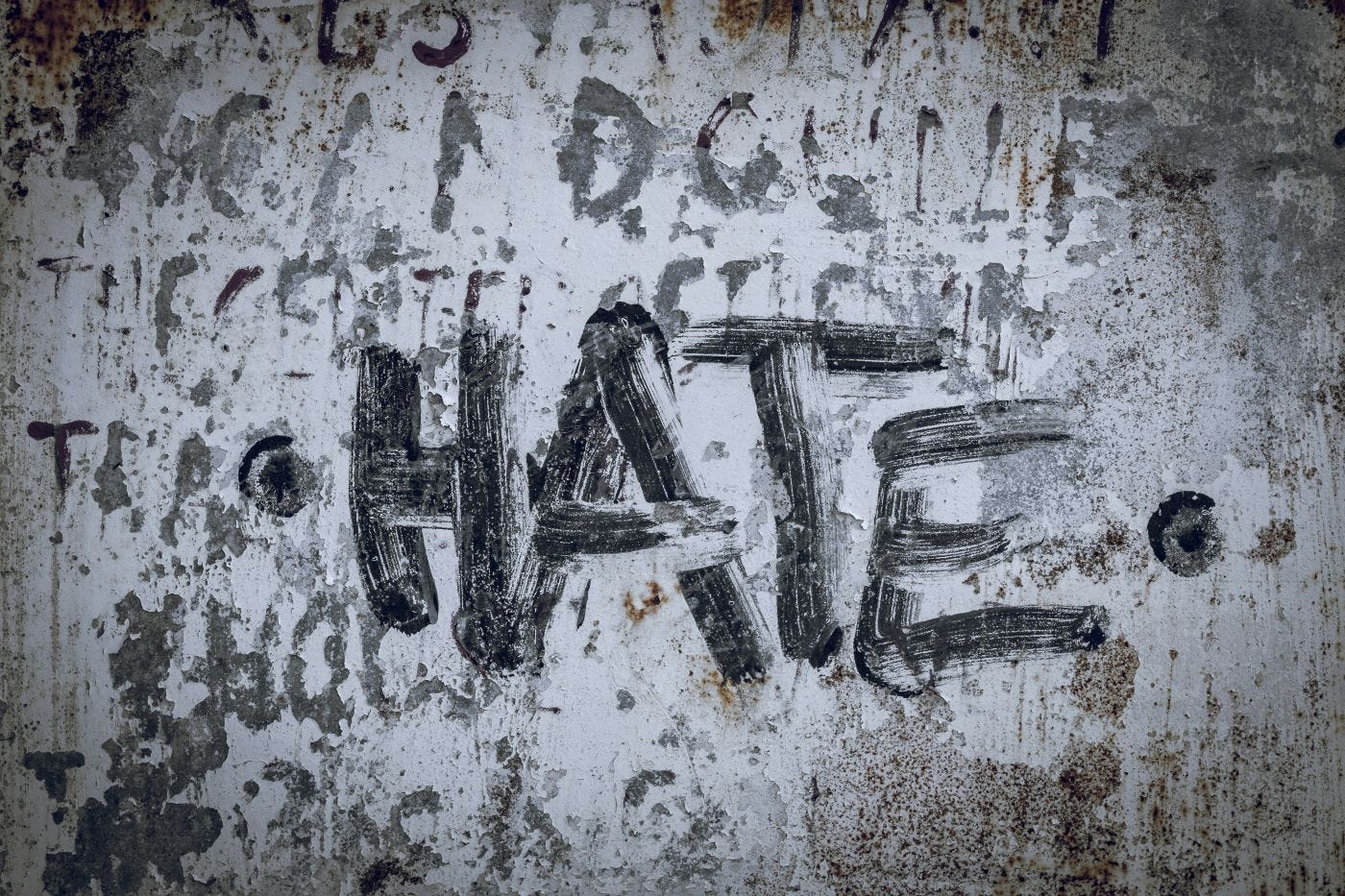
I am still reeling from recent events in my home country of Australia where hate is claimed to be gaining ground. The air throbs with a disquieting intensity, a cacophony of fear and fury. From hallowed halls of power to the digital labyrinths of social media, the wider world is convulsing in paroxysms of outrage – antisemitism, Islamophobia, racial animosity, and a thousand other iterations of human ugliness. We fret and rage. We protest. We legislate. Meanwhile the serpent of hate coils tighter, its venom seeping into the foundations of our collective existence.
I have spent decades traversing the intellectual topographies of human thresholds and potential. Because of that I find myself compelled to ask: are we not missing something profound? Are the solutions to our escalating self-destruction staring us in the face, yet dismissed, ignored, or simply overlooked in our fervent adherence to a dying paradigm?
My deepest conviction, honed through years of observing the human condition from the bustling metropolises of the West to the ancient wisdom traditions of the Global South, is this: love and peace are not just aspirations; they are the irreducible prerequisites for human survival. This is not a sentimental platitude, but a stark, empirical truth illuminated by the accelerating collapse in our most life-critical systems – the climate’s feverish ascent, the oceans’ dying breath, the soil’s fading fertility, the very fabric of social cohesion tearing at the seams. The industrial economism that’s captured our global operating system – a voracious, extractionist, and predatory form of neoliberal capitalism – is not just fostering inequality; it is actively metastasising violence, hate, and warmongering into the very marrow of our societies. This paradigm, with its relentless pursuit of infinite growth on a finite planet, its reduction of all value to monetary metrics, and its inherent competitive ferocity, must become obsolete. And it must do so with a swiftness that belies our sluggish institutional responses. If it does not, then we will.
The Delusion of Compartmentalised Solutions
We speak of “managing” hate, as if it were a contained ailment rather than a systemic symptom. We compartmentalise it into “antisemitism” here, “Islamophobia” there, “racism” somewhere else, applying specific balms to individual sores while the underlying contagion rages. This fragmented approach, a hallmark of the same industrial paradigm we need to transcend, blinds us to the holistic nature of our predicament. Hate, in its myriad forms, is but a manifestation of deeper pathologies: fear, insecurity, manufactured scarcity, and the profound alienation that defines modern existence.
Just consider the pervasive influence of this almost global worldview. Industrial economism has inadvertently fostered a “mindset” of scarcity and competition, even in contexts of abundance. It teaches us to view others as rivals, to hoard rather than share, to accumulate rather than allocate. This worldview has given rise to a palpable world-system of extraction and consumption, creating fertile ground for prejudice. When resources dwindle, or are perceived to dwindle, the instinct to demonise “the other” – the immigrant, the different, the favoured, the dissenting voice – becomes a convenient scapegoat for widespread ingrained failures. The Chinese wisdom I have absorbed over the past three decades suggests that true prosperity lies not in endless acquisition, but in harmonious balance and collective well-being. This stands in blatant contrast to the Western economic models that have driven much of our world to the brink, and our minds to the edge of insanity.
Possible solutions, far from being obscure, are archetypal. They’re encoded within the enduring wisdom traditions of humanity. Yet they are systematically ignored by the dominant technocratic mindset. They are not about incremental improvement but about radical re-orientation.
We must begin with education as an alchemical experience, not merely the transmission of data. Our current educational apparatus, largely a product of the industrial age, prepares individuals for a production line, not for conscious participation in a highly complex and interconnected world. It often teaches history as a series of isolated tales, mostly told by male heroes incidentally, rather than as an unfolding narrative of human folly and triumph, replete with repetitions and patterns.
To truly inoculate against hate, education must become an immersive journey from empathy into compassion, a cultivation of critical discernment that allows each and every individual to recognise the insidious tendrils of propaganda and misinformation. This means moving beyond rote learning where it still exists to foster a profound appreciation of diverse cultures, spiritual paths, and historical grievances, not as abstract concepts, but as living, breathing human experiences. What if every curriculum, from early childhood, were infused with the principle of universal kinship, challenging the notion of “otherness”? Could we design learning environments that prioritise emotional intelligence and collaborative problem-solving above competitive individualism?
Alongside this, the cultivation of radical empathy extends beyond mere dialogue. While intergroup contact holds promise, it often falters when it remains superficial. True empathy demands an imaginative leap, a willingness to inhabit, however fleetingly, the inner world of another. This is not about agreement. It’s about understanding the wellsprings of their fear, joy, and sorrow. How many of us truly invest the psychic energy to understand the historical trauma that shapes a particular community’s anxieties, or the profound sense of dignity that underpins another’s resistance? This calls for more than a polite conversation; it urges us to let go of self-righteousness and beckons us towards shared experiences that dissolve artificial boundaries of identity.
Consider the potential of mandatory, diverse community service programmes, wherein young people from disparate backgrounds are invited to work side-by-side on projects of communal benefit – building, serving, creating together. Such shared endeavour, forged in common purpose, has the potential to melt away preconceived prejudices with an efficacy that rational discourse rarely achieves. Could we imagine a world where such immersion is as fundamental to citizenship as learning to read?
The insidious role of digital architectures of division already demands a revolutionary response. Our current online landscape, driven by profit-maximising algorithms, has become a super-spreader of hate, an echo chamber where fear and grievance are amplified and monetised. This is not only a technical problem; it’s a profound ethical failure embedded in the design of our digital commons. To speak of “content moderation” as a sufficient balm is akin to treating a raging fever with a cold compress while ignoring the virulent infection consuming the body. We must demand uncompromising transparency and accountability from the architects of these digital worlds.
What if algorithms were legally mandated to prioritise human connection and verified information over engagement metrics that reward outrage? What if there were a global digital charter, enforced by an international body, that held platforms legally responsible for knowingly amplifying hate speech and incitement to violence? This would be a seismic shift, challenging powerful corporate interests, but the cost of inaction – the unraveling of social cohesion, the radicalisation of entire generations – is surely far greater.
Furthermore, we must embrace stewardship as a moral compass, not political expediency. In an era of profound uncertainty, the world craves leaders who embody courage and integrity. The truth is we are governened b the least among us; those who pander to the lowest common denominator of fear and division.
The silence of good people, or their complicity through inaction, is often more deafening than the shouts of the haters. Those individuals who’ve been rewarded with power, whether in government, faith communities, or business, have a sacred duty to demonstrate a vision of shared humanity, to unequivocally condemn all forms of prejudice, and to actively model inclusive behaviour. This means transcending the narrow confines of group interest when global challenges demand global solidarity. Where are the men and women prepared to sacrifice short-term popularity for the long-term survival of our species? What if political systems were restructured to reward collaboration and long-term foresight over adversarial posturing and cycles of blame? The very idea of “winning” in politics, especially within the industrial paradigm, often implies the defeat of an opponent, thus perpetuating the cycle of conflict. Upon reflection that thought is obscenely primitive.
The term “drastic remedies” often evokes images of authoritarianism or utopian fantasy. Yet, when a patient is in a critical condition, extraordinary measures are not just advisable; they become essential for survival. Our planet, and indeed our species, is in a critical condition. The collapse of our most life-critical systems is not a distant threat but a presentday reality, and it’s inextricably linked to the mindset of expressed hate and outrage.
One such drastic remedy, often whispered in the margins, is a fundamental re-evaluation of “free speech” in the digital age. The absolutist interpretation of free speech, born in a different era, is being weaponised to dismantle egalitarian societies and incite real-world violence. Is it not time to recognise that the freedom to shout “fire” in a crowded theatre is not absolute, and that the digital equivalent – the deliberate propagation of lies, incitement to hatred, and calls for violence against protected groups – carries far greater, global consequences?
This is not about censorship of dissenting opinion, but about the protection of human dignity and the prevention of harm. Could a new legal framework emerge that balances robust protection for legitimate expression with stringent penalties for speech that directly incites violence or systemic discrimination, perhaps drawing lessons from nations that have long grappled with the legacies of genocide and totalitarianism? The current reluctance to engage with such questions reflects a profound intellectual inertia, a fear of challenging sacred cows.
Another truly radical shift involves a re-imagining of economic justice. The industrial paradigm we inhabit thrives on vast disparities; it creates a fertile breeding ground for resentment and xenophobia. When pockets of extreme wealth coexist with widespread poverty and insecurity, the narrative of “us versus them” becomes powerfully seductive. What if the fundamental purpose of our economic system shifted from endless accumulation to the equitable distribution of resources and opportunities? This would entail not just progressive taxation, but a complete overhaul of global trade agreements, an end to predatory lending practices, and a commitment to universal access to fundamental human needs – food, shelter, healthcare, education. Such a re-distribution, often dismissed as utopian or socialist, is arguably the most potent antidote to the economic anxieties that fuel so much of our contemporary hatred. Could we envision a global economic framework where the health of ecosystems and the well-being of all peoples are the primary metrics of success, rather than GDP growth within the confines of the nation-state? This would require a deep re-alignment of values, moving away from a paradigm where human beings are reduced to mere cogs in the machinery of production and consumption.
Finally, and perhaps most profoundly, we must embrace psychological metamorphosis as a societal imperative. All external systems, all world-systems, ultimately derive their power and form from the collective consciousness, the shared “mindsets” of the individuals who comprise them. If we truly wish to eradicate the cancer of hate, we must confront the inner phantasms of fear, greed, anxiety and insecurity that give rise to it and fuel it. This is a call for a systemic commitment to practices that foster self-awareness, emotional regulation, and ethical reasoning from the earliest stages of life. What if every educational system, every civic institution, every workplace actively cultivated mindful concern and a sense of interconnectedness? This is the work of cultivating character, not merely competence; of fostering wisdom, not just knowledge. It’s a return to the philosophical roots of human flourishing, often dismissed as “soft skills” in our results-driven world, yet demonstrably essential for building resilient, peaceful societies.
The possibilities for transcending this era of escalating hatred and violence are not mysterious, even though we might pretend they are. We know, in outline, what’s required. What we do not yet have is the honesty to admit the price.
If we are really serious about preventing the next atrocity—against Jews, against Muslims, against any scapegoated “other”—we will have to abandon some of the idols we currently treat as sacred. We will have to accept that:
· Entire industries whose business model is outrage and division must be broken up, regulated out of existence, or transformed beyond recognition. That means confronting the media and technology corporations that profit from algorithmic polarisation, not just pleading with them to “do better.”
· Political parties and those privileged to speak on our behalf yet who traffic in dehumanisation—of migrants, of religious minorities, of geopolitical enemies—must be treated as a clear and present danger to social order, not as just another “side” in a normal contest of opinions.
· Economic arrangements that rely on structurally sacrificial populations—permanent underclasses, disposable workers, endlessly displaced communities—will keep breeding violence, however many “tolerance” campaigns we launch. Redistribution is not an ethical luxury; it’s a condition for peace.
These are not metaphorical shifts. They involve laws, enforcement, loss, and disruption. They mean stating, in plain language, that some uses of capital, some uses of speech, and some forms of political power are incompatible with a habitable planet and a non‑murderous civilisation.
If we decline that clarity, we should at least stop pretending to be perplexed when the next synagogue is attacked, the next mosque is firebombed, the next school becomes a crime scene. Please stop fooling yourselves and each other. We’re not facing “unimaginable” events. We’re facing the utterly predictable outputs of the systems of hate and competition we’ve chosen, again and again, to leave intact.
The real issue was never “How do we stop hate and violence?” We know, broadly, how: reduce precarity, dismantle architectures of humiliation and propaganda, stop telling lies, and raise children inside cultures that teach kinship instead of contempt. The real question is: what are we prepared to relinquish—which profits, which privileges, which carefully preserved rituals of historical trauma, which myths of national or civilisational supremacy—to make that possible?
We are approaching a fork in the road that cannot be indefinitely postponed. One path is the continued policing of atrocities: periodic spasms of horror, followed by inquiries, hashtags, and the comforting lie that nothing fundamental can be different given that we’re only human. The other is a deliberate, disruptive transition to a world‑system organised around sufficiency, cooperation, mutual obligation, and shared vulnerability; the acknowledgement that our enemies are manufactured.
To choose the second path is to accept that there is no “going back” to a calmer version of the present. It’s to accept that some institutions will not survive and that some treasured narratives about who “we” are will have to die.
We need to grow up. The age of pretending that we can keep our hatreds, our hierarchies, and our habits of exploitation and somehow be safe is well and truly over. We either design—and enforce—conditions under which hatred withers for lack of fuel, or we continue to live inside its blast radius.
The question I ask myself is brutally simple: do we care enough about the lives already lost, and the lives about to be lost, to pay the price of peace? If the answer is yes, then our task is not to feel more deeply, but to act more ruthlessly on what we already know.