My local pharmacy ran out of tablets by the second week. What remained on the shelf, and what people bought anyway, was the veterinary paste, apple flavoured, meant for the parasites of horses and cattle. Motorbikes queued past the noodle stall. Nobody was told to buy it by any government. A cousin had heard from a nurse in Khon Kaen, who had heard from a doctor on YouTube, that this was the drug the hospitals wouldn’t tell you about. The tube cost forty baht. Trust, that year, had become something you could squeeze from a plastic syringe.
Three years on, ivermectin has been tested properly, in randomised trials large enough to answer the most pertinent questions. Across dozens of them, run on different continents by researchers with no stake in the outcome either way, one pattern persists: no meaningful reduction in deaths, in hospitalisation, or in the length of an illness. Hydroxychloroquine fares little better as a treatment, though a handful of prophylaxis trials leave the prevention question more open than the treatment question, a distinction almost nobody who forwards the video bothers to draw. This isn’t a verdict handed down by a captured medical establishment protecting a rival product. It’s what happens when a large enough sample of sick people gets split at random and monitored.
Remdesivir sits in the same file, accused by the same voices of being something closer to a poison than a therapy. The record is more boring than either the manufacturer’s early marketing or its later critics allowed. Studies across patients with impaired kidneys, damaged livers, and end-stage renal disease, conducted independently of each other in Taiwan, Japan, and the United States, found no consistent pattern of harm to those organs, and several found a trend toward lower mortality even in the most fragile cohorts. The World Health Organization still recommended it in 2023 for patients at moderate to high risk, well after the emergency authorisations had expired and any commercial incentive to inflate its reputation had faded. Modest benefit, acceptable safety, no evidence of a body count. Not a triumph. But not a killer either.
Vaccines are undoubtedly where the fear runs deepest, and where both sides of the argument are lying by omission rather than by invention. It’s true that mRNA vaccination carries a measurable risk of myocarditis, concentrated almost entirely in young males after a second dose. Estimates run to a few dozen cases per million doses, worse in some age bands, milder in others, the studies disagreeing on the exact figure and saying so truthfully rather than converging on a number that flatters anybody.
It’s also true that most national health agencies calculated the benefit, population-wide, as clearly exceeding that risk. What gets buried by both camps is a third finding neither of them wants. Independent analyses of the FDA’s own figures, narrowing to men aged eighteen to twenty-five and using more realistic infection assumptions, found scenarios in which the arithmetic for that specific group runs the other way. That finding sits inside peer-reviewed literature, not a fringe channel.
A calculation that admits its own internal disagreement is harder to sell than one that doesn’t, and neither priesthood is in the business of pushing the version that moves fewer units.
Masks, distancing, and lockdown orders invite the same reckoning. Here the evidence is indisputably split. Reviews drawing on stringency indices across dozens of countries have found modest reductions in mortality attributable to distancing and closures. Other reviews, examining the same period with different assumptions, including about what a control group even means when the whole planet is affected simultaneously, find the measured effect barely distinguishable from noise. Both sets of authors hold professional credentials. Both published in reputable journals with an editorial board. Nobody ran a genuine experiment, because nobody could design one at that scale, and anybody offering certainty in either direction is in the business of marketing rather than reporting.
Testing and mortality figures deserve the same discipline, but here at least one popular claim collapses on contact with the underlying analyses. A PCR assay, correctly designed and correctly run, distinguishes true from false results at a rate nowhere near the “eighty-six percent false” figure that circulated widely online at the time. What is true, and arguably worth the confusion it caused, is that PCR detects fragments of viral genetic material that can persist after a person has stopped being infectious. That means a positive result and an infectious person are not necessarily identical, a subtlety lost in most public messaging on both sides.
Fatality figures suffered from a related collapse of nuance. Early case fatality rates, amounting to several deaths per hundred detected infections, were real numbers but skewed upward by undercounted mild cases and overwhelmed hospitals that were recording only the sickest patients. Infection fatality rates, calculated later once serology allowed a fuller count of the infected, told a sharply unequal story: close to negligible for healthy children and young adults, and nowhere near that for the old and the chronically ill, especially in the pandemic’s first year before vaccination and prior infection were taken into account. “Fatality was low” and “fatality was high” are both true statements about people the virus was never treating as one population.
Even after five years the lab-origin question still deserves the same restraint. American research funding did flow through EcoHealth Alliance, an intermediary organisation, and was used for tests on bat coronaviruses conducted partly at the Wuhan Institute of Virology. Whether that funded work crossed the definitional line into what regulators formally classify as ‘gain-of-function’ research is contested among the scientists who wrote those definitions in the first place. What does not exist, at least in any form available to the public, is a documented chain connecting specific funded work to a specific released virus. A hypothesis that remains plausible after five years of investigation is not the same as a hypothesis that has been proven. Treating the first as though it were the second, in either direction, reveals more about the speaker’s chosen tribe than about the virus.
Which brings the case around to the individual who, for a certain group of critics, became shorthand for the ensuing confusion. Anthony Fauci was certainly wrong about several things in public, sometimes badly. The early dismissal of airborne transmission, guidance on masks that shifted without adequate explanation of what had changed and why, and a public register that read as certitude when the underlying science was still shifting, were failures of judgement that are unacceptable in a senior official carrying so much responsibility. He was not wrong, on the evidence now assembled, about the comparative danger COVID posed to older adults, about the eventual failure of hydroxychloroquine as a treatment, or about the net population benefit of vaccination.
Reducing an institutional failure to one official’s biography is convenient for a headline looking to assign blame, but useless for any lucid analysis. The agencies over which Fauci presided made structural errors that had nothing to do with his personal integrity: punishing dissenting clinicians before their disagreements had been tested, treating uncertainty as something to manage through mainstream media rather than sharing concerns candidly with the public, and protecting institutional standing at times when admitting the limits of current knowledge, would all have cost less credibility in the long run than the reversals eventually did.
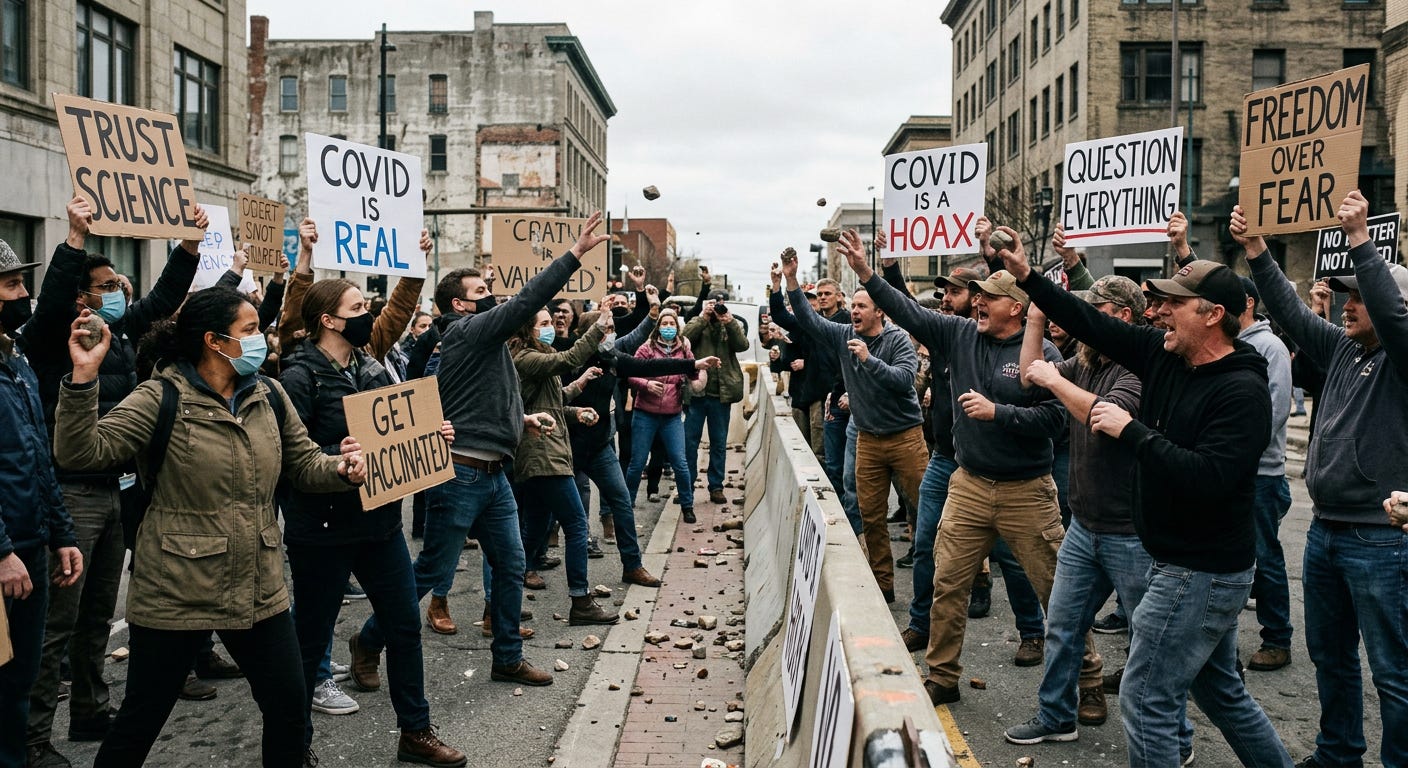
The instinct to doubt institutions is not the same as the impulse to think for oneself, although the two do get mistaken for each other constantly, and not just in countries with the shrillest podcasts. A grandmother in Lagos refusing to swallow a polio drop on a sugar lump because a cleric told her it carried a Western sterility agent, and a software engineer in Austin declining a booster because an account he follows told him the trial data had been suppressed, are performing the same manoeuvre. Neither has checked the underlying study. Both suppose they have checked everything that matters. The object of faith moved from a health ministry to a dissident physician with a large following, from a professional body to a channel with an algorithm behind it. The structure of faith didn’t move at all. What collapsed during the pandemic wasn’t trust per se. It was one particular brand of credulity, promptly replaced by another using the vocabulary of scepticism as a veneer.
None of this argues for restoring trust to institutions that spent it so carelessly. Health agencies that changed their story without explaining why they’d changed it, that treated dissent as a disciplinary issue rather than a data problem, that mistook public confidence for understanding, earned a considerable share of the doubt and distrust now aimed at them. The failure wasn’t in being interrogated. A population given the chance to wait patiently for better data instead swapped one unearned confidence for a second, and guarded the replacement as fiercely as it once guarded the original.
Most of what’s recorded above remains ambiguous at best. We still can’t be sure, and may never have all the answers, to these questions. That offers nothing to rally around, no enemy to name, no victory to promise. Which is probably why almost nobody builds a following on it.
My pharmacy has proper tablets again now. Correctly labelled, and correctly dosed, they are sitting unsold on the shelf. What moves off that shelf these days is a supplement promising to reverse whatever the vaccine supposedly did, sold by a different voice with the same tone of absolute certainty the last one had. The queue has re-formed. Nobody standing in it seems to have noticed they’re back in the same line.