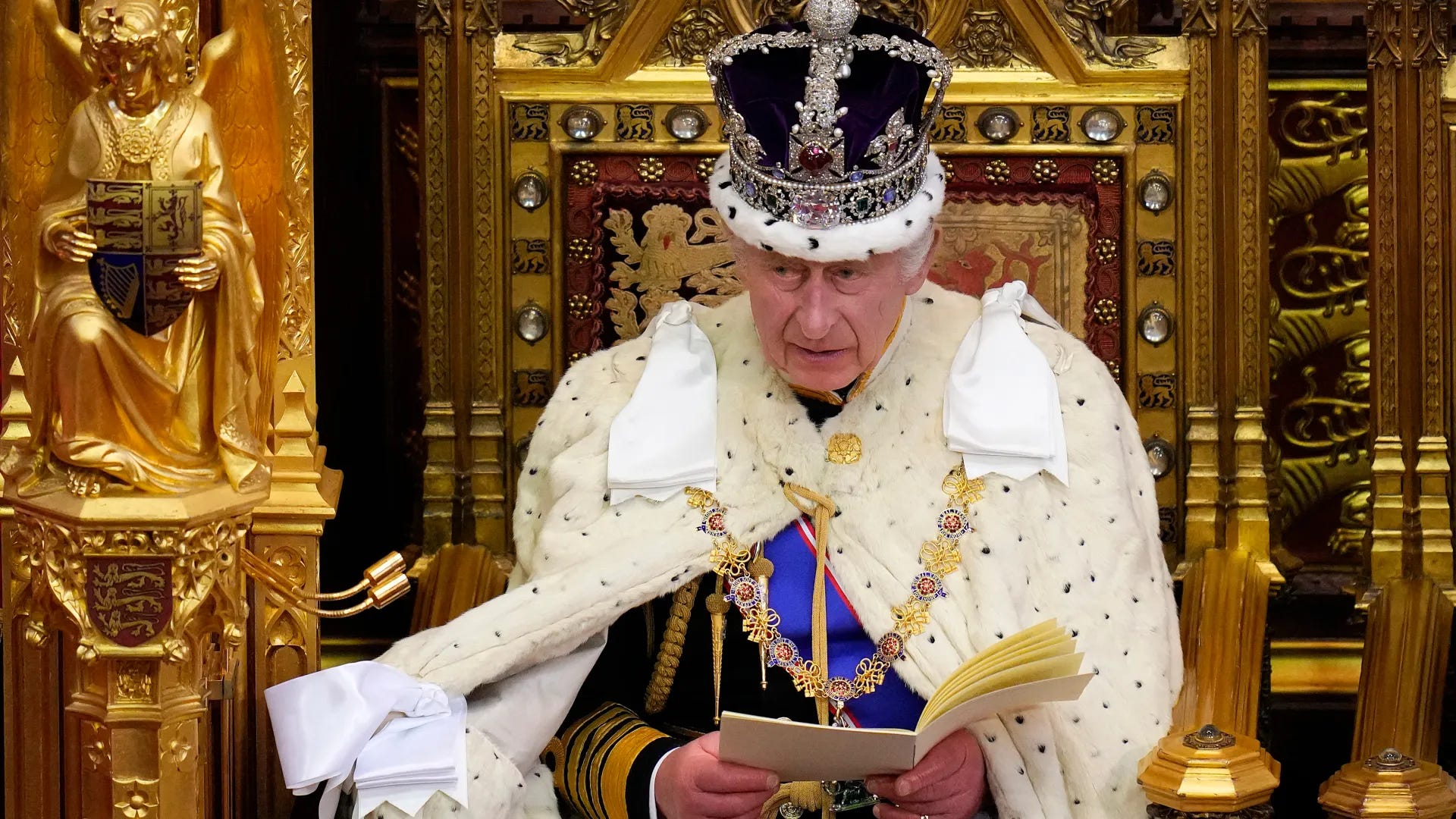
A man in his late seventies stands before the British Parliament wearing several centuries of borrowed authority — crown, ermine, a phalanx of guards whose uniforms date from wars nobody living can possibly remember — and reads aloud a government’s plans for digital identity systems, artificial intelligence regulation, and the automated administration of welfare. Nobody in the chamber finds this in the least bit strange. Perhaps its just me then.
Britain has spent three hundred years dismantling the idea that political power should be inherited, while keeping, at extraordinary expense and with evident public affection, one office where it still is. The monarch doesn’t write the speech he delivers. He doesn’t choose the policies. He functions, on the day, as something closer to a human interface — a face placed in front of a legislative programme that was assembled elsewhere, by people he did not elect and cannot dismiss. Behind him sits an ancient claim to sovereignty by blood. In front of him sits a modern state increasingly organised around databases, risk scores, and algorithmic eligibility checks. King Charles is the seam between two entirely different theories of from where authority comes. The seam holds because nobody looks at it too closely.
It would be so easy to call this theatre and leave it at that. Political power has always needed theatre — flags, anthems, and the revered hush that falls over a room when ceremony of any kind begins. Every state stages its authority by some means. Britain has simply had longer to perfect the staging, and more gold to stage it with. What the crown does, better than almost any other surviving institution of that ilk, is take an arrangement that would sound absurd stated plainly — one household holds a permanent, ceremonially protected place above several million citizens, purely as an accident of birth — and render it, through repetition and velvet, as something closer to the tides than to argument. You don’t vote on the ocean’s waves. You live with them, occasionally complaining about them if you’re surfing.
But watch what happens once the ceremony ends and the actual governing begins.
Ancient forms of power were visible by design — a face, a voice, individuals that could be booed, mocked, occasionally beheaded when the arrangement failed badly enough. The newer form is almost invisible. Your standing with the state can now be adjusted by a model you will never see, using data you didn’t know was being collected, according to rules few people, including elected representatives, can fully explain. A benefits claim gets flagged. A loan gets declined. A border gets refused. Somewhere in each case a human being made a decision once — wrote a rule, trained a system, approved a threshold — and then stepped back far enough that the decision now arrives without anyone left to answer for it. The King can be heckled on the street. The system that increasingly governs more of daily life than he ever did can’t be heckled at all. It simply returns an answer, and the answer is final in a way no British monarch’s word has been since Runnymede.
This is where the ceremony becomes more than curiosity. Sovereignty has not disappeared from the modern world — that fantasy belongs to people who confuse the shrinking of one throne with the shrinking of hierarchy itself. It has migrated. Wealth still arranges itself in tiers. Access to healthcare, education, credit, and even attention, still sorts populations into strata as sharply as any court did. What has changed is clarity. A crown announces hierarchy in gold letters, which is precisely why it draws so much anger. It’s the only hierarchy still rude enough to show itself. The algorithm that denies your mortgage application says nothing about lineage or entitlement. It says only: computed, declined. The injustice, if there is one, arrives with no fingerprints, because the fingerprints were distributed across a supply chain of engineers, contractors, and historical training data long before the decision reached you.
I am not trying to excuse the spectacle’s other abject failure, which is more ordinary and considerably harder to defend. Millions of the King’s subjects have spent recent years watching housing costs outrun wages, public services fray, the arithmetic of an ordinary life stop adding up — while the state, on schedule, produces a display of inherited wealth polished to a shine most of them will never touch in their own homes. The counter-argument that a diamond doesn’t literally take food from a hungry family is true, yet almost beside the point. Symbols don’t need to be literal in order to do damage. When ceremony insists that some forms of inequality are heritage and others are just policy, it’s making a claim about which arrangements deserve reverence and which deserve reform. That claim, delivered in gold thread before an audience with empty cupboards, is hardly neutral.
There is a case for the crown that doesn’t depend on gold at all, and it deserves to be stated plainly before it’s dismissed out of hand. An elected head of state changes with the political climate; a monarch, whatever else can be said against the office, does not. Continuity through governments that despise each other is a function democracies find difficult to build any other way, and Britain has, however accidentally, built exactly that. This is the argument royalists actually believe, underneath all the pageantry — that a species prone to hero-worship and tribal loyalty is safer directing some of that instinct toward a figure with no policy levers to pull, rather than toward whichever politician currently commands the cameras. It’s not a foolish argument. It is simply not the one being tested by the spectacle described here. The danger towards which I am pointing, one that I constantly warn about in The Hames Report, wears no crown at all.
Because somewhere behind both the ceremony and the outrage it provokes, a genuinely new kind of throne is being assembled, and it has no occupant to boo. Nobody sits on it. Nobody needs to. It’s built from infrastructure rather than ancestry — computation, data pipelines, the accumulated decisions of systems trained to optimise for outcomes nobody consciously chose. A king can be confronted, mocked, eventually reformed, because a king is a person and persons can be made to answer for their actions. A system built from ten thousand incremental engineering choices, none individually tyrannical, can produce an outcome no single person intended and no single person can undo. That’s not a flaw in the design. It may be the design’s most efficient feature — power that governs without ever needing to be seen governing, let alone forgiven for it.
So the old spectacle continues, robes and all, because ultimately it’s comforting to many, and because comfort can’t simply be ignored. Meanwhile the newer one assembles itself in servers and data centres that hold no ceremony whatsoever, is answerable to no chamber, wearing no crown that could be photographed, mocked, or eventually persuaded to abdicate. I am less fearful of the former than I am of this turn of affairs.