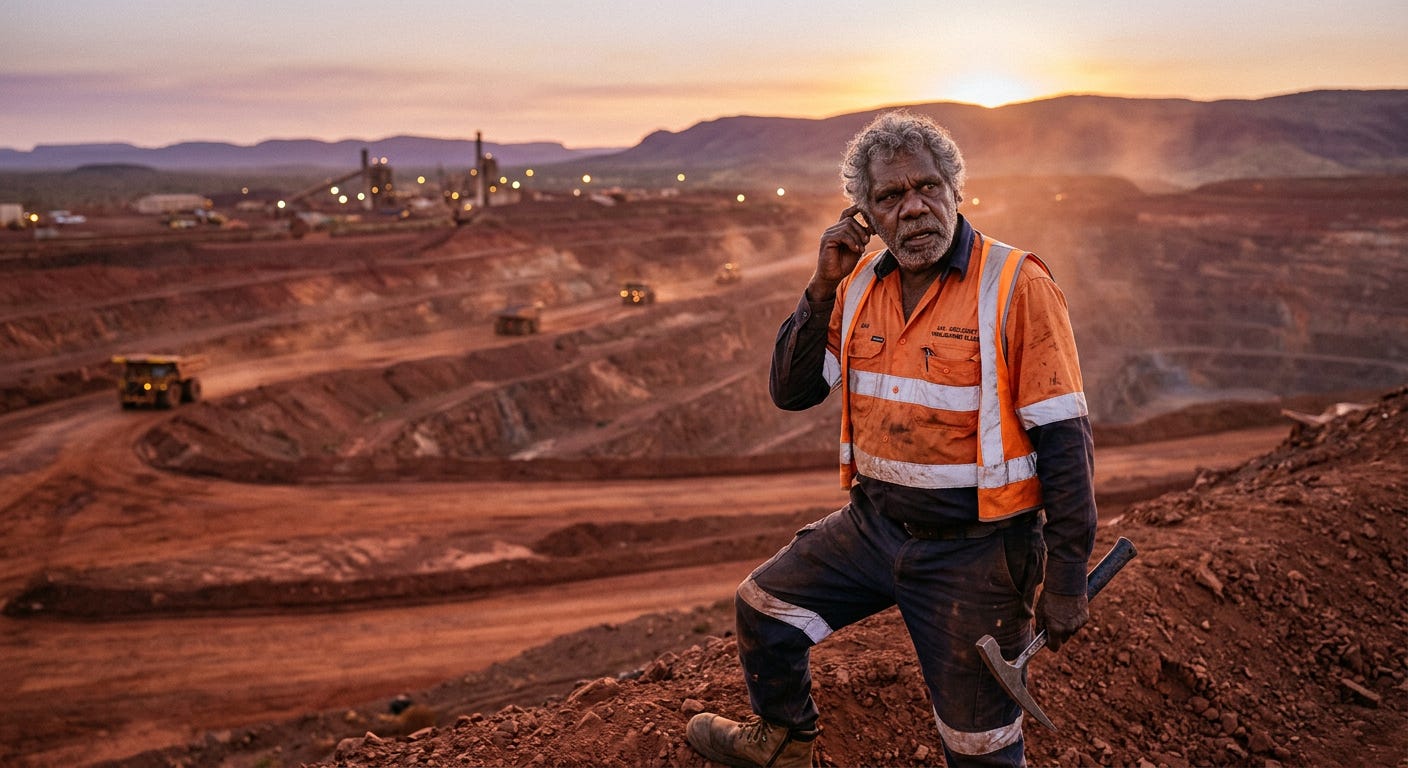
Ian, an indigenous award-winning geologist and an elder of the Yindjibarndi people, stands on the edge of an open cut mine in the Pilbara. He hears a voice. It’s not the voice of a fellow worker. Not a warning from a machine to get out of the way. Not anything in fact that belongs to the soundscape of extraction: engines, radios, safety briefings, or gravel under boots. The voice whispers that this land is sacred and that nothing can justify what’s being done to it.
Ian’s first instinct is to dismiss it. It’s often what we do when reality arrives in a form our training has not sanctioned. A spreadsheet can be discussed. A satellite image can be analysed. A biodiversity report can be peer reviewed. But a voice from within the land itself? That’s much harder to file. So the experience is treated as a figment of the imagination, an illusion, an episode, a personal response to stress. The mind says, “That didn’t happen,” and returns to the task at hand. The body doesn’t return quite so comfortably.
There are moments when a person’s official role and their deeper awareness come into conflict. On paper, the task is technical: assess the site, measure the impacts, identify mitigations, produce a report. The language is procedural and clean. It suggests that harm can be divided into categories, that it can be managed, and that any loss can be offset if the correct boxes are checked.
Yet some part of us knows that the situation exceeds the form. The body senses what a document can’t capture. The land isn’t simply a mine site. The wound is not just an environmental impact. The question is not only whether extraction can be made more efficient, legal, or profitable. The question is whether some places should not be violated at all.
When that knowledge has no permitted language, it may speak in symptoms. Anxiety. Panic. Visions at the edge of perception. A sudden inability to act normally in a meeting. These can be read clinically, and sometimes they should be. Human beings under stress do hear, see, and feel things that scare them. For example, we have ample clinical evidence that a disembodied voice may be a stress-induced auditory experience, an intrusive perception, a nervous system under pressure. A panic attack may be the body’s alarm system misfiring, or quite possibly firing exactly as designed.
But clinical language isn’t the only language available. It can describe mechanisms without exhausting meaning. A person can have a psychological episode and still have encountered an essential truth. A voice may come from inside the mind and reveal what the conscious mind refuses to accept. Symptoms may be personal and still point beyond the individual. What breaks through in such moments may be conscience, grief, moral injury, ancestral memory, ecological perception, or all of these at once.
Moral injury is one name for this rupture. It occurs when a person participates in, witnesses, or becomes entangled in something that violates their deepest sense of rectitude. It’s not simply guilt. It’s actually the collapse of the story that allowed that person to keep functioning. The professional narrative says this is development. The economic story calls it value. The regulatory account acknowledges that it’s allowed. The technical story says this is manageable. But the injured moral imagination says it is desecration.
Desecration is a word modern institutions avoid because it can’t be easily quantified. It implies that the world contains more than material objects. It implies that places can carry obligation. It implies there are thresholds that one simply does not cross, not because crossing them is inefficient, but because crossing them breaks relationship.
But desecration doesn’t belong only to mines, temples, or explicitly religious sites. It identifies a wider category of violation: the moment when an artefact entrusted with meaning is treated as if it were simply available to anyone, anywhere. A burial ground turns into real estate. A river becomes water rights. A ceremonial object becomes a collectible. A painting becomes an asset class. A ritual becomes spectacle. A body becomes a specimen. A ruin becomes a backdrop. A sacred site becomes a development constraint. The list goes on and on...
In each case, something has been lost. Not necessarily destroyed, at least not visibly. It may be preserved, documented, relocated, displayed, insured, or restored. But it’s been severed from the relationships that made it worthy of care and respect.
This is why desecration is often difficult for institutions to recognise. Institutions are built to identify physical damage, financial loss, legal ownership, and procedural compliance. They are less capable of seeing broken relationships. If a statue is smashed, the harm is visible. If a grave is excavated, the vandalism can be described. If a painting is slashed, the wound appears on the surface of the canvas. But what about a ceremonial object removed from the community that knows how to approach it? What about a sacred song recorded without permission and circulated without context? Or a landscape left physically intact but surrounded by noise, surveillance, roads, fencing, and extraction? What about an ancient object placed behind glass, protected from decay but stripped of the conditions that made it alive?
Desecration doesn’t always look like destruction. Sometimes it appears to be access. At other times like appreciation. Occasionally it can look like research. Conservation perhaps. Or even development with interpretive cues.
This is the problem with sacred things: they are not always harmed in ways an outsider can measure. A sacred site may not announce itself through its architecture. There may be no cathedral, no altar, no monument, no inscription. Its potency may live in story, taboo, ceremony, ancestral presence, seasonal return, or forms of silence that strangers mistake for emptiness. To disturb such a place is not simply to disturb land. It’s to disturb a web of obligations between the living, the dead, the more-than-human world, and those not yet born.
The same is true, though differently, of aesthetic objects. A painting is canvas and pigment, but it’s not only canvas and pigment. A carved figure is wood or stone, but it’s not just wood or stone. A handmade vessel is clay, but not only clay. A manuscript is ink and fibre, but not only ink and fibre. Such objects gather attention across time. They carry the hand of the maker, the gaze of viewers, the devotion of keepers, the memory of use, the discipline of craft, and the vulnerability of beauty. To damage them is not simply to alter matter. It is to wound an association.
That is why the vandalism of art, monuments, graves, or sacred objects often feels much more serious than ordinary property damage. The financial value may be calculable. Repairs might even be possible. But the violation exceeds the invoice. Something entrusted to care has been treated with contempt, or with the wrong kind of respect. The injury is not only to the object but to the field of meaning around it.
Aesthetic objects teach this because beauty itself creates obligation. Beauty asks for a different posture. It slows the hand. It interrupts the appetite. It asks to be approached with awe rather than consumed. A culture that can’t perceive beauty will struggle to perceive desecration, because it will have forgotten that the proper response to certain objects is not use, ownership, or extraction, but reverence.
This doesn’t mean that every beautiful object is sacred in the same way, or that every claim of sacredness must automatically settle every public question. Societies have to make tough decisions. Roads, hospitals, housing, energy, and infrastructure also carry moral weight. But a society can become cynical when it can’t tell the difference between inconvenience and violation. When sacredness appears only as an obstacle, and beauty solely as ornament, decision-making has already been morally impoverished.
The language of compensation often fails here. If a sacred olive grove is cut down and another is planted elsewhere, the physical organism is restored ecologically, but not relationally. If a grave is moved, the remains may be transferred, but the place of mourning has been ruptured. If an artwork is replicated, the image may return, but not the full history of the original’s passage through time. If a ceremonial object is preserved in perfect humidity behind museum glass, its material life may be protected while its ceremonial life is suspended.
Modern systems are fluent in substitution. They ask what would be an equivalent replacement, what mitigation would be adequate, what payment would be fair. Desecration answers that some things are not interchangeable. Not because they are infinitely expensive, but because price is the wrong measure to apply.
To speak of desecration, then, is to defend the existence of thresholds. It’s to say that some things should not be crossed, handled, displayed, excavated, photographed, traded, or transformed without permission from the relationships and curation that sustain them. It’s to insist that matter can bear memory, that beauty can impose duty, and that place can make claims upon us before we make claims upon it.
This is where the mine becomes more than just a hole in the ground. All mines are powerful symbols because they reveal the dominant logic of our age. Mines cut into the earth in search of buried wealth. They turn depth into commodity, and convert geological time into quarterly returns. What was hidden, compressed, and ancient is brought upward, sorted, priced, and circulated through markets far from the scars that remain visible in the landscape.
To the worldview of industrial economism, this is progress: matter transformed into wealth through ingenuity and labour. To another, it is a dangerous intimacy with the underworld: an opening of the earth that requires permission, ritual, restraint, and consequence.
The conflict between these views is not simply intellectual. It is civilisational. One says land is resource. The other says land is kin. One asks, “What can be extracted?” The other asks, “What must we honour?” One asks, “How do we reduce harm?” The other asks, “Who gave us the right to do this?”
Modern systems are very good at resolving the first kind of question. They are far less equipped to answer the second. This is why sacred land poses such a challenge for us. Sacredness is not just beauty, rarity, or cultural preference. It’s a claim on limits. It says that human appetite must stop here. It says the world is not endlessly available at whim. It says value doesn’t begin when something enters the market.
A sacred place may not look sacred to an outsider. It may not announce itself in a form that’s legible to law, science, or capital. There may be no no fence, no sign. Its meaning may live in story, ceremony, taboo, burial, song, lineage, or silence. The fact that a place can be destroyed by those who can’t perceive its sacredness is one of the great tragedies of colonial and industrial history.
In many traditional knowledge systems, the land is not inert. It remembers. It speaks. It holds agreements between the living, the dead, and the not-yet-born. Human beings don’t stand above it as managers but within it as relatives. Knowledge is not limited to data collected from a distance. It can come through dreams, ritual, illness, intuition, apprenticeship, and the authority of elders.
To a modern rationalist, this can sound like superstition. But that dismissal reveals the narrowness of the rationalist frame. The issue has nothing to do with whether every vision is literally true, or whether every voice should be obeyed without discernment. The real issue is whether modern institutions have amputated forms of perception that once helped communities survive.
People who lived close to land for thousands of years developed ways of noticing consequences. They encoded restraint in story. They placed prohibitions around fragile or powerful sites. They understood that wealth without taboo becomes predation. A sacred boundary is not the opposite of intelligence. Indeed, it may be intelligence in its oldest social form.
To say “this land is sacred” is therefore not only to make a spiritual claim. It is to make an ecological, ethical, and political claim. It says: this place is not empty. What’s here cannot be replaced elsewhere. No form of compensation can purchase permission from the dead. It also says the living have duties they didn’t invent and there are forms of knowing and appreciating much older than any environmental impact report.
Of course, one can explain the voice Ian heard sceptically. Perhaps it was produced by stress. Perhaps it emerged from buried discomfort. Perhaps later events gave it meaning in hindsight. Human beings are pattern-making creatures. We are capable of turning coincidence into revelation. But scepticism alone is not wisdom. It can protect us from delusion, but it can also deter us from transformation. It can become a method for ensuring that nothing outside the dominant worldview is allowed to matter.
A better approach is to hold multiple explanations at once. The voice may be psychological: an externalised form of inner conflict. It may be ethical: conscience breaking through professional obedience. It may be somatic: the body refusing to participate in denial. It may be symbolic: the earth appearing in the psyche as a speaking presence. It may be cultural: a suppressed sacred geography making itself known through the only channel available. Or it may be spiritual: the land itself, or those bound to it, saying no.
These explanations needn’t cancel one another out. A phenomenon can be neurological and meaningful, subjective and truthful, personal and historical. The modern habit of forcing experience into a single category often impoverishes it. We ask, “Was it real or did I imagine it?” as if the mind were not itself part of reality, as if cultures did not shape perception, as if bodies did not register truths before language does.
The more important question may be: what did the experience demand? It demanded that extraction be seen not only as an economic act but as a moral event. It demanded that land be encountered not only as surface and mineral deposits but as presence. It demanded that the authority of data be placed beside other forms of knowing, not always above or preceding them. It demanded the humility to consider that the smartest people may not be those with the most credentials, but those who remember how to listen and act appropriately.
Listening, however, can be a radical act. If the land is allowed to speak, then development is no longer a unilateral decision. If the dead are allowed into the conversation, then profit must answer to memory to some extent. If sacredness is real, even socially real, then some projects must end not because they’re impossible, but because they are just wrong.
That’s the scandal of sacred land. It doesn’t just ask for better management. It interrupts the premise of ownership.
The modern world is built on the assumption that literally everything can be converted: forests into timber, rivers into water rights, mountains into mines or luxury resorts, communities into stakeholder groups, rituals into cultural heritage. We even go so far as to assume that loss can be translated into compensation, and grief into counselling. The sacred resists translation. It says there’s something here that can’t be fully converted into money or the language of production and consumption.
The reasoning prefacing the writing of this essay, in itself part of the philosophy of ecority that I have been developing over the past year or two, caused me to wonder whether resistance is precisely what a culture of extraction needs most.
For centuries, industrial societies have treated limits as technical problems. If a resource runs low, find another. If pollution accumulates, dilute it. If local opposition arises, negotiate it out of its élan. If ecological damage becomes visible, model it. And if guilt appears, find ways to offset it. But the sacred introduces a different kind of limit: not the constraints of practicality, but the constraints of what should or should not be done.
Those limits are not anti-scientific. Science can tell us what’s happening to water, soil, species, and climate. It can reveal interdependence with astonishing precision. But science can’t instruct us as to what we should revere. It cannot, by itself, generate restraint. For that, societies need ethics, story, ritual, law, memory, and sometimes a voice that interrupts business as usual.
The point is not that every mine must be stopped because someone has an alternative vision. Nor is it that subjective experience should replace evidence. The point is that evidence itself is captured inside a particular worldview, and worldviews decide what counts as evidence through the world-system they manifest.
If sacredness is excluded from the beginning, then no amount of consultation will truly hear it. If land is defined first as property, then its deepest claims will appear irrational. If traditional knowledge is invited only after economic pragmatism has already determined the decision, then listening has become theatre.
A different way forward requires more than adding spirituality to sustainability branding. It needs us to admit that some communities have preserved knowledge about limits that industrial modernity desperately needs. It needs us to treat sacred sites not as obstacles to development but as teachers of restraint. It needs us to accept that land can be known through kinship as well as through measurement.
All of this would require courage from those trained to trust only what can be defended in the institutional jargon of materialism. Because sometimes the first sign that a worldview is failing is not an argument. It’s a disturbance. A dream. A sickness. An instinctive refusal in the body. A phrase that appears out of nowhere and will not leave.
“This land is sacred”. One doesn’t have to believe the land literally spoke to Ian in order to take that phrase seriously. It’s enough to ask why such a sentence has become so difficult for modern people to hear. It’s enough to ask what kinds of knowledge were buried so that extraction could proceed smoothly. And it’s enough to ask what the body knows when the report says not to worry and that everything is under control.
The voice at the mine, whether understood as psyche, spirit, conscience, or culture, cites a truth our age keeps trying to evade: the earth is not silent simply because our institutions are not listening.