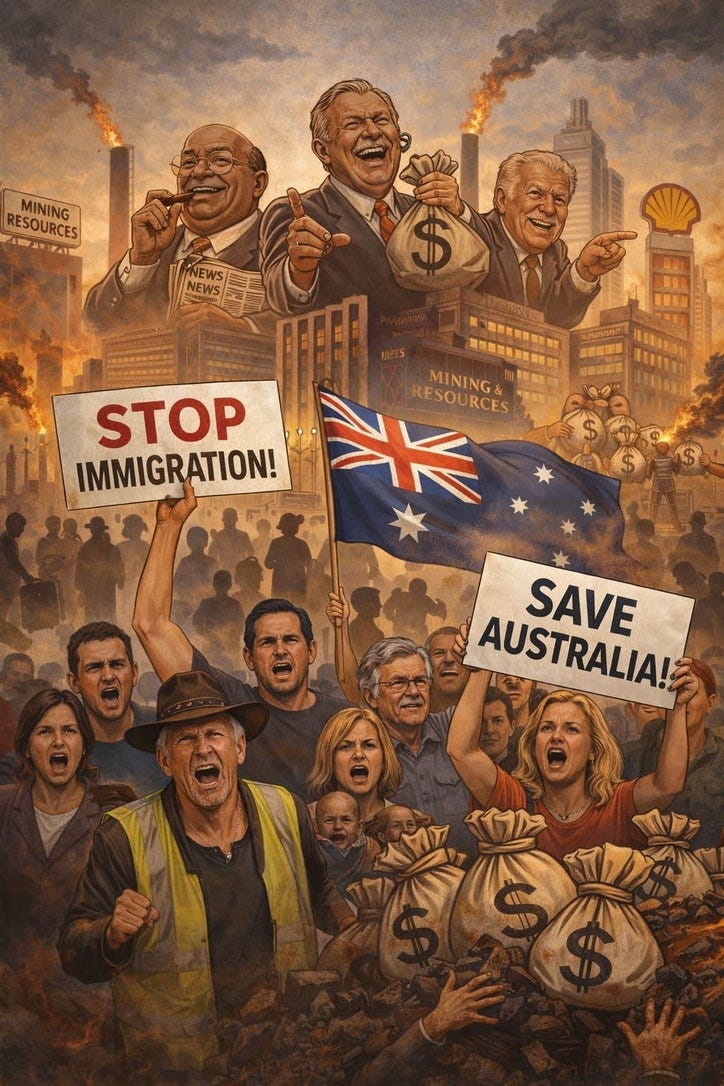
I live in Thailand these days, which is a useful distance from the tantrums of the West. From here, the spectacle looks almost hallucinatory: Australians wrapped in flags screaming “save Australia”; British pensioners raging about boats in the Channel or being arrested from protesting a government-supported genocide; Americans blaming their collapsing towns on “illegals” rather than on the corporations that stripped them for parts. The theatre is noisy, emotionally charged, and obsessively focused on the wrong target.
The symptoms are familiar enough: outrage, grievance, fear, a conviction that “we” are being replaced, invaded, undermined. The alleged culprits are equally familiar: migrants, Muslims, welfare recipients, feminists, “the woke”, whichever minoritised group can be painted as a cultural contagion this week. The story is simple enough to fit into a tabloid headline or a 15–second video clip. It also happens to be wrong.
What is actually eating Australia, Britain and much of the West, is not the stranger at the border. It’s a worldview turned operating system: industrial economism dressed up as both common sense and inevitable. A civilisation that confuses economic throughput with human flourishing, and market signals with truth, will inevitably consume its own foundations. And that’s precisely what we are watching.
The Australian case is not an exception. It is a zoomed‑in frame of a much larger pattern.
A civilisation punching sideways
In Australia, people are told their rent is insane because “the migrants are coming”. That their hospitals are overcrowded because “refugees are flooding the system”. That their wages are stagnant because “diversity hires” jumped the queue. Pauline Hanson and her One Nation Party are expert at craftin these one-liners. Meanwhile, in the same news cycle, a different section of the paper quietly reports that a global petroleum giant paid almost nothing in tax on tens of billions of dollars of revenue, or that yet another mining conglomerate has secured another royalty concession, or that the commercial banks have posted record profits on the back of household debt.
This is not a uniquely Australian pathology. It’s echoed in the United States, in the United Kingdom, across Europe, and increasingly in parts of Asia, Africa and Latin America where the industrial script has been imported and customised.
The pattern is not hard to trace once you step outside the mesmerizing circle of daily outrage. People sense, quite accurately, that the system is rigged against them. They feel the squeeze of rising costs, insecure work, overloaded services, the disappearance of any coherent social contract. That intuition is sound. The channel through which it is expressed has been carefully engineered.
Billionaire‑owned media systems, business lobbies, think‑tank networks and political parties have spent decades providing an easy story: your declining life-style and quality of living is caused by people like that, not by institutions like these. Fear of the unfamiliar is stoked, fermented and repeatedly distilled until it passes for identity. A society transfixed by its resentment of the neighbour has little energy left to investigate the architecture that makes neighbours interchangeable and disposable in the first place.
The gorilla in the room, munching through the groceries, is not a caravan of asylum seekers. It’s a globalised economic logic that treats every commons – land, water, atmosphere, community, imagination – as a set of assets to be flipped and stripped. Once you see that, it becomes impossible to unsee. It also becomes impossible to accept the daily circus as anything more than a deliberate distraction.
From industrial promise to extraction as destiny
Industrial economism began as a bargain. In return for relinquishing much of our autonomy to large bureaucratic structures – state and corporate – we were promised stability, security, increasing material comfort, and a sense of progress. For a while, in some countries, that bargain appeared to hold. Wages grew, public services improved, living standards rose.
But the logic built into the system always pointed in a different direction. What gets measured gets managed. What gets priced gets protected. What is left out of the ledgers is left out of the conversation. Once economic growth becomes the most important indicator of success, everything else becomes negotiable – democracy, the biosphere, the cohesion of communities, even basic decency.
The last four decades have been an exercise in tightening this logic into a doctrine. We gave it pleasant names: liberalisation, reform, stakeholder capitalism, global competitiveness. In practice, it meant selling public assets, turning social rights into commercial products, dismantling protections for labour, freeing capital to roam the world in search of the lowest obligations and the highest returns. It meant recoding citizens as consumers and communities as markets.
Australia, for all its self‑mythology as a “fair go” society, followed this script with impressive zeal. Critical infrastructure was privatised. Financial markets were deregulated. Trade and investment were liberalised. Tax regimes were adjusted to “attract investment”, which had the predictable effect of allowing multinationals to siphon profits offshore while contributing as little as possible to the society whose resources they mined and whose infrastructure they used.
The mineral boom should have been a once‑in‑a‑century endowment – the kind of gift that allows you to secure your future, build a robust sovereign fund, insulate your population from shocks, redesign your economy around long‑term resilience. Instead, the bulk of the upside went into private hands while the public sector collected a modest entry fee and the ecological bill was quietly deferred.
Other countries made different choices. Norway, with a far smaller population, contrived to build a longitudinal savings mechanism that now underwrites much of its social provision. Several Gulf states, in their own ways, have also used hydrocarbon rents to build state capacities and buffers, even if their political arrangements raise other questions. Australia had every opportunity to do at least as well. It chose otherwise.
Was that choice simply an error of judgement? Evidence suggests something more deliberate. Over time, the institutions tasked with governing the public interest became increasingly intertwined with the industries they were supposed to regulate. Lobbying, donations, revolving doors, ideological colonisation of policy elites – all of these are documented dynamics, not speculative conspiracies. When former ministers suddenly pop up as directors of the very firms that benefited from their decisions, the pattern does not require a PhD in political theory to decode.
When a society is treated as a mine
If you treat a country as a quarry, you eventually start treating its people in the same way. The logic is identical. Extract as much as possible, as quickly as possible, while taking as little responsibility as possible for the consequences. Mining corporations take ore. Banks take interest. Private equity strips companies and sells the components. Hedge funds bet on the volatility created by these activities. The housing market is turned into a casino in which those with capital bid up prices, inflate asset values, and then rent the basics of shelter back to those who can no longer afford to buy. Food systems become vertically integrated, with farmers squeezed at one end and consumers squeezed at the other, while supermarket chains announce record dividends.
At every node, the reward system privileges extraction over stewardship. An executive who boosts profits by cutting staff, outsourcing risk, and maximising short‑term returns is celebrated. An executive who chooses to dampen profits in order to retain staff, invest in local communities, or protect ecosystems risks being punished by markets. The machine recognises one language: yield.
The public, inevitably, feels the consequences long before they decipher the cause. They experience rising rents, impossible mortgages, insecure work, degraded public spaces, longer hospital waiting times, schools that rely on parental fundraising just to operate. Their children graduate into a labour market that offers neither stability nor respect, and a housing market that treats them as collateral.
Faced with this squeeze, people search for intelligible explanations. The official narratives are of limited use. Politicians talk about “headwinds” and “global conditions” as if these were cyclones that arrived unbidden. Mainstream economists, trapped in models that treat the biosphere and human dignity as externalities, declare that there is no alternative. Financial media, dependent on advertising from the very corporations that profit from the extraction, focus on share prices and quarterly returns instead of structural questions.
Into this void march the demagogues with their simple stories: your life is harder because of them. The stranger. The foreigner. The heretic. The deviant. The city elite. The rural bigot. Pick your hate‑object depending on your preferred flavour of resentment. The details differ across countries. The logic is almost eerily uniform.
Culture wars as inexpensive theatre
This is where the Murdochs of the world earn their fees. It takes real skill to run an outrage factory at industrial scale. You must manufacture a constant stream of enemies, keep the emotional temperature high enough that people remain in fight‑or‑flight mode, and simultaneously occlude the structural architecture that shapes their lives.
The culture war is ideal for this purpose. It’s cheap to produce, endlessly renewable, and highly engaging. It requires only a camera, a social media account, and a willingness to distort. Someone says something clumsy at a university. A protest gets rowdy. A local council proposes a new inclusion policy. A refugee is photographed on a beach. Any of these can be spun into evidence of civilisational decline, betrayal, or invasion.
Within hours, comment sections fill with bile. Radio hosts nurse the grievance into the evening commute. Politicians sniff the air and pile in. The specifics barely matter. What matters is the repeated association: your unease, your economic stress, your uncertainty about the future, are linked to this colourful, anger‑inducing spectacle, not to the dull, apparently technical business of tax codes, trade agreements, monetary policy, regulatory frameworks and corporate governance.
This is not to say that cultural questions are trivial. They are real, and they matter deeply to the people caught up in them. Identity, meaning, belonging, recognition and respect are vital human needs. Marginalised groups have every reason to challenge exclusion and abuse. The point is that these struggles are being weaponised in a way that suits the existing economic order very nicely. Energy that might otherwise flow into questioning the legitimacy of corporate capture is diverted into warring over pronouns, statues and flags.
Meanwhile, the material architecture of extraction – the laws, subsidies, trade rules, data regimes and debt structures that quietly determine who eats and who starves – hums away in the background, largely unexamined.
Divide and manage: polarisation as a technology of rule
We need to say out loud what too often remains whispered: the proliferation of division and separation is not just an unfortunate side‑effect of this order; it functions as a method of governance.
Every hierarchical system that relies on exploitation has understood one basic rule: unity among those being exploited is dangerous. Empires have always played ethnic and religious groups off against each other. Colonial regimes refined the art of “indirect rule”, elevating some communities over others to prevent any unified resistance. One‑party states have encouraged citizens to inform on neighbours. The principle is depressingly consistent.
The contemporary industrial‑economic variant is simply more sophisticated. Instead of crude decrees we have algorithms, targeted media, micro‑segmented advertising, party machines and outrage factories. What used to be done with batons, secret police and censorship is now achieved with notifications, curated feeds and a ceaseless flow of monetised animosity.
Is it an accident that digital platforms reward content which triggers anger and fear, precisely the emotions that fracture social trust? Or has outrage become a business model because fractured attention is profitable and politically convenient? When billionaire‑owned media spend far more time demonising migrants and “woke students” than examining tax codes, or monopolies or lobbying, is that merely an editorial quirk, or a rational strategy for protecting an investment‑friendly order?
We can verify that polarisation is being systematically fuelled. Ownership patterns in media are highly concentrated in many countries. Election strategists openly talk about “wedge issues” designed to split electorates along cultural, ethnic, regional or generational lines because it mobilises voting blocs. Social media metrics confirm that the more incendiary a post, the more it spreads. None of this is contentious.
What remains harder to establish – and therefore properly belongs as a question – is the degree of explicit co‑ordination. Are we dealing with a tightly‑run conspiracy, or with a looser ecosystem of actors – media barons, political consultants, platform engineers, think‑tanks – whose interests converge around keeping the public quarrelling with itself? Either way, the effect is identical: a populace at war with itself is far less likely to mount a coherent challenge to the extraction of its wealth, time, health and future.
The genius of this arrangement is that resistance energy is not merely suppressed; it’s harvested. Theincredible number of hours people spend raging at each other online, the emotional labour invested in hating the designated enemy of the week, are hours not spent organising across divisions, building parallel institutions, or calmly interrogating the structure of power. Anger, which could be a fuel for collective transformation, is redirected into a series of tiny controlled explosions that light up screens and leave the underlying edifice untouched.
A system that depends on this level of fragmentation begins to resemble not a malfunctioning democracy but a kind of managed theatre in which conflict is choreographed, stakes are kept carefully cultural, and the home audience remains enthralled but politically impotent.
The morality of patriotism
In that context, the patriotic theatrics that accompany anti‑immigrant hysteria are worse than empty. They are complicit. If patriotism means anything of substance, it must surely begin with the insistence that a country’s resources – natural, human, cultural, institutional – actually benefit the people who live and work there. That requires, at a minimum, robust safeguards against the wholesale capture of those resources by a narrow elite. It requires a social settlement in which the extraction of value is balanced by the obligation to replenish the commons on which that value rests.
Instead, we have elevated a kind of theme‑park nationalism: oversized flags, sentimental myths, military flyovers, and an endless rhetoric of “protecting our way of life” with almost no interest in what that phrase actually points to. If “our way of life” means anything more than consumption, it would have to include public health, public education, liveable cities, habitable ecosystems, intergenerational solidarity, a justice system that’s not for sale, and governance structures that cannot simply be bought.
On that measure, much of the West is failing. Patriotism, stripped of economic ethics, becomes a costume department for oligarchy. It is useful only in so far as it mobilises people to attack the wrong targets and vote for the right clients.
So the crude question must be asked: who, precisely, is betraying the nation? Is it the exhausted family crossing a sea in a leaking boat, having fled a warzone that may well have been armed or destabilised by Western weapons and policies? Or is it the executives and legislators who design systems ensuring that billions of dollars of mining revenues, financial returns, data flows and intellectual property rights are diverted into private accounts while the public ledger registers only liabilities?
Which of these two groups is more responsible for the unaffordability of shelter, the erosion of public services, the colonisation of childhood by advertising, and the creeping sense that the future has been pawned?
The ghost of progress
For all the justified anger, it’s worth pausing to ask why so many intelligent people fall for the misdirection. Propaganda alone is not a sufficient explanation. Something in the contemporary psyche has been primed to conflate prosperity with extraction, liberty with consumption, and identity with competitive victimhood.
I suspect part of the answer lies in the mythology of progress that accompanied industrial modernity. For generations we were taught that history is a staircase leading ever upwards, that each new machine, each new algorithm, each new financial instrument, is another step towards a better life. That story was plausible for long enough to become an article of faith. Even now, as climate breakdown, mental distress, biodiversity collapse and grotesque inequality accumulate, many cling to the belief that a new gadget or disruptor will rescue us.
This faith coexists with a deep anxiety that the promised future is slipping away. Amid that dissonance, scapegoats are psychologically useful. It is far more comforting to believe that paradise was stolen by a specific out‑group than to admit that paradise was built on untenable premises in the first place.
Industrial economism relies on this cognitive dissonance. It must maintain the illusion of perpetual advancement while normalising a reality that feels increasingly precarious. The result is a split consciousness: people sense that something is profoundly amiss yet cannot easily name it without calling into question the very categories – growth, competition, efficiency, success – that have structured their lives.
So they lash out at the visible irritants, the proximate strangers, the neighbour who votes differently, the colleague who uses new language, the teenager glued to a screen. They fight over the crumbs because the table itself is sacralised. To criticise the arrangement of the furniture is barely acceptable. To ask who owns the house, and on what terms, feels blasphemous.
Australia as parable, not exception
In that light, my own wonderful country of Australia becomes a parable rather than a special case. A continent‑sized nation with stunning ecological endowments chooses to treat itself as a pit‑head for global capital. It allows a handful of companies to dig up minerals, tap gas fields, and export raw commodities at vast scale. In return it collects royalties and taxes that, while not trivial, are small compared to the value removed. It establishes almost no meaningful intergenerational wealth fund. It tolerates elaborate transfer‑pricing schemes that shift profits offshore. It permits lobbyists to practically camp in the corridors of power.
Simultaneously, it allows its cities to be financialised. Housing becomes an investment vehicle, encouraged by tax breaks and accommodative credit policies. Politicians and commentators acquire multiple properties, and then profess astonishment when prices detach from wages. Younger generations are told to be grateful for “opportunities” in a market that treats them as tenants for life.
Public universities are turned into commercial enterprises chasing international fee revenue. Public broadcasters are squeezed. Public health systems are stretched until they rely on heroic overwork. Indigenous communities, who have lived with and within the land for tens of millennia, are lectured about development by people whose entire sense of time extends no further than the next election or a quarterly earnings report.
The same country then erupts periodically in moral panics about a few thousand refugees or a handful of cultural debates, while barely whispering about the structural giveaways that make this level of precarity inevitable. It recites slogans about mateship and fairness while presiding over one of the more concentrated media ownership structures in the world, and a political funding system that normalises influence‑buying.
Australia is not an outlier. It’s an emblem. Versions of this script play out in many places, adjusted for local history and culture.
Can we name the operating system?
If the crisis is misdiagnosed, remedies will be misdirected. It is no use patching leaks in the hull if the ship is steaming towards the wrong destination. The boat simply won’t make it. The task is not just to root out corrupt individuals or pass a few ethics laws, important as those might be. The far deeper issue is whether an economic logic that treats everything as expendable in pursuit of abstract numbers can ever be made compatible with the survival of complex societies and living systems.
Industrial economism is expert at colonising language. It wraps itself in phrases like “freedom”, “innovation”, “choice”, “security”, while delivering the opposite for many. It equates human worth with productivity, productivity with sacrifice, sacrifice with virtue. It tells us that the highest good is shareholder value, even if the shareholder has no relationship whatsoever with the community being transformed.
One might ask whether it’s even possible to have a genuinely democratic politics inside a system that tolerates such immense concentrations of private power. When a handful of corporations have budgets larger than many countries, data on billions of people, the ability to crash entire sectors by shifting their investment portfolios, and teams of lawyers writing the self-same rules that govern them, how meaningful is the average citizen’s ballot?
If politics has been relegated to the task of managing perceptions while real decisions are taken elsewhere, then the anger we see on the streets is entirely rational. It’s just misdirected.
Which raises a further question: is it conceivable to redesign the economic substrate itself, rather than merely arguing about how to decorate the superstructure? Could we live in societies that treat the biosphere as primary rather than as a storehouse, that treat human beings as participants rather than inputs, that prefer sufficiency to relentless expansion? What forms of ownership, governance, technology and value‑creation would that require?
These are not questions confined to the West. The industrial script has been exported worldwide through development loans, trade deals, management schools and media. Many countries in the Global South now find themselves caught between the fading promises of Western‑style modernisation and the rising gravitational pull of other industrial powers. In both cases the template is similar: extraction in exchange for a sliver of consumption.
People everywhere know in their bones that this arrangement is unstable. Farmers watching their soils degrade. Fisherfolk witnessing collapsing catches. Urban youth living in smog‑choked megacities with precarious gig work. Elders seeing traditional knowledge trashed as superstition until it is repackaged and sold back as wellness products. The unease is global even if its outlets are culturally specific.
Learning to see the water we swim in
One of the most difficult skills for any civilisation is the capacity to see its own assumptions as contingent rather than as natural law. Fish don’t easily perceive water; birds we might suppose, are unconscious of the air in which they fly. Humans immersed in a paradigm that has colonised education, media, law, religion and even personal aspiration do not easily perceive the paradigm itself. Yet if we are to stop mistaking the symptoms for the cause, we have little choice but to notice these things. The fetishisation of migrants as an existential threat, the obsession with culture‑war skirmishes, the quasi‑religious deference to markets, the suspicion of any notion of the common good – these are not random neuroses. They are the psychological fallout of a system in which shared meaning has been hollowed out and replaced by transactional calculation.
What would it take to recover the ability to interrogate that system? To say: the problem is not the boats, it is banks. The problem is not refugees, it is rentiers. The problem is not diversity, it’s the deliberate design of an order that extracts from the many to enrich the few and then hides behind flags when interrogated.
I’m not suggesting that we can flip a switch and produce an enlightened post‑industrial culture by decree. Worldviews ossify over centuries and unravel in unpredictable ways. But we can start by refusing to participate in the obvious con. We can decline to join the lynch mobs the tabloids assemble for us. We can ask impolite questions about who benefits from our anger. We can trace the money rather than just the memes.
We can – perhaps most radically – allow ourselves to imagine that economies might be re‑engineered to serve life rather than the other way around. That the purpose of a society is not to feed GDP but to cultivate wisdom, resilience, beauty, kindness, and continuity. That technology is a set of tools to be governed, not a destiny to be endured. That patriotism, if it is to have any future at all must start from the simple demand that a country’s wealth, in all its forms, is used to enrich its inhabitants rather than auctioned off while they fight over totems.
Which brings us back to division.
Once you see that fragmentation is not an accident but a technique, the emotional landscape looks different. The neighbour who has swallowed the latest fear campaign is no longer the enemy; they are another casualty of the same apparatus. The person raging about immigrants, or about “rednecks”, is not your opposite; they are your mirror, trapped on a different frequency of the same broadcast.
If that diagnosis is roughly correct, then any serious attempt to “fight back” cannot simply repeat the logic of separation in a more progressive vocabulary. It’s not enough to create a counter‑tribe with better facts. The deeper work is to refuse the script of permanent enmity: to notice when our outrage is being harvested; to resist the small satisfactions of contempt; to rebuild habits of listening in which someone’s economic pain is not instantly trumped by their cultural label.
Solidarity is a dangerous word in a system that feeds on division, which is precisely why it has been ridiculed or sentimentalised into oblivion. Yet some form of cross‑cutting solidarity – across class, ethnicity, faith, region and generation – may be the only force with the leverage to interrupt the extraction machine. Not the shallow unity of “we’re all in this together” intoned by politicians who own six houses, but the hard, practical solidarity that emerges when people recognise a shared structural predicament and begin to act accordingly.
Will that happen? Can it, given the sophistication of today’s division‑making technologies and the sheer speed at which narratives now mutate? I don’t know. The evidence can be read in both directions. On the one hand, polarisation metrics rise, trust craters, and attention spans collapse. On the other, movements do occasionally leap the fences: alliances between climate activists and farmers, between care workers and patients, between debtors and those who study the plumbing of finance. These are fragile, easily broken. They are also seeds.
What I do know is that continuing to shout at shadows while the gorilla cleans out the pantry is a guaranteed route to decline. Industrial economism will not collapse because we post better arguments on social media. It will adapt, absorb, and monetise dissent as it has done many times before. Its one vulnerability lies in the moment people refuse to play their assigned roles in the drama of mutual loathing, and turn their attention instead to the stage itself – who built it, who owns it, and why the exits have been bricked up.
The West’s misdiagnosed collapse is, at heart, a collapse of discernment. We have mistaken theatre for governance, noise for voice, symbols for substance. We have allowed ourselves to be curated into quarrelling micro‑publics while the real decisions about land, labour, energy, data and time are made elsewhere.
If there’s any point to my work – as a futurist, a strategist, a philosopher‑activist, a father watching his children and their children grow into this maelstrom – it’s to keep returning to that uncomfortable edge where we can still choose to see differently. To ask questions that cut across the pre‑fabricated divides. To remind myself, and anyone still listening, that the lines we have been taught to defend with such ferocity are not the lines along which the world is actually being organised.
The gorilla is still there. It has many names: neoliberalism, financialised capitalism, industrial economism. Choose whichever offends you least. The label is less important than the recognition. Once seen, it cannot be unseen. The only real question is whether we will go on screaming at each other, or finally decide to do something about the creature eating all our food.