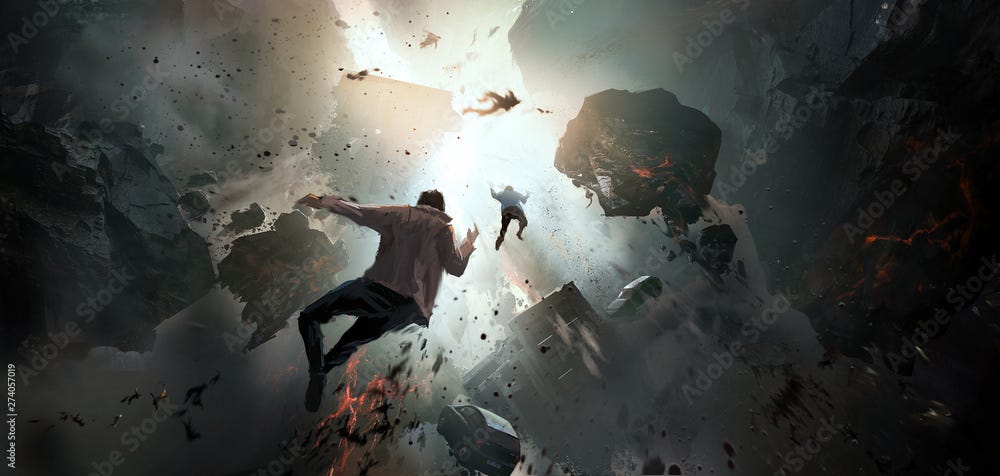
The hum of the 24-hour news cycle, a relentless ticker of geopolitical tremors, speaks of a world on the brink. Professor Jeffrey Sachs, with a clarity both chilling and undeniable, suggests we’re not on the brink at all, but rather already tumbling. His proposition of a nascent Third World War is not a speculative future, but a process already unfurling, a systemic breakdown that far transcends the immediate anxieties of missile trajectories and shifting alliances.
Yet, to fixate solely on the military-industrial complex, however real its machinations, is to miss the deeper, more insidious undercurrents that erode the very foundations of human flourishing. The geopolitical is just the sharpest edge of a multi-faceted crisis, a collective fever symptomatic of a malady that encompasses climate breakdown, the unbridled velocity of AI technology, and the calcified structures of injustice. We stand at a critical juncture, then, not merely of nations, but of our species.
Sachs sketches a grim picture: regional conflicts no longer isolated but interwoven, a vast, pulsating network of crises from the Middle East to the Indian Ocean. This is not the isolated skirmish of a bygone era; it’s the systemic resonance of global interdependence, where a ripple in one ocean creates a tidal surge in another.
The US pursuit of global dominance, a strategy of relentless expansion rather than defensive posture, acts as a primary accelerant, drawing reluctant behemoths like China and Russia into an increasingly polarized theatre. The dismantling of global governance, with the UN reduced to a husk, removes the guardrails designed to contain such conflagrations.
Europe, once a beacon of post-war reconciliation, now appears complicit, its diplomatic muscle atrophied, its vision blurred by an uncritical alignment. Energy infrastructure, the circulatory system of our global economy, becomes a brittle point of vulnerability, promising economic instability and further escalation. And presiding over this volatile convergence? A “leadership” often characterized by institutional militarism and personal volatility, a combination in the nuclear age that offers an unprecedented cocktail of existential risk.
This is the ground beneath our feet, shifting with unsettling speed. But the terrain is far more variegated than the daily headlines suggest. The geopolitical earthquake merely exposes deeper fault lines. Beneath the clash of empires lies the slow, inexorable grind of climate collapse, a silent war against the very conditions of life itself. The increasingly erratic rhythms of weather, the retreating glaciers, and the rising tides are not distant threats but present realities for millions, particularly in the Global South. Nor are these environmental pressures separate from the geopolitical; they are intimately entwined, driving resource competition, mass migrations, and internal instability that feed directly back into the geopolitical maelstrom. A drought in the Sahel is not simply a local tragedy; it’s a vector for conflict, a pressure point amplified by the larger forces Sachs describes.
Then there’s the bewildering, accelerating leap of unbridled technology. From the pervasive gaze of surveillance algorithms to the generative capacities of artificial intelligence, technology is remaking the human experience at a pace that outstrips our capacity for ethical or even conscious integration. It promises liberation while constructing new forms of control, and new architectures of manipulation. This is not a neutral tool; it’s a force reshaping our understanding of truth, community, and identity. The digital realm, once imagined as a democratizing space, has become a battleground for influence, a breeding ground for division, and a potent weapon in the hands of states and corporations alike. It’s the invisible infrastructure of Sachs’s “systemic breakdown,” a nervous system susceptible to hacking, manipulation, and the propagation of discord.
And underpinning all of this is the stubborn, almost sacred, persistence of injustice. The global economic order, the “industrial economism” that’s the implicit backdrop of our age, continues to funnel wealth and opportunity into ever-fewer hands, leaving billions to grapple with precarity. This is not simply a moral failing; it’s a structural instability. When vast swathes of humanity are denied basic dignity, when the promise of progress remains perpetually out of reach, the ground for resentment, extremism, and unrest becomes fertile. The cries for justice, whether from the favelas of Brazil or the refugee camps of Bangladesh, are not peripheral to the global crisis; they are its very core. They’re the pressure building beneath the surface, a force that, left unaddressed, will inevitably find violent expression.
The critical juncture, then, is this confluence: geopolitical escalation, ecological unraveling, technological acceleration, and persistent injustice. These aren’t four distinct crises, but four interwoven manifestations of a single, deeper civilisational confusion. To seek off-ramps from the geopolitical alone is to treat a symptom while the underlying disease rages.
The most potent off-ramp must begin with a profound reorientation of the dominant global mindset. This means a conscious retreat from the zero-sum game of hegemony toward a recognition of genuine interdependence. Not the marketing slogan of “win–win cooperation” occasionally intoned in diplomatic communiqués, but a lived awareness that in an entangled planetary system, victory conceived as domination is simply a slower form of defeat.
This is where Sachs’s diagnosis is most useful. By naming the present as an early phase of world war, he forces us to see that the primary terrain is not a line on a map but a set of operating assumptions: that security is produced by superiority; that energy is something to be seized and controlled; that technology is a race to be won; that the suffering of distant strangers is, at worst, an unfortunate externality. Once those assumptions are recognised as the real battleground, different off‑ramps come into view.
One of them lies, paradoxically, in the very breakdown Sachs describes: the erosion of US unipolarity and the emergence of a messier multipolar world. If the American project of global hegemony is indeed unsustainable, the question is not whether it will recede, but how. With a bang, or with a reconfiguration?
An intentional off‑ramp would mean the United States choosing, while it still can, to step down from empire and re-enter the world as a large, powerful, but fundamentally normal country. To abandon the fantasy of “full spectrum dominance” and accept a distributed sovereignty in which Russia, China, India, Brazil, South Africa, Indonesia, Iran, the ASEAN region, Latin America, and Africa are not junior partners or chessboards but civilisational actors in their own right.
That would require, among other things:
· A deliberate de-escalation doctrine: reframing security not as forward deployment and encirclement but as mutual restraint, arms control, and regional security architectures that include adversaries rather than isolate them.
· A recommitment to international law not as an instrument to be wielded selectively but as a constraint accepted by everyone equally, even when it bites.
· A recognition that the military-industrial complex, left unchecked, functions as a kind of metastatic tumour in the body politic: feeding on fear, secreting its own justifications, reconfiguring political and media ecosystems to ensure its continued nourishment.
There’s no sign, today, that such a reorientation is imminent. There are, however, fractures—moments when war weariness at home, fiscal limitations, and the visible failures of intervention begin to coalesce into doubt. Doubt is often the first off‑ramp in a system drunk on certainty.
A second off‑ramp lies with those who have, until now, been treated as the scenery rather than the protagonists in this world drama: the so‑called Global South. For most of the last five centuries, much of Africa, Latin America, South and Southeast Asia, and the Pacific have served as resource reservoirs, labour pools, and occasionally battlegrounds for the ambitions of others. Yet it is precisely in Lagos, São Paulo, Dhaka, Jakarta, Johannesburg, and Bogotá that the converging crises of climate, inequality, and technological disruption are felt most acutely—and where a different imagination is starting to take shape.
The stirrings are visible in formations like BRICS+, in new continental trade agreements, in local experiments with food sovereignty, community energy, and alternative finance. These are embryonic, contentious, often contradictory. But they share an intuition: if the old centres of power are locked into a suicidal logic, survival may depend on building parallel systems rather than pleading for reforms of the existing ones.
That might mean:
· Regional financial architectures less dependent on the dollar and its sanction regimes.
· South–South technology transfer focused on resilience—public health, water systems, agroecology—rather than on replicating the surveillance capitalism of Silicon Valley or Shenzhen.
A non‑aligned movement recalibrated for the 21st century, not as passive equidistance between Washington and Beijing, but as an active stance for planetary stability: insisting that climate, food, and health security not be held hostage to great‑power competition.
Can the Global South “stay out” of a slowly unfurling world war? Militarily, perhaps, for a time. Systemically, no. Supply chains, climate feedback loops, financial channels, and media streams bind us too tightly. The more pertinent question is whether the Global South can interrupt, divert, or transform the logics driving that war—whether it can be midwife to a different settlement rather than the battlefield for an old one.
Which brings us to China, and the speculative question of a China‑led civilisation.
It’s tempting, particularly from Beijing and from some Southern capitals, to frame China as the antithesis of American hegemony: where Washington brings intervention, Beijing brings non‑interference; where Washington demands structural adjustment, Beijing offers infrastructure; where Washington speaks the language of human rights while practicing selective amnesia, Beijing prefers the vocabulary of sovereignty and mutual benefit.
There’s some truth in this contrast. Across parts of Africa, Central Asia, and Southeast Asia, Chinese-built roads, ports, and power stations stand where Western promises and structural adjustment left only reports. For many governments, this feels less like a new empire and more like overdue recognition. The Chinese notion of a “community with a shared future for humankind” at least gestures toward interdependence, and its state-led developmental model offers a narrative in which poverty is not destiny but a design problem.
But we should be wary of projecting salvation onto any single actor, however ascendant. A China‑led order would be different. That does not make it redemptive.
China’s rise is being driven by the same deep code that underwrote earlier empires: industrial growth as the primary index of success; extraction of resources at continental scale; externalisation of ecological and social costs; the presumption that those downstream of these decisions will adapt, absorb, endure. Its domestic model normalises pervasive surveillance, control of information, and a hierarchy in which the party’s interpretation of harmony outranks individual dissent. Exported, not as explicit doctrine but as practice, that model offers techniques of governance—credit systems, monitoring infrastructures, seamless fusion of corporate and state data—that many embattled elites will find irresistibly useful.
If an American-led order has given us endless war, financialisation, and the commodification of almost everything, a Chinese‑coloured variant risks giving us a world that’s more infrastructurally competent but much more tightly supervised; somewhat less moralising yet more opaque; less fixated on missionary democracy, more confident in managed conformity. For those on the receiving end of drone strikes and sanctions, that may well feel like an improvement. It’s still not a new course for humanity. It’s a different configuration of the same civilisational model: industrial, extractive, growth‑obsessed.
We’re back, then, at the deeper crisis—the one Sachs’s geopolitical frame exposes but doesn’t quite name. The breakdown we’re living through is not only between nations. It’s within a civilisation whose operating system no longer fits the world it has made.
Reflect on climate change. It’s not an external shock; it’s the atmosphere’s ledger of two centuries of industrial metabolism. Consider unbridled tech. It’s not an alien invasion; it’s our own ingenuity unmoored from any shared story about what it’s for. And the chasms of wealth and opportunity? They’re not aberrations; they are features of a design that treats life as input and output, cost and return.
In that light, the question “Will China lead?” is less interesting than “What kind of world can any power lead us into without reproducing the same pathology?” A world in which energy remains a prize to be captured rather than a shared condition to be stewarded will breed war, whether the pipelines run east or west. A world in which technology is built primarily to extract attention, compliance, and profit will erode the capacities for judgment and solidarity that any peaceful order requires. A world in which billions are kept in structural precarity will not be pacified by rhetoric, whether it arrives in English or Mandarin.
The off‑ramps that matter don’t sit only in foreign ministries and war rooms. They sit in the deep assumptions that guide our collective choices. Among them:
· That human wellbeing is inseparable from the wellbeing of the larger living systems we inhabit, and that any economy at odds with that reality is, in time, self‑terminating.
· That security is produced not by domination but by relationships in which no party is forced to gamble everything just to be heard.
· That technology is not destiny but design, and that its trajectories can be bent toward care, repair, and shared understanding as easily as toward control—if we choose to measure its success differently.
· That justice is not an ornament to stability but its precondition.
These are not policies. They are different gravitational centres. Around them, many specific arrangements are possible: multipolar governance that is genuinely shared rather than a negotiated hierarchy; regional compacts that bind neighbours into mutual vulnerability rather than mutual suspicion; legal architectures that treat the atmosphere, oceans, and forests not as warehouses but as co‑trustees in any legitimate order, etc. etc.
This is where the role of what we still call “leadership” changes. The 20th‑century imagination, now threadbare, pictures leadership as the act of steering a nation or corporation toward advantage. In the 21st, under the shadow of systemic breakdown, leadership is closer to pattern change: helping groups of people see the system they are in, naming its logics, and experimenting together with different frameworks. Not the hero at the front, but the capacity in the middle.
No single state, however large, can perform that function for the rest of the world. At best, it can refrain from making it impossible.
So, can the Global South stay out of a new world war? Probably not, in the narrow sense. Its cities will feel the spikes in food and fuel prices; its coastlines will absorb the seas; its young will be recruited, formally or informally, into the conflicts others start. But it can, perhaps, do something more interesting than staying out or choosing sides. It can insist that the frame itself is wrong. That the true contest is not between the American century and a Chinese century, but between a dying civilisational logic and whatever might come after it.
We don’t yet have a clear description of that “after.” Fragments exist: in Indigenous governance practices that never forgot the land was alive; in feminist economies grounded in care; in municipal experiments with commons-based management of water, housing, and data; in small communities that have quietly decarbonised without fanfare. None of these, on its own, scales to the level of the planetary. Each of them, however, hints at a possibility that neither Washington nor Beijing is yet conscious: a civilisation that measures success by the health of its relationships rather than the height of its towers.
Standing where we are—amid wars that blur into each other, an atmosphere thickening with our exhaust fumes, machines that now speak back to us in our own tongues—it’s tempting to look for a saviour: a country, a leader, a technology, a treaty. That temptation is itself part of the old story. The work we need to do looks more like a distributed act of adulthood: millions of decisions, in thousands of places, that gradually make another pattern more real than the one we inherited.
Sachs is right to warn that a third world war, in slow motion, may already be underway. But the more consequential war, the one that will decide far more than borders, is quieter: between our loyalty to a civilisation that cannot continue, and our willingness to imagine one that might.