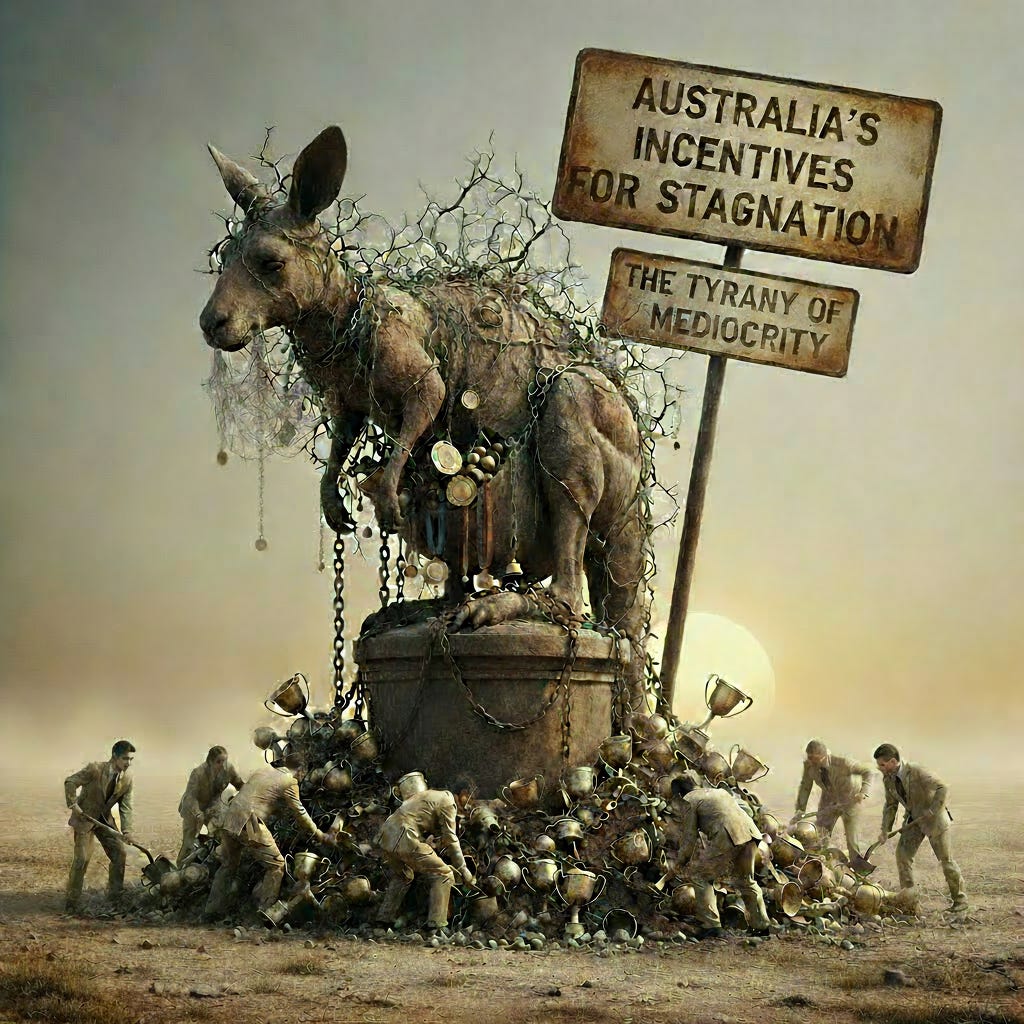
Australia is stuck—by design. Some of us can't even spell the word "Tyranny". While others retool their institutions for speed, learning, and ambition, we sanctify process, outsource audacity, and congratulate ourselves for avoiding embarrassment. We don’t merely ignore bold ideas; we smother them under a quilt of probity, consultants who know little and understand even less, and press releases. Fear is the operating system: fear of failure, fear of accountability, fear of our own region, fear of standing tall without a foreign hand to steady us. We confuse activity for progress, slide decks for decisions, tenure for wisdom, and credentials for competence.
In Canberra and across the states, policy is being shaped by staffers who’ve never shipped a product, changed a market, or led a team through the heat of execution. Departments optimise for declarations leading up to elections. Procurement punishes initiative and rewards brand names. Risk migrates upward to the minister’s office; responsibility diffuses into no one’s job. This is the unpalatable truth.
The private sector is hardly innocent. Boards recycle the same advisers to buy deniability. Foundations fund safe pilots they never revisit. NGOs preach systems change while managing grants like factory line items. Australia doesn’t have a war on innovation; it has incentives for stagnation, and we engineered them. The myth of expertise is the polite fiction that keeps the machine oiled. We’ve elevated caretakers over builders, managers of decline over visionary trailblazers. We worship compliance while our best operators take their ambitions offshore, because our system treats agency as a reputational hazard.
And yet, despite the drag, there are cracks of light. When mandates are clear and incentives align, Australia delivers. The Clean Energy Finance Corporation and the Australian Renewable Energy Agency are rare cases where capital and risk-taking converge to deliver projects that actually get built. Our quantum and photonics labs are world-class. The Australian Energy Market Operator is learning to orchestrate complex grids with a competence many countries would envy. NSW has shown what modern public digital can be. These islands of excellence matter—reform needs anchors—but islands alone cannot revive an ocean of inertia.
Why does the machine behave like this? Short political cycles compress horizons. The safest choice is the one with a press line and no headlines. Procurement treats process risk as paramount, outsourcing capability and memory to big-brand firms selling recycled templates. Superannuation optimises for low volatility, starving early-stage ventures; founders sell early or leave. A small, incumbent-friendly market offers few chances for a “customer zero,” and government—our biggest buyer—hides behind panels and paperwork. Credential inflation substitutes for mastery. Pay bands repel senior technologists. Mobility is prized over domain depth. Tall poppy reflexes punish visible failure, so we aim small and call it prudence.
The cost is more than economic. It is civic and psychological. We’ve forgotten how to organise ourselves outside government. We mistake management for leadership, reform for strategy, rhetoric for results. Once called the social laboratory of the world, we now rely on wealth transfers and nostalgia while the region around us—ASEAN, India, China, Japan, Korea—moves at compound speed.
Dependency is our comfort. We reach for the United States as a guarantor, Britain as a story, Europe as a mirror, while neglecting the Asia-Pacific we actually inhabit. That isn’t realism; it’s insecurity. Power is not purchased abroad and applied at home. It's built patiently through capability, trust, and production. This is not a failure of talent or resources; Australia has both. It's a failure of incentive design and institutional courage.
Enough diagnosis. The cure is not more first-order tinkering; it's a fundamental rewiring of the system so that doing the right thing becomes the easiest thing. Here's an opening framework:
1. Focus
Begin with focus. We need fewer, bigger missions—legislated, measurable, and insulated from electoral mood swings. Model them after a homegrown "DARPA Down Under," an agency inspired by high-risk, high-reward innovation engines like the US version, but tailored to Australia's strengths in quantum, agtech, and resources. Choose outcomes that can’t be faked: a state running a 24/7 carbon-free grid by a date we can verify; end-to-end domestic manufacturing of critical medical devices; a health-data research ecosystem that improves privacy as it accelerates discovery. Staff the mission boards with operators who have shipped real things, not lobbyists who’ve perfected plausible deniability. Buy results rather than process. Replace baroque tenders with short, sharp outcome contracts that allow 12-week alphas with local firms under safe-to-try rules. Make capability transfer the price of admission for consultants: if the skill doesn’t remain in the agency, the engagement fails.
2. Public Balance Sheet
Put the public balance sheet to work deliberately. Extend the model of mission-driven clean energy and northern development financiers into a national innovation facility that takes equity and revenue shares in scaling firms, ties support to production at home and growth in exports, and recycles gains into a permanent endowment. Build fast lanes where rules learn in real time—test beds in energy, health, transport, and financial services—co-designed with practitioners, renewed only on evidence, and shut down unless they earn their keep. Harness data as a superpower: Australia's world-class datasets in health, climate, and resources can be transformed into AI-fueled engines for predictive agtech, personalized medicine, and resource optimization. Establish trusted data environments with robust privacy guardrails (like differential privacy) to enable secure collaboration between researchers, startups, and regional partners, turning raw information into exponential innovation without compromising security.
3. Realign Capital and Talent
Realign capital and talent to our ambitions. Invite superannuation to place a small, voluntary sleeve—one or two percent—into diversified venture and growth portfolios with tapering first-loss protection, not as a patriotic tax but as a sensible bet on the nation’s productive frontier. Fix stock options and R&D settings so keeping headquarters and manufacturing here beats flipping early. Turn government into a genuine customer zero. Choose a handful of anchor agencies and require them to buy and scale domestic deep-tech and software against public dashboards. When it works, back those companies into exports; when it doesn’t, publish the post mortem and move on. Open the door for builders. Fast track permanent residency for senior engineers, product leaders, and manufacturing specialists who commit to mission areas or regions that need them.
4. Rebuild Capability Inside the State
Rebuild capability inside the state. Stand up small, term-limited tiger teams with the authority to ship alpha, beta, live in months, not years. Pay what it takes for critical technical talent and have them work in the open—roadmaps, repos, and post mortems visible by default. Professionalise product management in the public service and tie executive rewards to outcomes and learning velocity rather than paper compliance. Clean up the consulting market by open sourcing deliverables funded by taxpayers, auditing for deliverable laundering, and making internal capability uplift a non-negotiable deliverable.
5. Decentralise Without Abdicating Responsibility
Decentralise without abdicating responsibility. Seed regional mission hubs governed locally and aligned to comparative advantage—critical minerals processing, agtech water efficiency, marine robotics, advanced composites. Tie funding to exports, productivity, and quality jobs, not ribbon cuttings. Give communities a real stake in the projects that reshape their landscapes by allocating carried interest in energy and infrastructure projects. Build trusted data environments for health, climate, and logistics that let researchers and startups work with sensitive information safely and productively.
6. Culture and Structure
Culture must follow structure, but it does not change by accident. We should normalise intelligent risk by building a public failure ledger—a living archive of pilots, goals, methods, outcomes, and lessons—so that well-run failures retire bad hypotheses quickly and proudly. Extend this ledger into education: our schools and universities must reward building, not just signalling—capstones, industry challenges, and real-world projects should matter more than ATAR theatre; spin-outs and standards should count alongside citations. And we need a narrative of builder patriotism that honours operators—engineers, founders, delivery managers—in our national story. Tell the truth in daylight about projects that worked and those that didn’t, and celebrate the people who made both possible.
7. Regional Posture
All of this must be grounded in a mature posture in our region. Reciprocity, not dependency, is the way forward. Co-develop standards and joint ventures with ASEAN, India, Japan, and Korea in batteries, green iron, medical devices, and maritime tech, and align export finance and certification early. Create talent corridors—bilateral builder visas and university-to-factory tracks—that place Australians across the Indo-Pacific and bring regional talent here to build with us, not for us.
8. Habits, Assets, and Discipline
Some habits must end. Panel monocultures that equate probity with paperwork. Credential inflation masquerading as competence. Announceables that never face ex post evaluation. Some assets must scale. Mission finance that crowds in private capital. Strong guardrails expressed as lightweight rules with rapid feedback. Research excellence that actually translates into products and production. And some discipline must be restored. Start small and scale fast. Default to open so that code, standards, data, and lessons become public goods. Tie money to outcomes instead of memos. Protect the doers from political turbulence long enough to finish a cycle. Measure what matters: adoption, cycle time, productivity, export intensity, and quality jobs—not the volume of press releases.
These are the kinds of ideas that should have emerged from a "real" economic round table. All this is off the top of my head - deeper analysis would refine and develop a far more comprehensive yet realistic strategy.
Australia does not need another sermon on innovation, least of all from me. It needs missions with teeth, operators with authority, and a state that learns in real-time. We can keep rehearsing our fears, or we can rebuild our incentives so that courage is rewarded and competence compounds. The world is not waiting for us. Neither can we wait for the world. The time for illusions is over. The era of building—here, by us, for us and our region—begins when we decide it does.