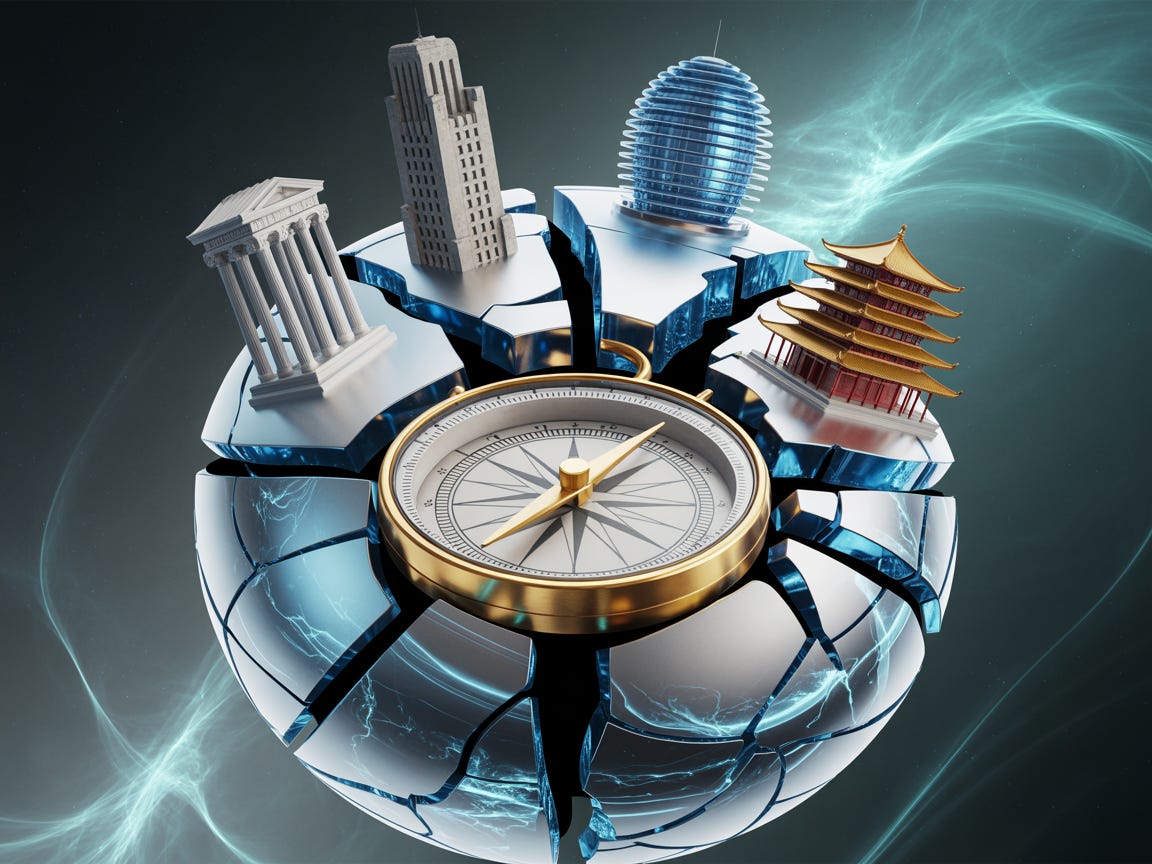
Forget the obsolete maps. The compass points of North versus South, East versus West, democracy versus authoritarianism—they’re quaint relics in a world splintering into a thousand flickering shards. We are no longer facing a simple binary dilemma, but a quadrilemma, the advent of four distinct ideological regimes, each a siren call promising a different route through the coming chaos of a world-system collapse. These are not just competing systems; they're rival ontologies, battling to define the essence of what it means to have agency in the 21st century. Yet we must resist the temptation to over-schematize—these categories bleed into one another, hybridize, and mutate across regions, demanding an advanced understanding of their complex interactions.
First, we have what I term Techno-Statism, most potently embodied by China and, in its more kleptocratic form, Russia. This isn’t your grandfather's communism. It's a hyper-adaptive system, a confusion of state-directed capitalism, ubiquitous digital surveillance, and ruthlessly efficient political control. Think of it as algorithmic governance, where the state becomes both the central planner and the panoptic sentinel, leveraging AI and big data to nudge—or shove—citizens toward pre-determined outcomes. China's paradoxical achievement—lifting hundreds of millions from poverty and constructing utopian cities while simultaneously constructing a digital reformatory—is a testament to this model's seductive power, the Faustian bargain of material security in exchange for individual liberty.
But even here, cracks appear: local dissent, economic imbalances, and the limits of top-down innovation. However, let's be clear, the Russian variant is less about systemic efficiency and more about enriching a select elite, using state power as a tool for personal aggrandizement. To conflate the two risks obscuring their divergent trajectories—China’s long-term stability project versus Russia’s extractive decay. Yet, both share a willingness to weaponize information and suppress dissent, tactics that resonate with populist leaders elsewhere.
Then there's Neo-Traditional Authoritarianism, a force that grips much of the Middle East and parts of Sub-Saharan Africa. This isn't a monolithic bloc, but a constellation of regimes drawing legitimacy from ancient sources—religious dogma, tribal loyalties, and patriarchal hierarchies. They maintain order through a potent cocktail of social conservatism, militarized power structures, and the suppression of dissent. From Saudi Arabia's religious police to the clan-based governance in regions of Somalia and Afghanistan, this model demonstrates a remarkable capacity to concentrate power while silencing any opposition, often cloaked in the language of cultural preservation and divine mandate. This is not a relic of the past; it's a highly adaptable system that leverages modern technology to reinforce traditional power structures. Yet its durability varies wildly—compare the brittle theocracy of Iran to the pragmatic monarchism of Morocco. Moreover, the export of religious extremism from these regions fuels cultural conflicts and undermines secular governance in other parts of the world.
The third force, Electoral Populism, has taken root across much of Latin America, South Asia, and, most disturbingly, within the very heart of the United States. This is democracy weaponized, mass electoralism decoupled from institutional depth, fueled by culture wars and the systematic erosion of vital checks and balances. Governance becomes a reality TV show, policy a mere performance, and democratic institutions hollowed out from within. From Trump's America to Modi's India, we see leaders who ride the wave of popular discontent while simultaneously undermining the very norms and institutions that brought them to power. This is not a rejection of democracy, but a perversion of it, a hijacking of the democratic process for authoritarian ends. Yet even here, the patterns diverge: Modi’s Hindu nationalism is institutionally entrenched in ways Trump’s chaotic personalism never was. Both exploit social media to amplify division and spread disinformation, tactics learned from authoritarian regimes.
Now, here's the kicker: these seemingly disparate models are not operating in isolation. We're witnessing a disturbing convergence, a coalescing around a technologically enhanced, patriarchal nationalism. It's an unholy alliance of plutocracy, extractive capitalism supercharged by military might, and algorithmic tribalism—a system that resurrects pre-modern hierarchies through the most cutting-edge tools. But this convergence is partial, opportunistic—more a cross-pollination of tactics than a unified ideological bloc. Authoritarian regimes still clash (China vs. Russia in Central Asia), and populists often undercut one another (Orbán’s EU sabotage vs. Trump’s transactional alliances). This is not a grand conspiracy, but a series of overlapping interests and shared strategies, driven by a common desire to maintain power in a rapidly changing world.
The surveillance technologies pioneered in China are now being eagerly adopted by populist regimes seeking to monitor dissent and control populations. The patriarchal traditionalism of Saudi Arabia finds echoes in the culture wars of American evangelicals and Hindu nationalists. The oligarchic capitalism of Putin's Russia resonates with the billionaire-dominated politics of contemporary America. Different faces, same game: a fundamental commitment to hierarchy, control, and the concentration of power in the hands of strongmen and their cronies.
Against this rising tide stands what we might call the European Project—not simply a geographical entity, and certainly not flawlessly utopian, but a civilizational aspiration anchored in the European Union and extending to like-minded nations such as Canada, Australia, New Zealand, Japan, and South Korea. This vision, forged in the crucible of two world wars, is rooted in secular reason, human rights, social solidarity, pluralistic law, and a deep sense of moral responsibility for the planet. It portrays a commitment to institutionalizing freedom, pursuing prosperity with justice, and building peace through interdependence. But let’s not romanticize it: the EU remains plagued by technocratic aloofness, unprocessed colonial guilt, and the rise of illiberal forces within its own borders. Indeed, the EU's own democratic deficits along with its failure to fully address its colonial past have created vulnerabilities that authoritarian forces are eager to take advantage of.
The genius of the European project lies not in its perfection, but in its audacious attempt to transcend the age-old patterns of power politics. Where other systems concentrate authority, Europe, in theory, tries to distribute it across multiple levels of governance. Where others privilege the strong, Europe strives to build safety nets for the vulnerable. Where others exploit divisions, Europe seeks integration. The EU's painstaking process of negotiation and consensus-building may seem cumbersome compared to the swift decisiveness of authoritarian systems, but it represents something truly unprecedented: the voluntary pooling of sovereignty in service of shared values. Yet this very slowness is now a liability in an era of cascading crises.
This grand experiment is teetering on the brink. The 2008 financial crisis exposed the fault lines within European capitalism, while migration crises revealed the tensions between national identity and universal values. Growing inequality is eroding the social fabric upon which European solidarity depends. Populist movements, from Hungary's Fidesz to Germany's AfD to France's National Rally, are exploiting democratic freedoms to undermine democratic institutions from within. In the meantime, authoritarian powers—Russia, China, and, increasingly, the United States—are actively working to destabilize European unity through economic coercion, cyber warfare, and narrative manipulation.
This is not just stagnation; it's the systematic dismantling of an alternative model of civilization. The rise of illiberal democracy within Europe itself—particularly in Hungary and Poland—demonstrates how the authoritarian virus can infect even the most committed democratic societies. Viktor Orbán's Hungary is a chilling example of how a leader can maintain electoral legitimacy while systematically dismantling press freedom, judicial independence, and civil society. It's a blueprint for how democratic institutions can be hollowed out while preserving the facade of democracy.
Meanwhile, BRICS nations—for all their internal contradictions—are crafting an alternative playbook: transactional multilateralism, developmental authoritarianism, and a rejection of Western moralizing. Their appeal lies not in ideological coherence but in raw opportunism, offering the Global South infrastructure without conditionality and solidarity without sermons. The BRICS represent a challenge to the Western-dominated world order, but they are not necessarily a force for democracy or human rights. Their rise reflects a growing disillusionment with the West and a desire for alternative models of development, but it also carries the risk of further entrenching authoritarian tendencies on a global scale.
To romanticize Europe as the last bastion of enlightenment ignores its hypocrisies—but to dismiss its potential is to abandon the only existing framework for transnational solidarity at scale. The stakes are far higher than European pride or geopolitical influence. What's at risk is the collapse of the only civilization that has genuinely attempted to translate moral universalism into institutional reality. But even this framing risks Eurocentric myopia: other democratic experiments (Taiwan’s digital democracy, Uruguay’s egalitarian reforms) remind us that alternatives can emerge outside the European tradition. If the European project fails, the 21st century will be shaped not by freedom and justice, but by a cabal of authoritarian and illiberal powers. There will be no anchor left for human dignity on a global scale.
The urgency of this moment cannot be overstated. Unlike other great powers, Europe cannot rely on military might or resource extraction to maintain its position. Its influence rests entirely on the appeal of its model—and that appeal is fading as European societies grapple with internal contradictions and external pressures. If European-style multilateralism collapses, what alternative framework exists for addressing global challenges like climate change, technological governance, or economic inequality? China's model may prove efficient domestically, but it has not yet demonstrated the capacity to foster the kind of voluntary international cooperation that these complex problems demand.
The critical question for me is whether the European project can adapt rapidly enough to survive. Can it transcend its colonial foundations and the persistent neo-colonial dynamics that shape its relationships with the Global South? Can it become more democratically legitimate, bridging the chasm between technocratic governance and popular will? Can it become more economically dynamic, competing with American innovation and Chinese efficiency? Can it become more geopolitically relevant, wielding influence in a world increasingly dominated by great power competition?
Above all, can Europe articulate a compelling vision of the future, one that offers a genuine alternative to the siren song of authoritarianism? This requires more than defensive measures; it demands a renaissance of European imagination and solidarity. It means reigniting the pioneering spirit that assembled the postwar order while adapting it to the challenges of the 21st century. This vision must be rooted in a commitment to social justice, environmental regeneration, and democratic participation, not just within Europe but on a global scale. It requires a willingness to challenge the power of corporations, redistribute wealth, and empower marginalized communities.
The European Union represents a unique experiment, but not the only one. Its failure would be catastrophic, but not apocalyptic—other pockets of democratic resilience persist, and new models may yet emerge. This is not a call for complacency or nostalgia, but a final, desperate plea for a radical reimagining. The future of human self-respect hinges on whether Europe can reclaim not just its own destiny, but its role as a beacon for all those who refuse to believe that freedom and justice are luxuries we can no longer afford. It's time for a European renaissance, a rebirth of the values that have made it a beacon of hope in a darkening world.
The time to act is now, before the twilight of convergence descends completely. This renaissance must be more than a revival of past glories; a radical transformation is needed - a reimagining of what it means to be human in a world facing unprecedented challenges. It requires an alternative kind of collective leadership, both visionary and pragmatic, idealistic and realistic, rooted in European values and open to the wisdom of other cultures.