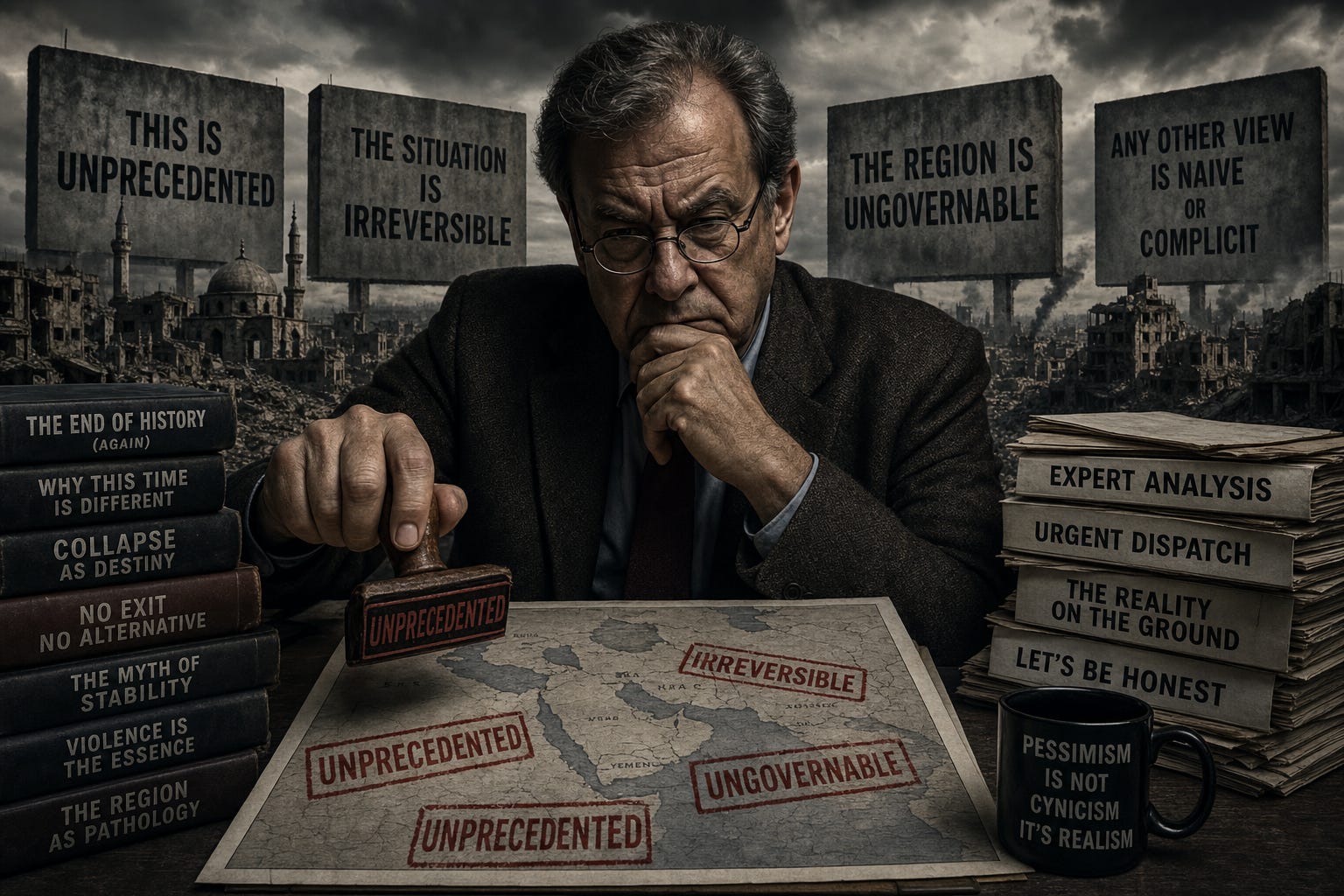
I am only too well aware that I am labelled a Cassandra in some quarters. It’s true that I tend to critique what’s happening in the world in ways that shine a light on the more dystopian aspects of the human condition. But there’s another species of pessimism that mistakes itself for rigour. You find it everywhere in commentary on the Middle East — in the conference papers, the op-eds, and even in the urgent podcast dispatches from distinguished professors who have, for reasons worth examining, discovered a reliable audience in catastrophe. The argument barely varies: this is unprecedented, the situation is irreversible, the region is ungovernable, and anyone who suggests otherwise is either naive or complicit.
What the argument never quite explains is why, if perpetual collapse is the condition, the region keeps producing people; trade; music; governance experiments; and, occasionally, when the fog merchants aren’t looking, something that resembles a tentative peace.
Fog has its uses. It obscures terrain that would otherwise demand more careful navigation. And the Middle East, as a category, has been shrouded in fog so thoroughly and for so long — by geopolitical strategists with axes to grind, by media ecosystems that run on friction, by celebrity intellectuals whose reputations were built in one era and are now being sustained through the performance of certainty in another — that the actual landscape beneath has become almost indecipherable.
What follows is my attempt to read it more accurately. To burn off the fog in order to see more clearly.
Let’s not start with the obvious. Not with Gaza, not with Tehran, nor with the ruins of Beirut’s southern suburbs or the diplomatic theatre going on in Washington. Let’s start instead with a fact that almost never appears in the same sentence as the word “crisis”: the economies of the Gulf Cooperation Council [GCC].
As of early 2026, the GCC is collectively advancing one of the more ambitious economic diversification programmes on the planet. Trade agreements are burgeoning. Infrastructure investment deepening. Sovereign wealth being directed, at scale, into technology, renewable energy, and regional connectivity. The UAE alone is projected to grow its infrastructure sector at five per cent compounded annually through 2030. None of this is, in itself, a peace settlement. But it’s the metabolic condition of a region that has decided, in its economic sinews if not always its political rhetoric, that the future is worth building for.
This matters because worldviews are not abstractions. They are embedded in the bones of institutions, in the flow of capital, and in the direction of infrastructure. When a civilisation is genuinely collapsing, the investment stops. The Gulf has not stopped. That’s no small signal.
Now for the harder terrain — and here I want to resist, quite deliberately, the seductions of both the Western triumphalist reading and the catastrophist one, because both are doing something intellectually dishonest. Both are selling certainty in a situation that the evidence refuses to resolve neatly.
What actually happened between June 2025 and now? The twelve-day exchange between Israel and Iran broke something that had been the central organising architecture of regional destabilisation for three decades: the so-called Axis of Resistance, the network of proxies through which Tehran projected force without formal accountability. The architecture hasn’t been demolished. Hezbollah, bloodied and leaderless through 2025, reconstituted faster than its adversaries anticipated and was back on the battlefield by March 2026. The Houthis, despite sustained American and Israeli pressure, resumed strikes on Israel and retain the Bab el-Mandeb as a lever they have not yet fully pulled. Proxies are resilient organisms; they evolved precisely to survive decapitation.
Hamas is the more complicated case. Militarily, it has been the most thoroughly degraded of the three – its command infrastructure dismantled, its tunnel networks largely destroyed, and its senior leadership killed or exiled. Yet it controls half of Gaza under the current ceasefire, boycotted the April 2026 local elections rather than being excluded from them, and its spokesman welcomed those same elections as “an important and necessary step” — the language of an organisation repositioning rather than one that has accepted defeat. Whether Hamas reconstitutes as a military force, transforms into a political one, or fractures along the fault lines that a prolonged siege typically opens in any organisation remains the most consequential unanswered question in the Gaza framework.
The Board of Peace was designed, in part, to make that question irrelevant by building Palestinian governance around it. Whether that design survives contact with reality is another matter.
But the Western narrative of clean victory is equally misleading, and it’s worth examining why — because what observers across Asia, Africa, and Latin America actually absorbed from the 2026 conflict is something more significant than any tactical scorecard. Iran was struck by six thousand targets. Its supreme leader was assassinated. Its cities were damaged. Its economy, already on its knees, was further immiserated. And it closed the Strait of Hormuz. Shipping transits fell to five per cent of normal levels. The IMF revised its global growth forecast down by 2.3 percentage points in a single quarter. The USS Gerald Ford ended its deployment. Trump negotiated a ceasefire with an adversary he had declared already defeated – and then, by credible accounts, became desperate to maintain it by denying Iranian violations rather than confronting them.
The Centre for Strategic and International Studies, not an institution given to anti-American sentiment, described the conflict as “a war of endurance, not firepower”, in which the contest was less about battlefield outcomes than about each side’s willingness to bear costs. What Iran demonstrated — at enormous human expense to its own population — is that a nation of eighty million people with a strategic culture shaped by millennia of siege does not behave according to the coercive logic that Washington’s war planners assumed. The thirty kilometres of Hormuz proved more consequential than six thousand airstrikes. That lesson is being absorbed in capitals from Ankara to New Delhi to Beijing, where the accelerating push toward de-dollarisation of energy trade, long a theoretical project, has acquired new urgency and new practical momentum from the episode.
None of which means Iran has won. Its nuclear programme has been set back. Its proxy network remains structurally degraded. Its domestic legitimacy, savagely suppressed before the strikes, faces a leadership succession whose outcome nobody can confidently predict. What it means, precisely stated, is that “winning” and “losing” are imports from a strategic grammar that the actual situation has already outgrown. The region is generating a new grammar. Reading it requires abandoning the old one.
What followed the June 2025 ceasefire had the structural appearance of institutional progress. A UN Security Council resolution — 2803, November 2025 — with rare convergence behind it. A transitional framework for Gaza. A US-chaired Board of Peace, announced on Truth Social as “the Greatest and Most Prestigious Board ever assembled”, whose charter was quietly expanded between announcement and ratification from a Gaza reconstruction mechanism into a would-be rival to the United Nations — prompting France, Germany, the UK, and most Western democracies to decline membership on the grounds that they would not legitimise a body designed to circumvent the multilateral order. An interim Palestinian technocratic committee, with no Palestinians on the supervising board above it, that has received less than one billion of the seventeen billion dollars pledged for its work. And in late April 2026, Palestinian local elections were held simultaneously in the West Bank and, for the first time in over twenty years, in one Gaza municipality — Deir al-Balah. Turnout was twenty-three per cent, described by officials themselves as a largely symbolic pilot. Presidential and legislative elections remain distant. Hamas formally rejected the disarmament proposal in April. The administration’s attention had by then moved almost entirely to Iran.
One could read all of this as thin gruel. That would be generous. The scaffolding metaphor requires at least that the scaffolding be erected in good faith. What the Board of Peace more closely resembles is a billboard placed in front of a building whose foundations are being quietly removed on the other side — which is to say, in the West Bank, where the actual work of the current moment is being done.
But there’s a distinction worth preserving between insufficiency and absence. Scaffolding is not architecture. It precedes it.
The question the doom economy can’t accommodate is the one indigenous to every ecological system under stress: what are the conditions for regeneration, and are any of them present? It’s a different question entirely from “Has the problem been solved?” Regeneration is always partial, always contested, always vulnerable to the next perturbation. A forest recovering from fire doesn’t look like a forest. Yet. That doesn’t mean it’s not recovering.
Several conditions are, in fact, present. Iraq, long entangled in Tehran’s orbit, is showing early signs of a more autonomous regional posture. Syria under Ahmed al-Sharaa is still unstable but qualitatively unlike the apparatus that preceded it. The Gulf states — with their extraordinary capital reserves and their unambiguous preference for stability over ideology — remain the silent gravitational centre of any functional regional settlement, and they are, despite everything, still in motion toward deeper integration.
Saudi Arabia’s position is the most consistently misread in standard commentary. The near-certainty of Saudi-Israeli normalisation that analysts were confidently projecting eighteen months ago has dissolved, but the reasons matter more than the outcome. Riyadh secured the American military and nuclear cooperation it wanted without paying the normalisation price. That isn’t a failure of diplomacy. From the Saudi vantage point, it is precisely its success. Whether the structural interests that would eventually support normalisation have disappeared is a separate question. They have not. They have been deferred, which is a different condition entirely.
Here’s what the celebrity pessimists consistently miss – whether they broadcast their certainties from university podiums, YouTube channels, or the kind of substacks that have discovered that outrage scales better than accuracy: the Middle East is not one thing. It never was. The region that contains Beirut’s intellectual tradition and Muscat’s quiet reformism and the extraordinary social laboratory of post-revolutionary Iranian civil society is not the same entity as the one being narrated in the catastrophist register. Treating it as a single system in terminal failure is an epistemological convenience. It has never been an analytical achievement.
The trimunary — my three-fold test of whether any arrangement is good for the people involved, good for the living systems that sustain them, and good for those who will inherit what we leave behind — proves more useful here than any standard geopolitical framework. Applied honestly to the current moment: for Palestinians in Gaza, the ceasefire is neither peace nor security; it’s the bare precondition for both, still fragile, still violated at its edges, still politically hostage to forces that have no interest in its consolidation. For the region’s ecosystems – the watersheds, the agricultural systems, and the coastal metabolisms already destabilised by climate – every year of conflict is an irreversible loss of adaptive capacity that no subsequent peace can restore. For future generations across the entire Levant, each year in which governance institutions fail to consolidate is a year in which the inherited condition worsens and the range of possible futures narrows.
The trimunvirate does not generate much optimism. It produces a different kind of solemnity than catastrophism allows—one that can distinguish between a situation that’s bad and one that’s static and that insists, on the basis of evidence rather than temperament, that the two are not the same.
What might resolution actually look like – not in the fantasised sense of final-status agreements signed on White House lawns, but in the ecological sense of a system finding new homeostasis after disruption? It could look like the gradual consolidation of Palestinian governance institutions capable of surviving the withdrawal of external props. It could look like the slow deepening of Gulf economic integration to the point where regional instability carries an unacceptable cost for the states with the most capital and the most to lose. It could look like Israeli domestic politics eventually producing leadership capable of distinguishing between security and annexation. It could look, from within, like incremental and frequently reversible progress and would only be recognisable as resolution in retrospect.
That last condition — Israeli domestic politics — deserves more than a subordinate clause, because the obstacle it names is not incidental to the current impasse. In many respects it is its engine.
The West Bank trajectory is not simply a risk to the Gaza framework. It is its structural negation, and the two are proceeding simultaneously, which is the fact that most commentary manages not to state clearly. While the Board of Peace convenes in Washington and Palestinian technocrats attempt to build governance institutions in the ruins of Gaza, a parallel project is being executed with quiet systematic thoroughness in the West Bank: the physical elimination of the territorial preconditions for any Palestinian state whatsoever. This is the stated intention of ministers who hold the balance of power in the current Israeli governing coalition.
Finance Minister Smotrich, whose 2017 Decisive Plan called explicitly for a single Jewish state between the Jordan River and the Mediterranean, with Palestinians either emigrating or remaining as individuals without national rights, has since that document’s publication acquired the actual levers of West Bank civil administration and used them with ideological consistency. Over 47,000 new housing units in the West Bank were advanced, approved, or tendered in 2025 alone. The E1 project east of Jerusalem — designed, in Smotrich’s own words, to bury the idea of a Palestinian state — has received final approval. Land registries have been transferred to Israeli administrative control. The Oslo framework’s distinction between Areas A, B, and C is being dissolved through administrative absorption, incrementally and largely beneath the threshold of international attention, which was conveniently focused on Hormuz. Between October 2023 and October 2025, the UN documented 999 Palestinians killed in the West Bank by Israeli forces or settlers – nearly half of them, according to UN Human Rights monitors, unarmed and not involved in any confrontation at the time of their killing.
This is not peripheral to my argument. It is central to it. The scaffolding and the demolition are happening simultaneously. That contradiction sits at the heart of any honest account of where the region actually is, and any framework for resolution that does not address it is, at best, a sophisticated form of avoidance.
None of this is without consequence, even within the current coalition’s own terms of reference. The UAE has described West Bank annexation as a red line. Saudi Arabia has issued equivalent warnings. The Chatham House analysis noted that the annexation acceleration has directly undermined both UN Security Council Resolution 2803 and the White House’s stated preference for a stable West Bank — meaning the Israeli far-right is not simply antagonising Palestinians and Europeans but actively complicating the diplomatic project of its principal patron. Israeli elections are due by late October 2026. The current coalition is not permanent. But permanence is not what the project requires — facts on the ground accumulate regardless of who governs next, and that is precisely the logic driving the pace.
The doom merchants have three signature arguments for the endgame. One is a third world war. The second is a global depression. The third is a famine. All three deserve a direct answer, because they are being deployed as substitutes for thinking rather than as conclusions of it.
On the third world war: the escalatory chain the catastrophists imagine — the US and Israel versus Iran drawing in China and Russia, the multipolar blocs aligning, and the regional becoming systemic — has not materialised, and the structural reason it has not materialised is itself worth understanding. China and Russia, for all their verbal solidarity with Tehran, provided no military support when Iran needed it most. The multipolar order that the doom merchants frame as a hostile alignment of anti-Western blocs turns out, under pressure, to be a collection of states hedging their individual interests. There are no binding alliance chains capable of dragging reluctant great powers into someone else’s catastrophe — which is what prevented 2026 from becoming 1914.
The Doomsday Clock stood at 89 seconds to midnight as this year opened, and that figure is real, but the risk it measures is not imminent great power war over the Middle East. It is the broader unravelling of the arms control architecture, the proliferation incentives that the Iran war has seeded in the strategic calculations of states from Seoul to Riyadh, and the slow degradation of the cooperative frameworks that once made the most catastrophic outcomes less likely. The danger is diffuse, structural, and accumulating. It is harder to narrate than a third world war. It is also more accurate.
On global depression: the honest answer is that the world came closer to a serious recession in March 2026 than most people yet understand. When the Strait of Hormuz closed, ship transits fell by ninety-four per cent within twenty-four hours. One energy analyst, asked to describe the scenario on record, said simply, ‘If the Strait stays closed, we’re not talking about a global recession.’ We’re talking about a depression. The ceasefire of April 8th and the strait’s partial reopening pulled the world back from that threshold — prediction markets cut US recession odds in half in a single day. Under the IMF’s reference scenario, assuming disruptions fade by mid-2026, the outcome is slowed growth and elevated inflation, not structural contraction. What the episode revealed, however, is something the fog merchants on the optimistic side are equally reluctant to acknowledge: the global economy that industrial economism built is one chokepoint away from catastrophe. A thirty-kilometre strait whose navigational channel is two miles wide carries one fifth of the world’s oil supply. The brittleness was always there. 2026 simply made it visible. A ceasefire doesn’t make it less brittle. The next actor who grasps that lever will not need nuclear weapons or a great power alliance. They will need thirty kilometres of water and the willingness to use it.
The famine claim deserves more careful treatment than the other two, because unlike a world war or depression, it’s not a prediction about the future — it is in fact a description of something already happening to people who are already on the margins of survival. The FAO chief economist was precise where my friend Steve Keen’s YouTube packaging was not: a short Hormuz closure keeps global food stocks intact; three months or more of disruption threaten planting decisions for 2026 and beyond; prolonged closure could push an additional 45 million people into acute hunger, compounding existing food insecurity affecting 360 million. That’s not a global famine in the apocalyptic sense — it is something, in many ways, worse because it is specific. It falls on Sudan, where 40% of the population already faces famine conditions after three years of civil war. About Yemen, which imports 90% of its food. In Bangladesh and Nepal, whose farmers depend on fertiliser that transits Hormuz and whose workers depend on remittances from the Gulf. These are not mere abstractions. They are populations whose food systems were already at the margin before a decision made in Washington and Tel Aviv closed the world’s most consequential chokepoint.
This is where the doom merchants’ framing does its most insidious work. By packaging genuine, ongoing, measurable suffering as a global apocalypse narrative — “in three months we’ll enter a famine” — they simultaneously sensationalise it for audiences in wealthy countries and obscure its actual character: not an undifferentiated catastrophe but a profoundly unequal one, falling hardest on those least responsible for and least protected from the decisions that caused it. A thirty-kilometre strait, 20-30% of global fertiliser, and the agricultural calendars of the Global South: these are not the ingredients of science fiction. They are the circuitry of a global food system that industrial economism built to be maximally efficient and therefore minimally resilient — one that, like the energy system that depends on the same chokepoint, has now demonstrated in plain sight exactly how brittle it is.
That’s the real lesson the doom merchants are too busy with their destinies to teach. Not apocalypse. Something more mundane and more serious: a civilisational operating system — industrial economism in its most exposed form — that concentrates global dependency into single points of failure, that monetises instability, that funds the very conflicts it then narrates as inevitable, and that will continue generating crises of this kind for as long as it remains the only grammar available for organising collective life on this planet.
Which brings us back to where this essay began — not with Gaza or Tehran or the Board of Peace or the Decisive Plan, but with the GCC’s infrastructure investments and the metabolic signals of a region that has not stopped building. The trimunary still asks its three questions. The forest still does not look like a forest. And the fog merchants are still in business, because fog is what they sell, and there is no shortage of buyers.
But the landscape beneath, read carefully and without the comfort of false certainty in either direction, is a place where things are still possible — not because the protagonists are wise, the institutions adequate, or the great powers honest, but because the alternative has become sufficiently expensive for enough of the relevant actors that the calculus is slowly, incompletely, and reversibly shifting.
That is not comfort. It is, however, the truth that the commentary industry has the least incentive to tell.