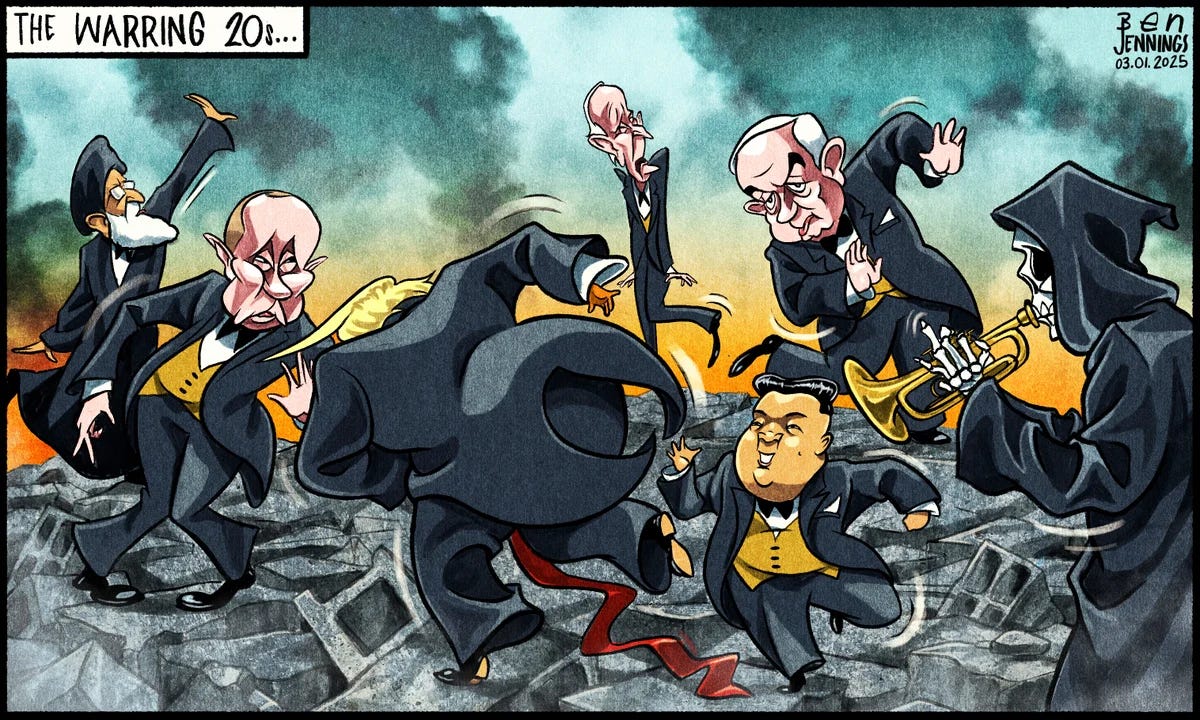
I have been listening, for years now, to the same weary confession. People tell me they still vote – out of habit, or duty, or some last shred of hope – but no longer expect very much from the exercise. The posters change yet the choreography of power barely alters. In much of the world styled as “liberal democracy”, elections have become a kind of consumer choice: we pick brands, not directions.
In the same breath, another story is gaining confidence. If the West is theatre without transformation, then China, so the argument runs, is the opposite: no alternation of power, but genuine capacity to change course. There is no ballot box in Zhongnanhai, yet whole economic architectures can be dismantled and rebuilt within a generation. While parliaments debate, the Party acts.
British parliamentarian George Galloway has turned this contrast into a personal franchise. Western democracy, in his telling, is empty form. China delivers the substance: poverty reduced, cities built, high‑speed rail laid across continents. If “rule of the people” is to mean anything, he suggests, it should be measured by outcomes, not rituals.
There’s enough truth in that diagnosis of democratic decay for it to sting. The mistake lies in drawing the conclusion that one‑party rule is therefore a superior operating system – and in accepting that the essential question of our age is whether democracy or autocracy does a better job of running the same world.
I say that as someone who has, perhaps more than most Western commentators, spent years defending China against the lazy prejudices of what still passes for polite company. I have advised Chinese institutions, worked with leaders shaped by very different histories to my own, and argued – sometimes to the discomfort of my peers – that the country’s developmental achievements deserve far more respect than they receive in Euro‑American discourse. Precisely because of that history, I am no longer satisfied with the way the debate is framed.
Regime forms differ. They matter. But beneath the obvious contrasts, a deeper sameness has taken hold. Until we’re willing to look directly at that, most of our arguments about politics will feel strangely weightless.
A Narrowing Tunnel of Democratic Possibility
If you strip away the flags and slogans, the pattern across many electoral regimes is oddly familiar. In Europe, Australasia, the Americas, parts of Africa and Asia, the decades after the Second World War carried at least a whiff of structural possibility. New welfare states were built, public assets created, decolonisation movements wrote constitutions in languages very different from those of their former masters.
Since the late 1970s, that imaginative space has shrunk. Parties that once argued about the nature of the economy now quarrel mainly about its administration. The language of citizenship has ceded ground to that of “taxpayers” and “consumers”. Trade and investment treaties, negotiated at a distance from any meaningful public scrutiny, lock in particular economic doctrines for a generation at a time. Central banks are insulated from electoral pressure. Corporations gain the practical ability to move capital and production across borders at will, which gives them quiet vetoes over any policy they deem unfriendly.
Rotate the government and you usually get modest adjustments at the margin, less often a change of underlying direction. Many people sense this, even if they lack the vocabulary to describe it. Climate pledges are made and broken. Inequality deepens and is rebranded as “meritocracy”. Public services are hollowed out and sold back to citizens piecemeal. It’s hard, from the outside, to avoid the conclusion that crucial decisions are no longer taken in the places we still call “political”.
Against that backdrop, Beijing can look, to some, almost enviable. There, at least, is a state that appears able to decide and then act. Land can be taken, industries wound down or scaled up, whole cities willed into existence at a speed that would throw most parliaments into procedural paralysis.
Deng Xiaoping’s pivot after 1978 is the canonical case. No referendum asked whether China should dismantle Maoist central planning and invite foreign capital. No opposition party had the power to block reforms in committee. The Party diagnosed its crisis, ran experiments in coastal enclaves, and then rolled the successful variants out across the country. Those of us who have spent time in China during the past four decades have witnessed how thoroughly that decision has rearranged daily life – from the air in people’s lungs to the contents of their pockets and the products in the shops.
Measured by infrastructure and income statistics alone, such capacity can seem compelling. Particularly when viewed from democracies where a single railway line takes decades to approve, or where even modest emissions cuts become pitched battles.
The more important question, though, is not simply whether an apparatus can move quickly. It’s what happens when it moves in the wrong direction, and what recourse anyone has when it does.
Hong Kong: When Flexibility Turns to Cement
Hong Kong, a city I have known and worked in for many years, has become an unwelcome laboratory for these questions.
The immediate spark in 2019 was an extradition bill. It proposed allowing suspects to be sent across the border to face trial in mainland courts. For those who had grown up under a different legal order – where judges, however imperfect, were not answerable to a ruling party – that fused two worlds they had been told would remain distinct. Whatever else people disagreed about, they understood that the risk was not theoretical. Conviction rates in politically salient cases on the mainland are, by any comparative standard, astonishingly high. To fall into that system is to be almost certain of punishment.
The protests that followed were not a single, pure expression of “the people”. They involved liberals trying to preserve a constrained but real space of free speech; young radicals animated by localist or even separatist ideas; trade unionists; small‑business owners; ordinary workers furious about housing, wages, and the creeping sense of a promise betrayed. They were messy, fractious, occasionally self‑destructive – in other words, human.
Beijing’s ultimate response was the National Security Law. Drafted behind closed doors, written in expansive, ambiguous language, it created new offences – subversion, secession, collusion with foreign forces – whose outlines could be drawn as widely as the authorities chose. It bypassed Hong Kong’s own legislature. It established mainland‑linked security organs on Hong Kong soil, answerable not to local institutions but directly to the capital.
Overnight, the ecology of public life altered. Independent newspapers either closed or were tamed. Activists went to prison or into exile. Vigils commemorating the Tiananmen massacre, held peacefully for decades, disappeared. Teachers revised curricula. A city whose very identity had been entangled with a noisy, sometimes infuriating, public sphere found itself suddenly muted.
Galloway and others framed this as a regrettable but inevitable assertion of sovereignty. Any state, they argued, would do the same when confronted with what it perceives as an existential threat. That defence relies on a convenient compression: it treats demands for accountable government and protection of promised freedoms as indistinguishable from plots to tear the country apart. It also leans heavily on colonial history – Britain ruled Hong Kong for over a century without democracy – as if past injustice were a sound basis for present injustice.
What struck me, as I watched friends pack their bags or close their offices, was how little room there had been for any genuine negotiation. A system that prides itself on “consultation” and responsiveness to “the masses” chose, when it mattered, to act through decree. Policy flexibility became legal cement. There were no channels through which people could meaningfully contest, amend, or delay the change. The only veto they had – their bodies on the streets – was met with a law that turned protest itself into potential evidence of subversion.
This is what capacity looks like in the absence of robust feedback. A state that can build a railway network in five years instead of fifteen can also, when it judges its patience exhausted, compress the politics of an entire city into a single night’s announcement.
For someone like me, who had spent years pushing back against Western demonisation of China, Hong Kong’s rapid silencing posed an inescapable question: to what extent had I mistaken developmental competence for political wisdom?
Democracy’s Slow, Structural Harm
It would be comforting, at this point, to contrast that blunt force with a picture of democratic systems that, while flawed, retain self‑correcting virtues. To a degree, they do. Journalists in some countries can still expose corruption without being disappeared. Courts sometimes restrain ministerial overreach. Unions, when they survive, can force wages and conditions onto the agenda. Social movements occasionally win laws previously dismissed as unrealistic.
Yet anyone living in a developed democracy can point to domains where harm accumulates slowly and no meaningful correction occurs. Entire regions deindustrialise while political leaders offer platitudes about “reskilling” and “mobility”. Environmental protections are shaved away to accommodate “competitiveness”, even as ecosystems collapse. Surveillance technologies, introduced under the banner of counter‑terrorism, bleed quietly into monitoring of activists and marginalised communities. Housing morphs from shelter into speculative asset, shutting younger generations out of stability.
When these processes are challenged, the response is typically procedural rather than substantive. Inquiries are held, reports written, recommendations shelved. Campaigns change governments, only to run up against the same constraints their predecessors cited: bond markets, trade obligations, constitutional limits, hostile media, hostile donors.
It is in this labyrinth that many conclude democracy has become an empty shell. The problem, I would suggest, is not so much that democracy has failed on its own terms, as that it has been drafted into serving a very different master – one we rarely name, and almost never vote upon.
The Industrial Spell
That master is what I have come to call industrial economism. It’s less a policy platform than a civilisation‑wide enchantment, At the heart of this worldview sits unrelenting growth, extractionism and predatory forms of capitalism.
Under its influence, we take for granted a cluster of propositions. That more production and more consumption are synonymous with progress. That nature is fundamentally a stock of resources, waiting patiently to be turned into commodities. That human beings are, in their public roles, either units of labour or units of demand. That the purpose of government is to lubricate this machinery and police anything that might jam the gears.
This worldview didn’t emerge everywhere at once. Its roots can be traced through the mills and enclosures of England, the slave plantations of the Americas, the conscript armies and factories of continental Europe, the colonial outposts of Asia and Africa. For a time it could plausibly be described as Western. That time has passed. The logics born in Manchester and Massachusetts now shape planning documents in Beijing, Jakarta, Lagos, São Paulo, Johannesburg and beyond.
China’s post‑1978 turn didn’t so much betray socialism as reveal industrial economism’s promiscuity. Markets, we discovered, are entirely comfortable under one‑party rule, provided contracts are honoured and the workforce can be kept in line. Many in the West assumed that introducing capitalist mechanisms would inevitably lead to political liberalisation. What actually happened is that the Party adopted the tools of accumulation it once denounced, and used them to strengthen its own hand.
Equally, Western democracies that wrap themselves in the language of freedom have shown little hesitation in sacrificing actual human and ecological freedoms on the altar of industrial growth. Their populations may have more formal rights; their landscapes and souls are no less scarred.
If there’s a shared doctrine uniting contemporary Beijing and Washington, Brussels and Delhi, it is this: the economy must grow, whatever the planetary consequences, and governance exists to manage that imperative.
Once we see that, the obsessive debate about whether democracy or autocracy is the “better” system begins to look like a quarrel between two high priests about who chants the liturgy more efficiently, when the altar itself is already cracking.
What Outcomes Conceal
Defenders of China’s trajectory are fond of figures. No other state, they remind us, has reduced income poverty on a similar scale, in such a short span. Life expectancy has risen; literacy has spread; physical infrastructure in many regions is unrecognisable compared with the mid‑twentieth century. Walk through a rural village that now has paved roads, electricity, and clinics where once there was none, and those achievements are not abstractions. They are, however, incomplete.
How should we weigh those gains against the costs borne by ecosystems pushed beyond their limits – rivers rendered unsafe to drink, soils steeped in toxins, skies that shorten lives? How do we count the experience of minorities whose cultures are being homogenised under a single national narrative? The Uighur farmer moved into “vocational training” far from his land; the Tibetan monk watching his monastery become a tourist exhibit; the Cantonese speaker in Hong Kong told, in effect, that her language and legal traditions must now defer.
Nor are these questions confined to authoritarian settings. When any government trumpets its success in raising incomes, we should ask: at whose expense, and for how long? Farmers in one country may be “lifted” from subsistence by growing export crops, while peasants in another are dispossessed to make way for the plantations. Greenhouse gases emitted by factories in one region alters rainfall patterns for pastoralists thousands of kilometres away. Children everywhere inherit, without consent, an atmospheric chemistry their grandparents would barely recognise.
Aggregate statistics have a way of smoothing over these asymmetries. Poverty lines are drawn and redrawn. A family that crosses a monetary threshold is branded “non‑poor”, even if their social and ecological environment has become more precarious. Forests razed for mining or soy become “growth”. The suffering of those left with dust and debt disappears into GDP.
Galloway’s preference for outcome‑based evaluation accepts too readily the categories offered by the very system he claims to critique. It invites us to judge regimes by how much they have increased production, not by how they have altered the quality of relationship – between people, between communities, between humans and the rest of nature. It risks treating voice, dignity, cultural survival and meaning as optional extras, to be bolted on once the great project of material provisioning has been completed.
Most of the people I meet, whether in Beijing or Bangkok, Barcelona or Baku, sense that trade‑off is false. They may not express it in the same language, but they feel the cost of being reduced to mere instruments in someone else’s plan, even when that plan brings them better phones and smoother roads.
Sovereignty as Cloak
Sovereignty is one of modernity’s most effective incantations. Invoke it in Washington, Moscow, Ankara, New Delhi or Canberra, and awkward questions fall silent. Opposition to certain projects becomes, almost by definition, suspect. External critics can be dismissed as hypocrites. Internal dissenters can be painted as traitors or dupes.
It’s not hard to see why this spell retains its force. For much of the world colonial intrusion is recent history. Structural adjustment, covert interventions, military occupations and coercive trade regimes have left deep scars. States insist, quite understandably, on the right not to be lectured by former or current imperial powers. Yet sovereignty today is as often used to shield regimes from accountability as to protect peoples from predation. It allows leaders to conflate their own continuity with national survival. It erases the diversity of voices within their jurisdictions, presenting “the people” as a single subject whose will they uniquely channel.
In more open democracies, that conflation is at least partially contestable. Courts may push back against executives. Regional governments and municipalities may carve out distinct policies. Civil society can mobilise to say: you do not speak for all of us.
In tighter systems the equation is blunter. To challenge the Party is to challenge the nation. To question a security policy is to invite suspicion. Village‑level elections or online feedback mechanisms may exist, but they operate within strictly policed boundaries. When they begin to generate anything resembling an autonomous power base, they are quickly pruned.
Sovereignty then becomes less about shielding a community from unwanted external domination and more about shielding a particular configuration of power from its own constituents.
Time Out of Joint
Another domain in which both democracy and autocracy are ill‑equipped for the age they helped create is time. Industrial economism compresses our attention into distinctive units: quarters for corporations, electoral terms for governments, five‑year plans for parties. These cycles encourage a focus on the immediate and the measurable. Investments with long payoffs, or benefits that accrue mainly to those not yet born, struggle to compete.
Authoritarian regimes appear, at first sight, to have an advantage. Without the need to curry favour with voters every few years, they might be better placed to invest in long‑term public goods. There is some evidence of this. China’s build‑out of high‑speed rail, its early ramp‑up of manufacturing for renewable energy technologies, and its poverty reduction strategies have all involved horizons beyond the next news cycle.
But the same centralisation that allows for such planning also makes sudden, sweeping reversals more likely. Zero‑COVID policies, enforced with a zeal that turned high‑rise apartments into temporary prisons, were abandoned in late 2022 with astonishing speed and minimal explanation. Whatever one thinks of the epidemiology, the experience for ordinary citizens was one of being whipped between extremes without meaningful consultation.
Democracies, by contrast, are haunted by short‑termism of a different kind. Politicians who attempt to introduce serious climate measures, for example, face opponents promising immediate relief from fuel taxes, or soothing assurances that technological salvation is around the corner. Electoral pressures make it tempting to push hard decisions onto the next government. Even when laws are passed, they can be undone by the following administration.
There are attempts, uneven and fragile, to stretch political time: constitutional provisions for future generations, legal rights granted to rivers and ecosystems, citizen assemblies tasked with thinking beyond party lines. Whether these are openings into a different relationship with time or just decorative panels on the same old house will only become clear if they begin to bite into decisions that matter.
Meanwhile, the Earth system operates on its own timetable. Ice melts, oceans warm, species disappear, soils erode, weather patterns shift, whether or not our institutions can keep up.
Material Locks, Mental Locks
People sometimes accuse writers like me of overemphasising ideas – as if changing stories alone could steer civilisation away from catastrophe. They are right to be suspicious of any account that treats worldviews as the only hinges of history.
We are hemmed in not only by metaphors and narratives but by the ensuing world-system of concrete, steel, code and law. Power stations, pipelines, mines, ports, roads and dams represent decades of sunk investment and technological lockin. Institutional commitments that are hard to dislodge. Debt contracts link pension funds in one country to coal plants in another. Trade agreements make it costly, sometimes illegal, to favour local producers or protect certain ecosystems. Military alliances and security doctrines channel vast resources into preparations for wars that, if ever fought, would make present debates feel antiquated.
These material structures exercise their own inertia. To close a coal plant early is to strand assets, unsettle workers, upset balance sheets. To abandon a highway project is to anger contractors and communities whose hopes have been pinned, however ambivalently, to its completion. Politicians who challenge such projects face not only ideological opponents but very concrete interests.
Yet stories and structures are not neatly separable. Industrial economism rationalised the building of those pipelines and ports. Their existence now makes it easier to believe the story that nothing fundamental can change. The factory in the valley and the narrative in the schoolbook reinforce each other.
If we’re to slip industrial economism’s grip, we will have to work in both registers at once: loosening the mental locks that make ecological overshoot appear normal, and, where possible, retooling or retiring the physical arrangements that embody that normality.
Experiments in the Cracks
Against the scale of these entanglements, local experiments can seem almost embarrassingly small. A cooperative farm here, a community‑owned energy project there; an indigenous nation asserting treaty rights; a town in Kerala practising participatory planning; a municipality in Europe trialling doughnut-shaped prosperity indicators; a network of coders building open‑source tools beyond the reach of platform monopolies.
It’s tempting, especially for those whose sense of realism has been shaped inside ministries and boardrooms, to dismiss such endeavours as marginal, even frivolous. They don’t shift global capital flows. They don’t control armies. They are vulnerable to policy changes and funding cuts. And yet, when I visit these places – whether in the backblocks of Bangkok, a township outside Cape Town, a reclaimed factory in Barcelona, or a fishing village in the Mekong delta – I am struck by a different quality. People talk about prosperity without immediately reaching for GDP. They speak of time in seasons and generations. They use words like “enough” without shame. They treat the river, the soil, the forest as participants in decision‑making, not as mute backdrops.
These are not perfect utopias. Conflicts arise. Old hierarchies reassert themselves. External pressures intrude. But they are sites where the industrial spell is, at the very least, named and occasionally interrupted.
The critical question – and it is very much an open question – is how such nodes might interweave into patterns capable of handling problems that no village, no city, no single watershed can resolve alone: cross‑border pandemics, mass displacement, the allocation of a finite carbon budget, the dismantling of the global arms trade.
If they fail to address these, the argument for retaining large, centralised structures will remain strong, even if those structures are plainly misaligned with the ecological realities we face. If, however, they can begin to sketch forms of federation and mutual obligation that preserve diversity while coordinating action, they might offer glimpses of governance beyond the stale democracy–autocracy binary.
Rethinking Leadership
Much of contemporary commentary treats leadership as the stuff of exceptionally talented and visionary individuals. We obsess over presidents, prime ministers, CEOs, generals, billionaires, as if their virtues and vices alone determined the fate of nations.
Having advised more than my fair share of such people – in Bangkok and Beijing as well as in Canberra and Washington – I can attest that personal character matters. A courageous minister can occasionally push a system further than it would otherwise go. A narcissistic leader can inflict outsized harm.
But leadership, in the sense that has come to preoccupy me, is not a job description. It emerges when groups of people, without waiting for permission, decide to improve one or more aspects of the human condition and then act together over time to do just that. It’s visible in Hong Kong students sweeping the streets after protests. It’s visible in Thai villagers quietly refusing to sell land to dam projects. It’s visible in South American women forming savings circles that double as political education. It’s visible in Chinese netizens who, despite censorship, find inventive ways to share forbidden information. It’s a shared phenomenon.
The question I now use to evaluate a political system is less “How are its rulers chosen?” than “What space does it leave for such emergent leadership to surface, learn, and influence the larger pattern?” Does it listen to those at the margins, or co‑opt them, or silence them? Does it protect whistle‑blowers, or prosecute them? Does it tolerate communities organising around values that diverge from the official story?
On this score, democracies – even bruised, compromised ones – usually offer more degrees of freedom than overtly authoritarian regimes. Journalists can, sometimes, amplify the voices of the excluded. Courts can, sometimes, side with those against whom the state has aligned. Elections can be fought on platforms shaped, at least in part, by movements.
My point is not to romanticise these openings. They are under sustained assault in many places. Nor is it to claim that people in autocratic settings lack agency; they definitely do not. It’s to recognise that the cost of exercising that agency, and the range of outcomes it can plausibly achieve, differ.
An Uneven “We”
In writing The Hames Report I am always wary of the inclusive “we”. It is far too easy to say “we” destroy forests, “we” emit carbon, “we” benefit from cheap labour, and in doing so erase the asymmetries that structure our world. I am often corrected on that score, which I thank my readers for.
Industrial economism is not a neutral field upon which equal players move. A small class of asset owners, executives, senior officials and professionals in both North and South reap vastly disproportionate rewards from its continuation. They have easier access to the levers that might redirect it. Their choices, multiplied by their reach, carry more weight.
At the same time, the harshest impacts of the paradigm fall on those who had least say in its design: farmers dealing with erratic rainfall, fisherfolk watching catches collapse, slum‑dwellers living on floodplains, Indigenous peoples whose territories sit atop mineral deposits, informal workers whose livelihoods evaporate when global supply chains shudder.
Yet even here, agency is not absent. Many of the most imaginative alternatives I encounter arise from precisely these zones of precarity. They are born of necessity. When the old order robs you of both stability and dignity, you have fewer illusions to defend.
So when I say “we” are involved in sustaining or loosening the industrial spell, I mean something layered. Those of us with education, mobility, and access to decision‑makers bear heavier obligations. Our failure to act, or our half‑heartedness, has consequences. But nobody is entirely outside the field. Even the poorest of the poor, as I have seen repeatedly, can and do refuse certain roles, and invent others.
Recognising this unevenness matters if we are to avoid both moral paralysis (“everything is rigged, nothing can be done”) and moral vanity (“I recycle, therefore I have done my part”).
Is “Democracy versus Autocracy” Even the Right Question?
So where does this leave the familiar binary that saturates current affairs programmes and think‑tank reports?
It would be glib to say regime type is irrelevant. It is not. It matters, in a very immediate way, whether journalists disappear or merely get sued; whether protesters face batons or bullets; whether a court sometimes, however imperfectly, challenges the state; whether an election can remove a government that has lost any plausible claim to represent. Those differences translate into real variations in suffering and possibility. Any argument that smooths them over deserves suspicion.
At the same time, the planetary predicament we now share cannot be reduced to a contest between Western‑style democracy and Chinese‑style autocracy. Both operate within an industrial world-system that’s driving climate disruption, biodiversity loss, social fragmentation and crises of meaning. Both cling to growth metrics that no longer describe anything remotely like flourishing on a finite planet. Both deploy technology to monitor, manage and, increasingly, pre‑empt their populations.
Within that frame, deepening democracy can still make a material difference to who suffers, and how much. It can open channels for marginal voices, slow certain forms of harm, block some worst abuses. These are not trivial gains. They can spell the difference between a brutal and a bearable life for millions. But if we confine our imagination to choosing which regime better administers industrial economism, we remain stuck in the wrong conversation. The more unsettling, and therefore more necessary, inquiry asks: what kinds of governance become possible if we cease to treat endless accumulation as sacred, and begin to treat ecological limits, human dignity, and cultural plurality as non‑negotiable?
No existing state, democratic or autocratic, has yet answered that question convincingly. Some have mouthed fragments of such a vision – “ecological civilisation” in Beijing, “wellbeing economies” in a few small democracies – but practice has lagged far behind proclamation.
In the meantime, the most interesting work I see is not happening in the places that dominate our news feeds. Far from it. It’s taking root in the cracks: in how people grow and distribute food, settle disputes, share knowledge, educate children, and steward land and water, long before parliaments or politburos take notice.
If The Hames Report has a function in this moment, perhaps it’s to keep pointing beyond the ready-made binaries, to signal the existence of those cracks, and to insist that the unspoken assumptions framing our loudest arguments are themselves up for renegotiation.
Whether that renegotiation occurs gently, as a kind of civilisational midwifery, or violently, as collapse and scramble, will not be decided solely in Beijing, Washington or Brussels. It will be shaped in the unglamorous, untelevised spaces where people quietly choose, on a daily basis, whether to keep playing by the old rules, in the old game, or begin inventing another.
Democracy or autocracy? For now, the world remains trapped, in various proportions, in both. The more decisive choice may be whether we permit either to go on serving an industrial spell that is clearly exhausting its host – or whether we have the courage and imagination to ask different questions while there is still time to hear and take action on the answers.