Part One
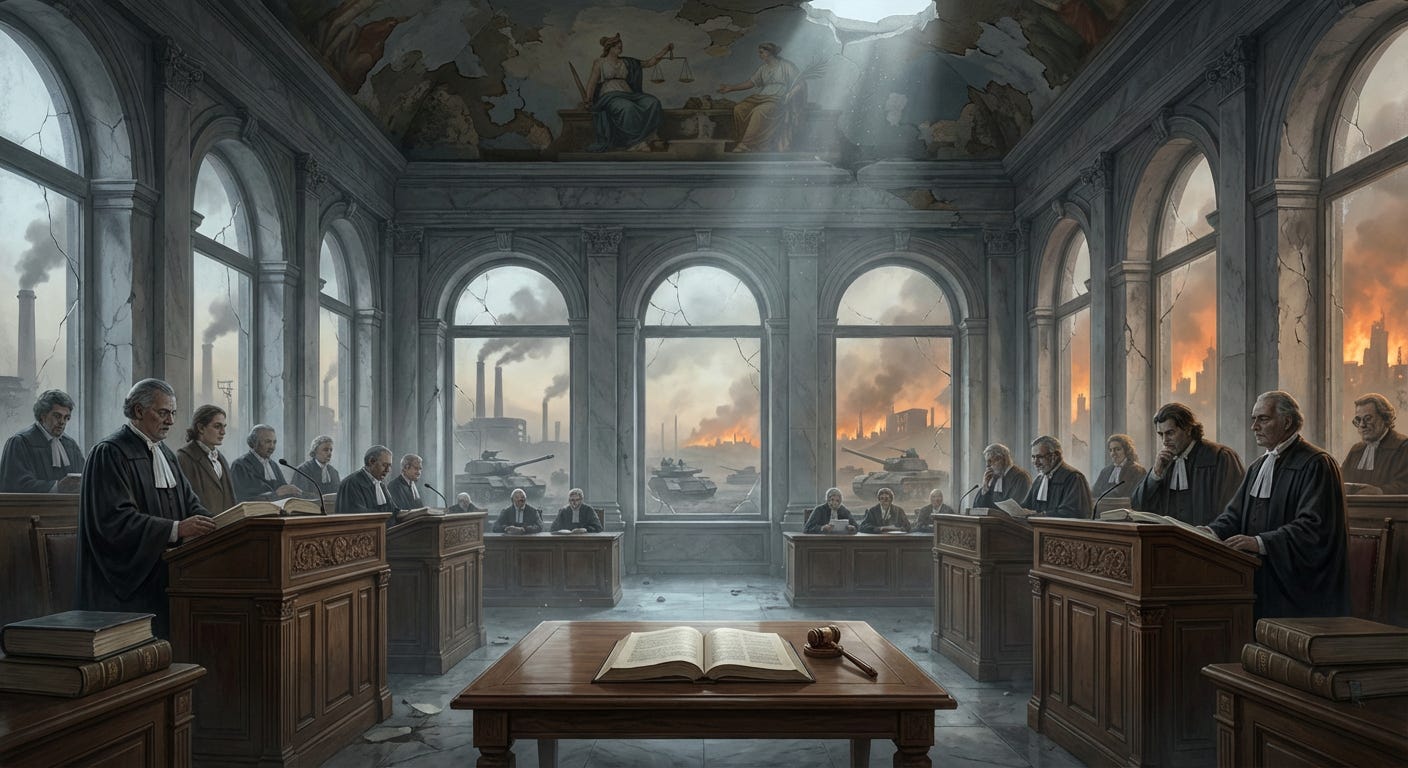
The System and Its TheatreThere’s a predictable ritual that follows every large-scale act of organised violence. Lawyers appear. Investigators are dispatched. Tribunals are proposed. Commissions of inquiry are constituted. Occasionally, years or decades later, someone is convicted of something. The ritual is performed with great seriousness, and is, at its core, a form of civilisational theatre — not because accountability is wrong, but because the ritual’s deeper function is not accountability at all. It is legitimation. By reaching for law in the aftermath of war, we perform our belief that war is an aberration from an otherwise rational order — a rule broken rather than a feature operating exactly as intended.
That performance is what requires examination. Not the laws themselves, which often encode genuine moral insight. But the reflex — the reflex of a particular civilisational paradigm that says: when something goes catastrophically wrong, reach for a framework, design enforcement mechanisms, build tripwires. It’s the same reflex that produces, in the most sophisticated recent thinking on this subject, a Civilization Preservation Protocol: a tiered system of psychological pressure, cultural taboos, moral councils, and pre-committed sanctions designed to make the threat of mass civilian destruction instantly and catastrophically costly. The thinking is serious. The architecture is ingenious. And yet it’s still reasoning from inside the world that requires such an architecture in the first place.
Before we examine what a different framework might look like, we need to do something this paradigm resists: step outside it entirely, and look back.
From outside, what you see is not a flawed but well-intentioned system doing its imperfect best. What you see is an elaborate ritual designed to make organised mass killing acceptable, codified, and therefore repeatable. A set of rules whose very existence implies that there’s a correct way to destroy a city, a lawful method for slaghtering civilians, a permitted tonnage of death before behaviour becomes prosecutable. Diverge fro these rules and you commit war crimes. From outside the paradigm of industrial economism, the rules of war are not a moral achievement. They are a confession — an admission, written in legal language, that the societies producing these rules intend to keep making war and require only that it be conducted with a certain procedural decency. Viewed from any genuinely different civilisational logic, they are not just inadequate. They are a kind of organised hypocrisy so thorough that it has ceased to recognise itself as such.
That is the ground we’re standing on. And this, in the end, is not an abstract civilisational conversation. It’s a conversation about survival. The distinction is not rhetorical.
The Threshold We Crossed and Then ForgotIn August 1945, the human species crossed a threshold from which there is no technical return. Before that threshold, war was — however horrifically — a recoverable condition. Civilisations were destroyed, populations decimated, landscapes rendered uninhabitable for generations. But the species persisted. The living world persisted. The future, however diminished, remained open. Following that threshold, nothing can be assumed.
We have spent the eighty years since Hiroshima engaged in an elaborate collective project of not fully reckoning with what crossing that threshold means. We built deterrence theories and mutually assured destruction doctrines that made the unthinkable thinkable by making it systematic. We signed non-proliferation treaties while expanding arsenals. We developed tactical nuclear weapons — as though nuclear violence could be made proportionate, contained, surgical. We watched the number of states with nuclear capability grow, watched non-state actors acquire increasing sophistication, watched the command-and-control structures built to prevent accidental launch age and fray, and we continued — with remarkable consistency — to treat war as a manageable feature of the human landscape rather than what it has become: a potentially terminal one.
The tools have not simply changed in degree. They have changed in kind. And that categorical change has an implication that no amount of strategic sophistication can reason away: enduring peace is no longer an idealist preference or a civilisational aspiration or one policy option among several to be weighed against national interest and quarterly returns. It’s the precondition for there being anyone left to have preferences, aspirations, or returns at all.
I will repeat that: Enduring peace is not an aspiration. It is the precondition for there being anyone left to aspire to anything at all.
A civilisation that treats enduring peace as optional — that builds its economic metabolism around permanent threat environments, that profits from stoking fear and the perpetuation of conflict, that reaches for rules rather than origins — is a civilisation that has decided, however unconsciously, to bet the species on its own capacity for restraint. Given the evidence of the last eight decades, that’s not a bet any rational being would accept if they were required to name it openly. The extraordinary thing is that we accept it continuously, without naming it, because the systems that require us to accept it are also the systems that shape what we are able to name.
War Is Not a Failure of the SystemWhich brings us to the first necessary refusal: the refusal to keep treating war as a breakdown of the industrial order rather than one of its most reliably profitable products.
War sustains asset prices. It absorbs surplus industrial capacity. It provides the conditions under which otherwise unacceptable concentrations of state power are enthusiastically embraced. It generates reconstruction contracts that flow to the same financial institutions that funded the destruction. It creates permanent threat environments that justify permanent procurement cycles. The weapons that kill people in one decade are replaced, at enormous public expense, by more sophisticated weapons in the next — and the companies that manufacture them are listed on the same stock exchanges where pension funds seek returns for the same citizens those weapons are nominally protecting.
This absurdity is a structural feature — a metabolic pattern — of an economic system that requires continuous expansion, cannot tolerate genuine peace economies at scale, and has developed cultural and political immune responses sophisticated enough to absorb almost any reform while leaving the underlying metabolism untouched. It doesn’t require bad faith on the part of individuals, many of whom are sincerely patriotic, genuinely fearful, and entirely convinced by the narratives they inhabit. The system doesn’t require intention. It requires only continuation.
The rules of war are one of those immune responses. They are not cynical in origin — many of those who wrote them were people of moral integrity trying to limit suffering. But in their function, they serve the system rather than constraining it. They define the boundaries of acceptable industrial violence. They preserve the legitimacy of the institutions that conduct it. They give the international community something to argue about that’s not the existence of the war economy itself. And they are selectively enforced with a consistency that should, by now, have destroyed any illusion about their neutrality — the International Criminal Court prosecutes Africans with statistical regularity; the architects of Iraq and Gaza retain their freedom, their honours, and in some cases their lecture fees.
Here is what that selectivity reveals: the rules of war do not constrain power. They constrain the powerless. They function, in practice, as a mechanism by which the powerful define the terms of their own accountability and then decline to be accountable on those terms. This is the system operating exactly as designed.
None of this means the rules of war should be abolished. It means we should stop imagining that better rules, more cleverly enforced, will address what is not, at source, a problem of rules. And it means we should stop imagining that a species with the weapons we now possess can afford the luxury of a framework that legitimises the institution of war while merely managing its edges.
We cannot. The arithmetic is simple and the denial is no longer affordable.
What the Law Cannot SeeWe need to begin from a different premise: that we belong to a community of obligation — planetary, multigenerational, inclusive of the living world — and that every significant decision can and should be evaluated against three simultaneous questions. Is this good for future generations? Is it syntrophic — does it strengthen rather than deplete the web of living systems on which all life depends? Is it genuinely beneficial to all parties, not merely advantageous to one at the expense of others?
These are not legal questions. They are metabolic ones. They ask not whether a rule was broken but whether a system is healthy.
Applied to war, this reframing goes to the source. The question is not how do we regulate the violence that our civilisation produces? It is what kind of civilisation no longer requires violence as a metabolic process? The first question assumes violence will occur and designs around it. The second rejects that assumption — and in the context of the survival threshold we have already crossed, the second question is not idealism. It’s the minimum adequate response to the situation we are actually in.
A civilisation oriented around those three simultaneous obligations does not need rules against destroying civilian water infrastructure because it has already asked — at the design stage of its political economy, its investment frameworks, its educational culture — whether the institutions it is building create conditions for flourishing or conditions for predation. The rules against atrocity are, from this vantage point, a symptom of prior failure. They are emergency medicine for a patient whose illness was preventable. That they are sometimes necessary does not make them sufficient, and mistaking the emergency room for a health system is precisely the error the prevailing paradigm keeps making — at increasing cost as the weapons become more destructive and the actors who possess them multiply.
The metabolic language is deliberate. In living systems, cancer is not a failure of the body’s rules. It’s a failure of the body’s composition — cells that have decoupled from the organism’s larger purposes and begun replicating purely for their own expansion, consuming what they depend on, producing nothing that sustains the whole. The war economy exhibits this pattern with uncomfortable precision. It has decoupled from the conditions that sustain the systems it inhabits. It grows by consuming what it needs to survive. And the appropriate response to cancer is not to write better rules governing the rate of cell division. It’s to restore the conditions — systemic, environmental, immunological — under which the organism’s own intelligence can recognise and rebuff the pathology.
The difference, of course, is that organisms don’t choose their cancers. We have chosen ours. We maintain it, fund it, honour its practitioners, and narrate its products as defence, security, and the protection of civilised values. That choice can be unmade. But only if we first acknowledge that it is a choice — and that its continuation, given where the weapons now stand, is a choice to gamble with the survival of the species on the assumption that deterrence will hold indefinitely, that no system will fail, that no head of state will be sufficiently irrational, that no accident will cascade beyond retrieval.
Deterrence has held so far. So has every other system, until it hasn’t.
Withdrawing the NutrientsIf war is a metabolic disorder rather than a rule violation, the intervention is metabolic rather than legislative. It targets the nutrient streams on which the war economy depends. There are four of them.
Financial liquidity is the capital that funds weapons development, procurement, and the reconstruction contracts that follow destruction. An investment framework genuinely built around syntrophic returns — not the ESG gesture-politics of the current moment, which leaves the underlying logic entirely intact, but a fiduciary standard grounded in those three simultaneous obligations — would find the entire defence sector structurally incapable of attracting capital. Not because weapons manufacturing is illegal but because it fails all three criteria simultaneously and catastrophically: it is not good for future generations, it is anti-syntrophic by definition, and it produces benefit for one party only through the harm of another. Pension funds, sovereign wealth funds, and development banks operating under such a charter would be obliged — not by moral sentiment but by their own stated criteria — to treat arms manufacture as they currently treat asbestos production: a legacy liability in terminal structural decline.
Legitimacy is the cultural and political consent that allows those we call ‘leaders’ to mobilise populations for war. That consent is not natural. It is manufactured, and it requires continuous maintenance — through media framing, educational curricula, the rituals of nationalism, the narrative grammar that turns killing into sacrifice and invasion into liberation. A different cultural model would not primarily argue against these narratives. It would offer a more compelling alternative: that the deepest courage is the refusal to allow fear to be weaponised; that the highest civilisational achievement is not military dominance but the building of conditions in which future generations inherit a more living world rather than a more depleted one; that belonging to a planetary community of obligation is a more adequate identity than the tribal rivalries on which war recruitment has always depended.
Impunity is the absence of personal cost to those who profit most while others do the dying. The appropriate response is not shame campaigns against leaders in the moment of threat — that is still reactive, still downstream. It’s the systematic reduction of the social and cultural capital of those whose wealth is built on organised killing: not through law but through cultural refusal, sustained and patient and ultimately more durable than any tribunal. The psychic distance that industrial culture maintains between the decision and the dying — through abstraction, through patriotism, through the bureaucratic diffusion of responsibility — should be continuously, deliberately closed.
Demand is the deepest intervention and the most difficult. The demand for the war product is created by threat environments, and threat environments are in significant part created by the same industries that profit from their resolution. Breaking this loop requires something the rules-of-war framework cannot contemplate: a genuine redistribution of the conditions of security — not military security but ecological, economic, and existential security. Most wars, stripped of their ideological clothing, are quarrels over scarcity: of water, arable land, economic dignity, cultural recognition, the simple sense that one’s future is not being consumed by someone else’s present. A different civilisational model would address scarcity at source, rather than managing the violence that scarcity produces.
Part Two
The Gaps We Have Not Yet ClosedA framework that cannot face its own vulnerabilities is not a framework. It’s a manifesto. And manifestos are precisely what the current moment does not need — it needs rigorous, honest thinking that can survive serious challenge. What follows is that challenge, applied from the inside.
The Evolutionary ObjectionThe argument that war is primarily a product of the industrial capitalist worldview is compelling but partial. A thoughtful historian or evolutionary anthropologist will point out that organised lethal intergroup conflict predates capitalism, predates industrialism, and appears across human cultures that had no weapons industry to profit from it. No alternative framework can claim that dismantling the financial liquidity of arms manufacturers will remove the deep drivers of conflict. It might remove one powerful amplifier and perpetuator — and that’s significant. But it’s not the same claim.
There are aspects of human territorial, status-seeking, and coalitional behaviour that appear to be genuinely ancient, and no restructuring of economic incentives will dissolve them entirely. Three simultaneous obligations constitute a civilisational aspiration, not a species reassignment.
The honest response is this: the evolutionary objection changes the scope of the claim without defeating it. The alternative does not need to eradicate the impulse toward intergroup violence. It needs to remove the institutional amplifiers, the economic incentives, and the cultural narratives that transform episodic human conflict into industrial-scale, species-threatening organised war. Those amplifiers are not ancient. They are modern, constructed, and removable. And in the context of the survival threshold — where the weapons now exist to make any sufficiently escalated conflict potentially terminal — the task of removing those amplifiers is not simply civilisational improvement. It is species-level triage.
Evolution has no inbuilt mechanism for warning a species that it has developed the means of its own destruction. It simply continues — without that species.
The Transition IssueAny serious alternative will be clear about what it’s building away from. The mechanics of civilisational metamorphosis — the actual path from here to there — remain underspecified. Who are the imaginal cells, where are they, how do they connect, and what prevents the immune response of the existing system from absorbing or destroying them before they reach critical mass?
History is full of movements that correctly diagnosed civilisational pathology and were assimilated by the system they sought to replace. Green growth. Stakeholder capitalism. ESG. Each absorbed the language of transformation while leaving the underlying metabolism untouched. Any serious alternative needs a more developed theory of transition — one that accounts for the extraordinary adaptive capacity of the prevailing paradigm, including its ability to co-opt the vocabulary of change while protecting its structural interests.
Without this, the alternative is a destination without a map and without a vehicle. The metaphor of imaginal cells is evocative and accurate. It is not yet sufficient. The work of making it sufficient — of identifying the specific institutional, financial, cultural, and educational acupuncture points that constitute the practical path — is among the most urgent intellectual tasks our species faces.
The Scarcity Thesis Is IncompleteThe claim that most wars, stripped of their ideology, are quarrels over scarcity is partially true and widely supported — but only partially. Some of the most destructive violence of the modern era was not primarily a resource conflict. The Holocaust was not a water dispute. The Rwandan genocide was not driven by material scarcity in any straightforward sense. The current American cultural and political violence — the kind that produces apocalyptic threats against entire civilisations from the world’s wealthiest society — is not fully explained by resource competition.
Identity, status, humiliation, and the need for an enemy are independent drivers of collective violence that persist even in conditions of material sufficiency. The scapegoating mechanism, the psychodynamics of group cohesion through shared hatred, the way in which those in power manufacture enemies not because resources are scarce but because enemies are politically useful — these are not dissolved by regenerative economics.
A more complete framework needs a developed psychology of surplus violence: the violence that human groups appear capable of generating even when their material needs are met. This is not a peripheral concern. In a nuclear-armed world where the greatest immediate threats come not from resource-poor states but from wealthy ones with authoritarian governance and apocalyptic ideologies, it may be the pivotal one.
The Workers the Framework Has Not Yet ReachedThe war economy’s workers are not its executives. They are people in defence manufacturing communities doing what economies require people to do, in places where that work is often the only substantial employer, in families where it has been the only substantial employer for generations. Any honest transitional framework must offer them something real — a valid alternative, not just an abstract argument that lands on their livelihoods as a concrete loss.
This is not a theoretical objection. It’s actually the same failure that has broken every serious attempt at industrial transition from coal to renewables: the people who bear the transition costs are not the people who designed the system, and they know it. A framework that doesn’t address their dignified passage is not a genuine transition framework. It is elite philosophy with working-class consequences, and it will be refused — correctly — by those it most affects.
The survival argument actually helps here, if it is made candidly and without condescension. The workers of the war economy are not the enemies of a different future. They are people whose skills, whose communities, and whose sense of purpose need to be redirected rather than discarded. The civilisational project is large enough, and urgent enough, to absorb those capacities entirely — if it’s willing to make that offer explicitly rather than assuming the structural logic will be self-evidently persuasive to those who will personally bear the cost of the transition.
The Legitimacy Bootstrapping ProblemThree simultaneous obligations ask: is this good for future generations, syntrophic for the living world, beneficial to all parties? But who determines when an action meets those criteria? Any council of moral authorities — however constituted — immediately raises the question: whose philosophy? Whose theology? Whose definition of syntrophic?
Every previous attempt to establish universal moral authority has reflected the power of whoever convened it. The ICC’s statistical profile is not accidental. The Geneva Conventions were written by Europeans for a European conception of warfare. Even the most well-intentioned framework risks encoding the values of whoever has the institutional capital to convene it — replicating precisely the epistemic colonialism that any genuinely different civilisational logic must refuse.
A framework with genuine non-Eurocentric commitments — and any serious one must have them, not as a procedural nicety but as a foundational requirement — needs a more robust account of how legitimacy is generated and distributed across genuinely different civilisational traditions. The communities whose wisdom this project most needs are precisely those with the most experience of having their wisdom extracted and their interests overridden by frameworks that claimed universality while serving particularity. Earning their trust is not a communication challenge. It is substantially an architectural one.
The Temporal GapThe threats we now seek to address operate on electoral cycles, quarterly earnings reports, and the decision window of a man with a button. Any alternative civilisational framework must operate on a different timescale altogether.
What does any of this say to the people whose water infrastructure was destroyed last Tuesday?
The honest answer is: not enough. Not yet. A framework designed for civilisational health is not the same project as emergency medicine, and pretending the first substitutes for the second would be a dishonesty that undermines everything else.
Emergency medicine remains necessary. The rules of war, for all their absurdity and moral bankruptcy when viewed from outside the paradigm, remain necessary — not because they work but because in the absence of anything better they are the only language of constraint that has any purchase at all, however partial, however compromised, however easily vetoed by those with sufficient power. The argument here is not that we should abandon that language tomorrow. It is that we should stop mistaking it for a solution and start, with genuine urgency, building the conditions under which it gradually becomes redundant.
The survival argument transforms this temporal problem without dissolving it. Yes, civilisational change takes generations. But the case for beginning that change — for treating it as the primary project of our political, economic, and cultural life rather than a peripheral aspiration — is not that the outcome will arrive in time to save us. It is that the alternative — continuing to maintain a war economy in a world of nuclear weapons, biological capabilities, and increasingly autonomous lethal systems, on the assumption that deterrence will hold indefinitely — is a bet whose expected value, over any sufficiently long time horizon, approaches zero.
We are not choosing between imperfect short-term solutions and an ideal long-term one. We are choosing between a long-term project that might succeed and a short-term accommodation that will eventually fail. The only question is what we’re doing with the time between now and that failure: whether we’re building something that can replace the current system before it destroys the conditions for replacement, or whether we’re maintaining the current system until there is nothing left to replace.
Coda: The Choice We Are Already Making
The paradigm of industrial economism is not going to reform itself. Its adaptive capacity is too strong, its absorption of transformative language too practised, its structural interests too deeply embedded in the institutions — financial, political, cultural, military — that constitute the world as currently organised.
The war economy will not be argued out of existence. Other than the unlikely proposition of people from all over the world suddenly uniting in their refusal to engage in physical combat, it will be metabolically starved, culturally refused, and ultimately rendered obsolete by the emergence of a different civilisational logic — or it will continue until the system it inhabits can no longer sustain the cost of its own violence. Given the weapons now available, that second outcome is not a historical tragedy of the kind we have survived before. It is a different category of event entirely.
This means that every institution, every investment, every cultural product, every educational curriculum, every political choice that normalises the war economy and treats enduring peace as optional is not just ethically compromised. It is, at the species level, suicidal. Not dramatically, not immediately, but structurally and with increasing certainty as the weapons multiply, the actors with access to them diversify, and the systems designed to prevent their use age beyond their design parameters.
A civilisation that knowingly maintains a suicidal economic institution — because it is profitable, because it is politically convenient, because reforming it would require confronting too many entrenched interests — has made a choice. Not by declaration but by continuation. By treating the inherited as the inevitable, and the inevitable as beyond question — which is how every destructive system outlasts the people who might have changed it.
No alternative framework can offer a painless path. Whatever transition we choose will not be frictionless. The gaps in the argument are real. The distance from here to a civilisation oriented around the flourishing of the living world rather than its consumption is vast and the mapping of that distance remains incomplete. But the insistence that the question must be asked — what kind of civilisation no longer requires violence as a metabolic process? — is not utopian. It is the minimum condition of sincerity. Answering it is not optional. And the work of answering it, however incomplete and however long, is the only work at this scale that’s proportionate to the situation we’re actually in.
At one level, the rules of war are an absurdity — a laughing stock, when viewed from outside the paradigm that produced them. But they were never the point. The point is the kind of civilisation that makes rules of war a category error — not because violence has been legislated away but because the economic, cultural, and psychological conditions that make organised killing profitable, heroic, and rational have been replaced by conditions that make it simply unnecessary.
We are not there. We may not get there in time. But the work of getting there is the only work that takes seriously what we have built, what we risk, and what we owe to every generation that will come after — if they come at all. Everything else is theatre. And the theatre, at this point, is not merely absurd. It’s lethal.