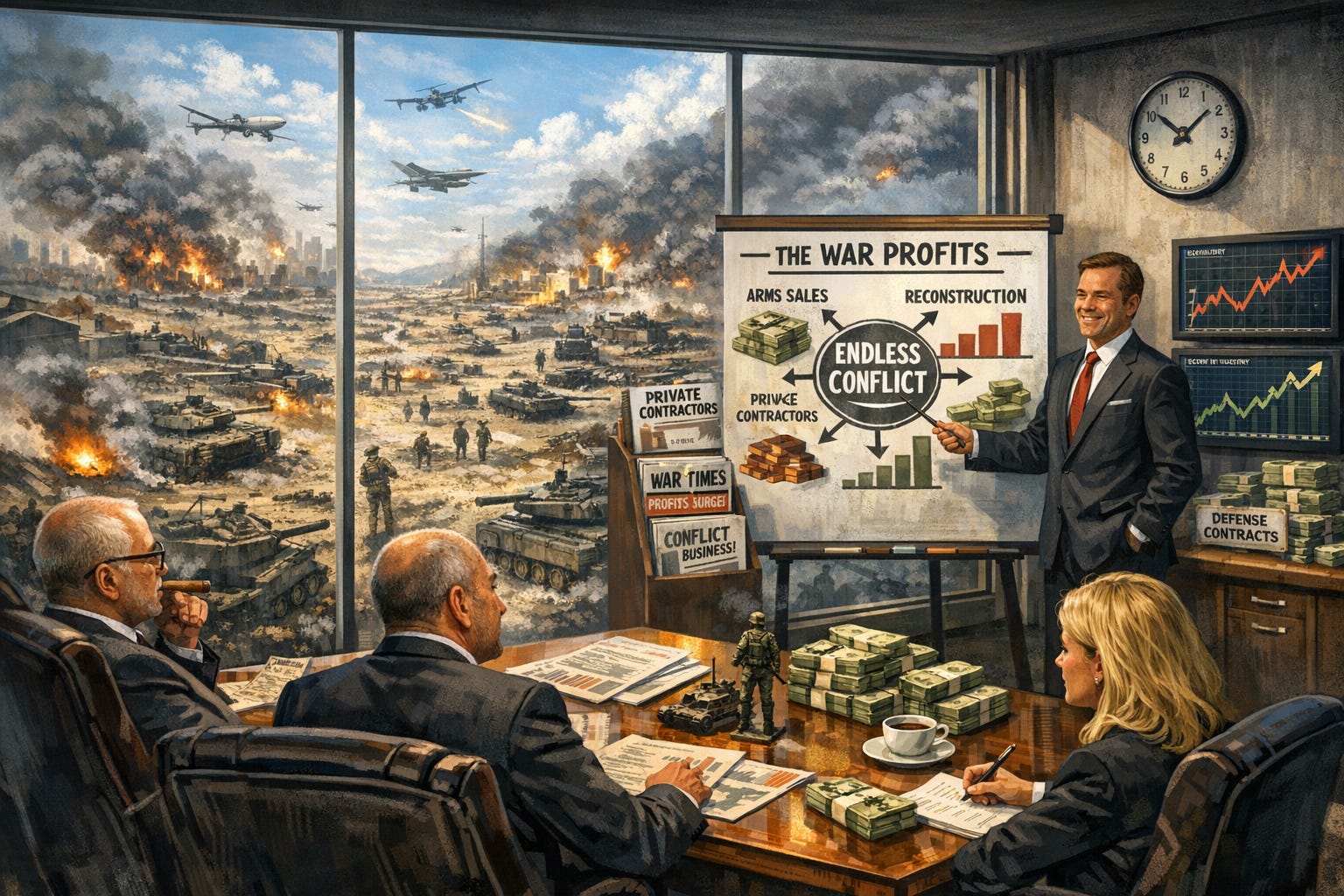
There’s a grammar to modern warfare that we have been slow to read. Not because it’s obscure — its logic is explicit, its beneficiaries named, its ledgers filed in the public domain — but because the vocabulary in which it’s conducted belongs to another story altogether. That story is one of liberation, security, humanitarian concern, and the eventual promise of peace. Beneath it runs a different text entirely, and what it describes is not the ending of conflict but its most profitable phase: the moment destruction gives way to reconstruction, and sovereignty yields to debt.
Industrial economism — the civilisational operating system that subordinates every human and ecological value to the imperatives of capital accumulation and market expansion — has always required frontiers. When geographic frontiers closed, it opened financial ones. When financial ones saturated, it discovered that destruction itself could be made generative: not simply as an industry during wartime, but as the precondition for an even more lucrative industry afterward. The reconstruction economy is not the peace dividend. It is the business model that war was always serving.
The Four-Step Logic
The operational logic is worth stating plainly, because its plainness is itself a kind of evidence. A country is destroyed — through sanctions, proxy conflict, direct bombardment, or the sustained application of military pressure. The military-industrial complex is paid first, in real time, by governments whose weapons procurement budgets dwarf their diplomatic ones. Then a peace deal is offered. The destroyed country, having no material alternative, accepts. It now needs to borrow — billions, sometimes hundreds of billions — to rebuild the physical infrastructure that was unmade in the years preceding. Those loans arrive through the institutional architecture of the postwar order: the IMF, the World Bank, the European Union, and a penumbra of private capital managed by firms whose names recur with remarkable consistency across every theatre of reconstruction. Rules accompany the loans. Conditions are attached. Sovereignty, in any meaningful sense, exits.
This is the documented operating model of the post-Cold War international economic order, visible in Iraq, in Libya, in the structural adjustment programmes applied to the Global South across four decades, and now clear again — with remarkable candour — in the emerging arrangements around Ukraine, Gaza, and the signalled targeting of Iran. What has changed is not the logic but the people announcing it. The architects are no longer even bothering to work through deniable intermediaries. They are identifying themselves.
Negotiators Without Portfolios
Consider the figures who have emerged at the intersection of American foreign policy and real estate capital. Jared Kushner and Steve Witkoff carry no formal diplomatic mandate, no experience in international law, no training in the history of the conflicts they are navigating. What they carry is access — to the American presidency, to sovereign wealth funds, to the private equity infrastructure of post-conflict reconstruction. Witkoff negotiates with Putin. Kushner designs what he has called Gaza’s Board of Peace; entry to which — according to reports that have not been credibly denied — carries a minimum buy-in of one billion dollars. Kushner has described Gaza in the language not of geopolitics but of real estate: a hundred and fifteen billion dollars of beachfront value waiting to be unlocked. This is not a slip of the tongue. It is the vocabulary of the actual project.
Alongside them, the same private equity names appear that appeared after every previous reconstruction: Apollo Global Management, KKR. An eight-hundred-billion-dollar reconstruction package has been assembled for Ukraine before the war has formally ended. Seventeen billion in taxpayer funds has been pledged for Gaza. The scaffolding for Iran is already being measured. These are not coincidences of timing. They are the visible skeleton of a system.
The media calls these men negotiators. The word is not inaccurate, exactly — they are negotiating. But the terms they are negotiating are not primarily political. They are financial. The distinction matters enormously, because it determines whose interests structure the agreement, and whose interests are structured by it.
Industrial Economism and Its Hungers
To understand why this persists — why it doesn’t produce outrage commensurate with its scale — we need to understand the civilisational paradigm that normalises it. Industrial economism is not only an economic system. It’s a total cosmology: a way of assigning value, legitimacy, and meaning that has colonised the full spectrum of social life from education to governance to the conduct of international relations. Within its grammar, the extraction of profit from any event — including catastrophe — is not just permissible but virtuous. It’s called growth. It’s called development. It’s called, with particular audacity in this context, reconstruction.
The paradigm requires continuous expansion. When organic markets saturate, manufactured scarcity and manufactured crisis become structural necessities. War is the most efficient generator of both. It destroys accumulated wealth at scale, creating demand for replacement. It destabilises existing ownership arrangements, creating opportunities for acquisition at distressed prices. It produces debt — sovereign, generational, inescapable — which is the most reliable instrument of long-term control that capital has ever devised. A country that owes cannot refuse. It must comply. A people that owes cannot choose. This is not an accident of the system. It’s one of its primary outputs.
What has changed in the current moment is the degree of frankness. For most of the postwar era, the profit logic of conflict was laundered through the language of security doctrine, humanitarian intervention, or the export of democracy to those who didn’t want it. These rhetorical covers have worn thin enough that the figures operating the system no longer consistently bother with them. When a senior adviser to an American president describes a besieged and starving territory primarily in terms of its real estate yield, and when this statement produces no significant political consequence, we have arrived somewhere new — not in the logic of the system, but in the degree to which that logic is prepared to announce itself.
The Naming Problem
Language is not neutral here. The insistence on calling these processes peace negotiations, the insistence on calling their architects negotiators, is itself a structural feature of the system — part of the mechanism by which consent is manufactured and resistance is pre-empted. If what is happening is a peace process, then to oppose it is to oppose peace. The rhetorical trap is elegant and well-worn. But it depends on a category confusion that we can’t afford to indulge.
Peace, understood in any serious sense, is not just the absence of conflict. It’s a condition in which people are free to determine their own lives, govern their own territories, and participate in their own futures. It’s incompatible with sovereign debt structured by external creditors. It’s incompatible with governance boards whose membership is purchased by financial entry fee. It’s incompatible with the subordination of political arrangements to the prior requirements of capital deployment. What is being constructed in Gaza, in Ukraine, in the emerging architecture around Iran is not peace. It is the institutionalisation of dependency under a flag of truce.
This requires calling out. Not because naming changes the material facts — the loans will still be structured, the beachfront will still be priced, the vulture funds will still be positioned — but because the capacity to recognise what a system is actually doing is the first precondition for imagining something different. Industrial economism survives in part because it has successfully convinced us that its arrangements are natural, inevitable, and ultimately benign. The insistence on accurate language is a small but non-trivial act of resistance against that claim.
The Question of Alternatives
The standard response to any critique of this kind is to ask what the alternative is — as though the absence of a fully specified replacement system is a reason to accept the present one. But the question, honestly engaged, does have answers. Reconstruction finance structured around sovereignty rather than conditionality is not a utopian concept; it has precedents in the Marshall Plan’s non-extractive architecture, however imperfect that precedent may be. Multilateral reconstruction institutions governed by affected populations rather than creditor nations are technically conceivable and politically achievable. Conflict resolution processes from which private capital is structurally excluded are not impossible to design. The issue is not whether alternatives exist but whether the political will needed to pursue them can be assembled against the concentrated interests that benefit from the present arrangement.
That is, ultimately, a question about power. And power, in this context, has both a structural dimension and a cognitive one. The structural dimension — who controls what resources, whose armies stand where, whose currencies denominate the debt — is real and formidable. But the cognitive dimension is the one that has historically proven more permeable. Systems don’t collapse when their opponents become strong enough to defeat them by force. They collapse when enough people withdraw their consent — the everyday, unreflective acceptance of the system’s categories and legitimacies — that keeps them operative. The reconstruction business, like every extractive system, depends on a story about itself that its beneficiaries need us to keep believing.
What We’re Actually Watching
We’re watching the late stage of industrial economism unravel. The ideological covers that once provided plausible deniability — the Cold War binary, the War on Terror’s security logic, the humanitarian intervention doctrine — have degraded to the point where the financial architecture is visible beneath them. What we’re watching is not unprecedented. It’s a version of what was done to colonised territories across four centuries, now being applied with updated instruments to nominally sovereign states whose sovereignty has been devalued by debt, by military dependency, or by the systematic destruction of their physical infrastructure. The form is new. The logic is ancient.
What is genuinely new is the degree to which the system is announcing itself — in press releases, in investment prospectuses, in the casual remarks of people who no longer feel the need to pretend. This candour is not a sign of confidence. It’s a symptom of a system that no longer trusts its own narrative to do the work. When extraction must present itself openly rather than through euphemism, it’s because the euphemisms have stopped working. That failure is worth noting. It’s the kind of thing that precedes change.
Peace is not a business deal. It never was. But the people who are designing the next round of reconstruction have a strong interest in our continued confusion on this point. Clarity, therefore, is not merely an intellectual virtue in the present moment. It is something closer to a political obligation.