Introduction
The economic anthropologist Jason Hickel has argued that if we want to see an end to imperialist wars, we must overcome capitalism. To some, this might sound like a neat slogan, the reduction of all human conflict into a single economic cause. War, after all, is older than capitalism. Rome, Carthage, the Mongols, the Crusaders — none were capitalist, yet all fought wars of expansion and domination. Human beings, it seems, have always been willing to kill and die for territory, for glory, and for gods.
But Hickel’s point is more subtle than that. He’s not claiming that capitalism invented war. Rather, he argues that capitalism reshaped it: gave it a new metabolism and made it universal, and with that I cannot argue. The wars of our age — industrial wars, global wars, resource wars — differ in kind from those of antiquity, and it's impossible to divorce them from capitalism as practised. To see that this is so, we must trace the long arc of history. My intentions is not to dismiss pre‑capitalist violence, but to understand how capitalism transformed war into something relentless, planetary, and potentially permanent.
Wars Before Capital
Pre‑capitalist wars were brutal, but also bounded. Rome’s legions conquered the Mediterranean, but their campaigns were seasonal and limited by logistics. They fought for tribute, slaves, and land — wealth in tangible form. The Mongols swept across Asia with terrifying speed, but their empire fractured within generations; it was fuelled by pasture needs and prestige, not by the endless compulsion to expand markets. The Crusaders marched for salvation, their campaigns drenched in blood, but they were episodic, not structural requirements of an economic system.
Empires rose and fell, often violently, but they could pause. Rome could consolidate provinces for centuries. The Ottomans could hold their ground without perpetual outward push. War was central, yes, but it was not required for the survival of the system.
Capitalism’s Colonial Metabolism
That changed with the birth of capitalism. The Spanish conquest of the Americas was not the first empire, but it was the first fully capitalist one. Gold and silver from Potosí and Zacatecas did more than just enrich monarchs. These precious metals became the foundation of Europe’s emerging money economy, fueling global trade routes. The genocide of indigenous peoples, the plantation system of sugar and cotton, the transatlantic slave trade: these weren't incidental atrocities. They were essential to how wealth was created and accrued.
The Portuguese in Brazil, the Dutch in Indonesia, the British in India — everywhere, commerce and conquest fused. Chartered companies like the Dutch and British East India Companies were corporations with armies. They fought wars, signed treaties, toppled rulers. Violence became routine, not episodic. It was the enforcement arm of profit.
By the seventeenth century, capitalism had mutated war into something structurally necessary. Colonies were not luxuries; they were lifelines. Sugar from the Caribbean, tea from Ceylon, spices from Indonesia, cotton from India — these were not trophies but inputs for a global world-system. War became the mechanism by which extraction zones were created and defended.
What distinguished these wars was not their brutality — pre‑capitalist empires were brutal enough — but their inherently self‑sustaining logic. Rome could stop conquering. Spain, Britain, Holland could not. To pause meant to stagnate, to be outcompeted. Capitalism created a zero‑sum game in which survival meant expansion. Each empire had to extend its reach or face decline. War was no longer occasional. It had become structural.
And this new metabolism fed on extraction. Land, minerals, human bodies — all were commodified. Africans were enslaved to work plantations; forests were cleared for sugar; mines devoured indigenous labour. The Atlantic slave trade was not an aberration; it was the engine of early capitalism. Millions died. But not because of episodic cruelty. It was because the system demanded it.
Industrial Imperialism
By the late eighteenth and early nineteenth centuries, the connection between capitalism and conflict was complete. Industrialisation multiplied demand: cotton for textiles, coal for steam engines, rubber for tyres, copper for wires. Colonies were not optional any longer; they were indispensable. The Opium Wars forced open Chinese markets, turning addiction into imperial policy. The Berlin Conference of 1884 parceled Africa like a pie chart, its people treated as obstacles or labour inputs. Leopold’s Congo became a slaughterhouse for rubber, killing millions.
This was not empire for honour. It was empire for commodities. And it set the stage for the industrial wars of the twentieth century.
The “Scramble for Africa” is often described as though it were a sudden frenzy, a diplomatic accident set off by the ambitions of a few men. But it was nothing of the sort. It was the logical consequence of industrial capital’s insatiable hunger. By the late 1800s, Europe’s factories were producing more goods than their domestic markets could absorb. Overproduction — a problem Marx had foreseen — threatened a crisis in consumption. The solution was to force open new markets and secure cheap raw materials abroad. Africa, rich in resources and perceived as “empty” by European eyes, became the prize.
The Berlin Conference of 1884 was not a gathering of statesmen in the traditional sense. It was more like a boardroom meeting, where the continent was carved into zones of plunder. No African voices were heard. Lines were drawn across maps with little regard for the people who lived there. Soon came the railways, plantations, and mines. And with them, the massacres. Leopold’s Congo became infamous, a slaughterhouse for rubber, where millions perished under a regime that measured human lives against quotas of latex. But in truth, the entire continent was subjected to variations of the same logic: extraction enforced by violence.
China provides another relevant example. British merchants had developed a taste for tea, silk, and porcelain. China had demanded silver in return, creating a trade imbalance. The solution, devised in London’s counting houses, was to flood China with opium grown in India. When Chinese authorities resisted, Britain sent gunboats. The Opium Wars were not fought for honour or faith. They were fought for profits. Addiction became imperial policy, enforced by cannon fire.
From Colonies to World Wars
As empires expanded, they collided. By the early twentieth century, almost the entire world had been carved up by Britain, Spain, France and the Dutch. Latecomers like Germany and Italy found themselves at a disadvantage. Their industries demanded colonies that were already occupied. Their frustrations grew. The system could not expand indefinitely without conflict among the predators themselves.
This is why World War I was inevitable. It wasn’t just a tragic accident caused by tangled alliances. It was the result of how capitalism had evolved. As Lenin explained in Imperialism, the Highest Stage of Capitalism, established capitalism produces giant monopolies, concentrates power in finance, and pushes wealthy nations to invest and expand abroad. But by the early 1900s, the world’s markets and colonies had already been carved up. That meant the great powers of the time were inevitably going to collide, each trying to protect or expand their share. The war was the structural outcome of this global capitalist competition.
The First World War was the first fully industrial war. Machine guns, poison gas, tanks, and airplanes turned battlefields into slaughterhouses. Ten million died in the trenches, not for ideals but for empire. Behind the nationalist rhetoric of honour and freedom lay the scramble for colonies, the competition for markets, the defense of trade routes. The war was capitalism devouring itself — contradictions erupting in mud and blood.
The aftermath was no less revealing. At Versailles, victors divided the Middle East into mandates, securing oil for Britain and France. Reparations and debt crushed Germany, setting the stage for the next conflagration. The League of Nations promised peace, but behind its lofty phrases stood the same economic rivalries, unresolved and festering.
World War II was, in part, the result of those unresolved contradictions. Germany and Japan, excluded from the first imperial banquet, sought colonies of their own. Their visions — Lebensraum in Eastern Europe, the Co‑Prosperity Sphere in Asia — were economic projects dressed in nationalist myths. Hitler’s dream of a thousand‑year Reich was inseparable from the need for oil, grain, and land. The Holocaust itself, although uniquely horrific, was bound to this project: a racialised capitalism that saw human beings as obstacles to be removed for the sake of resources.
The Pacific war revolved around oil and rubber as much as ideology. Japan’s strike on Pearl Harbour was driven by US embargoes that cut off access to fuel. The Allies, too, pursued economic goals. American entry into the war ensured not just the defeat of fascism but the establishment of a new global order, secured by institutions like the International Monetary Fund and World Bank, designed to open markets under the Pax Americana.
The brutality of the war — fifty million dead, cities reduced to ash by firebombing and nuclear blasts — was not an aberration. It was the culmination of capitalism’s logic of imperial competition.
Cold War Empires
The Cold War entrenched this fusion of economics and war. On the surface, it seemed like an epic contest of ideologies: capitalism versus communism, freedom versus dictatorship. But beneath the rhetoric lay a consistent economic reality. The United States sought to secure capital markets, investment flows, and access to resources. The Soviet Union sought to preserve its bloc and project influence.
Proxy wars were fought across the globe. Korea, Vietnam, Angola, Afghanistan, Nicaragua — battlefields where local struggles were subsumed into the larger clash of world‑systems. Coups and interventions proliferated. The CIA toppled governments in Iran (oil), Guatemala (bananas), and Chile (copper), not because these nations in any way threatened American security, but because they endangered American corporate interests. United Fruit, ITT, Standard Oil — their profits were national security.
Soviet interventions in Hungary, Czechoslovakia, and Afghanistan likewise revealed the imperial side of a system that claimed to have abolished it. The Red Army didn’t march for profit; it marched to maintain control over Soviet borders resources, and influence. Both systems acted imperially, but global capitalism had the advantage: it was integrated, flexible, adaptive. Institutions like the IMF and World Bank embedded economic domination into governance, enforced by the spectre of US military power.
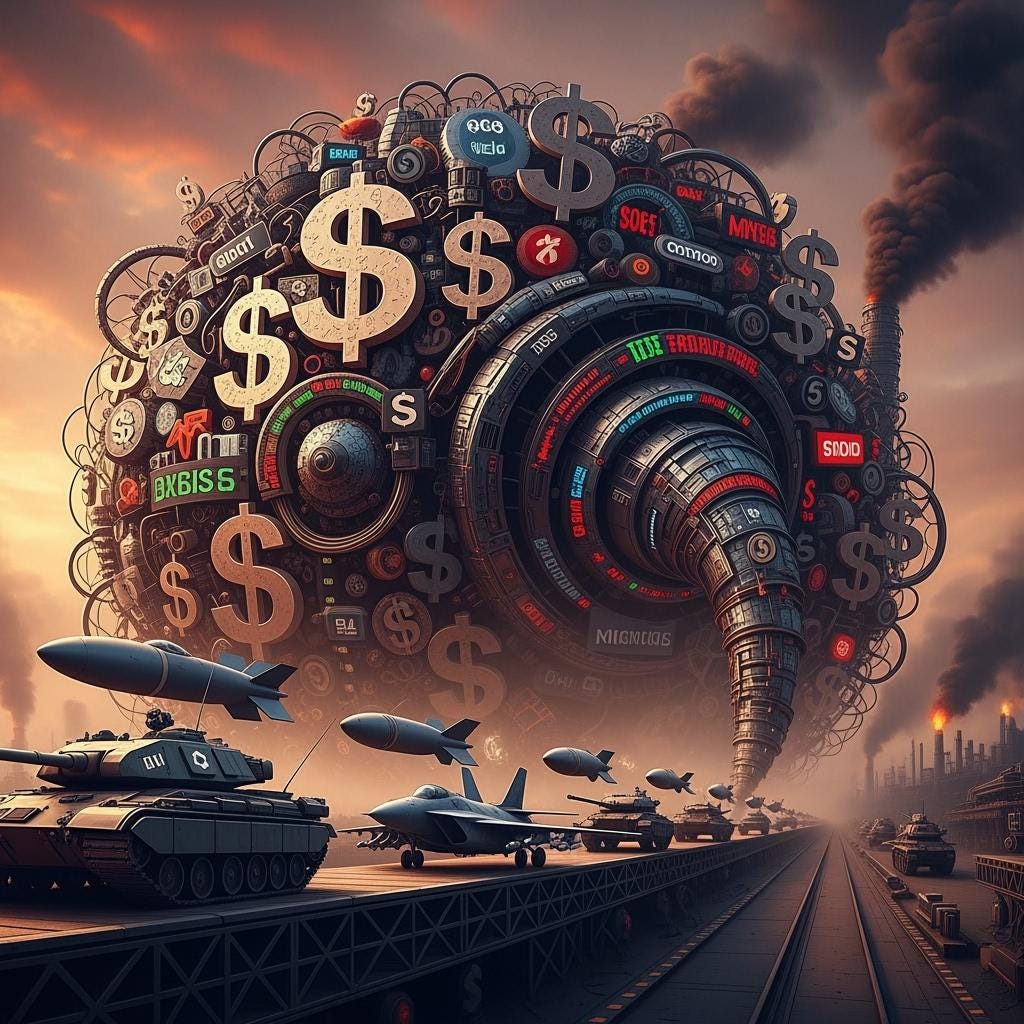
By the mid‑twentieth century, another feature had emerged: the self‑perpetuating cycle of the military‑industrial complex. Dwight Eisenhower, hardly a radical, warned of it in 1961. Arms manufacturers, defense contractors, and lobbyists had a vested interest in perpetual conflict. But they were not alone. Generals and military bureaucracies pressed for ever‑larger budgets, knowing that bigger arsenals at home meant more power and prestige internationally. Politicians, too, discovered that defense spending brought jobs and contracts to their districts, turning war into a tool of domestic politics. And behind it all, banks and investors reaped steady profits from holding shares in the weapons industry. High military spending meant high returns.
This is capitalism’s genius: to turn even destruction into accumulation. Bombs are dropped, cities levelled, and contracts signed to rebuild what was destroyed. War becomes a market, and death becomes a revenue stream.
Neocolonialism and Resource Wars
By the late twentieth century, formal empires were collapsing, but informal ones thrived. Decolonisation didn’t end extraction; it rebranded it. The IMF imposed structural adjustment austerity programs that forced nations into debt traps, opening markets to foreign capital. Multinational corporations replaced colonial governors, but the logic was exactly the same.
And when nations resisted, war returned. The US invasion of Grenada in 1983, the bombing of Libya in 1986, the Gulf War in 1991 — each justified in moral language, each rooted in strategic and economic interests. By the century’s end, capitalism had perfected its machinery of war. It no longer needed formal colonies. Debt, trade agreements, and military bases did the work. But if subtlety failed, bombs still fell.
By the dawn of the twenty‑first century, the old imperial empires had formally collapsed, but the logic of extraction had not. It had been refined, streamlined, and globalised. Where governors once ruled colonies, corporations now managed supply chains. Where fleets once seized ports, trade agreements and debt repayments took up the work. And if any resistance arose, or when rival powers challenged dominance, the old tools reappeared. Gunboats had been replaced by drones, but the logic was the same: war as enforcement of accumulation.
The 2003 invasion of Iraq is often remembered through the rhetoric of “weapons of mass destruction” and the “war on terror.” But beneath all the weasel words from George W. Bush and the flags, the war was about oil. Documents later revealed that US and British officials were discussing oil contracts months before the invasion.
The companies that profited — Halliburton, Bechtel, BP, ExxonMobil — tell the story. The war was not a blunder. It was an armed restructuring of Iraq’s economy. Contracts were rewritten, pipelines secured, fields reopened to foreign companies. Hundreds of thousands of Iraqis died, millions were displaced, but the mechanism of accumulation was restored. The occupation was not chaos; it was enforcement.
This was capitalism at its most naked: destruction followed by reconstruction contracts, death followed by profit. War was not failure. It was highly profitable business.
Afghanistan, too, became a theatre of accumulation. The war stretched on for two decades, the longest in American history. It was framed as retaliation for terrorism, but it quickly became a playbook for contractors. Private firms supplied everything from fuel to food, from logistics to intelligence. Billions flowed to corporations, while Afghans endured endless bombardment.
The war was unwinnable by design, because winning was never the point. Constant conflict meant permanent contracts, steady budgets, and political leverage. By now the military‑industrial complex had developed into a self‑sustaining ecosystem: armies, contractors, investors, and politicians all bound together in cycles of profit and power. In this system, war itself becomes the product — not just in Southeast Asia or the Middle East, but wherever militarised control and occupation can be justified. Each new front, whether Vietnam, Iraq, Afghanistan, or Gaza, reveals the same underlying pattern: conflict is less a failure of policy than a structural feature of accumulation.
Congo reveals the same logic. Its minerals — coltan, cobalt, copper, gold — are indispensable for modern life. The technologies and conveniences upon which we rely—smartphones, laptops, electric vehicles, and more—are deeply connected to exploitation in resource-rich but politically and economically vulnerable regions. But the supply chains are soaked in blood. Militias finance themselves through mines; children dig cobalt with their hands. Multinationals purchase through opaque intermediaries, ensuring plausible deniability. Congo is not a failed state. It's a looted one.
Gaza is often framed solely in terms of nationalism and security. Yet beneath its tragedy lies energy. Offshore gas reserves in the eastern Mediterranean have long been contested. Control of these reserves, and the infrastructure needed to exploit them, adds another layer of complexity to the violence. Energy corridors haunt even the ruins.
Yemen, too, is more than a proxy war between Saudi Arabia and Iran. It sits on the Bab el‑Mandeb Strait, a chokepoint for global oil flows. Whoever controls Yemen controls a crucial valve of the global economy. The humanitarian catastrophe — famine, disease, bombardment — is inseparable from this geography. Yemenis suffer not only from politics but from the fact that their land is a bottleneck in the arteries of capital.
Ukraine’s war is often cast as a clash of civilizations: democracy versus authoritarianism, sovereignty versus aggression. And it is certainly that. No question. But it’s also about pipelines, markets, and resources. Ukraine is one of the world’s largest exporters of grain. Its pipelines carry gas to Europe. Its land is fertile, its industries strategic.
For Russia, Ukraine is both a buffer and a breadbasket. For the West, it’s a frontier of expansion. The enlargement of NATO, you see, is not only military; it is economic integration. The war is not reducible to capitalism, but capitalism structures it. Security and accumulation are fused.
New Frontiers of Extraction
As ice melts, the Arctic reveals new shipping routes and fossil fuel reserves. What should be a planetary red line — leaving carbon in the ground — becomes instead a new arena of preposterous competition. Russia, the United States, Canada, and others jostle for control, deploying icebreakers and submarines. Climate catastrophe itself becomes a frontier for profit. This is capitalism’s genius and its curse: to turn even collapse into opportunity. The melting Arctic is not a warning but a market.
The so‑called green transition offers no escape from the predator’s logic. Electric cars, wind turbines, and solar panels require lithium, cobalt, nickel, and rare earths. Much of the world’s lithium lies in the salt flats of Bolivia, Chile, and Argentina. These fragile ecosystems are now sites of scramble.
The rhetoric is sustainability, but the reality is extraction. Communities are displaced, water tables drained, landscapes scarred. Militaries hover in the background, ready to secure supply. Green capitalism does not abolish imperialism. Once again, it rebrands it. The wars of the twenty‑first century will be fought not only for oil but for the minerals of the green transition.
As the century unfolds, climate breakdown will drive conflict on a scale we can hardly begin to imagine. Water scarcity, crop failures, rising seas — these will displace hundreds of millions. Borders will harden, militaries will mobilise, walls will rise. Migration will be securitised, turned into a pretext for violence.
Already we see glimpses: conflicts in the Sahel fuelled by desertification, Syrian refugees destabilising politics in Europe, water disputes in South Asia. These are not distant futures. They are the "here and now". And capitalism, far from mitigating them, accelerates and amplifies them. Its addiction to fossil fuels drives warming. Its inequality ensures the vulnerable suffer most. Its militaries prepare not for prevention but for enforcement. Climate wars are not distant possibilities. They are inevitable, unless the system, or human morals, change.
What began with colonies and oil fields now stretches toward the stars. The same logic that turned Vietnam, Iraq, Afghanistan, or Gaza into profitable quagmires is already being projected onto the Moon, Mars, and beyond by the technocratic elite. Mining rights, orbital infrastructure, and lunar bases are cast as the next frontier of progress. But beneath the rhetoric lies the familiar pattern: accumulation secured through militarised control. Lenin described imperialism as the highest stage of capitalism; Eisenhower warned of the military‑industrial complex. Together, their insights point to the same conclusion: in the twenty‑first century, war and expansion have become structural necessities of the extractionist world‑system — and now threaten to become interplanetary in scale.
Beyond Critiques
Critics are fond of reminding us that war predates capitalism. True. But my point is not to do with invention. It is transformation. Capitalism transformed war into a structural, continuous, and mechanised enterprise. Others point to socialist states as counterexamples. Yes, the Soviet Union and China acted imperially. But they did so in a world dominated by capital, forced into militarisation by encirclement and competition. Their imperialism was derivative, shaped by pressures emanating from global capitalism.
Liberals argue capitalist democracies rarely fight each other. Again true — but they export violence relentlessly. Europe’s peace rests on centuries of colonial plunder and ongoing extraction. America’s peace with Canada coexists with its record of interventions in Latin America. The absence of intra‑capitalist wars is not proof of capitalism’s pacifism but of its success at externalising violence.
Realists insist that anarchy drives war. But that underestimates how capitalism defines security itself. Oil flows, trade routes, technological standards — these are economic goods treated as security imperatives. Capitalism fuses them.
So we return to Hickel’s claim. Would abolishing capitalism abolish war? Perhaps, but not entirely — human rivalry runs deep. Without abolishing capitalism, or at least what it’s become, enduring peace is impossible. The system’s predatory metabolism ensures that crises will always generate conflicts, that markets will always be enforced by militaries, that imperialism will always find new justifications.
This is not an ideological exaggeration. It's an ingrained systemic truth. From Iraq to Congo, from Gaza to Ukraine, from the Arctic to the lithium triangle, the trajectory is clear: today’s capitalism requires extraction, and extraction requires enforcement. When contracts fail, bombs fall. When communities resist, drones strike. When rivals threaten, wars erupt.
The Predator’s Logic
The challenge is not only to critique capitalism, but to re‑imagine economics altogether: sufficiency instead of accumulation, stewardship instead of extraction. To redefine security as cooperation rather than domination. To build institutions that restrain predatory power. To cultivate cultures that see the Earth not as a quarry or a garbage tip but as Gaia — the source of all life.
This is not utopianism. It is survival. Without transformation, the twenty‑first century will most likely become a century of endless resource wars — over oil, over water, over lithium, over land. To imagine peace while leaving capitalism intact is to imagine fire without heat.
Hickel’s insight is not reduction but clarity. War has many causes, but in the modern era its central engine has been the predator’s logic of capital. To end imperialist war is to end the empire of extraction. Anything less is to mistake flickering shadows for the fire. The predator’s logic can expand to the heavens, but only at the cost of life below. To break it is not a dream — it's most likely the core precondition for our survival.