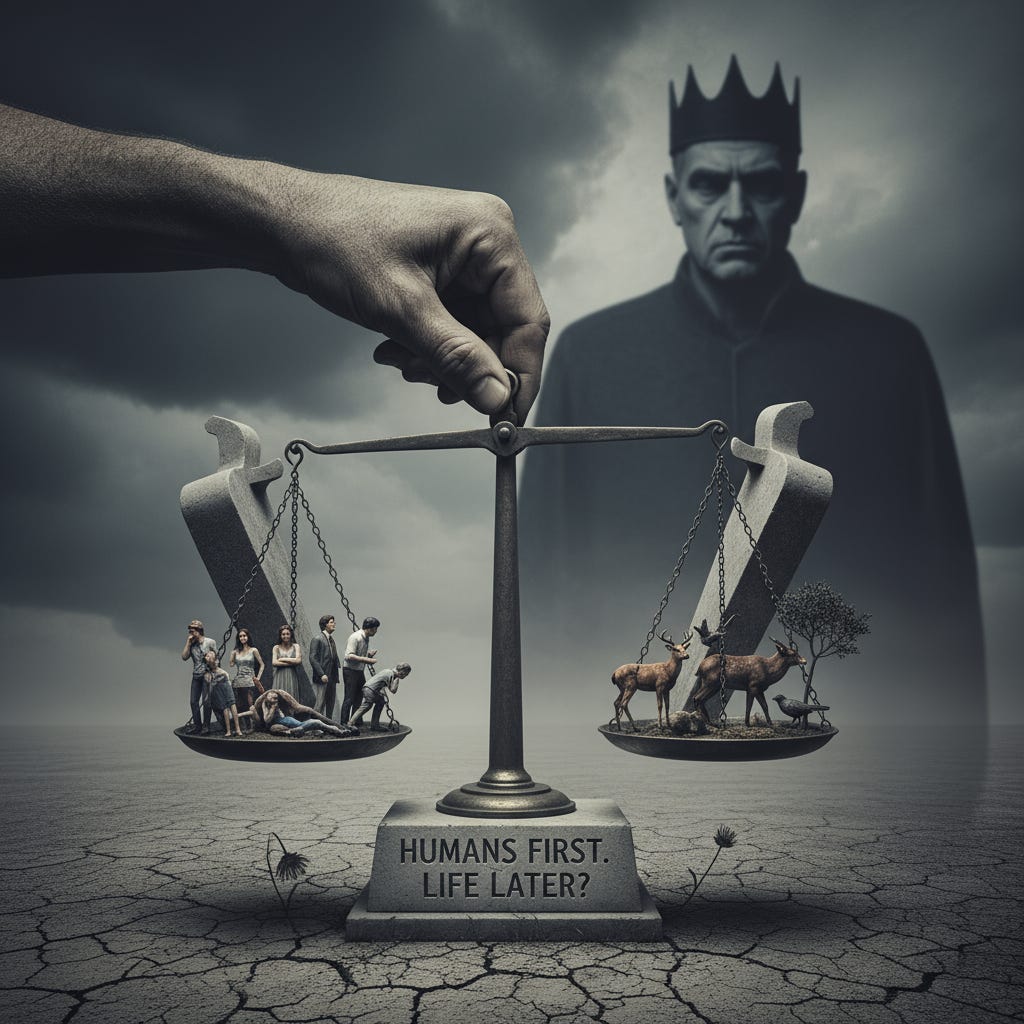
Humanity teeters on the edge of an existential unravelling, where converging crises stem from the unyielding grip of our dominant worldview. This is the fundamental cognitive charter that dictates our perception and comprehension of existence. There are three dominant pillars:
Anthropocentric supremacy separates humans from the “more-than-human” world, treating nature as a resource to conquer
Hyper-individualism privileges solitary ambition over shared flourishing
Extractive ideologies, such as neoliberal capitalism, conflate progress with perpetual expansion at any cost.
Far from ethereal abstractions, this worldview spawns our physical, measurable, world-system. It’s here that economies commodify life itself, polities entrench disparities, and innovations favour mechanistic efficiency over any sense of moral equilibrium. With increased scale this world-system has become toxic: more humans on the planet means we’re consuming more, more raw materials are being extracted, more products are being manufactured; greater industrialised food yield is causing obesity and ill-health, and more waste is polluting the environment. The source worldview, a global monetocracy which I call “industrial economism” (arguably the main reason for what we term progress), is now propelling us toward a precipice that demands radical recalibration.
The crisis manifests in any number of converging threats: climate destabilisation eroding habitable zones, biodiversity collapse unravelling food webs, and AI-driven disruptions amplifying social fragmentation. These are compounded by water scarcity sparking resource wars, economic inequality fuelling societal unrest, and pandemic threats overwhelming fragile healthcare systems. Ocean degradation and fisheries collapse undermine global food security, while deforestation and the loss of indigenous land accelerate environmental destruction. Polar ice melt and rising sea levels displace millions, as urban overpopulation strains infrastructure and mass migration overwhelms borders, creating humanitarian crises. Meanwhile, energy crises and geopolitical tensions over resources like rare earth metals exacerbate instability, and cybersecurity vulnerabilities allow digital warfare and misinformation to undermine institutions. Together, these interconnected crises form a feedback loop of escalating global instability.
These are not isolated events but symptoms of a worldview mismatch—an outdated mental model colliding with the complexities of a finite, interconnected planet. Worldviews evolve at a glacial pace, mostly through cultural reification of core beliefs. However, they become dysfunctional when environmental pressures exceed their design. The inertia of these paradigms—reinforced by cognitive biases, institutional power, and narrative habits—prevents the substantive recalibrations needed for survival. How is this relevant for us now? Changing our minds about the veracity and indeed virtue of “industrial economism” means confronting not just core beliefs but the very ontology they sustain, leaping from separation to symbiosis in a world where stasis equates to extinction.
The Evolutionary Threshold
At this juncture, humanity must cross an evolutionary threshold: this requires a giant leap of consciousness that re-orients our basic belief systems toward adaptive resilience. History demonstrates that such leaps are not anomalies but necessities for species survival. The Agricultural Revolution, for instance, shifted human consciousness from nomadic animism to settled dominion over land, enabling population growth. The Axial Age birthed an ethical worldview that transcended tribal loyalties, fostering moral frameworks like Confucianism and Buddhism. The 18th-century European Enlightenment recalibrated from divine absolutism to rational inquiry, birthing scientific realism and democracy.
Today’s required leap is unprecedented in scale and urgency: a progression from atomistic individualism to syntrophic symbiosis, where consciousness recognises itself as embedded in planetary networks. This entails substantive changes in our core convictions—redefining value not as material extraction but as regenerative balance; viewing time not as linear chronological movement but as cyclical stewardship; and embracing epistemology not as conquest of knowledge but as humble participation in emergent truths. Ontologically, this threshold demands an expanded sense of self, where “I” includes ecosystems and future generations, generating a world-system where bioregional governance rubs shoulders with circular economies.
The radical nature of this evolution lies in its systemic depth: worldviews are not personal opinions but shared mental models - collective operating systems, propagated through education, media, and policy. Crossing the threshold requires disrupting these loops, acknowledging that survival hinges on epistemic humility—treating all paradigms as provisional maps, subject to revision in light of global realities. Without this leap, we remain trapped in maladaptive cycles, accelerating toward collapse.
The Stasis Trap
Why, then, does humanity cling to a worldview that propels us toward ruin? The answer lies in a multifaceted stasis trap, where neurobiological, psychological, and sociocultural forces conspire against any fundamental change. Neurologically, our brains are wired for predictive coding—favouring familiar patterns to minimise energy expenditure, making radical recalibrations feel like threats to survival. This manifests as confirmation bias, where evidence contradicting anthropocentric or individualistic paradigms is dismissed as anomaly.
Psychologically, worldviews anchor identity; substantive shifts induce existential dissonance, a perverse comfort in denial over the discomfort of reconstruction. Socioculturally, power structures tautologically reinforce dominant paradigms—capitalist systems reward extractive mindsets, while hierarchical institutions punish deviation as instability. As Max Planck noted, scientific paradigms often advance “one funeral at a time,” but in our accelerated crisis, generational turnover is insufficient. This trap is amplified by global inequities: our colonised worldview, as critiqued by Achille Mbembe, imposes rigid hierarchies that stifle adaptive indigenous knowledges, perpetuating a cycle where change feels impossible.
Philosophically, this reveals the perverse undercurrent of stasis: it masquerades as stability while eroding resilience. Radical and utilitarian mind-changing demands breaking free—confronting the trap’s illusions to enable the leap. Without addressing these barriers, our world-system remains locked in self-destructive loops, blind to the adaptive intelligence required for survival.
Pathways to Metamorphosis
Metamorphosis is not inevitable doom but a deliberate process: catalysing collective mind-changing through targeted pathways that disrupt stasis and foster evolutionary leaps. These must operate at multiple scales, leveraging each crisis as a crucible for transformation.
Liminal Technologies serve as accelerators, tools designed to induce perspective shifts and rewire consciousness. Contemplative technologies, such as biofeedback systems that enhance empathic neural pathways, can dissolve egoic separation, fostering a relational worldview. Complexity simulators—AI-driven models visualising multicrisis scenarios—bypass denial by immersing users in systemic interconnections, prompting substantive recalibrations like shifting from growth obsession to regenerative limits. Memetic ecosystems, platforms curating narratives of symbiosis (drawing from indigenous ethics or Eastern non-duality), amplify an adaptive worldview, countering dominant memes through viral cultural evolution.
Fractal Transformation ensures scalability, propagating change through nested levels. At the micro scale, personal recalibration begins with embodied practices—mindfulness rituals or nature immersion that erode anthropocentric illusions, evolving individual consciousness toward interdependence. Meso-level communities of practice, such as regenerative cooperatives or citizen assemblies, prototype a world-system immersed in principles of ecority (i.e. ecological integrity), testing symbiotic governance in small localised experiments. Macro-level reforms involve redefining success metrics—replacing GDP with indices of ecological vitality and relational well-being, institutionalising mind-changing as policy.
Crisis as Crucible reframes existential threats as opportunities for leaps of consciousness. Climate breakdown initiates planetary stewardship, compelling a shift from exploitation to guardianship. AI disruptions redefine human purpose, evolving from control-based models to collaborative intelligence. Pandemics reveal interdependence, accelerating moves from individualism to communal resilience. These pathways are radical in their integration: they demand not just intellectual assent but lived embodiment, where mind-changing generates self-reinforcing systems aligned with survival.
The Emerging World-System
As consciousness leaps, an emerging world-system materialises, the manifestation of a recalibrated worldview that prioritises symbiosis over separation, and ecority over economism. Consider the transitions:
• From competition as engine to cooperation as foundational, birthing steward-owned regenerative cooperatives where economic activity serves ecological restoration, not extraction.
• From growth as telos to sufficiency as imperative, yielding regenerative economics and circular bioregions that maintain human needs within planetary boundaries.
• From human as controller to human as participant, inspiring biomimetic design and multispecies justice frameworks that integrate non-human agencies into decision-making.
These are not utopian ideals but biophysical imperatives: systems resisting symbiosis face energetic collapse, as finite resources clash with infinite-growth illusions. Philosophically, this emergence reflects an adaptive ontology—our world-system as a living extension of consciousness, evolving through feedback to sustain life. The radical promise is a harmonious global network, where substantive mind-changing and embracing of 3rd-order change ensure humanity’s role as co-creator, not destroyer.
The Courage to Re-conceive
Humanity’s survival rests on a profound truth: worldviews symbolise our deepest collective choices. They are not inevitabilities, and substantive recalibration is our mandate for metamorphosis. This giant leap of consciousness—from rigid separation to adaptive symbiosis—demands intellectual kenosis, emptying inherited models that no longer sustain life; relational audacity, forging polities of mutual care; and temporal defiance, acting as ancestors to future beings.
As indigenous wisdoms like the Kogi’s aluna (cosmic consciousness) remind us, we must “think with two minds”—honouring ancestral insights while co-creating an emergent paradigm of ecority. If we cling to stasis, collapse will follow; if we embrace the leap, however traumatic the strggle, we evolve into resilient stewards of a thriving world. The metamorphosis begins with the courage of applied wisdom: declaring all we had assumed incomplete, and reimagining everything in service to life’s continuum.