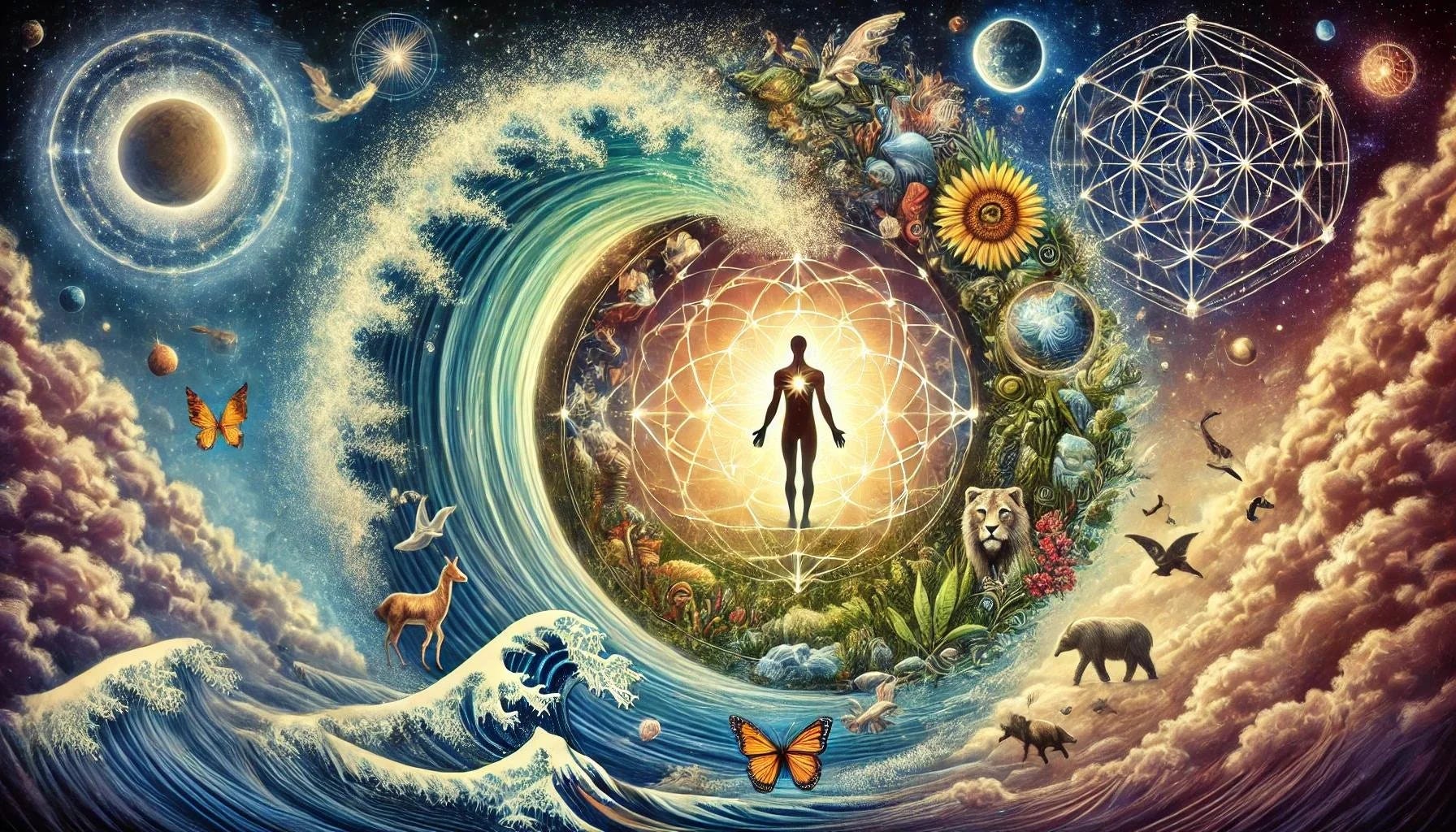
The conversation about whether Earth would prosper without humanity fundamentally misframes our predicament. We’re not discussing a hypothetical absence but confronting an evolutionary reality—we are here, wielding geological-scale powers with Palaeolithic emotions and mediaeval institutions. The more relevant question is not whether the planet needs us but whether we can evolve rapidly enough to become the species this moment demands.
Let me be precise about our situation. We’ve entered what systems theorists recognise as a phase transition, where the old organising principles of human civilisation have become actively pathological. The extractive logic that built our world now cannibalises it. The competitive dynamics that drove our evolution now threaten our extinction. The tribal identities that once ensured survival now fragment our response to planetary-scale challenges. We are, in essence, a success story that has outlived its own premises.
Consider the thermodynamic reality. Earth functions as a dissipative structure, processing solar energy through increasingly complex arrangements of matter and information. For billions of years, this complexity accumulated through purely biological evolution—a slow, patient elaboration of forms and relationships. Then consciousness emerged, and with it, a new evolutionary mechanism: cultural transmission. Suddenly, information could accumulate and transmit outside genetic constraints. The biosphere had evolved a capacity to observe and modify itself.
This is where conventional environmental discourse reveals its poverty of imagination. Yes, we have triggered a sixth mass extinction, but focusing solely on destruction obscures a more profound transformation. We represent the biosphere’s first attempt at conscious self-regulation. The Anthropocene is not merely an epoch of damage but a transition phase where evolutionary dynamics shift from purely genetic to increasingly memetic and technological vectors. We are witnessing—and participating in—evolution’s attempt to evolve its own evolutionary mechanisms.
The ecological accounting that condemns us—the megafaunal extinctions, the atmospheric disruption, the oceanic plastification—represents the birth pangs of this transition. Every previous major evolutionary leap created massive disruption. The Great Oxidation Event, when cyanobacteria poisoned the atmosphere with oxygen, eliminated most existing life forms. Yet it also enabled the aerobic metabolism that powers complex life today. Our disruption differs only in its conscious dimension—we can comprehend our impact and potentially modulate it.
But comprehension without corresponding institutional evolution creates a unique form of suffering. We see the catastrophe approaching yet seem paralysed to prevent it. This paralysis does not stem from ignorance but from a fundamental mismatch between our governance structures and our technological capabilities. We try to manage planet-shaping technologies with institutions designed for agrarian societies. We make irreversible planetary decisions through political systems that can’t think beyond electoral cycles. We’ve become gods with the wisdom of infants.
The tragedy of the commons that economists describe is actually a tragedy of disconnection. When consequences are displaced in space and time, when feedback loops span decades or continents, our evolved moral intuitions fail. The manager who approves toxic waste disposal never sees the cancer clusters. The consumer who buys palm oil never witnesses the orangutan’s habitat destruction. The voter who supports short-term economic growth never directly experiences the climate chaos their grandchildren will inherit. We have created systems that systematically obscure consequences, then wonder why we make destructive choices.
Yet within this dysfunction lie seeds of transformation. The very fact that we can map these failures, that we can model climate systems, that we can track biodiversity loss, and that we can communicate instantaneously across the globe, for example—hint at emergent properties of a planetary nervous system. The internet, satellite monitoring, artificial intelligence, and genetic engineering—these are not just discrete instruments but potential organs of a new form of collective intelligence that could operate at the scale and speed our challenges demand.
The climate crisis serves as an evolutionary forcing function. It creates selection pressure for cooperation at unprecedented scales. Nations that cannot collaborate on emissions reduction face cascading agricultural failures, mass migrations, and social collapse. Corporations that cannot transition to circular economies face stranded assets and supply chain disruptions. Individuals who cannot expand their circle of concern face a world of perpetual conflict and scarcity. The crisis is pedagogy at a planetary scale, teaching us through consequence what we failed to learn through foresight.
This is where strategic foresight methodologies such as those being developed by the Asian Foresight Institute become essential. We must cultivate what I call “temporal multiliteracy”—the ability to read patterns across multiple timescales simultaneously. The quarterly report and the geological epoch must coexist in our decision-making. We need institutional innovations that embed both anticipatory and longer-term thinking into immediate incentive structures. Carbon pricing, ecological accounting, regenerative economics—these are not policy preferences but survival prerequisites.
The transformation required is thus fundamentally ontological. We must shift from seeing ourselves as separate from nature to understanding ourselves as nature’s experiment in self-awareness. This is not mere philosophical repositioning but a practical necessity. When we truly grasp that we’re not on the planet but of it, that consciousness is not alien to Earth but Earth’s way of knowing itself, then preservation becomes self-interest properly understood, not altruism.
Consider this. We’re potentially the only conscious beings in the observable universe. The silence of the cosmos—Fermi’s paradox—suggests that the leap from life to consciousness to technological civilisation is extraordinarily rare, perhaps unique. If we fail, it may be millions or billions of years before consciousness re-emerges, if ever. We carry not just our own future but potentially the only future where the universe comprehends itself.
The institutional architecture for our metamorphosis already exists in embryonic form. The Paris Agreement, however inadequate, represents humanity’s first attempt at planetary-scale coordination. The Sustainable Development Goals, despite their contradictions, articulate a shared vision for human flourishing within ecological boundaries. Indigenous governance models demonstrate sustainable relationships with ecosystems across centuries. The technologies for renewable energy, regenerative agriculture, and circular manufacturing mature daily. What’s missing is not knowledge but integration—the weaving of these elements into a coherent civilisational transformation.
We’re at a bifurcation point. The old trajectory—exponential growth on a finite planet—has reached its limits. Two attractors compete for our future: ecological and social collapse or conscious evolution toward what we might call a “Gaian civilisation”—one that enhances rather than degrades planetary resilience. The window for choosing between these futures narrows with each passing season.
The pessimism that declares Earth better without us mistakes a phase for a conclusion. Yes, our adolescent phase has been catastrophically destructive. But adolescence is not destiny. Species, like individuals, can mature. The question is whether we can compress millennia of potential moral and institutional evolution into the decades we have remaining.
The measure of our success will not be the absence of impact—that’s neither possible nor desirable for a conscious species. Rather, it will be the quality of our integration with Earth’s systems. Can we become a force for increasing biological diversity rather than reducing it? Can we enhance the planet’s capacity for self-regulation rather than disrupting it? Can we create meaning and beauty that justifies the terrible price of our existence?
These are not rhetorical questions. They’re engineering challenges. Social, institutional, and technological engineering of the highest order. They require us to design new forms of governance that operate across scales from local to planetary. They demand economic systems that price externalities and value ecosystem services. They necessitate educational systems that cultivate systems thinking and foresight. They call for spiritual and philosophical frameworks that reconnect human purpose with planetary flourishing.
Earth did not need consciousness, but having emerged, consciousness can’t be dismissed as error. We are the universe’s attempt to understand itself, and that attempt has reached a critical juncture. Either we evolve rapidly—institutionally, culturally, and spiritually—or we fail, taking with us the only known instance of cosmic self-awareness.
But failure is not predestined. The same exponential dynamics that drove our destructive growth can drive regenerative sufficiency. The same creativity that produced nuclear weapons can produce ecological restoration. The same global connectivity that spreads pandemics can spread enduring solutions. We have the knowledge. We have the technologies. What we need is the collective will to become what this moment demands—not just another species but the nervous system of a living planet, the means by which Earth manages its own evolution.
The outcome depends not on chance but on choice—millions of choices, made daily, by billions of beings waking up to their true nature as temporary expressions of a planetary process that has suddenly become self-aware. That awakening, more than any technology or policy, will determine whether humanity becomes Earth’s greatest catastrophe or its most profound achievement. We’re not separate from Earth having an environmental crisis. We are Earth, having an identity crisis. Resolving it successfully may be the universe’s only chance to know itself. No pressure!