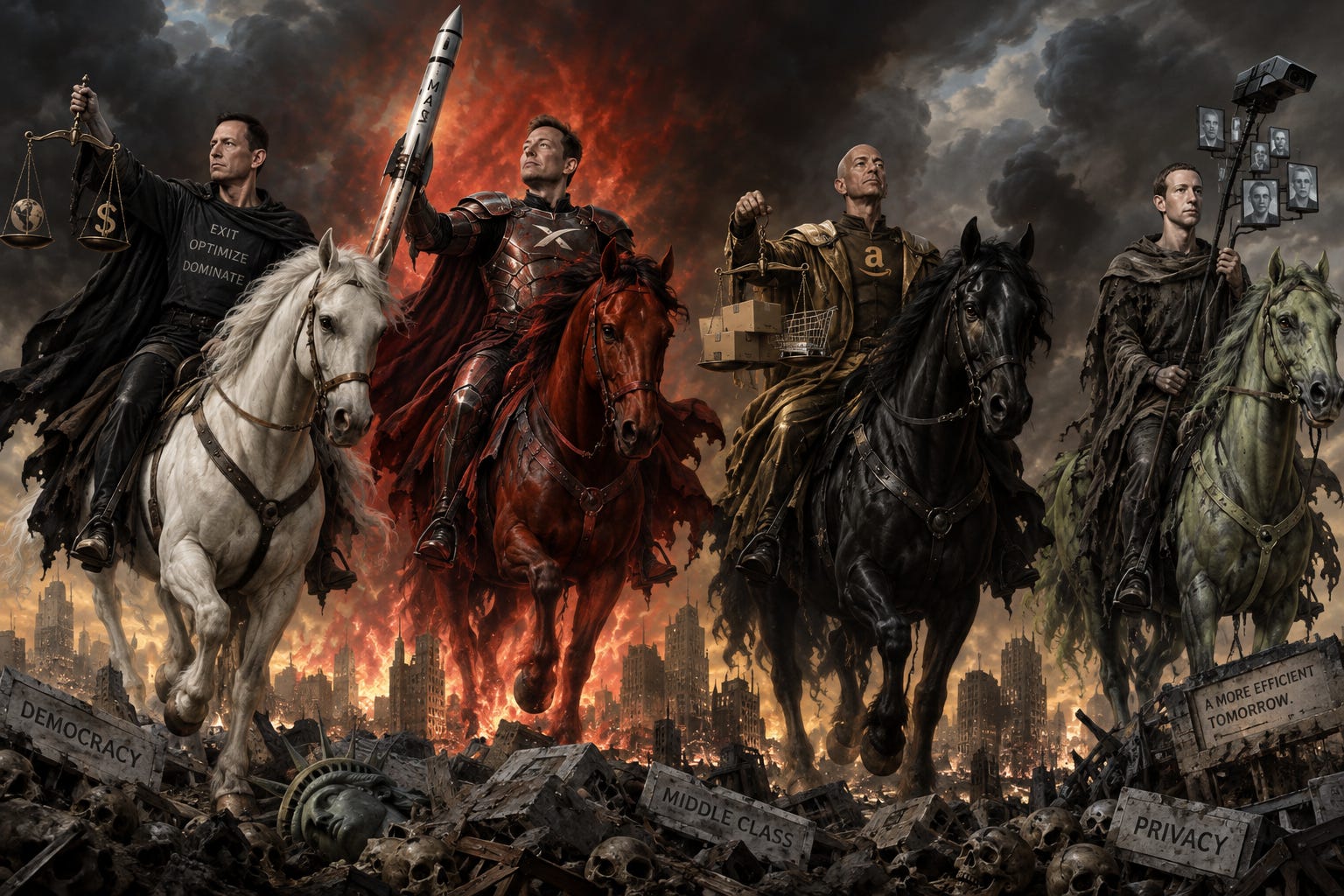
Synopsis: In 2022, one man decided that Ukraine’s military would get no satellite coverage near Crimea, while Iran’s protesters would get it free of charge. Sovereignty had quietly changed hands. This essay follows the handful of technology founders who now build the systems that societies can no longer do without. It reads their power against the long history of redeemers, and against two precedents: the East India Company’s absorption by the Crown, and Beijing’s abrupt halt of Ant Group’s share listing. From India to Abu Dhabi to Washington, the line between those who build the future and those meant to govern it is wearing thin. Meanwhile, choices that will shape civilisation reach the rest of us as terms of service, accepted unread. So who gets to imagine humanity’s future, and who gets to say no?
In September 2022, Ukraine’s military asked for Starlink coverage to be switched on over the waters near Sevastopol, where Russia’s Black Sea Fleet lay at anchor. Sea drones packed with explosives were ready to run in beneath the signal. The request was refused. No cabinet refused it, and no alliance or court did either. One man made that decision. By his own later account, he reasoned that the strike might provoke a nuclear response, and he didn’t wish to be complicit in it.
That same month he announced he was switching the service on over Iran, where crowds filled the streets and the government was throttling the internet. Washington had loosened its sanctions to allow it. Tehran had not been consulted.
Set these two decisions side by side and an unsettling pattern comes into focus. Within a few weeks, a private citizen, who was also, at the time, the world’s wealthiest man, had declined to extend a capacity for war to one state and had pushed a capacity for dissent into another. Once upon a time both acts belonged only to governments. In this case the only accountability either decision faced was the conscience of the man who made it. Reasonable people differ sharply on his judgement in each case, but the structure is the story.
Two years earlier, the same company’s terms of service had included a clause that was easy to scroll past. It said that on Mars, and on the journey there, the parties would treat the planet as free of any Earth-based government’s authority. Settlers would govern themselves by principles established in good faith. It was a constitutional claim over another world, set inside a consumer contract for supplying a domestic internet service. Most of the people who accepted it were simply trying to get online.
The redeemer’s grammar
We tend to imagine that the gravest dangers come from people who intend us harm. The twentieth century suggests otherwise. Its worst catastrophes were set in motion by men who saw themselves as redeemers — of a humiliated nation, of an exploited class, of a people supposedly corrupted by foreign elements. Hitler imagined himself as Germany’s restorer. Mao’s Great Leap was meant to overtake Britain in steel within fifteen years. The Khmer Rouge declared Year Zero and emptied Phnom Penh in a matter of days, in the name of a purified prospect. Before all of them, the European empires dressed conquest as a civilising mission, and many of the administrators who ran it sincerely believed that to be the case.
Ideologically, these visions share almost no common ground. They were racial, revolutionary, agrarian and imperial, and they pointed in every direction at once. What they do share is a structure. Each imagined a future vivid enough and important enough to justify the use of extraordinary power in the present. Each decided in advance who belonged to that future and who stood in its way.
None of today’s technology billionaires is building a regime of that kind, and to suggest otherwise would be absurd and lazy. Their visions are universalist rather than racial and expansive rather than exclusionary, aimed at abundance, longevity and the expansion of intelligence rather than purification. Yet the structure itself will attach to any ideology. It can live in a party, a church or a revolutionary cell — or a company for that matter.
In our own age it has found an unlikely host. That host is the meeting of vast wealth, unprecedented technical capability and an equally unprecedented confidence in one’s own convictions about the direction in which humanity ought to be heading.
Blueprints for a species
Listen to how these entrepreneurs describe themselves.
SpaceX presents its purpose as making humanity multiplanetary, with a self-sustaining city on Mars as the goal. OpenAI’s leadership talks less about products than about infrastructure for a civilisation: abundant intelligence, computation at planetary scale, and science, medicine and education reinvented. Marc Andreessen’s techno-optimist manifesto casts technology as the prime mover of human progress, with the settlement of other worlds as its natural sequel. Peter Thiel’s long lament about stagnation begins from a diagnosis of civilisational decline. The great industrial acceleration has stalled, he argues, and we have forgotten how to build.
This is the vocabulary of cosmology, borrowed for a prospectus.
Around these ambitions a private intellectual ecosystem has grown up — longtermism, effective altruism, accelerationism, techno-optimism. Each is a complete political philosophy, with its own theory of value, its own account of history and its own portrayal of where humanity is finally headed. They quarrel with one another, sometimes bitterly. But the quarrel happens in research institutes, funded fellowships, podcasts and manifestos, while parliaments mostly watch from the gallery. An argument about the long-term prospects of eight billion people is being conducted within a strikingly small circle, using frameworks the public has never been invited to endorse or refuse.
For most of the modern era, projects on this scale belonged to states. Governments built the railways and the dams, the nuclear and the space programmes. Today some of the most consequential technical ventures on Earth are conceived, financed and run by private companies whose founders hold personal fortunes larger than the annual output of entire nations. The state has lost its monopoly on planetary imagination, and it is rarely the quickest to act. Speed decides authorship. The company that ships first sets the defaults — the protocols, the dependencies, the terms everyone else must accept — and the legislature that convenes two years later can only amend them. More and more, governments turn up late as the editors of futures drafted elsewhere.
So a quiet succession unfolds. The entrepreneur becomes a self-styled futurist. In time the futurist becomes a philosopher, and the philosopher a political actor. At that point the line between building tomorrow and deciding what tomorrow should be fades, and finally vanishes altogether.
Money has always bought influence. But today’s technology turns wealth into agency. A rich man could always buy a newspaper on his way to becoming a media baron. But a technology fortune can now build the network through which hundreds of millions of people first confront political reality. Philanthropy could always endow a laboratory. In the hands of the ultra-wealthy it has grown into a parallel system of public priority-setting, answerable chiefly to its donors. The Gates Foundation ranks among the largest funders of the World Health Organization, and its preferences flow through disease campaigns and vaccine programmes across the Global South. Agricultural initiatives bankrolled from Seattle have shaped seed and fertiliser policy for smallholders across much of Africa, and not always to the smallholders’ benefit. Some newer fortunes have dropped the foundation form altogether in favour of limited liability companies. These are free to invest, lobby and fund political causes with none of the disclosure a charity must make. And because gifts attract tax relief, the public subsidises priorities it never chose.
The money that once endowed the laboratory now also funds the argument about what the laboratory is for. The institutes and fellowships that incubated longtermism and effective altruism owe much of their existence to a handful of donors. A founder can go further still, and assemble the computing infrastructure on which a new kind of intelligence is trained. Capital once bought a seat inside existing systems. Increasingly it builds alternatives to them.
Meanwhile the public’s relationship to all this is being recast, almost unnoticed, as a consumer relationship. Civilisational choices arrive as software updates and terms of service, accepted with an instinctive click. Nobody votes on what comes next. We adopt it, one clause at a time, and most of the clauses go unread.
The case for the builders
The strongest objection deserves a full hearing. Visionaries often see what institutions cannot. The Wright brothers looked like cranks until they actually took to the air. The first personal computer looked like a hobbyist’s toy. Reusable rockets were widely thought uneconomic. Artificial intelligence went from laboratory curiosity to global infrastructure in just a few years. Scepticism is no guarantee of wisdom. Institutions harden, bureaucracies protect themselves, and experts become captives of the assumptions that made them expert in the first place.
The builders often have what the institutions lack — a willingness to act before certainty arrives. No civilisation has advanced without people like that.
But the same virtue holds the seed of its own undoing. The person accustomed to moving ahead of certainty may, over the years, come to treat its absence as a licence to stop listening altogether. Each vindication against the consensus — once, then twice, then a dozen times — lays down another thin ring of conviction, until the capacity to hear is overgrown, the way a tree slowly envelops a wire fastened to its trunk. Dissent begins to sound like voices drifting up from far behind: the calls of people still walking a road he left long ago. This is where genius curdles into ideology.
The word that ends arguments
Once a technological vision grows powerful enough, it begins to describe itself as inevitable. AI is coming. Automation is coming. Mars and abundance and the post-scarcity economy are all coming. Perhaps they are. But “inevitable” may be the most politically useful word in the language. Declare an outcome inevitable and opposition starts to look irrational. Regulation becomes obstruction, deliberation becomes delay, and democratic disagreement becomes ignorance. What comes next stops being a question over which to argue and becomes a launch date to meet.
Then a darker shift becomes possible. People who disagree stop being fellow citizens in a shared argument. They become obstacles — friction on the road to a destination already chosen. This is exactly the move the redeemers of the last century made, from every point on the political compass. It needs no malice at all, only certainty.
I should declare a professional interest. Much of my working life has been spent as a foresight strategist and practitioner, crafting scenarios for governments and boards and helping institutions imagine what they might face. We futurists spent decades insisting that the future is plural, open and contestable. Yet our own language of trends, drivers, megashifts and trajectories helped teach a generation of leaders to speak of tomorrow as a condition that simply arrives, to be positioned for rather than argued over. The megatrend report is the purest form of this habit. Published annually by consultancies and banks, it projects the present forward — more urbanisation, more consumption, more data, ever-rising demand for energy and minerals — and presents each extrapolation as fate. What it seldom admits is that every trend line records a set of choices. An extractive economy described in the future tense acquires the dignity of natural law. Ministries plan around the forecast, investors price it in, and the prophecy, obeyed often enough, fulfils itself. The mine opens because the report said demand would rise. The report was right because the mine opened. The language of inevitability did not start in Silicon Valley. Some of it was lent by people like me.
Ambition, technology, even the dream of remaking civilisation from its foundations — all of these can survive scrutiny. The danger begins at a narrower threshold: the moment the dream acquires an owner.
A company with an army
Call it technological sovereignty: sovereignty without a flag. It accrues to the firms that build the systems without which a society can no longer function, and it gives practical authority without any of the formal apparatus of statehood.
If that sounds unprecedented, our memories are short. The East India Company raised armies, minted coin, collected revenue, administered justice and ruled tens of millions of people. By the early nineteenth century its private forces outnumbered the British Army. It was a sovereign in the guise of a trading house. The uprising of 1857 made that arrangement untenable, and the following year the Crown absorbed it. The most powerful corporation on Earth became a government department.
The lesson cuts both ways. Private sovereignty is old, and it didn’t last. When the gap between corporate power and public accountability became intolerable, the state reasserted itself. But the correction came only after rebellion, famine and mass death. It came by blunt absorption, with no coherent theory of how such power should be governed.
A more recent correction is revealing in its own way. In November 2020, less than two days before what was expected to be the largest share listing in history, Beijing halted the flotation of Ant Group. Ten days earlier, Jack Ma had stood before an audience of the country’s bankers and regulators and publicly criticised its financial watchdogs. Beijing brought its private giant to heel in under a fortnight, and without bloodshed. London had needed a century and a rebellion to subdue the East India Company. Some observers saw prudent discipline of a lender grown too large to fail. Others saw the state crushing one of its most dynamic firms. Both readings are defensible. Neither disputes that the state had the reach, and the will, to act.
Much of the world has neither. The modern successors also differ in one decisive respect. The East India Company’s power was visible. Armies, tax districts and territories can be counted, mapped and debated in parliament. Technological sovereignty is infrastructural and epistemic. It lives inside systems that governments don’t fully understand and increasingly can’t run without. The regulator must ask the regulated to explain what it has built. On this terrain, capture works through knowledge — the slow, structural dependence of those who govern on those they are supposed to govern. Picture a ministry in Nairobi or Dhaka or Asunción negotiating with a firm worth more than its entire national economy. For that ministry, the dependence is complete before the talks begin.
Some of the new sovereigns have no intention of waiting to be absorbed. They are exploring exit. Thiel helped fund early experiments in seasteading, floating communities beyond the reach of any existing state. Cryptocurrency was conceived, quite openly, as an escape from monetary sovereignty. And there’s that clause in the Starlink contract: a settlement charter for another planet, distributed as a user agreement.
That is why these four men matter. Musk’s companies now occupy domains once reserved for states: launch, orbital communications and artificial intelligence. Altman matters because a handful of AI laboratories may shape education, discovery, labour and information for most of humanity. Thiel matters because his investments and political alliances trace the fusion of venture capital, frontier technology and state power. Andreessen matters because he has written down, more plainly than most, the creed beneath the code.
They are not interchangeable. Their philosophies, their politics and their projects all diverge. But they share a world in which capital, computation, infrastructure and ideology can combine inside private institutions at a scale that has no precedent. That world deserves scrutiny without worship, without envy, and without demonology.
The questions it raises have left science fiction behind. They are governance questions waiting for capability to catch up. If AI produces extraordinary abundance, who owns the infrastructure that produces it? If radical life extension becomes possible, who is admitted and who refused? If people come to settle beyond Earth, under whose law will they live? If artificial systems surpass their makers, who sets their purposes? And if biology becomes editable, who decides what counts as improvement?
The inversion
For two centuries, political power largely determined technological power. That relationship is now reversing.
The about-turn is no longer theoretical, and it recognises no borders. The architects of what comes next have moved from petitioning governments to working inside them — sometimes in person, sometimes through their companies, and sometimes with the traffic running the other way. In 2009 India gave the task of issuing a digital identity to more than a billion people to the co-founder of one of its largest software firms, with the rank of a cabinet minister. A decade later, the founder of Indonesia’s first ten-billion-dollar start-up left his company and took charge of the country’s schools. In Abu Dhabi, the national security adviser chairs the nation’s flagship AI company, so that security doctrine and computing strategy meet in a single man. Beijing has reached the same fusion by the opposite route. It has bought token stakes in the domestic arms of its largest platforms: a sliver of equity that brings a board seat and a say over content. And in Washington, the Army now commissions serving technology executives as lieutenant colonels while they keep their day jobs. In some systems the builders enter the state; in others the state enters the builders. Either way, the membrane between those who build technology that remakes societies and those charged with governing it has worn thin enough, in places, to see through.
The gap in time horizons widens alongside. The technological elite can spend decades contemplating what humanity might become, while democratic institutions spend their energy on what the government should do next Tuesday. One side thinks in centuries; the other thinks in election cycles. One imagines Mars — the other haggles over fuel excise.
For centuries we have asked how governments should restrain corporations. We may now have to ask the reverse: how democratic societies can govern corporations able to reshape the conditions under which governments themselves operate. That problem is far more complicated, for an uncomfortable reason. The people building the future may sincerely believe they are building it for all of us.
They may be right. They may be wrong. History offers no mechanism by which sincerity guarantees wisdom. Intelligence confers no legitimacy. Technical achievement confers no moral authority. Wealth, however vast, confers no mandate.
Learning by catastrophe
What would accountability even look like? No one yet knows. But past concentrations of dangerous power do suggest an outline — and the timing of how societies handled them is by no means encouraging.
Drug safety laws tightened across much of the world only after thalidomide. Japan’s parliament passed its sweeping pollution laws in 1970, fourteen years after Minamata disease was first officially recognised. India wrote its umbrella environmental statute in the aftermath of Bhopal. Almost everywhere, financial regulation has followed the crash rather than come before it. Societies are remarkably good at governing technologies in hindsight, turning disaster into institutional memory.
Some of the systems now being built may not allow that luxury. A market collapse can be survived and reformed. But other failures may offer no second draft. A misaligned intelligence woven into the infrastructure of a hundred countries could be one. A dependency that has quietly become irreversible could be another.
Beneath this lies a structural mismatch that no single reform will cure. Democratic deliberation is slow partly by design, because friction is how societies avoid being stampeded. But friction built for a slower century now produces a perverse result: the future arrives before the argument about it has finished. Oversight that takes a decade to respond to systems that change every eighteen months ends up as commentary.
The candidate instruments are familiar:
• Large-scale computation could be treated as critical infrastructure, with public obligations attached.
• International coordination could follow the example of nuclear governance, which is imperfect and leaky, but at least real.
• Liability regimes could make the builders of consequential systems bear the risks they now pass on to everyone else.
• Competition law could be rethought for an economy whose monopoly commodity is intelligence rather than oil or steel.
• Genuine, technically literate public representation could sit inside the institutions making decisions at that scale.
Every single one of these is difficult, but each one has precedent. In other words, none requires inventing governance from nothing. Each would extend, faster and more widely, principles already tested: consequential power requires accountability, infrastructure a society depends on owes that society something, and no private purpose, however benevolent, can substitute for public consent.
Yet the instruments matter less than the conviction they would serve, and that conviction is what has gone missing. It’s the shared understanding that decisions of civilisational consequence need legitimacy of equal breadth. It has to be recovered while the dependencies can still be unwound. Afterwards will be too late.
Who gets to say no
None of this argues for shrinking or fearing human aspiration. Civilisation needs people who think impossibly large thoughts — the dreamers, the obsessive entrepreneurs, the ones prepared to ask why not. Why shouldn’t humanity live beyond Earth? Why shouldn’t intelligence become abundant, disease rare and poverty technically obsolete? These are beautiful questions.
The danger lies in a question the builders rarely put to themselves: why should I be the one who decides?
Our civilisation has produced a handful of individuals able to think and act at the scale of the whole Earth, while its instruments of accountability remain national, institutional and stubbornly twentieth-century. A satellite constellation circling every continent still answers to the regulator of the country that licensed it. An AI model trained under one jurisdiction’s rules is used in almost every other. Imagination has slipped both its leash and its borders. Accountability still stands at the frontier, checking passports.
Technology’s great promise is release from constraints that once looked permanent. Its great danger is that in escaping the old constraints we submit to new ones. Those new constraints are designed, with perfect sincerity, by people certain they know where humanity ought to go.
Somewhere tonight — beside a paddy field, or in a tower block on the edge of a city of twenty million — someone will tap “accept” on an update they have not read. A small portion of their future will pass quietly into private hands. They will not have been asked. No one will think to ask them.
Who, then, gets to imagine humanity’s future — and who gets to say no?