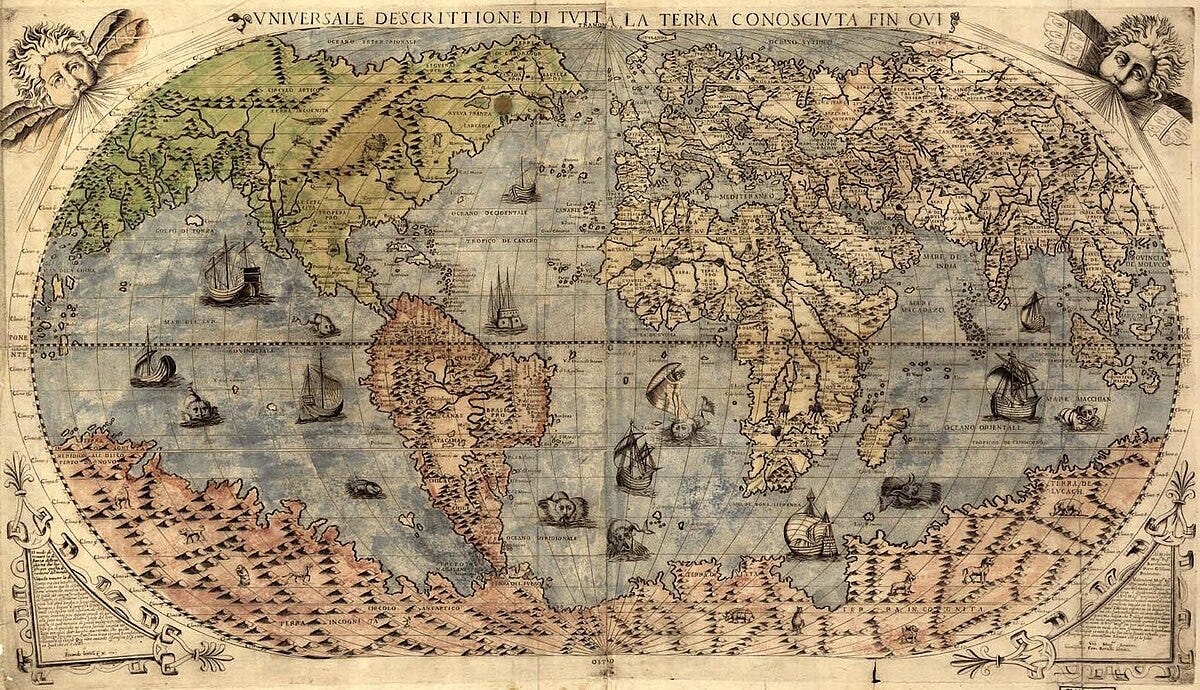
The maps and charts we use to make sense of the terrestrial and geopolitical landscape have become little more than a collection of ghosts. Our reliance on the antiquated polarities of “East versus West” or the “Global North versus South” reveals a desperate clinging to a flat-earth mentality in a multi-dimensional crisis.
These geographic fictions no longer capture the fault lines that actually fracture our shared reality. Today, the pulse of power, the architecture of legitimacy, and the mechanisms of control are organised less by the lines on a map than by the invisible algorithms of the institutions we inhabit. We are witnessing a shift where the ways we use technology, markets, and identity have superseded the physical terrain. There’s no longer a tidy way to map the turbulence of the present.
Perhaps a more revealing inquiry would involve peeling back the layers of regional identity to expose the underlying regime logics. Rather than imagining that vast swathes of the planet belong to immutable ideological camps, we might observe a small number of recurring patterns—diverse ways of organising political power and justifying its exercise. These patterns are not confined by borders; they appear simultaneously across continents, intersecting and competing within the same borders. They are not rigid taxonomies, as no society perfectly embodies a single archetype, but they allow us to perceive why similar systemic tremors keep emerging in seemingly disparate contexts.
The Mirage of Constrained Power
Take the pattern often described as the liberal–constitutional model. Its hallmark is the formal constraint of power, where a government’s right to rule is anchored not merely in the theatre of an election but in a profound respect for the laws, rights, and procedures that are supposed to bind the state as tightly as the citizen. We see this logic animating the social contracts of the European Union, the Nordic states, Canada, Japan, Australia and New Zealand, stretching its influence to the constitutional experiments in Uruguay, Costa Rica, and the often-strained transitions in South Africa or Chile. These systems aim to protect civil liberties and allow for a genuine turnover of power, weaving a commitment to international law and human rights into the very fabric of their national identity.
This arrangement is frequently mislabelled as a purely European inheritance, which ignores the rich, cross-pollinated history of its development. Were not the core components of this order co-created through Japan’s post-war constitutional reconstruction, the courageous human rights jurisprudence of Latin America, and the participatory democratic innovations born in the favelas of Brazil? Even where this project appears most robust, it remains fragmentary and under siege. The chasm between the rhetoric of equality and the reality of migration policies or racial hierarchies remains a jagged edge. Is it possible that the liberal–constitutional project is less a finished monument and more a fragile, global aspiration that is neither monolithic nor the sole repository of universalist hope?
The Majoritarian Surge
In the shadows of that fragility, a second logic has gained a terrifying momentum: competitive populist-majoritarianism. In these environments, many of the rituals of democracy remain—elections are held, opposition figures speak—but the vital spirit of constitutionalism is being systematically drained. Leaders here claim a mystical mandate to embody the “will of the people” against a curated gallery of enemies: corrupt elites, disloyal minorities, or foreign agents. Independent courts, the free press, and the vibrancy of civil society are reframed as irritants or obstructions to the national soul.
This is the theatre of permanent mobilisation through identity conflict. Power is not seized by abolishing the constitution, but by hollowing out its checks and balances until it becomes a shell. We see the echoes of this logic in the political currents of India, the recent histories of Brazil and the Philippines, and even within the United States. In these spaces, institutions do not vanish; they become battlegrounds. While a judge may occasionally push back or a local election may defy the trend, the trajectory is unmistakable. Could it be that what we often dismiss as regional populism is actually a sophisticated governing logic capable of capturing and corrupting any democratic framework from within?
The Technocratic Machine
A radically different pulse is found in technocratic authoritarian statism, a model that finds its most potent expression in the Chinese party-state and, with varying degrees of nuance, in Vietnam, Singapore, and the more technocratic wings of the Gulf monarchies. Here, legitimacy is bought with performance: economic expansion, social stability, and the promise of national rejuvenation. Political competition is viewed as an inefficient distraction. The ruling apparatus monopolises high politics while managing markets with a surgeon’s precision. These regimes are the masters of the “industrial economism” I have long critiqued, investing heavily in infrastructure and education while deploying a digital panopticon of mass data collection, algorithmic surveillance, and social credit systems.
It’s a mistake to conflate this institutionalised authoritarianism with the erratic whims of a personalist dictator. The Chinese state, with its intricate internal rules and cadre systems, operates on a logic of longevity and collective discipline that is entirely absent in a kleptocracy like Russia, for example. To lump them together is to ignore the fundamental differences in how they maintain stability and how they justify their existence to their subjects.
The Cult of the Strongman
The fourth pattern—personalist or neopatrimonial authoritarianism—is far more fragile and predatory. Here, power is not held by a party or a sacred law, but by a single individual or a small, loyal clique. Formal institutions like parliaments and courts are merely instruments for patronage and the selective punishment of rivals. State resources are treated as the private treasury of a leader, distributed through networks of loyalty tied to blood, region, or personal debt. From the current shadows of the Kremlin to the embattled leadership in Nicaragua and Venezuela, this logic thrives on the hollowing out of the state to serve the few.
We must also question the tendency to dismiss vast regions of the Middle East and Africa as being defined by “traditionalism.” Does foregrounding religion and tribalism not obscure the very modern mechanics of personalist rule and patronage that look remarkably similar whether they manifest in Eastern Europe or Central Asia? When we focus solely on “tradition,” do we miss the universal grammar of coercion and the hollowing of institutions that occurs whenever power is disconnected from the common good?
Guardians of the Sacred
There is, however, a distinct fifth logic where ideological or religious traditionalism is the central pillar of the state. In these theocratic systems, authority is explicitly anchored in a sacred or revolutionary order that claims to transcend human law. Clerical councils or revolutionary guards possess the constitutional power to vet both leaders and the laws they pass. This is not merely a conservative society; it is a polity where religious law is the constitutional core, regulating dress, social conduct, and dissent as matters of faith or heresy. Iran and Taliban-led Afghanistan are stark examples, though they often mix this sacred logic with the more mundane tools of technocracy or nationalist fervour.
Across all these diverse patterns runs a terrifying transversal current: the rise of a global market for digital control. Governments of every stripe are becoming addicted to digital infrastructures—data brokers, AI-driven monitoring, and biometric databases—that allow them to track, profile, and nudge their populations with unprecedented intimacy. This is the dark side of our technological maturity. While liberal democracies may still possess the legal tools to restrain these instruments, the reality often lags behind the rhetoric. In majoritarian or authoritarian hands, these same tools do not just monitor; they amplify polarisation and cement control.
Is it possible that we are not facing a unified “illiberal front” but rather a global repertoire of digital instruments that any regime can use to serve extractionist and predatory ends? The powers deploying this grammar—whether in Beijing, Moscow, Delhi, or Riyadh—distrust one another as much as they dislike liberal limits. They don’t share a common project so much as a common toolset and a shared resentment of any constraint on their sovereignty.
What remains, then, of the alarmist cry that the “European Way” is the only thing standing between us and the abyss? If we strip away Eurocentric vanity, the core concern is valid: the world’s most advanced experiments in embedding human dignity and social protection into law are under severe strain. But this is not a European struggle; it’s a global one. The “liberal–constitutional project” is already being defended in the courts of South Africa, the truth commissions of Latin America, and the grassroots democratic movements in Seoul and Porto Alegre.
We must shift our focus from defending a single civilisational bloc to supporting the family of institutions that protect human agency wherever they exist. No country is a static monolith; each is a field of conflict where these five logics vie for dominance. The outcome is not a predetermined tragedy. We live in a world where a few basic patterns of power are constantly challenged from within by the desire for a more humane solidarism. Any realistic strategy for navigation must start from that complex, and perhaps less comforting, reality.
If we accept that these regime logics are the skeletal structures of modern power, we must then ask: what is the flesh and blood that sustains them? What’s the invisible gravity pulling all five toward the same predatory horizon?
The answer, I suspect, lies in the metabolic engine of industrial economism. Whether a state identifies as a liberal democracy or a technocratic autocracy, it’s almost invariably plugged into the same extractionist motherboard. This neoliberal ghost in the machine treats the living world as a warehouse of resources and the human spirit as a dataset to be mined. It is here that our shared civilisational belief systems—the “worldviews” we take for granted—manifest as the corporeal “world-systems” that dictate the price of bread and the surveillance of our private thoughts.
Consider how the digital panopticon is not merely a tool for the state, but a fundamental reshaping of the human mindset. We are being taught to think in ways that serve the machine. In the liberal-constitutional project, this manifests as “nudge” theory and the commodification of attention; in the technocratic state, it’s the social credit score. In both, the result is the same: the erosion of genuine agency. Are we losing the capacity for the kind of original, heretical thinking that birthed the very concepts of rights and dignity we now claim to defend? When our choices are algorithmically curated, is the “citizen” not being surreptitiously replaced by a “user-consumer” whose rebellion is just another data point for the market?
This is the deeper danger. The patterns of power I’ve described are increasingly reliant on a form of technologically enhanced psychological management that makes traditional dissent look quaint. If our cognitive processes are being colonised by the predatory logic of extraction, then the struggle is no longer just between different types of government. It is a struggle for the integrity of the human mind.
I see this daily in my work across the Global South. The most vibrant resistance often comes not from those trying to replicate the “European Way,” but from those grounding their actions in alternative paradigms—systems of thought that reject the binary of market versus state and instead prioritise the health of the whole. These are the local innovators and paradigm-shifters who understand that to change the system, one must first liberate the mindset from the industrial paradigm.
We are, quite literally, thinking our way into a dead end. The challenge for those of us who still believe in a humane future is to stop merely reinterpreting the old maps and start birthing new ones. We need a civilisational renaissance that transcends the toxic habits of the past two centuries.
To cultivate these alternative paradigms, we must first commit to a profound unlearning of the industrial mindset that has been sedimented into our consciousness over centuries. The industrial paradigm is not just a collection of factories and balance sheets; it’s a cognitive cage that traps us in a permanent logic of extraction, competition, and predatory growth. To bypass the digital panopticon and the suffocating weight of industrial economism, we require a rebirth of how we perceive our place in the web of life. Architecture without new capacities for perception and decision-making will simply recreate the old order in new forms.
The Liberation of the Mindset
The first movement in this renaissance is to address the “how” of human thought. We have been taught to see the world as a series of discrete, exploitable parts rather than a living, interconnected whole. This fragmented worldview is what allows the technocratic state and the majoritarian populist alike to treat citizens as data points or electoral fodder. Is it possible that the most radical act of resistance today is not a protest in the street, but the reclamation of our own attention? When we shift our internal focus from the scarcity-driven narratives of the market to a mindset of radical sufficiency and interdependence, the bars of the digital cage begin to loosen their grip.
This shift requires us to move beyond the binary of the individual versus the collective. In the Global South, particularly within indigenous frameworks of “Buen Vivir” or “Ubuntu,” we find worldviews that never succumbed to the Western obsession with atomised self-interest. These are not relics of the past but sophisticated templates for a future where legitimacy is grounded in the health of the entire ecosystem. By cross-fertilising these ancient wisdoms with modern digital sovereignty—tools like decentralised protocols and encrypted networks—we can begin to build “interstitial” spaces of power that the state can neither track nor commodify.
The Mycelial Architecture of New World-Systems
If the mindset is the seed, then the world-system is the forest. We must move from a predatory industrial economism to what I describe as a “vitality-based” economy. This is not a task for the faint-hearted, nor is it something that can be achieved through the hollowing out of existing institutions. Instead, it involves the deliberate cultivation of mycelial networks—localised, circular systems that thrive in the cracks of the crumbling industrial monolith. We see the precursors of this in the grassroots democratic innovations of Seoul, the community-led reforestation projects in the Sahel, and the rise of mutual aid networks that bypass traditional banking.
These systems don’t seek to compete with the global market on its own terms; they seek to render it irrelevant to the daily survival and flourishing of the community. Could it be that the true “path” is not a single highway but a thousand small trails blazed by those who refuse to be “nudged” by algorithms? In these spaces, the digital panopticon finds no purchase because the logic of the community is not one of visibility and control, but of relationship and reciprocity. We are talking about a move from “users” of a system to “stewards” of a living reality.
Navigating the Great Transition
The danger of our current moment is that we might mistake the collapse of old maps for the end of the world—or the “end of history” yet again. It is, in fact, the end of a very specific and highly toxic world-system. The five regime logics I have identified—the constitutional, the majoritarian, the technocratic, the personalist, and the sacred-traditionalist—are all, to varying degrees, attempting to manage this collapse by tightening their grip on the steering wheel. But you cannot navigate a transition of this magnitude by simply gripping the wheel harder. You must learn to read the stars, the currents, and the subtle shifts in the wind.
This is where the “heretical” thinking of the futurist becomes essential. We must dare to ask questions that have no place in the mainstream discourse: What if the state, in its current form, is no longer the primary vehicle for human progress? What if the most important “world-system” of the twenty-first century is one that has no capital city and no central bank? By fostering a global family of institutions that prioritise human dignity over data-harvesting, we can ensure that the vacuum left by the industrial era is not filled by a digital dark age, but by a more luminous and symbiotic order.
The choice is ours, but it’s a choice that must be made in our hearts and our minds long before it can be reflected in our laws. We are the architects of the next paradigm—and also its midwives. Let’s build it with the wisdom of the ancients and the tools of the future, unburdened by the ghosts of the industrial past.
To step out from the shadow of the digital panopticon and the suffocating weight of industrial economism, we must first acquire a new set of faculties—not the rote learning of the industrial classroom, but a profound fluency in the rhythms of living systems. The navigators of this transition, whether they sit in boardrooms or organise at the grassroots, require a cognitive toolkit that is as prismatic as the reality we are entering. This is not about the accumulation of data, which the machine already does better than any human, but about the cultivation of knowing—a dynamic, embodied wisdom that allows us to sense the tectonic shifts before they reach the surface.
These are five complementary faculties, distinct from but responsive to the five regime logics described earlier.
The first of these faculties is systemic. We have been conditioned by the industrial paradigm to be specialists in fragments, yet the crises of our age—from ecological collapse to the hollowing out of democracy—are stubbornly whole. A leader without systemic literacy is like a sailor who understands the sails but is oblivious to the currents or the coming storm. We must learn to perceive the “acupuncture points” within our social and economic world-systems where a small, well-placed intervention can lead to a fundamental shift in behavior. This involves moving beyond the vanity of “solving” problems to the more humble and effective practice of stewarding healthy ecologies of action.
Parallel to this is the urgent need for a digital and cognitive sovereignty. If our mindsets are being algorithmically nudged toward polarization and consumption, then the most vital literacy is the ability to decolonise our own attention. This is a form of mental hygiene for the twenty-first century. It requires an understanding of how our biological impulses are being weaponised by surveillance capitalism and the courage to build “firewalls of the soul.” This is not an argument for a Luddite retreat into the past, but for a sophisticated engagement with technology that serves human agency rather than eroding it. How can we design digital architectures that foster reflection rather than reflex, and deep connection rather than addictive distraction?
We must also dwell upon the necessity of anticipatory literacy. In my work with strategic navigation, I have often argued that the future is not something that happens to us, but something we birth through our present choices. Most of our current institutions are designed to respond to the past, looking through the rearview mirror while accelerating into a thicket of surprises. To navigate the great transition, we must develop a “prospective” mindset—the capacity to sit with uncertainty and detect the weak signals of the emergent paradigm. This is the art of the midwife, not the engineer. It requires us to abandon the illusion of control and embrace the reality of influence, learning to work with the grain of change rather than against it.
Finally, there is a relational or contextual literacy that transcends the atomised self-interest of neoliberalism. We need to rediscover the “inter-being” that connects our local actions to the global whole. This is where the wisdom to be found in parts of the Global South—the Ubuntu philosophy of “I am because we are”—cross-fertilises with our modern understanding of global interdependence. Those in positions of authority must become fluent in the languages of different worldviews, moving beyond the binary of “us versus them” to find the common ground where diverse regime logics might coexist without conflict. This literacy challenges the widely held assumption that progress must be a zero-sum game of competition.
Is it possible that by cultivating these faculties, we are not just preparing for the future, but actively calling it into being? When we change the way we think, we change the way we act, and when our actions align with the health of the whole, the predatory systems of the past begin to lose their power. This is the subtle, lyrical work of the philosopher-activist: to weave a new tapestry of meaning from the threads of our shared survival.
Let’s apply these faculties to the governance of Artificial Intelligence, a phenomenon often misdiagnosed as simply a technological breakthrough when it is, in fact, the ultimate flowering of the industrial paradigm. If we view AI through the lens of industrial economism, we see a familiar pattern: the extraction of human experience to fuel a new form of predatory capital. To govern this emergent force, we must move beyond the narrow debates of “safety” or “efficiency” and address the deeper civilisational shifts it portends.
The Systemic Pulse of Algorithmic Power
A systemic literacy reveals that AI is not a standalone tool but a metabolic extension of our current world-system. It requires immense physical inputs—vast quantities of water to cool data centres, rare earth minerals extracted from the bruised earth of the Global South, and the staggering energy consumption of large-scale computation. Is it not a profound irony that our most “immaterial” technology has the most corporeal of footprints? When we treat AI governance as a software problem, we ignore the ecological and social costs embedded in its very hardware. A truly systemic approach would ask how these systems can be integrated into the circularity of a vitality-based economy, rather than serving as the ultimate accelerant for planetary exhaustion.
From an anticipatory perspective, we are currently mesmerised by the “Horizon One” capabilities of generative models—their ability to mimic and iterate. But the weak signals of the third horizon suggest a shift toward “sentient infrastructures,” where AI begins to manage the fundamental flows of energy, food, and logistics. If these infrastructures are governed by the same logic of extraction that dominates our financial markets, we risk creating a world where human agency is not just monitored but rendered obsolete by design. The literacy of anticipation allows us to sense these trajectories and begin birthing counter-narratives that prioritise human-centric intelligence—systems designed to augment our wisdom rather than replace our will.
Decolonising the Algorithmic Mindset
The most intimate battleground for AI governance is the human mindset. Here, cognitive sovereignty becomes the essential shield. We are witnessing the birth of a global “architecture of persuasion” that uses AI to nudge our desires, polarise our politics, and narrow the horizons of our imagination. When we are constantly fed algorithmically curated “truths,” our capacity for heretical, original inquiry—the very hallmark of the human spirit—begins to atrophy. Could it be that the greatest threat of AI is not that it will become “conscious,” but that we will become so accustomed to its patterns that we forget how to think for ourselves?
Governing this space requires more than just regulations on data privacy; it requires a radical commitment to cognitive freedom. This might involve the creation of “digital commons” where AI models are trained on diverse, non-predatory datasets, or the implementation of “transparency by design” that exposes the biases of the machine. It is a quest to ensure that the digital panopticon does not become a permanent psychological prison. We must learn to use these tools to expand our relational literacy—fostering deep connection and understanding across cultures—rather than allowing them to be weaponised for the majoritarian or technocratic ends I described earlier.
Toward a Relational Governance of the Commons
Finally, the governance of AI must transcend the current “arms race” between a few powerful states and corporations. This is where relational literacy offers a different map. By moving beyond the binary of the US–China rivalry, we can begin to see AI as a potential global commons. Imagine a governance framework informed by the pluralistic worldview of the Global South—where the value of AI is measured not by profit margins, but by its contribution to the collective flourishing of all life. I don’t imagine this as a utopian dream, but as a strategic necessity if we’re to avoid a fragmented, warring world of competing algorithmic regimes.
We’re at a proverbial crossroads where the industrial paradigm is attempting to use AI to perfect its control, while a new, more syntrophic order is struggling to find its voice. By applying these five faculties—systemic, digital, anticipatory, relational, and contextual—we can begin to weave a governance structure that is as sophisticated and dynamic as the technology itself. It is a work of lyrical complexity and hard-headed strategy, aimed at ensuring that our digital future remains profoundly human.
A Charter for Cognitive Sovereignty is not a mere set of legalistic constraints; it’s a manifesto for the preservation of the human soul in an age of algorithmic encroachment. To frame such a document, we must look beyond the “extractionist” tendencies of industrial economism and instead anchor our digital rights in the sanctity of the interior life. We are seeking to define the boundaries of a “mental commons” that no state or corporation has the right to strip-mine for profit or control.
The Charter for Cognitive Sovereignty
I. The Inviolability of the Interior Horizon
Every inhabitant of this planet possesses an inherent right to an unmonitored interior life. The thoughts, half-formed ideas, and private musings of the individual are not “raw material” for predictive analytics. We must establish a “sanctuary of the mind,” where the transition from thought to data is a conscious, consensual act, rather than an automated theft. This challenges the predatory assumption that every human impulse is a commodity waiting to be harvested.
II. The Right to Algorithmic Disobedience
As we are increasingly nudged by “choice architectures” designed to narrow our horizons, we must assert the right to be unpredictable. True agency requires the ability to opt out of the personalised “filter bubbles” that atrophy our capacity for heretical and original inquiry. This involves a mandate for “serendipity by design”—the right to encounter ideas, people, and worldviews that have not been pre-cleared by a profit-maximising algorithm.
III. Transparency of Intent and Origin
The “black box” of technocratic authoritarianism must be pried open. Any system that seeks to influence human behavior—whether through social credit, targeted advertising, or political “nudging”—must be required to disclose its underlying logic and its intended outcome. We have a right to know when we are being spoken to by a machine, and more importantly, why that machine has been programmed to steer us in a particular direction.
IV. The Preservation of the Relational Commons
The digital tools we use must be stewards of the “between-ness” of human life—the relationships and cultural mindsets that bind us. We reject the weaponisation of identity through algorithmic polarization. This charter demands the creation of digital infrastructures that prioritise the health of the whole, fostering deep, contextual literacy rather than the shallow, reactive outrage that fuels the current attention economy.
V. Cognitive Restitution and Redress
Where the digital panopticon has already eroded the mental well-being or the social fabric of a community, there must be a mechanism for restitution. This is the “restorative justice” of the digital age. It requires those who have profited from cognitive extraction to contribute to the rebuilding of the mental and social commons—investing in the very faculties of anticipation and systems-thinking that their technologies have sought to undermine.
This Charter serves as a navigational beacon, guiding us away from the “industrial-digital” dead end and toward a renaissance of human agency. It is a tool for the philosopher-activist to turn conversations about AI into actions that protect our shared future.
By enshrining these principles, we are not just regulating a technology; we are defending the very essence of what it means to think, to feel, and to be human in an interconnected world. We are asserting that while our tools may be artificial, our intelligence—and our sovereignty over it—must remain profoundly real.