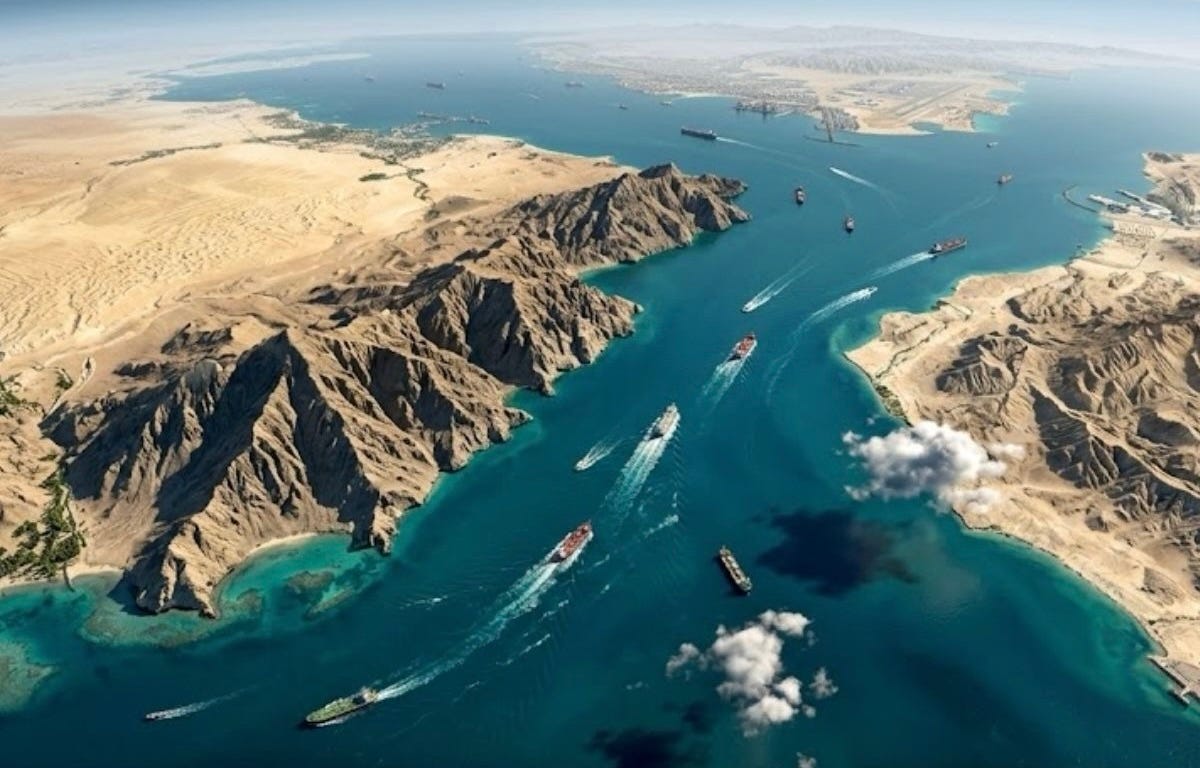
Stand on any Gulf shoreline at dusk and the water looks ancient, indifferent. Tankers drift across the horizon as they have for decades. The air smells of salt and petrochemicals. Everything appears, to the casual eye, stable — the kind of stability that comes not from genuine equilibrium but from forgetting how recently it was all assembled.
Beneath that apparent calm, something stranger and more precarious is happening. The Emirates, Saudi Arabia’s coastal cities, Bahrain, Qatar, Kuwait — and increasingly Israel — have performed one of the most audacious acts of civilisational overreach in recorded history. They have converted salt water into the primary substrate of human survival, and then trusted that the machinery required to maintain that conversion would remain beyond reach. It’s not so much an Achilles heel as an entire civilisation balanced on one.
But I want to resist the seduction of the vulnerable node. Pointing at a desalination plant and saying “there — that is the danger” does what strategic analysis always does when it wants to feel useful: it locates a single thing to protect or destroy, and thereby flattens the ecology of causes into a problem someone might actually solve. Desalination is not the danger. It is the diagnostic.
What we’re really looking at is the material consequence of a worldview. The Gulf’s dependence on these coastal machines did not emerge from nowhere — it emerged from the intersection of ecological constraint, oil-funded omnipotence, and a developmental philosophy that treated cities as perpetual-growth engines rather than organisms adapted to their particular corner of the earth. Dubai, Doha, Abu Dhabi: these are not extended oases. They are closer, in structural terms, to orbital stations. Tethered to the sea, to the grid, to supply chains whose threads run back through straits and corridors half a world away.
That same philosophy — the presumption that any natural limit can be overridden with sufficient capital and imported ingenuity — is precisely what Iran has learned to read as weakness.
The standard vocabulary for Iran’s regional strategy is military: proxies, forward bases, missile envelopes, escalation ladders. This framing is not false; it’s simply too thin. Iran has not built an empire in any classical sense. What it has cultivated over four decades is something far less legible to Western strategic minds: a mycelial network, threads of loyalty, armament, and narrative woven through the soil of other states. Hezbollah in Lebanon, armed factions in Iraq and Syria, the Houthis in Yemen — each organism is locally rooted, drawing sustenance from its own specific grievances, yet plugged into a wider Iranian ecosystem of training, weapons, and shared story. You can cut a visible branch. The underground web persists, adjusts, grows around the wound, just like the regime in Tehran.
The implications are not simply tactical. The deeper significance is temporal. Networks of this kind do not require victory in any single engagement. They require endurance. And endurance, it turns out, is a function of what a society is willing to absorb — how much dislocation, sacrifice, and deferred expectation can be folded into an acceptable national narrative before coherence begins to crack.
Washington, Tel Aviv, Abu Dhabi: these are polities that have promised their citizens a particular quality of life, a degree of insulation from turbulence. Disrupted aviation, rerouted shipping, spiking insurance premiums, weeks of mobilised reserves — each of these carries a political cost that compounds quickly in societies optimised for short electoral cycles. Tehran, by contrast, has spent four decades absorbing sanctions, isolation, and war. Its baseline expectations have been lowered through sustained attrition. The political economy of pain is genuinely different, and that difference is itself a strategic resource.
This is not to romanticise Iranian governance, which is coercive and factional in ways that produce their own internal fractures. But in the calculus of who can sustain pressure longest, institutional brittleness on one side and institutional adaptation to chronic stress on the other are not equivalent.
The Strait of Hormuz. Bab el-Mandeb. The Eastern Mediterranean lanes. These are typically described as arteries — and arteries, when discussed in strategic contexts, are things to protect or sever. But for Iran and its aligned movements, they function as something more intimate: as a vocabulary.
A mine in the water, a missile finding a tanker, a series of plausibly deniable strikes on Western-linked cargo — each is a sentence in an ongoing argument. The Houthi operations in the Red Sea are illustrative in a way that deserves more than tactical commentary. A group from one of the most materially impoverished countries on earth forced the world’s largest logistics companies to reroute shipping around the Cape of Good Hope, adding thousands of nautical miles, weeks of transit time, and millions in fuel costs. Insurance premiums climbed. Just-in-time supply chains, already strained by the pandemic’s aftershocks, absorbed another jolt. A single local actor, enabled and oriented by Iran, reached through the tendons of globalised commerce and squeezed — not hard enough to rupture, but hard enough to be felt in Frankfurt, Shanghai, and Rotterdam.
This is not war. It is strategic nuisance elevated to diplomacy — a reminder that the wealth of connected societies is not insulated from the grievances of disconnected ones, and that the same infrastructure which makes global trade possible also makes it exquisitely sensitive to friction at its narrowest points.
The desalination plants of the Gulf sit inside this same logic. Their vulnerability is not confined to the kinetic — to the possibility that they could be struck and disabled, an engineering problem that is easy to conceive — but extends through the wider systems on which they depend. It is symbolic. They represent the degree to which Gulf survival has been outsourced to systems that are simultaneously indispensable and exposed: the same shipping lanes, the same energy markets, the same fibre-optic and power grids that could, under pressure, become sites of a very different conversation.
Weapons travel through the air. Stories travel through everything. Across much of the global South — a category that encompasses the majority of the world’s population and no longer maps neatly onto Cold War cartography — the question of Palestine has become something larger than its own geography. It has become a shorthand for accumulated experience: colonial maps drawn without the consent of those who lived within them, Western military adventures that left behind rubble and institutional collapse, the daily liturgy of visa refusals and development condescension. Walk through neighbourhoods in Lagos, Jakarta, Karachi, or Bogotá and you see the same flags, the same videos, the same fragments of Gaza and Jenin looping on cheap phones. The conflict has escaped its geography; it now lives in a shared grievance carried by global networks.
Iran has positioned itself — with skill, with cynicism, and with the kind of partial truth that always proves more durable than outright fabrication — as a champion of that constellation of feeling. What gives Tehran an edge over other claimants to this position is consistency between word and deed. Arab governments that periodically invoke Palestinian solidarity while quietly coordinating with Washington and Tel Aviv are intelligible to the populations they address. Gaps between performance and action are, in the age of leaking and live-streaming, increasingly short-lived. Iran’s rhetoric and its actions align more often — not because its intentions are noble, but because its strategic interests and its narrative have converged around a common target.
The consequence for Israel and the United States isn’t universal condemnation — it’s something more insidious: a shrinking of the interpretive space in which their actions can be read as legitimate. In African Union corridors, at Latin American universities, in the comment sections of Southeast Asian news aggregators, the frame is no longer controlled by Western editorial hierarchies. This does not confer immunity on Iran or its partners. But it provides political cover in the venues that increasingly matter — multilateral institutions, investment decisions, the willingness of nominally neutral states to offer logistical or financial cooperation.
There is a habit in geopolitical writing, and I have perhaps indulged it here, of framing these dynamics as a contest: Iran gaining, the US and Israel losing, the Gulf monarchies caught between. But this binary obscures something strategically more interesting than the score.
The Iranian advantage — such as it is — is not primarily a product of Iranian genius. It’s the emergent property of a global system designed around efficiency, extraction, and speed, now being audited by forces that operate on entirely different logics. When you build an order on tightly coupled infrastructure, concentrated in narrow coastal corridors, optimised for just-in-time delivery and the free movement of capital, you have also built an order in which any actor willing to introduce friction into those corridors possesses leverage disproportionate to its conventional military power.
Is this not worth sitting with? Why have the most advanced economies on earth arranged their essential functions — water, electricity, food supply chains, data cables, petroleum flows — into a handful of nodes that can be mapped, targeted, and disrupted by actors with a fraction of their resources? The question is not rhetorical. It points toward something architectural, something that reveals the choices embedded in industrial economism itself: a preference for efficiency over redundancy, for optimisation over resilience, for the appearance of security sustained by complex machinery over the harder, slower work of genuine rootedness.
The desalination plant is, in this light, not just a target. It’s a confession. It says: we chose to inhabit this desert at a scale that the desert cannot support, and we trusted that the machines required to bridge that gap would remain inviolable. That trust was always a wager on the permanence of a particular world order. The wager is being called.
The conflict in the Middle East is habitually read as regional drama. I think that framing is now dangerously small. What’s actually being stress-tested in the straits and on the coasts of the Gulf, in the narrow coastal plain of Israel, in the Red Sea’s contested lanes, is the entire planetary architecture that late industrial civilisation has assembled. The Houthi sailor launching a drone from a mountainside in Yemen and the pension fund manager in Amsterdam recalculating shipping risk exposure are both, in different idioms, responding to the same structural fact: that the system designed to deliver security, prosperity, and stability to some has produced exposure, precarity, and a vulnerability now clear to every adversary as leverage.
This is not, I want to be clear, an argument for any of the parties to this conflict. It’s a claim that the right questions are not being asked — certainly not in the corridors where decisions with generational consequences are being made. The question is not how to harden the desalination plants, though hardening them is sensible. It is not how to deter Iran more credibly, though deterrence has its place. It is: what does it mean that we have built civilisations whose most elementary biological requirements are now comprehensible as strategic targets to actors we cannot predict or fully control?
Leadership — collective, deliberate, intergenerational — requires beginning from that question rather than retreating from it into tactical management. The war everyone imagines, jets over Hormuz, rockets over Haifa, drones over Dubai, is real enough. But it’s also being fought inside the design assumptions of the world we have already built. And that is, perhaps, the more difficult theatre to address.
Because the water that comes from those coastal machines is not only water. It’s the residue of a long set of choices about how to organise power, extract value, and distribute risk. And what the current moment reveals, with a clarity that is almost clinical, is that those choices were never as secure as they appeared from the Corniche on a clear day when the Gulf looked almost benevolent.