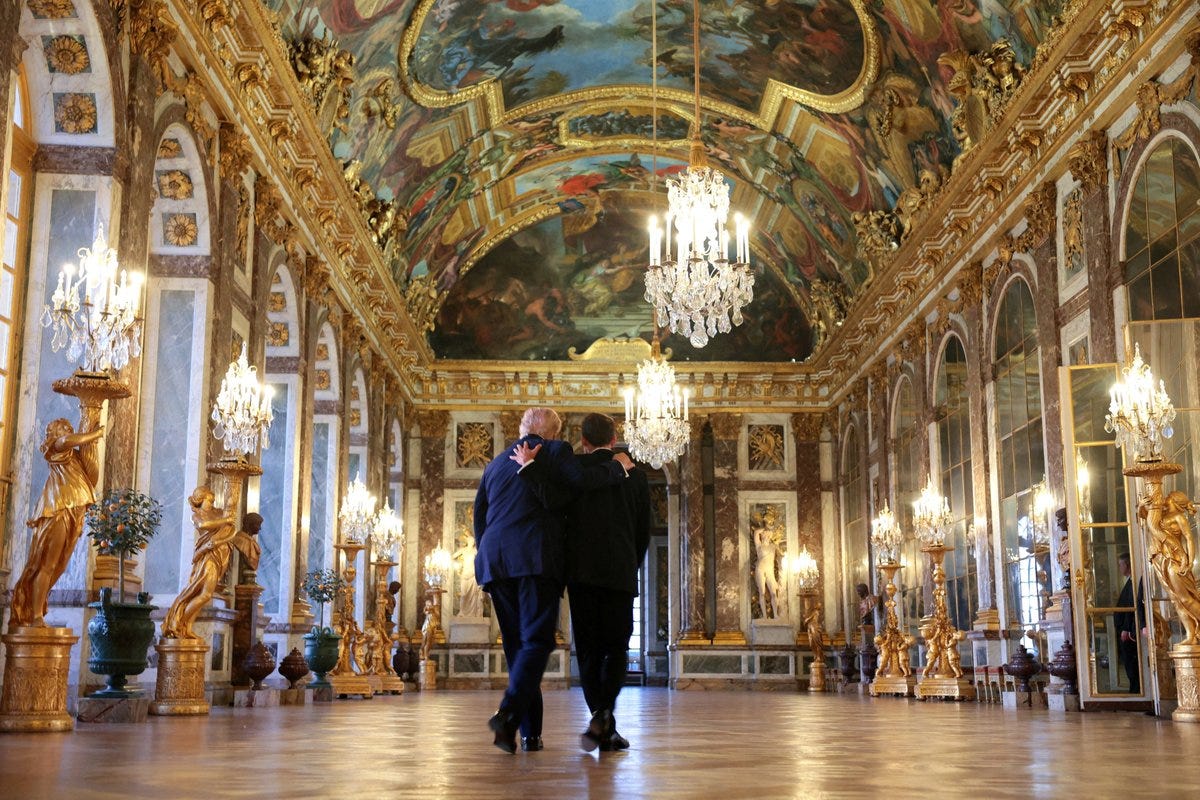
The deal was signed at Versailles. I want to pause and just sit with that for a moment — the geometry of it, the choreography. Rubio handing the document across the table, Trump putting his name to a memorandum of understanding between Washington and Tehran, and then Trump and Macron walking in to dinner in the palace of the Sun King. The mirrors. The gilt. The long avenue of fountains stilled for the evening. A man signs an instrument meant to slow the dying in Lebanon, and then he sits down to eat under ceilings painted to flatter a monarchy that bankrupted itself on wars and spectacle and couldn’t feel the ground shifting beneath the parquet flooring.
I am not writing this today as an analyst. The analysts have done their work, and you can read it anywhere — who gained; who lost; the sixty-day clock; the Hormuz Strait reopening; warnings of a global famine; and the money that will be released against benchmarks nobody outside the room has seen in full. I am writing as someone who has great difficulty comprehending how our world has come to this. Look instead at one entry in the accounts. Twenty-five billion dollars, frozen for years, that Iran could not touch. Now handed back in two halves — some at the signing, the rest only if Tehran behaves — and a part of it routed toward repairing the very damage the bombing caused. Read that sentence again. The frozen savings of a sanctioned state, unfrozen to become a reconstruction fund for the war just fought against it. Debit, credit, and balance carried forward. That’s the kind of entry that gets recorded. All of this is real, and of course all of it matters. But it’s not what kept me at my desk last night writing this.
Here’s the thing the ledger of states doesn’t record. Three and a half months of war. Khamenei dead. Larijani is dead — the very person who understood the situation intimately, killed at the start of the negotiations as if to make them deliberately more difficult. A strait that carries a fifth of the world’s oil closed and then reopened, and in between, somewhere, was the unphotographed: the families in Nabatieh whose names didn’t make the dispatches; the convoy of twenty-five trucks turned back at a checkpoint and was sent the long way round, twelve hours to carry people home to houses that may no longer be standing. Markets soared. The S&P is up nearly two per cent. Oil down five. Ships of the world, start your engines.
Set those two journeys side by side, because the system can only see one of them. The oil’s movement moved the index inside the hour — America had been draining its emergency reserve to its lowest level since 1983 to keep pump prices down through a war it was itself prosecuting, and the day the strait reopened, that draining could stop. That’s what registered. The trucks carrying people home took twelve hours and moved no number anywhere. It’s the same word for both — ‘flow’ — and only one of the two things it names ever reaches the ledger.
I have lived long enough, and in enough places, to recognise the particular obscenity of a sentence like “Let the oil flow”. It’s the voice of a civilisation that has learned to read the world through a single mechanism and has forgotten it was ever a choice. The only thing that seems to matter is keeping the massive Ferris wheel of global production and consumption spinning. We have built our entire apparatus of life’s meaning around throughput — barrels, basis points, and the restoration of commercial traffic through a choke point — making the resumption of flow into a moral event. The oil moves again, and we can breathe again. The exhalation feels like relief, like peace, like something good has happened in the world. And something good has happened, in its way. The dying slows. I cannot pretend the dying slowing is nothing. To the mother in southern Lebanon, it’s the difference between worlds.
But watch what the framing does. It converts a catastrophe into a transaction. It then balances the books and calls it peace. It cannot hold the dead in the same hand as the index. It has no column for them. The ghosts of this war — and there are so many of them now, the named and the unnamed both — exert no gravity on the ledger at all because the ledger was designed, from its foundations, to exclude them.
This is what I keep trying to say in the books I have been writing and what I want to say here more plainly than I usually allow myself to say in The Hames Report. The machinery that produced this war and the machinery that produced this peace are one and the same paradigm. I call it industrial economism. And the ledger is simply that paradigm doing its bookkeeping — the audit it runs on everything that lives, the running total it keeps in barrels and basis points and never in mornings or children or grief. We didn’t switch systems when the shooting slowed down. The same logic that priced the war as worth fighting now prices the ceasefire as worth signing. And it is the pricing itself — the reduction of a living, breathing, grieving region to a flow problem and a compliance schedule — that’s the deeper wound. Trump’s deal does not heal it. The deal is written in its own language.
I felt the old vertigo reading it. You may know the feeling. It’s the sense of standing inside an enormous, beautifully orchestrated structure and realising the orchestration is the problem – that the building is sturdy, the load-bearing walls are intact, and the whole thing will stand for another century. And yet that’s precisely the catastrophe. Westphalia held. The state system did what the state system does. It metabolised three and a half months of killing into an 800-word document of fourteen points and walked into dinner. Nothing broke. That is the horror of it. Nothing broke!
And here is what I need to say plainly, because we keep letting ourselves believe the opposite. The strait reopened. The billions moved. The dying slowed. The index climbed. That is not the system failing. That is the system in perfect health, meeting its specifications, doing precisely what it was built to do. We have made a civilisation that can take three and a half months of killing and process it into a document and a market rally without one component struggling and then return a verdict and call the verdict ‘peace’ and mean it. The industrial machine is not broken. It’s never run more smoothly. That is what the world has come to. Not that we can’t count the dead. But we’ve built the instrument so well it no longer needs to, nor has any interest in doing so.
And yet I want to leave us somewhere other than despair, because despair is just the ledger turned inside out — it’s what you get when you accept the system’s accounting and find the total unbearable. There’s another way to think about this. I have spent fifty years trying to learn it, and I am still, most nights, a novice.
The mother carrying her child home along the longer road doesn’t experience the ceasefire as a basis-point movement. She experiences it as a morning her son is still alive. That morning is not in the ledger, and yet it’s more real than the ledger. The whole of the future — the actual future, the one that arrives rather than the one that is projected — is built out of mornings like that, out of the obligations we hold to one another and to the children and to the living systems that support us, none of which the memorandum can see and all of which persist regardless.
So I am not going to ask you to celebrate this peace, and I am not going to ask you to mourn it. I am going to ask you to refuse the choice. To hold the slowing of the dying as the genuine mercy it is, and in the same breath, without flinching, to refuse the accounting that made the dying intelligible as a price in the first place. Both hands. The relief and the refusal. That is the discipline. That is, I have come to think, nearly the whole of it.
The machine will return its verdict, and the verdict will be total, and the verdict will not be true. It can never be true. It can’t reach the mother’s morning. It can’t touch the son who is alive today, who would otherwise not have been. Those are outside the accounting of industrial economism. They are more real than anything inside it, and the one thing the instrument cannot do, for all its perfection, is compel you to agree with it.
That refusal is small. It’s also the whole of what they can’t sign away. The state signed at Versailles last night. You signed nothing. Don’t let them tell you that you did.