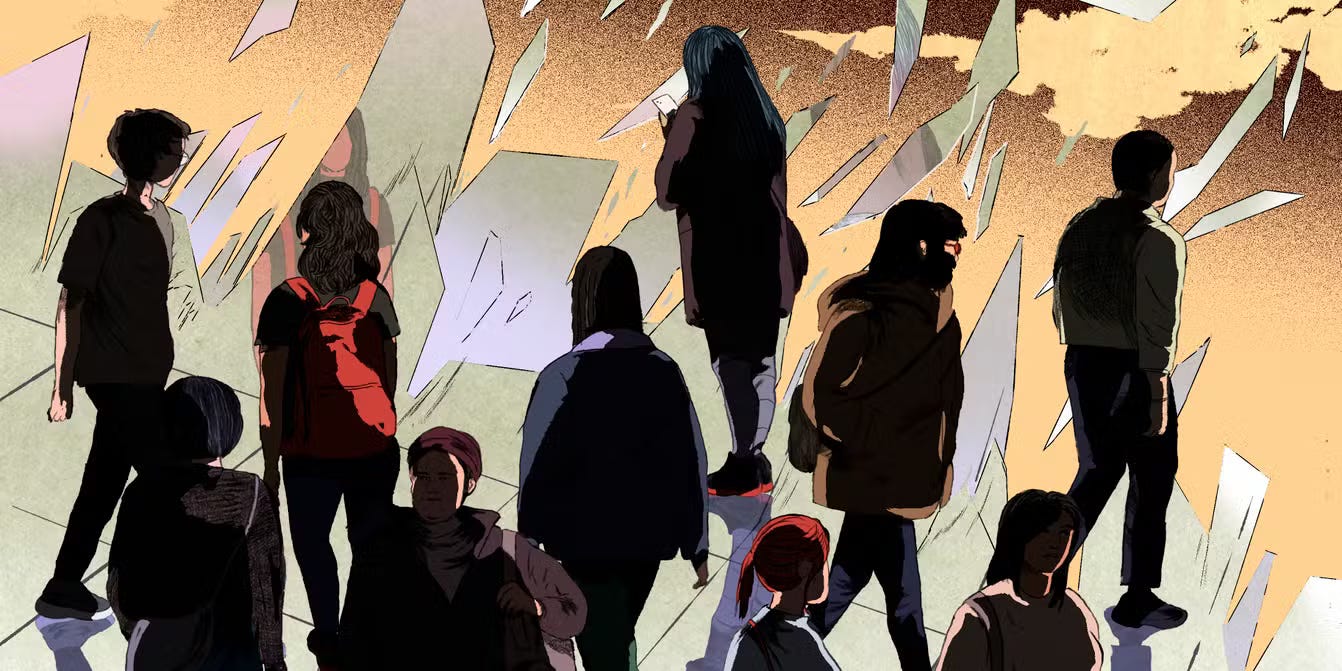
Let’s begin with a fable. Five monkeys. A ladder. Bananas. A jet of cold water that punishes the whole troop whenever one of them reaches for the fruit. Soon enough, the group attacks any climber, not from inherent malice but to avoid collective pain. Then the water is turned off. The attacks persist. One by one the original monkeys are replaced. None of the newcomers has ever been sprayed. Still, they enforce the rule as if it were a law of nature. If you could ask them why they would have no answer beyond the old incantation: that’s just what you do.
Whether this experiment actually occurred is beside the point. Some myths convey a truth more perceptive than data. This one describes the hidden scaffolding of culture: inherited prohibitions, second-hand fears, and the etiquette of survival that calcifies into ideology. We absorb patterns from people who absorbed them from people who absorbed them from others.... And so the cage without bars, once externally imposed, is internalised through ritual and repetition until it feels indistinguishable from reality.
The modern state—and its private-sector adjutants—understands this perfectly. Before we speak of governments, media, or markets, however, we should acknowledge the biology that makes us complicit. The brain is a patterning organ. Repetition incises each groove a little deeper. Practice does not make perfect; practice makes permanent. Myelin wraps the well-travelled circuits, reducing friction until a behaviour or a belief fires faster than thought. Stress pairs with anxiety, opportunity with fear, authority with safety, dissent with danger. After enough repetitions, these couplings feel like identity. They’re not. They are ruts.
The good news is neuroplasticity: every pattern can be weakened by disuse and replaced with a better route through deliberate rehearsal. The unsettling corollary is that what you can rewire in yourself can be rewired in you by others. What works for an individual scales to a population. From that fact the architecture of modern propaganda flows.
States—authoritarian and democratic alike—behave as behavioural scientists with a singular aim: not only to control what people do, but to program what they feel is appropriate to think. The most exquisite control never announces itself as control. It feels natural. It feels just like common sense.
Repetition is the principal tool. By saturating the environment with the same frames, phrases, and stories—across news bulletins, entertainment, schooling, and ceremony—propaganda constructs neural highways. Hear “threat to our way of life” ten thousand times and your brain glues “external enemy” to “existential danger.” Familiarity masquerades as truth. You cease to evaluate; you just recognise. The content could shift with the faction or the flag—the mechanism remains. The Soviet catechism, the fascist chant, the democratic bumper sticker, the algorithmically amplified hashtag: each is a metronome for myelin.
Emotions accelerate the process, fear and distress most of all. Pair a stimulus with panic, disgust, grief, or righteous indignation and you can fast-track a reflex for years. After the shock of 9/11, an entire repertoire of behaviours—airport theatrics, tolerance of surveillance, conflation of dissent with disloyalty—was wired into daily life through relentless reminders of omnipresent danger. The COVID-19 pandemic produced a different set: mask as morality play, quarantine as virtue, questioning authority as selfishness. Whether particular policies were prudent or not is not the point here. The point is what took root: automatic responses that bypass any form of critical analysis and recruit citizens to police one another. The monkeys attack long after the water stops.
History is thick with such anchoring. Nazi Germany attached Jews and other out-groups to disgust and contagion. The Soviet lexicon fused “counter-revolution” with mortal threat. During China’s Cultural Revolution, humiliation rites and rote citation reworked people from the inside out. Today, biometric surveillance and social credit compress reward and punishment into real time, conditioning compliance with an efficiency earlier regimes could only dream about. And in the West, subtler means prevail. Media consolidation orchestrates choruses of repetition. Party duopolies train binary thinking. Slogans become loyalties. The cage is upholstered, but it’s still a cage.
Ritual secures the cage. Bodies learn what minds later rationalise. Stand for the anthem, hand to heart, words recited in unison: somatic anchors forge links between posture, symbol, and belonging. Drill and parade discipline reflex before reason. Religious and civic liturgies do the same work in different vestments. After a lifetime of rehearsal, the symbol summons the feeling—or the feeling summons the symbol—without needing either a story or a reason. You are moved before you know you’re moving.
Language completes the enclosure. Words are not neutral labels; they are shortcuts through the neural thicket. Control the vocabulary and you narrow the possibilities of thought. Euphemism reframes moral reality—”collateral damage” anesthetises the horror of dead civilians, “enhanced interrogation” hushes the scream of torture. Thought-terminating clichés—”conspiracy theorist,” “national security,” “for the children,” “threat to democracy”—operate as neural stop-signs. Say them and inquiry stalls; declare them loudly and inquiry ceases. Repeat a noble word often enough and you hollow it out. “Freedom,” “justice,” “terrorism”—emptied of specific meaning become pure triggers, emotional batteries waiting for a wire.
In essence, this is the “manufacture of consent” Noam Chomsky talks about. Agenda setting tells us what, and what not, to attend to. Framing tells us how to feel about it. Source management conditions trust and disdain. The Overton Window—the zone of thinkable thought—is not just cultural; it’s physiological. Ideas inside the window feel fluent because their pathways are paved. Concepts outside it feel awkward, dangerous, or unspeakable because they must force a route through scrub. Permit theatrical fights over narrow issues while tabooing foundational questions and you create the comfort of dissent without the risk of transformation. People will swear they are thinking freely while traveling along tracks laid down for them.
None of this requires a malevolent power or population. Most people defending the system are the monkeys who never felt the spray. They enforce rules they did not write and can’t justify because their nervous systems have been trained to equate any kind of deviation with danger. From social media pile-ons to workplace orthodoxies, conformity is now as autonomic as digestion. Pluralistic ignorance does the rest: everyone suspects everyone else believes, so everyone performs in sync. Anxiety is eased, curiosity punished. Thus, the ritual continues.
The most disquieting implication sits close to home. Much of what passes for identity - both individual and collective - is simply sedimented conditioning. Political instincts, moral certainties, tastes, fears, dislikes—most are residues of repeated coupling. That can feel nihilistic, as though the self were nothing but programming. But it can also feel emancipatory. If much of you was unconsciously installed, much of you can be consciously redesigned. The work is not a leap out of biology. It’s the craft of attention, where the skills are humility and discipline.
Notice your triggers and pause before the pattern runs its course. Shift your posture, breathe, and name the feeling—small moves that open a gap for reflection. Seek disconfirming evidence and stay with the discomfort instead of retreating to familiarity. Practice making the strongest case against your own view, but do it gently and with generosity. Choose communities that prize metacognition over loyalty—people who help you test reality rather than enforce an alternative orthodoxy. Broaden your vocabulary so you can express what you sense and recognise when language is being used to corral you. You’re not trying to establish immunity from conditioning—that’s impossible. You’re learning which conditioning to reinforce, and which to let fade.
Don’t be surprised if this feels like loss. You are dissipating neural pathways that once felt like you. The social costs are real, too. Conditioned populations treat deviation as treachery. You will be named: crank, extremist, conspiracist, heretic. These are spells cast to stop rational thought. Hear them as such. Respond with curiosity rather than submission or reflexive defiance. Remember that those who attack are playing out a programme. Have compassion for the programme while refusing to be bound by it.
The stakes stretch beyond the personal. Tyrannies endure not primarily by force but by recruiting citizens to conduct the policing themselves. Democracies decay when citizens mistake the comfort of well-rehearsed narratives for true freedom. A society that understands how conditioning works is harder to govern through fear and easier to mobilise for redesign. If we care about the future of freedom, we must widen literacy: not only the ability to decode text and numbers, but the literacy of patterning—the capacity to see the apparatus shaping our attention, emotions, and choice.
This is generational work. The grooves in a civilization’s mind take time to cut but longer to reroute. That entails building institutions that reward doubt and teaching perspective-taking. Designing media that exposes rather than narrows. Reimagining education so that children learn to examine their own thinking as rigorously as they learn arithmetic. You can expect backlash. But build anyway. Each person who resists the attack reflex eases the path for the next. Each community that respects inquiry expands the space in which we can breathe.
There’s no final escape from conditioning. We are living systems after all. We learn by repetition. The question is not whether we are programmed, but whether we’re aware of the programming and capable of choosing. The monkeys in the fable were not wrong to draw a lesson from cold water. They erred in confusing yesterday’s punishment with today’s reality: the difference between inheritance and truth. Our task is to keep asking: who installed this pathway, to what end, and what becomes possible if I walk another way?
Which brings us back to the ladder. You may climb and be attacked. You may hesitate and be applauded. One path offers comfort, and the other, agency. Agency is never a certainty. Certainty is often nothing more than a well-myelinated reflex. Agency is the willingness to live with conscious uncertainty, to hold competing narratives in abeyance without fusing too quickly with any, to examine your own attraction to the familiar before choosing.
We must expect the state to continue using the tools that work. Corporations will continue to optimise for your attention and your triggers. Crowds will continue to administer the spray of shame. None of that is a reason to surrender. It’s a reason to deepen your practice, extend your compassion, and refine your discernment. Recognise when your feelings are being used as levers. Notice the clichés that stop thought. Refuse the rituals that demand unthinking assent. Build alternative rituals of inquiry and solidarity.
Awareness confers responsibility. Once you have seen the cage, to pretend it’s not there is collusion. To see it and berate those who cannot is cruelty. The wiser course is to see it, name it, and then model another way of being—quietly, persistently, artfully. Not to win an argument, but to demonstrate that a different repertoire is possible.
The bananas are still there. The attacks will come. For many of us, the water was never real. The fear was inherited. The rule was received. Climb anyway.