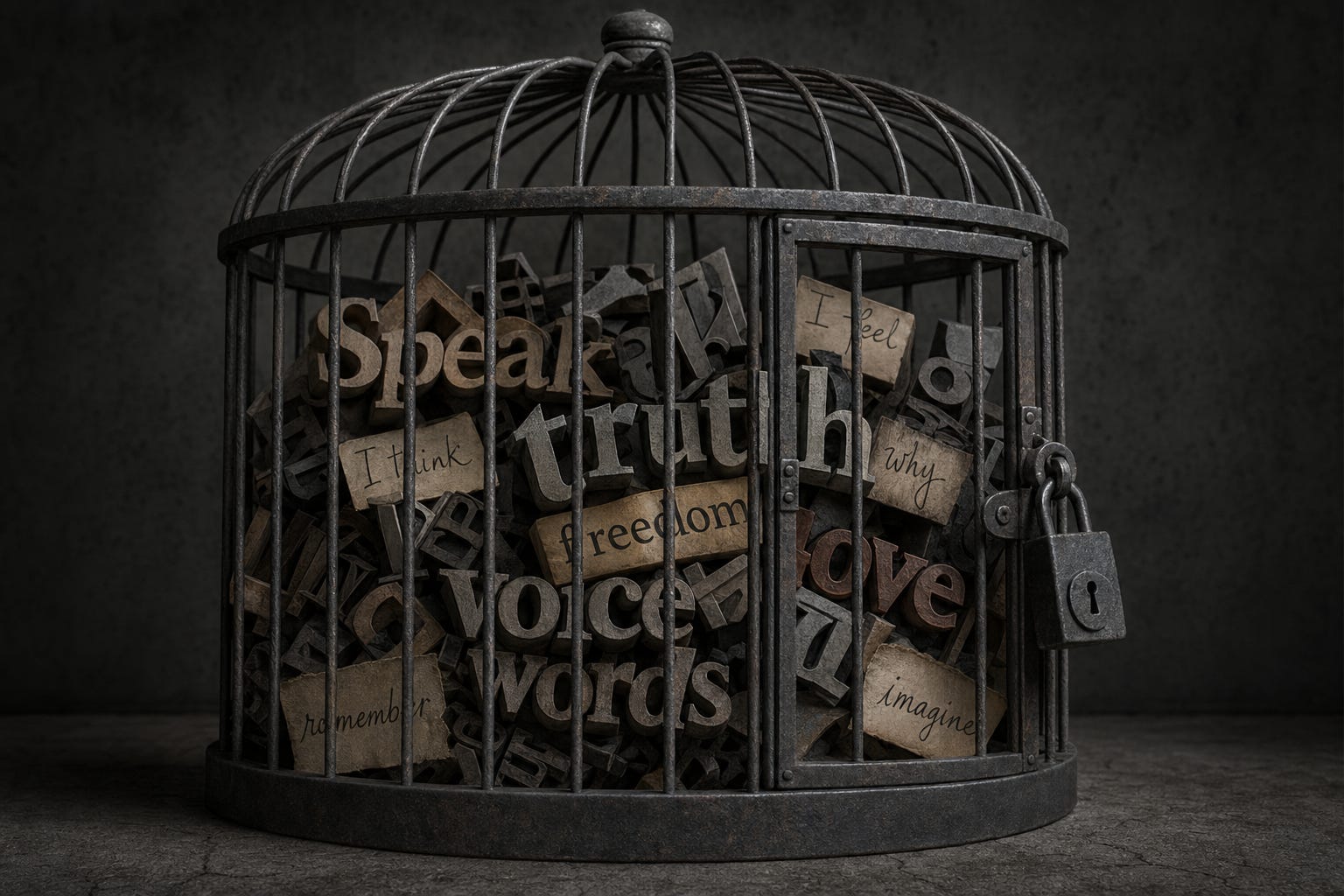
There’s a comfortable assumption, so widely held that it rarely announces itself, that language is a tool we pick up and put down — neutral in itself, shaped entirely by the intentions of whoever wields it. Here words are vessels. Meaning is poured in from outside. The map and the territory remain distinct, and provided we are careful, honest, and sufficiently rigorous, language will carry what we intend it to carry without spillage or distortion.
This assumption is false. It has always been false. And the cost of its persistence — in political life, in public discourse, in the institutions charged with protecting human dignity — is not simply intellectual. It’s measurable in what gets seen, what gets named, and what, by consequence, gets addressed. And, of course, what does not.
Language doesn’t describe the world from a neutral position outside it. It participates in the world’s construction. Don’t write this off as a postmodern extravagance. It’s an observable fact about how human attention works, how categories form, and how perceptions are organised and directed. The words available to a community at any given moment determine, to a far greater extent than we like to acknowledge, what that community is capable of noticing. Not because reality changes with vocabulary — it does not — but because without the right instruments of articulation, much of what is real remains functionally invisible. Seen, perhaps, but not seized or examined. Felt, perhaps, but not named. And what can’t be named cannot, in any politically consequential sense, be confronted.
Greate writers know this implicitly. George Orwell understood it with unusual clarity. His great concern was not only that politicians lied — lying is as old as politics — but that the structure of political language had evolved to make lying unnecessary. If the available vocabulary already forecloses the possibility of certain thoughts, then the suppression of inconvenient truths requires no active deception. It’s built into the instrument itself. Imprecision becomes a form of control. Vagueness is not careless — it is functional. It creates just enough fog to prevent the formation of the clear perception that might otherwise demand a response.
What Orwell identified in the mid-twentieth century has not diminished one iota. It has refined itself. The mechanism is now less crude and more sophisticated: the strategic deployment of precision. A definition so carefully constructed that it appears to illuminate while actually foreclosing. A category so precisely bounded that it admits the acceptable and excludes the dangerous, not through logic but through prior determination of where the lines fall. The appearance of rigour in service to the prevention of rigour. This is conceptual capture — and today it’s among the most consequential political phenomena operating in liberal democracies.
Language shapes perception through several distinct mechanisms, and naming them separately matters.
Selection. No utterance captures everything. Every act of description involves choices — conscious or not — about what to include, what to foreground, what to marginalise, and what to leave outside the frame entirely. A hospital described as a military target and a hospital described as a place where children are being treated are not two descriptions of the same neutral fact. They direct attention differently. They activate different moral responses. They make some things visible and some things irrelevant. Neither may be technically false. But they are not equivalent, and the choice between them is never innocent.
Nomination. The act of giving a name to something both crystallises it and constrains it. To name a thing is to make a claim about its nature: what category it belongs to, what other things it resembles, what responses it therefore warrants. This is why disputes about names are always disputes about something more than names. When the question of whether a particular set of actions constitutes genocide is contested, what is at stake is not lexicography. It’s the entire apparatus of moral, legal and emotional response that the word activates. Genocide demands certain things of those who witness it. A lesser word demands less. The choice of word is a choice about obligation.
Ludwig Wittgenstein’s late work circled this problem from a different angle. The limits of my language, he had written in his early period, are the limits of my world. He later complicated this — language is not a single system but a family of overlapping practices, each with its own internal logic, its own criteria for what counts as a correct move. But the insight about limits remained: the language game being played in any given situation determines what can be said within it, and therefore what can be thought. When the rules of a language game are controlled — when certain moves are declared illegal before the game begins — the game’s outcome is not discovered. It’s determined in advance.
Legitimation. Language doesn’t just describe what exists — it distributes authority over what matters. When selected voices are described as experts and others as activists, when certain arguments are described as analysis and others as propaganda, when certain suffering is described as a crisis and other suffering as collateral, what’s being performed is not impartial description but the allocation of credibility. Some things, and some people, are granted the standing to make claims that will be taken seriously. Others are not. And the criteria for that allocation are never as objective as they are made to appear.
Pierre Bourdieu called this symbolic power — the capacity to make the world seen and believed in a particular way. Its exercise doesn’t require force or even explicit authority. It operates through the ordinary processes of communication, through the taken-for-granted assumptions embedded in the language that dominant institutions use without scrutiny. The newspaper that describes a military operation as a response to terrorism and another that describes it as the continuation of an occupation are not just offering different perspectives. They are constituting different realities for their readers — different maps of who the actors are, what their intentions are, and therefore what kinds of responses are thinkable.
—
If these mechanisms operate constantly — and they do — then the question of responsibility becomes pressing. Not only the responsibility of those who manufacture language for political purposes, though that responsibility is real and serious. The more uncomfortable issue is what responsibility falls on those of us who use language without examining it: who inherit categories, who reproduce framings, who permit the “taken-for-granted” to remain unexamined because examination takes effort and the existing vocabulary is convenient.
Judith Butler has argued that to be constituted by language is not to be determined by it. The fact that we’re born into language games we didn’t choose, that our earliest perceptions are already structured by categories we didn’t invent, does not absolve us of the obligation to interrogate those categories. Indeed, it makes that obligation even more urgent. The subject who simply reproduces inherited language is not innocent. The subject is complicit — not through intentional malice but through the abdication of the particular kind of attention that language, used seriously, demands.
This is a harder argument than it sounds. It doesn’t ask us to become linguists or philosophers before we’re permitted to speak. It asks something simultaneously more modest and more demanding: that we notice when the words we’re using are doing work we have not authorised. That we pay attention to what our vocabulary selects and what it suppresses. That we resist, in particular, the comfort of borrowed precision — the definition handed down by authority, the framework adopted because it’s already in public circulation, the category accepted because questioning it is socially costly.
The social cost of questioning dominant language frameworks is not trivial. This is worth acknowledging plainly, because the responsibility being described here is not exercised in a vacuum. The person who insists on using the word genocide in a context where institutional authority has decided the word is impermissible is not just making an intellectual choice. They are accepting a social penalty. The academic who applies the full rigour of international law to a state that has been placed, by the dominant framework, beyond such application risks more than peer dissent. They risk their career, their standing, their safety. The social machinery for enforcing linguistic compliance is real, and its costs fall unevenly — most heavily on those with the least institutional protection.
But this, too, is an argument for taking language seriously rather than an argument against it. Because the enforcement of linguistic compliance is itself a form of power, and power that cannot be named cannot be resisted. The first act of resistance is always description. Not protest, not action, but the precise, accurate, unflinching naming of what’s happening. Without that, everything that follows is operating in the dark.
What each of us owes to language, then, is this: the refusal to accept that clarity is impossible when the actual obstacle to clarity is not complexity but control. The willingness to make the distinction — patient, repeated, unglamorous — between precision that illuminates and precision that forecloses. The capacity to ask, of any definition presented as authoritative: who constructed this, using what criteria, in whose interest, and what does it make impossible to say?
These are not rhetorical questions. They are the questions on which the integrity of public discourse depends.
—
Which brings us to resistance — and to what it actually looks like in practice, because resistance to conceptual capture is not a single dramatic act. It’s a practice. It’s what happens when individuals and communities decide, repeatedly and against social pressure, that the integrity of their moral vocabulary matters more than the comfort of compliance.
The first form this takes is etymological recovery — the return to what words were built to mean, before they were stretched, narrowed, or reversed by strategic redefinition. This is not conservatism. It’s not an argument that language should be static. Language evolves, and its evolution often represents genuine moral progress — the extension of concepts like rights, dignity and personhood to those previously excluded from them, for example. But there’s a difference between evolution and capture. Evolution expands the moral reach of an idea. Capture restricts it — bends it back toward the interests of the powerful, away from the vulnerable it was designed to protect.
The word genocide was coined by Raphael Lemkin, a Polish-Jewish lawyer who lost forty-nine members of his family to the Holocaust and spent the remainder of his life ensuring that what had happened to them could never again go unnamed. Recovering the original load-bearing meaning of that word — not as an insult or a polemical charge but as a precise legal category with specific criteria, built from the ruins of the worst catastrophe the modern world had produced — is not an act of aggression. It’s an act of fidelity. Fidelity to Lemkin’s project, to the institutions that codified his work, and to the survivors whose testimony made those criteria possible. Using the word with that precision, in the face of institutional pressure to use a softer term or no term at all, is not inflammatory. It is responsible. The inflation of language and the deflation of language are both forms of distortion. Resistance means holding the word at its actual weight.
The second form resistance takes is the maintenance of distinctions that power finds inconvenient. The distinction between a people and a state. Between an identity and a political project. Between hatred and criticism. Between the protection of individuals from prejudice and the protection of governments from accountability. These distinctions are not at all complicated. They are elementary. Their collapse is not the result of genuine conceptual difficulty — it’s the result of a sustained effort by those who benefit from the collapse. Restoring them requires no new philosophy. It requires only the insistence on thinking clearly in the presence of those who find clarity threatening.
The third form is perhaps the most important, and the least visible: the cultivation of what might be called “attentive reading” — the habit of noticing what language does rather than simply what it says. This means attending to what is foreground and what is background. To who is described as an actor and who as a condition. To whose suffering is rendered in human terms and whose in statistical ones. To which questions are treated as genuinely open and which are treated as settled before they are examined. To the difference between a debate in which both positions are permitted to make their best case and a debate in which one position has been pre-emptively disqualified.
This kind of reading — or listening, or watching — cannot be reduced to a technique. It’s more of a disposition - the disposition of someone who has understood, at a level below argument, that language is never just describing what is happening. It is always, simultaneously, making choices about what matters, who counts, and what kind of world is being constituted in the act of speech.
The stakes of that understanding are not at all abstract. They are as concrete as the decisions made by governments on the basis of what their citizens are permitted to name. As concrete as the humanitarian responses that are mobilised or withheld depending on which framework of description has succeeded in dominating public perception. As concrete as the children who are operated on without anaesthetic while the adults responsible for their situation argue, in the comfortable distance of committee rooms and opinion pages, about which words it is permissible to use to describe what is being done to them.
Language in this light is not an accessory to political life. It is its substrate. The medium in which power is exercised, contested, legitimised and occasionally, with effort and courage, refused.
—
We began with an assumption: that language is a neutral instrument, capable of cleanly describing reality without distorting it. We end with a different understanding — not of language as hopelessly compromised or irredeemably political, but of language as a site of an ongoing contest whose outcome is never fixed and never trivial.
What we permit ourselves to name influences what we permit ourselves to confront. It’s where the work begins. The work of precision — not the defensive precision that forecloses, but the illuminating precision that opens. The work of distinction — between what is genuinely similar and what has been strategically conflated. The work of attention — to what our vocabulary selects, suppresses, and constructs in the act of seeming merely to describe.
None of this is politically neutral. The refusal to accept that neutrality is possible is itself a position, and an honest one. But it’s a position with a discipline attached to it — the discipline of applying the same quality of attention, the same insistence on precision, the same willingness to name what is happening, regardless of whose interests are thereby served or challenged.
That discipline can be extremely uncomfortable. It’s not safe. And it’s not optional — not for anyone who has understood what’s actually at stake when language is used as a mechanism of containment rather than a means of illumination.
What’s at stake is not simply the integrity of words. It’s the integrity of attention itself. And attention, directed honestly and without exception toward what’s actually happening in the world, is the precondition for everything that might, in any meaningful sense, be called a response.