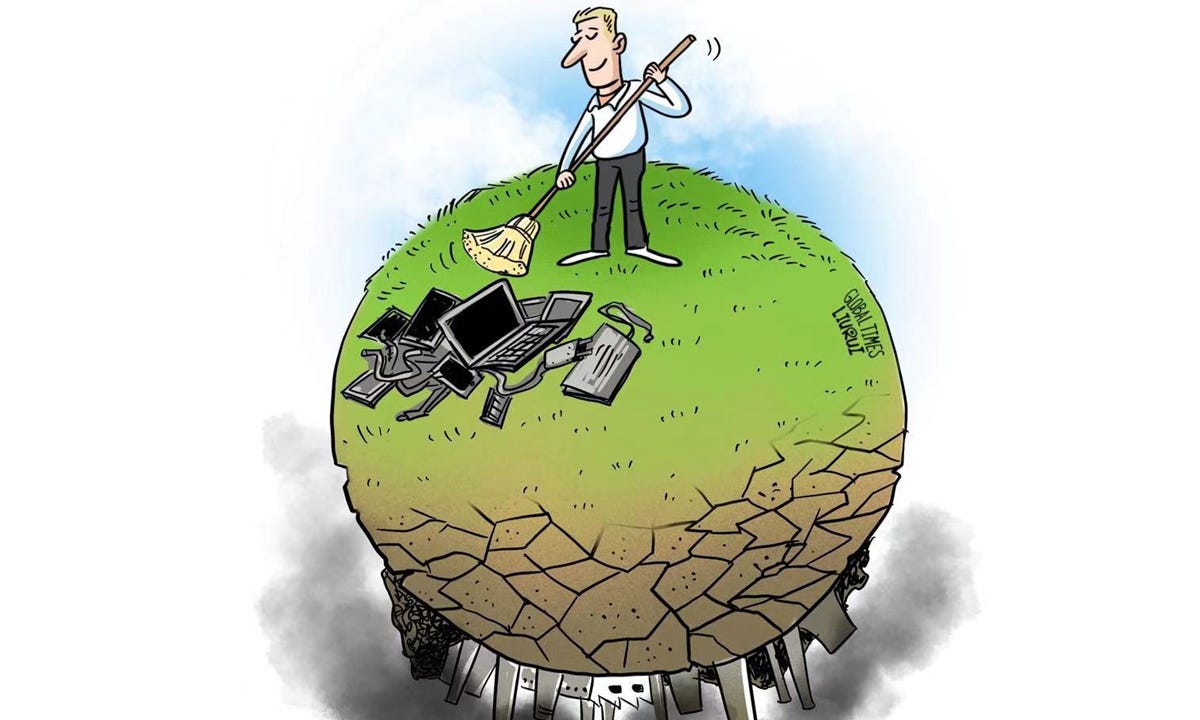
Picture a vast theatre. The packed audience sits transfixed by an elaborate drama unfolding on stage—nations clashing, borders shifting, ideological battles raging with all the sound and fury that power can orchestrate. The spotlights blaze. The music swells. Everyone pays attention to the geopolitical spectacle while behind the theatre, unseen by the mesmerized crowd, there’s smoke. The building itself is on fire.
That is our predicament. It's not a metaphor. The flames licking at the foundations are real—rising global temperatures, mass extinction, and ecosystem collapse—all direct results of an economic system built on extraction and exploitation.
We're witnesses to the accelerating reality of a planetary crisis across so many dimensions simultaneously that it defies the neat, sanitized, and simplified narratives of the mainstream. While we're all distracted by the geopolitical theatre, the ecological catastrophe unfolding before us is real, yet we're ignoring it. All of this is not some abstract tragedy of the commons or a failure of individual obligations—it's the inevitable consequence of a colonial extraction machinery that has been devouring the Earth for centuries, leaving behind a trail of devastation that now threatens to consume everything in its path.
The geography of this crisis tells a story that power would prefer to keep hidden. In the towering citadels of the imperial core—London, New York, Brussels, Tokyo—the ruling classes who control the means of production, the energy systems, and the global capital flows continue their relentless accumulation while the Global South bears the devastating weight of their choices.
These are not abstract market forces but concrete decisions made by identifiable elites who wield capital as a weapon of ecological destruction. Through their investment portfolios, the demands of corporate shareholders, and their management of our financial institutions, they orchestrate a system of planetary plunder that treats the Earth as nothing more than a balance sheet to be optimized. These elites are not villains by individual moral failure, but as functionaries of a system that rewards ecocide—their power derives from positions in institutions designed for extraction.
The great ideological sleight-of-mouth of our time lies in how power frames ecological collapse as some universal human failing, when in reality it's the inevitable consequence of a civilization built on extraction. The crisis we face is not biological but political - the direct result of an industrial economic order designed by and for elites who treat both nature and human labour as infinite resources to be mined.
Their system cannot function without this violence, yet they demand we believe no alternative exists. Every coal-fired power plant, every fracking operation, every industrial agriculture complex represents a deliberate choice by the neoliberal accountants of "industrial monetocracy" to prioritize short-term profits over long-term planetary survival. These decisions flow from corporate headquarters and investment banks in the imperial core, not from subsistence farmers in Bangladesh or indigenous communities in the Amazon.
Weigh up the brutal arithmetic of this arrangement. The numbers do not lie: multinational corporations headquartered in imperial capitals extract 50% of all materials consumed by Global North nations directly from the plundered periphery. From the cobalt mines of Congo to the palm oil plantations of Indonesia, from the lithium deposits of Bolivia to the rare earth excavations scarring landscapes across Africa and Asia, every ton of material flowing northward represents a strategic investment decision by ruling class institutions. Each smartphone, each electric vehicle battery, each solar panel carrying the promise of a "green" future is built upon the ecological sacrifice zones of the Global South, where communities are poisoned, displaced, and dispossessed so that capital can maintain its expansion while greenwashing its image through technological spectacle.
The ruling classes of the imperial core don't simply benefit passively from this arrangement—they actively design, finance, and enforce it. Through their control of global financial institutions, they structure debt relations that trap Southern nations in cycles of dependency. Through their ownership of production facilities, they determine what gets produced, how, and for whose benefit. Through their influence over energy systems, they decide whether the world transitions to renewable sources or continues burning fossil fuels. The climate crisis is not an accident; it's the predictable outcome of their strategic choices, repeated daily in thousands of boardrooms where ecological considerations are systematically relegated to quarterly profit reports.
This is neocolonialism—no longer reliant on the gunboats of the 19th century, but enforced through a seamless fusion of financial power and corporate rule. Transnational elites—embedded in Wall Street, the City of London, Brussels, and Tokyo’s boardrooms—orchestrate a global extraction regime where debt is the new empire. These elites are not rogue actors but cogs in a machine: whether CEOs, cabinet ministers, or fund managers, their actions are dictated by capital’s logic. Remove one, and the system replaces them with another. Even apparent dissent—BlackRock’s ESG pledges, BP’s ‘Beyond Petroleum’ rebrand—serves only to greenwash continued plunder. The machine metabolizes reformist gestures like antibodies neutralizing a threat.
Meanwhile, the International Monetary Fund and World Bank act as enforcers, structuring loan conditions that gut public services, privatize resources, and lock the Global South into perpetual raw-material export. Any nation that resists—whether by nationalizing oil, rejecting austerity, or prioritizing ecological restoration—faces capital flight, sanctions, or coup attempts.
Sovereignty is permitted only when it serves capital’s appetite for slave labour and cheap resources. The same system that plunders the Global South also fractures resistance in the imperial core—pitiless austerity for the working class, greenwashing for the conscience of the privileged. Yet the myth of a ‘labour aristocracy’ is crumbling: the same finance capital that immiserates Lagos also evicts London renters and replaces Detroit autoworkers with robots. The iPhone assembly-line worker in Shenzhen and the Amazon warehouse slave in Alabama are twin casualties of one system. Alternatives do exist: Bolivia’s nationalization of lithium for communal benefit, the Niger Delta’s protests against Shell’s ecocide, and the growing demand for energy democracies that place wind, solar, and land under collective control. Real solidarity means admitting there's nothing 'green' about energy technologies built with Xinjiang's forced labour or Congo's child-mined cobalt—and working to change the global trade and banking systems that reward these abuses.
The paradox of our moment reveals the fundamental irrationality of ruling class priorities. We live in an age of unprecedented productive capacity, where human ingenuity has unlocked technologies that could easily provide dignified lives for every individual on Earth while healing our damaged ecosystems. But technology is never neutral: the same lithium battery that powers an electric bus in Oslo may be forged in Bolivian salt flats by child labour. The difference isn’t engineering but ownership—a solar panel owned by a worker coop serves life; one owned by BP serves quarterly dividends. Yet because production remains under the dictatorial control of capital, almost eighty percent of humanity languishes in deprivation while a tiny elite accumulates wealth at rates that would make the pharaohs blush. This is not a failure of technology or knowledge—it's simply the predictable outcome of organizing production around capital accumulation rather than human flourishing or ecological balance.
The mythology of inevitability that surrounds these crises serves to mystify what is actually a choice made daily by ruling class institutions. We're told that solving poverty will take generations, that transitioning to sustainable energy systems requires decades of careful reform, that addressing ecological resilience and climate breakdown demands sacrifice from ordinary people while leaving the fundamental structures of capital control untouched. These are lies. They are designed to protect an economic régime that cannot survive honest scrutiny of its ecological impacts.
The truth is that both ecological collapse and mass deprivation could be resolved with remarkable speed and ease if the ruling classes lost their stranglehold over production, if their capital were expropriated and production reorganized democratically, if communities had sovereign control over their resources and labour. The technology exists. The resources exist. The knowledge exists. What doesn't exist is political will among our ruling elites who understand that such transformations would spell the end of their class dominance and their ability to extract wealth from both human capital and natural systems.
This is why liberation movements in the Global South face such ferocious repression from imperial core states acting on behalf of their ruling classes. Nor is this struggle binary—the same financial elites that drain Congo’s cobalt also bribe its politicians, just as Shell operates with impunity in Nigeria through local oligarchs. True sovereignty must overthrow both the foreign extractor and the domestic collaborator. A truly sovereign Palestine threatens not just Israeli apartheid but the entire architecture of Western capital's control over Middle Eastern energy resources. A Congo that controls its own mineral wealth would undermine the entire global electronics industry dominated by core-based corporations. A Venezuela or Bolivia that uses oil revenues for its own social development rather than servicing debt to imperial financial institutions represents an existential threat to the entire system of capital accumulation that sustains ruling class power in the Global North.
The violence unleashed against these movements—from Gaza to Kinshasa, from Caracas to Baghdad—flows directly from ruling class calculations about preserving their control over global production systems. Every drone strike authorized from Pentagon war rooms, every proxy war funded by intelligence agencies, every economic sanction designed in treasury departments represents the active defense of capital's planetary extraction machine by those who profit most from its operation.
Understanding this dimension fundamentally reframes the ecological crisis. It becomes clear that there can be no genuine environmental movement that doesn't directly challenge the power of capital controllers, no meaningful climate action that doesn't expropriate the wealth and productive assets of the ruling classes, no ecological healing that doesn't begin with breaking their stranglehold over global production systems.
This isn’t some arcane theory. From the silver mines of Potosí to the lithium fields of Atacama, 500 years of colonial arithmetic prove one law: capital will cannibalize the planet until nothing remains unless we stop it. Our only counterforce is the same one that toppled slave economies and forced land reforms—mass expropriation. Not ‘net zero’ fantasies. Not ‘ethical’ supply chains. The seizure of extractive wealth, down to its last bloody dollar, and its redistribution as reparations to the gutted periphery is now needed.
This requires acknowledging that the ruling classes at the core of empires are the primary architects of ecological collapse and that any serious response, including renewal and regenerative approaches, must begin with dismantling their control over capital, production, and energy. It means building solidarity between communities around the world in a shared vision of ecological democracy that explicitly targets ruling class power as the fundamental obstacle to planetary survival. This power resides not in individuals but in the structures they temporarily inhabit—structures that must be dismantled so no new oppressors can take their place.
The Earth is dying because capital is killing it, and capital is controlled by identifiable ruling class networks that value their wealth accumulation over the continuation of life itself. The only medicine powerful enough to heal these wounds is the complete expropriation of ruling class assets and the construction of a truly democratic global civilization organized around care rather than capital, regeneration rather than extraction, cooperation rather than class domination, and compassion rather than exceptionalism.
The choice before us could not be more clear: ecological socialism or planetary barbarism. The planetary deadline approaches with merciless indifference to our hesitation, while ecological collapse accelerates far beyond the pace of our political imagination.