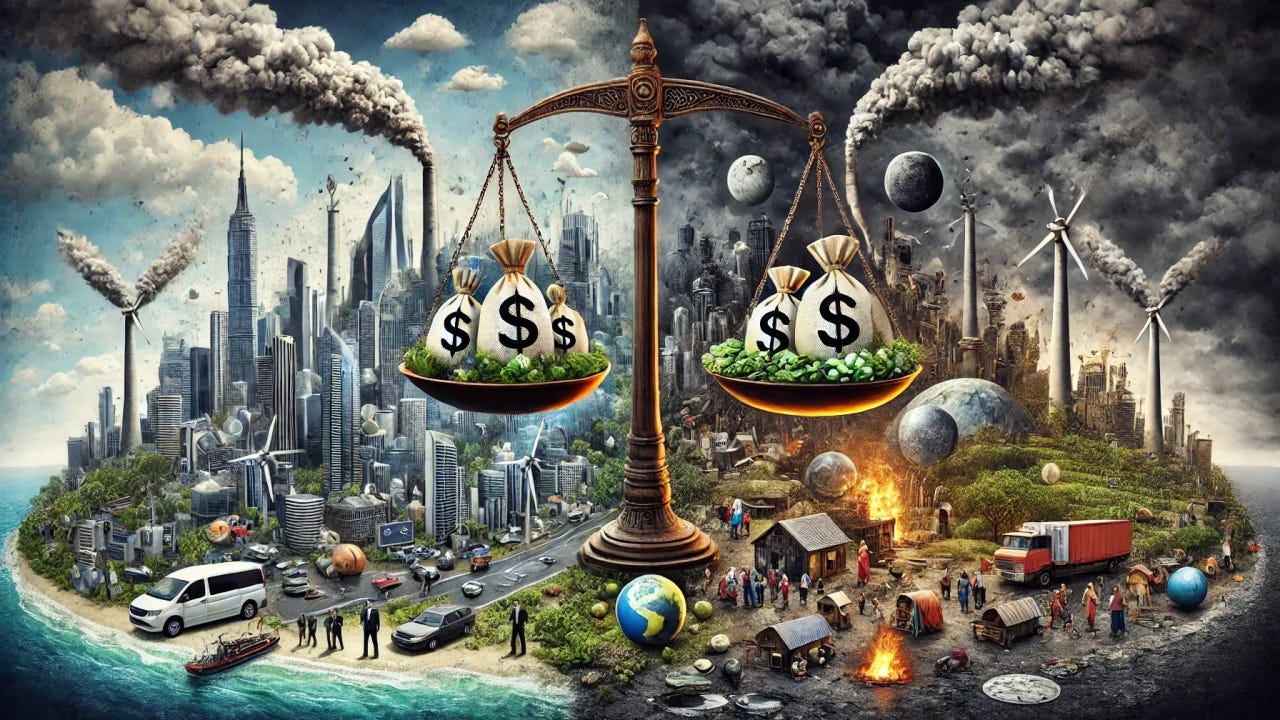
In these early years of the twenty‑first century, Homo sapiens have engineered a civilisation capable of sending robots to Mars, editing genes with surgical precision, and trading trillions of dollars at the speed of light. And yet none of that extraordinary sophistication can guarantee that a child born in Kinshasa, Karachi, Kingston or Kraków will have roughly the same life chances as a child born in Canberra, Copenhagen or Chicago. This is the predictable outcome of a game we have collectively chosen to play – and then largely forgotten we invented.
In today’s newspapers a headline caught my eye. Coinciding with the World Economic Forum in Davos, nearly 400 millionaires and billionaires from 24 countries are calling on governments to increase taxes on the super‑rich. This headline captures one concern – that the super‑rich can buy political influence. But this is only a small part of a much deeper problem.
Extreme wealth concentration allows a small group to control key assets, distort markets and shape public discourse through media ownership, philanthropy, and funding of think tanks and election campaigns. Even where taxes on the rich are formally high, tax avoidance strategies, weak enforcement and the global mobility of capital often undermine effective taxation, shifting the burden onto ordinary citizens through regressive taxes. Moreover, higher taxes alone will not fix structural inequalities if public revenues are misused or reinforce existing corporate power. Nor will they tackle entrenched intergenerational privilege. The issue is not only undue political influence, but the broader ways in which extreme wealth affects democracy, economic fairness and social stability.
What we politely call inequality is, in fact, the operating logic of industrial economism: a global, monocultural creed that treats human beings as disposable inputs to a machinery whose purpose is quite simply the leverage of production and consumption. As long as that creed remains sacred – to politicians, executives, economists, technologists and, crucially, to billions of ordinary citizens who no longer see alternatives – the stabilisation of human prosperity across the planet will remain a slogan rather than a project.
The fundamental issue is not how to make current arrangements slightly more tolerable by taxing wealth. It’s whether we still possess the imagination, courage and collective intelligence to re‑script the guidelines of a civilisation that’s become addicted to its own dysfunctional norms. The fact that this “design” feels natural doesn’t make it inevitable. What has been constructed can be redesigned.
The Topology of an Unjust Game
If we insist on speaking of “prosperity”, we should be honest about how it is currently manufactured and measured. By most conventional metrics – GDP per capita, productivity, stock market capitalisation – the world has never been richer. Yet UNICEF, the World Bank and WHO all converge on the observation that hundreds of millions of people remain chronically undernourished; that vast numbers lack access to clean water or reliable sanitation; that preventable diseases still reap harvests of avoidable death in low‑income regions. We already have more than enough material wealth to secure a dignified life for everyone, but within the present rules of the game there is no compelling desire to do so.
This is not just because “the rich are greedy” or “corruption is rife”. Those are symptoms. The deeper pattern is structural: prosperity has been defined as an outcome of competitive advantage in markets designed to be asymmetrical. Countries, corporations and individuals are encouraged – trained, in fact – to view advantage as a positional good. My success depends, implicitly, on your relative failure.
Trade regimes embody this logic. Wealthy states demand the free movement of capital while constraining the movement of labour. Intellectual property regimes lock technologies, pharmaceuticals and seeds behind legal fortresses long after their development costs have been recouped. Commodity chains are arranged so that value is systematically extracted from resource‑rich but cash‑poor regions and consolidated in financial centres that produce mostly paper promises and data exhaust. Any serious attempt to equalise prosperity has to begin by acknowledging that the global economy is not malfunctioning. It is functioning exactly as it was designed: to concentrate benefits and disperse harms.
The game is tilted. The board is rigged. Yet we continue arguing about how to move the pieces more “efficiently”.
Civilisational Myths and Invisible Handcuffs
Beneath laws, contracts and trade flows lies something almost imperceptible yet ultimately far more potent: our taken‑for‑granted stories about what it means to be human. Industrial economism rests on a few core myths which, repeated often enough, have hardened into secular scripture.
One such myth is that value is essentially monetary. That which can be priced is thereby rendered meaningful; that which cannot be priced is relegated to sentimentality or “externality”. A rainforest becoming timber and cattle pasture registers as economic growth. A rainforest remaining intact – stabilising climate, sustaining biodiversity, nourishing Indigenous cultures – is treated, by most national accounts, as economically nonexistent. When people in wealthy cities talk about “helping the poor”, they rarely question a calculus that routinely sacrifices living systems and ancient cultures on the altar of short‑term cashflows.
A second myth is that human beings are primarily competitive, rational maximisers of self‑interest. This caricature, occasionally useful for modelling certain decisions, has colonised our entire cultural imagination. It justifies austerity for the many and opulence for the few. It underwrites a managerial class convinced that people must be coerced or bribed into doing anything worthwhile, and that social policy is a matter of nudging discrete individuals rather than cultivating relationships and shared purpose. Yet fields as varied as anthropology, evolutionary biology and behavioural economics consistently reveal patterns of cooperation, reciprocity and mutual care that this myth struggles to explain.
A third, related myth is that history is a linear race from “backwardness” to “modernity”. Industrialised nations are implicitly cast as having reached the finish line; everyone else is expected to catch up by emulating their energy‑hungry, debt‑driven, consumption‑obsessed habits. This is especially puzzling now that we have rock‑solid evidence – from the IPCC, countless climate models, atmospheric measurements and ecological fieldwork – that if the entire planet were to adopt the consumption patterns of today’s richest societies, we would need several Earths to absorb the impacts.
These myths are not only intellectual errors; they are operating codes that shape institutions, policies, educational curricula and everyday decision‑making. They are the invisible handcuffs preventing us from grasping the obvious: that a civilisation organised around endless extraction on a finite planet will inevitably produce islands of obscene wealth surrounded by oceans of avoidable misery.
Why “Development” Has Failed the Poor – And the Rich
Since the end of the Second World War, various development models have promised to lift the “bottom billions” into lives of greater opportunity. Some of these efforts have been genuinely beneficial: vaccination campaigns, basic education, and access to clean water and electricity have improved life in many regions. Yet despite decades of aid, microfinance, structural adjustment, impact investing and philanthropic crusades, the overall architecture of inequality remains stubbornly intact.
Why? Partly because too much “development” has been an exercise in turning diverse cultures into low‑wage outposts of a global consumer monoculture. Export‑led growth strategies lock countries into supplying raw materials and cheap labour to global supply chains whose command centres sit elsewhere. When commodity prices fall or capital flight begins, livelihoods evaporate overnight. Meanwhile, local subsistence economies, which once guaranteed a modest sufficiency, are dismantled in the name of progress.
Paradoxically, the same development paradigm has also failed citizens of affluent societies. While their material standard of living, broadly speaking, is higher, many report increasing levels of anxiety, loneliness and a gnawing sense of hopelessness. Young people in wealthy countries are told to dream big, only to discover they are cogs in financialised systems they do not control and cannot trust. The promise of the “good life” keeps receding, replaced by precarity and debt. The same system that denies basic security to billions also denies meaning and trust to millions who appear, on paper, to have “made it”.
So inequality is not simply a gulf between North and South, or between rich and poor. It’s a system that impoverishes the many in multiple dimensions – materially, emotionally, culturally, spiritually – even as it showers unprecedented privilege on a tiny minority. It’s a system that alchemises living diversity into inert capital.
The Mirage of Easy Remedies
Mainstream dialogues now cycle through a predictable repertoire of putative remedies: inclusive growth, fair trade, corporate social responsibility, sustainable finance, digital inclusion. Each new catchphrase arrives garlanded in infographics and panel discussions. Yet when one steps back from the noise, the pattern is remarkably consistent: the core assumptions of industrial economism remain unchallenged.
We are told that more economic growth will help the poor “catch up”, despite extensive empirical work – from Thomas Piketty and colleagues on wealth concentration, to numerous IMF and World Bank analyses on income distribution – indicating that growth under current rules tends to magnify inequality unless strongly counteracted by deliberate redistribution and robust social protections. We are instructed to have faith that technology will “leapfrog” traditional development paths, even though digital platforms, without deliberate regulation, often amplify existing power imbalances and siphon new forms of rent from users who generate data but capture only a fraction of the value.
What’s rarely questioned is the notion that prosperity must be mediated primarily through wage labour in corporate structures whose fiduciary duty, in most jurisdictions, is to maximise returns for shareholders rather than to serve communities or natural ecosystems. The predictable result is a society trying to solve problems created by its dominant economic logic with slightly more polished versions of that same logic.
This is analogous to prescribing ever stronger painkillers for an injury while forbidding any discussion of why the injury keeps happening in the first place. That even these relatively modest reforms are fiercely resisted is itself evidence of how tightly the deeper code holds.
Equalising Prosperity: Obvious Levers We Refuse to Pull
If we’re serious about equalising prosperity, several levers are already in plain sight. They are not mysterious. They are resisted for reasons that are primarily political and ideological, not technical.
Global tax regimes could be redesigned to reduce the appeal of tax havens and ensure that multinational corporations pay their fair share where economic activity actually occurs. There is extensive research – from the IMF, OECD and numerous independent economists – demonstrating that tax avoidance and evasion drain public coffers in ways that disproportionately harm low‑income countries. Reversing that pattern would immediately expand the fiscal room for public investment in health, education and infrastructure.
Similarly, debt relief and fairer lending practices could reduce the structural stranglehold that sovereign debt exerts on many nations. Analyses from the Jubilee Debt Campaign and others have shown how debt repayments often exceed expenditure on health or education in low‑income states. When a significant slice of national income is channelled outward to service loans contracted decades earlier under questionable terms, talk of “development” begins to sound like a cruel joke.
Other familiar measures – universal access to primary healthcare, genuinely free basic education, enforceable labour standards, robust social safety nets – are supported by overwhelming empirical evidence. They enhance productivity, reduce crime, increase innovation and stabilise societies. They are not radical in any meaningful sense. Many were pioneered, tested and refined in countries that now enjoy relatively equitable prosperity. Their extension globally would not require new physics, although it would require new priorities. That such well‑documented measures remain politically unpalatable, despite their proven effectiveness, is itself evidence of how firmly the deeper code holds.
But these measures, on their own, remain insufficient. They operate within the gravitational field of industrial economism. They reduce the worst pain while leaving the underlying disease untreated.
Counterintuitive Strategies: Shifting the Deep Code
If the architecture of inequality is encoded within our civilisational myths, then equalising prosperity requires changes at that deeper stratum. These shifts often appear counterintuitive precisely because they do not conform to the dominant mental models of how we have defined progress.
One such strategy is the deliberate de‑centring of GDP as the primary measure of success, not only in affluent nations but worldwide. We have known for decades that GDP conflates costs and benefits: natural disasters can “boost” GDP; unpaid care work, without which societies would collapse, is invisible to it. Yet governments and media still treat GDP growth as a proxy for wellbeing. Emerging alternatives – from Bhutan’s Gross National Happiness to New Zealand’s Wellbeing Budget to various “doughnut”‑style frameworks – are early experiments in re‑anchoring policy to what actually matters: physical health, psychological resilience, ecological integrity and social cohesion.
What if low‑income nations were supported, intellectually and financially, to pioneer such frameworks rather than being lectured to “catch up” by replicating the historical trajectories of the industrialised North? Could the so‑called “developing world” become the vanguard of post‑industrial prosperity, learning from the mistakes of others instead of being condemned to repeat them on a larger scale? Many people in those contexts understandably aspire to the material security and services industrialism has brought elsewhere. The challenge is not to deny those gains, but to transcend the paradigm that delivered them in such a destructive and unequal form.
A second counterintuitive move would be to invert the usual direction of knowledge transfer. Instead of assuming that technical and institutional wisdom flows from “advanced” economies outward, global governance could formally recognise Indigenous and local community knowledge as a strategic resource. There is a growing body of peer‑reviewed research, across ecology, agriculture and conflict resolution, indicating that Indigenous practices often maintain biodiversity, steward water systems and resolve social tensions with a subtlety industrial bureaucracies struggle to match.
What happens if climate adaptation funds, for example, are channelled not only into engineering projects designed in distant capitals, but into legally empowered networks of local stewards whose intimate understanding of place has been systematically ignored or suppressed? Would that not begin to equalise not only income but agency – the capacity for communities to shape their own futures rather than having “solutions” imposed upon them?
A third counterintuitive strategy is to design mechanisms that put a floor under both poverty and wealth. Much has been written about minimum incomes, but far less about maximum claims on collective wealth. Yet numerous studies of inequality – again, Piketty’s work is only one among many – highlight how extreme concentrations of wealth translate into disproportionate political influence. That influence is then used to defend arrangements that perpetuate inequality.
A civilised society might, therefore, decide that beyond a certain threshold, further accumulation by individuals or entities is simply inappropriate because it distorts democracy and corrodes solidarity. This need not be punitive. It could be framed as a rite of passage: the moment at which wealth ceases to be private property and becomes a trust held for the benefit of all. The revenues thus generated could anchor global public goods: pandemic preparedness, climate stabilisation, open science, cross‑border education initiatives.
A final, and perhaps most radical, strategy would be to reimagine work itself. At present, much human talent is squandered on occupations that either add little genuine value or actively damage the social and ecological fabric. Advertising entire careers to encourage consumption that makes people more anxious; financial engineering that yields profits from volatility without supporting productive investment; arms manufacturing that depends on a steady supply of conflict – these are not signs of a healthy labour market.
What if a planetary social contract guaranteed every person access to a portfolio of meaningful roles throughout life – some paid, some unpaid, some creative, some caring – supported by a basic security that emancipates them from the tyranny of subsistence? Pilot schemes in different regions have already demonstrated that when people are given unconditional income support, they do not, on the whole, collapse into indolence. They start businesses, care for relatives, study, volunteer, create art. They participate. Equalising prosperity, in this light, becomes less about distributing cash and more about distributing time, security and dignity. Understandably, such proposals provoke anxieties about state overreach or local capture, but those risks are at least manageable – and arguably preferable to the risks of clinging to a failing status quo.
Power, Story and Stewardship
We can’t discuss equalising prosperity without confronting the question of power. Power today is heavily concentrated in a relatively small constellation of states, corporations, financial institutions, digital platforms – and individuals. These entities are not monolithic; they contain people of goodwill wrestling with contradictions. Still, collectively, they function as guardians of a world‑system that serves their interests. Yet power, as history shows, is never entirely secure. It is constantly re‑negotiated through culture – through what people deem legitimate, normal and inevitable. When large numbers of citizens start to withdraw consent from certain stories, the institutions based on those stories begin to wobble.
This is where leadership, in its broader sense, becomes vital. Not leadership as celebrity, charisma or status, but leadership as the moment when groups of people decide to shift the patterns holding a problem in place. That can happen anywhere: in a village co‑operative, a city council, a transnational movement, a scientific consortium or a digital community. It rarely happens at the behest of individual heroes.
Equalising prosperity will demand precisely this kind of distributed stewardship for the greater good. Communities in affluent societies will need to let go of the illusion that their comfort can be sustained indefinitely at the expense of others. Communities in poorer societies will need to insist on dignity without aspiring to copy the most destructive habits of the wealthy. International institutions will need to remember the purposes for which they were created and have the courage to reinvent themselves when those purposes are no longer being served.
Underneath all of this lies a simpler, older question: what do we owe one another as co‑inhabitants of a fragile, incredibly beautiful, astonishing planet?
Beyond Industrial Economism
Industrial economism has given us antibiotics and smartphones, jet travel and mass literacy. It has also given us mass extinction, climate breakdown, epidemics of loneliness and obscene disparities of wealth. To equalise prosperity we cannot simply trim its sharper edges; we must outgrow it.
That does not mean a return to some imagined pastoral past. It suggests an entirely different societal orientation: from extraction to regeneration, from scarcity stories to sufficiency practices, from rivalry to mutual reliance. It invites us to treat the Earth less as a warehouse of resources and more as a living commons; to treat each other less as competitors for scarce spoils and more as co‑authors of a shared experiment.
The most counterintuitive insight of all may be this: genuinely equalised prosperity will probably demand that some of what the affluent currently call “wealth” be relinquished – not only for the sake of justice, but for the sake of sanity. When enough people awaken to the realisation that comfort and joy are to be found in having enough in common with others, not in outstripping them, the embrace of industrial economism will begin to weaken.
Can we reach that discovery before ecological thresholds and social fractures foreclose gentler transitions? I am not at all sure. But one fact is already inescapable. A civilisation that tolerates grotesque inequality in the midst of material abundance is not just inefficient. It is confused about what it actually means to be human.
We don’t need to make an unjust game slightly kinder. We need to change the game – its rules, its myths, its measures of success – so that a child born anywhere on this planet can grow up knowing that their worth is not determined by an accident of latitude, but by the simple, profound truth of being flesh and blood.