The October 7, 2023 attacks by Hamas and Israel's subsequent military response in Gaza have precipitated far more than just another regional conflagration. What we're witnessing is the seeds of a systemic rupture—a moment when accumulated contradictions and vulnerabilities within the old global order have reached a critical threshold, generating aftershocks that extend far beyond the immediate theatre. This is not just another cycle of violence in the Middle East, but rather a catalytic event that is exposing the profound inadequacies of our current international architecture whilst simultaneously creating the conditions for either terminal fragmentation or transformative renewal.
The immediate diplomatic responses to the conflict have revealed the polarisation that characterises global politics. Western nations, led by the United States, the United Kingdom, and Germany, moved swiftly to condemn Hamas whilst affirming Israel's right to self-defence. The US provision of military assistance and systematic blocking of UN Security Council resolutions calling for an immediate ceasefire demonstrated the reflexive nature of these alignments. India's navigation between supporting Israel whilst urging humanitarian restraint illustrates the delicate balancing act required of nations with sensitive regional relationships. Meanwhile, the Muslim world—from Turkey and Iran to Malaysia—alongside emerging powers like Brazil and South Africa, have rallied behind the Palestinian cause, framing the violence within the broader context of decades of occupation, displacement, and blockade.
This polarisation has manifest itself most clearly in the fractured proceedings of the United Nations. Whilst the General Assembly has passed multiple resolutions condemning Israeli actions, the Security Council remains gridlocked, its veto system rendering it incapable of meaningful intervention. The very institution designed to maintain international peace and security has become a drama for great power competition, exposing the obsolescence of governance structures that were designed in and for a bygone era.
The legal dimensions of the conflict have introduced new complexities that extend far beyond traditional frameworks of international relations. South Africa's December 2023 petition to the International Court of Justice, alleging breaches of the genocide convention, represents more than a clear-cut legal challenge—it constitutes an attempt to weaponise international law in service of broader geopolitical objectives. The ICJ's January 2024 interim decision, mandating preventive measures whilst stopping short of enforcing a ceasefire, has galvanized a global activist movement that increasingly frames the conflict through the lens of historical injustices such as apartheid. This legal warfare reflects a deeper struggle over the meaning and application of international humanitarian law in an era of asymmetric conflict.
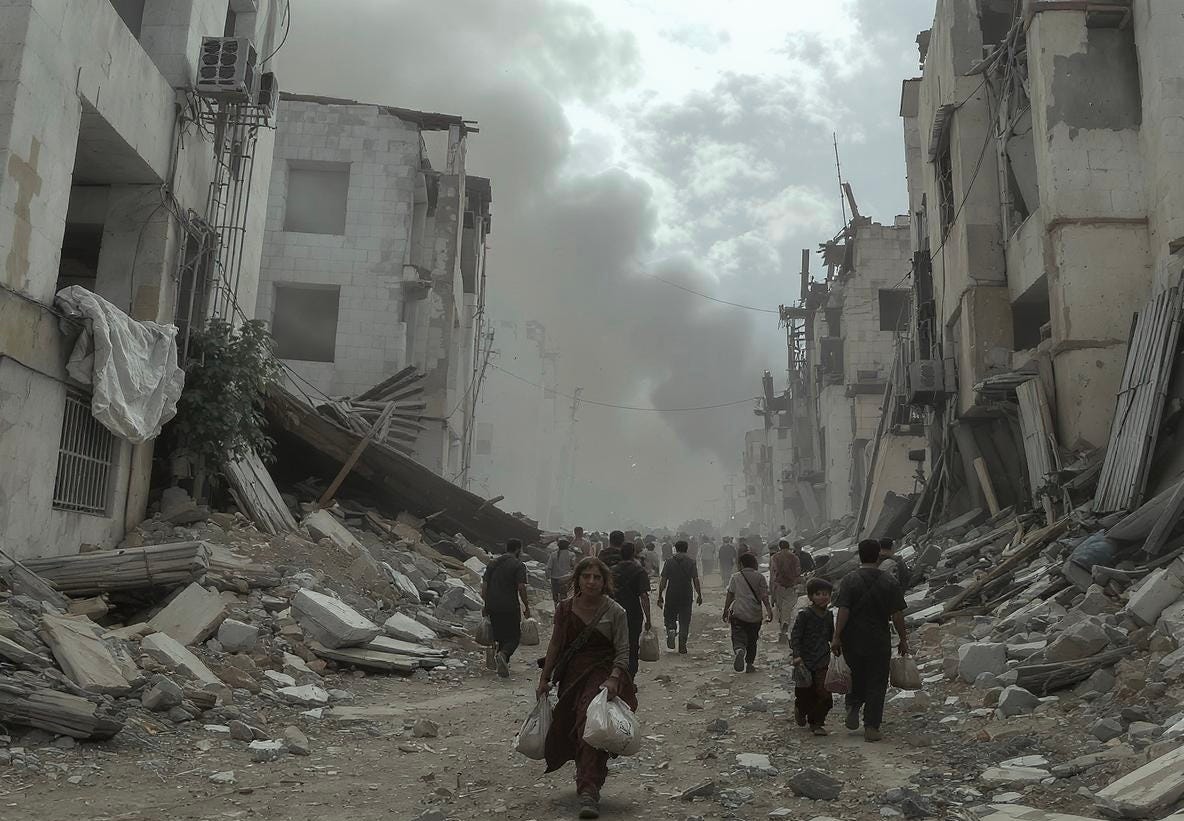
The visible humanitarian catastrophe unfolding in Gaza has provided the moral urgency that transforms abstract legal arguments into visceral political realities. With over 59,587 Palestinian deaths reported by July 2025, including 17,000 children, 143,498 people injured, and 14,222 missing presumed dead, along with the methodical obliteration of essential infrastructure such as hospitals and schools, the conflict has generated images and narratives that transcend traditional media gatekeeping. The UN's warnings about acute hunger and child malnutrition reaching famine levels amongst hundreds of thousands of people have created a moral imperative that existing diplomatic frameworks appear incapable of addressing. Border constraints and persistent combat have obstructed aid delivery, leading organisations like Doctors Without Borders to argue that humanitarian access is being weaponised. The inadequacy of initiatives such as Jordanian and US airdrops has only served to highlight the fundamental disconnect between the scale of the crisis and the capacity of current institutions to respond effectively.
Diplomatically, the conflict has precipitated a cascade of relationship crises that extend far beyond the immediate parties. Bolivia's decision to sever relations with Israel in November 2023, followed by Colombia and Chile's recall of their ambassadors, signals a broader Global South rejection of Western narratives about the conflict. Perhaps more significantly, the conflict has derailed the Abraham Accords' trajectory of Arab-Israeli normalisation, particularly the anticipated agreement between Israel and Saudi Arabia. This represents not merely a tactical setback but a strategic reconfiguration of Middle Eastern geopolitics, with China and Russia positioning themselves as alternative mediators whilst critiquing Western inconsistencies.
The psychological and social dimensions of the conflict have manifest themselves in a global surge of antisemitism, Islamophobia, and anti-Palestinian sentiment. In Europe and the United States, antisemitic incidents have spiked by over 300% in some areas following October 2023, frequently connected to street protests. Islamophobic discourse has also intensified, subjecting Palestinian supporters to discrimination and marginalisation. This polarising effect reflects deeper anxieties about identity, belonging, and the limits of multicultural tolerance in liberal democracies under stress.
Inevitably, economic ramifications extend well beyond the immediate conflict zone, revealing the vulnerabilities of globalism. Energy price volatility driven by fears of Iranian escalation, combined with Red Sea shipping disruptions by Houthi forces supporting Palestinians, has inflated freight costs and disrupted supply chains globally. Israel's vital technology sector has experienced significant slowdowns amid military mobilisations and cautious international investment, whilst Gaza's aid-dependent economy faces complete collapse with unemployment rates soaring and reconstruction costs estimated in the tens of billions.
Perhaps most significantly, the conflict has catalysed an unprecedented mobilisation of global civil society. From massive rallies in London, New York, and Istanbul involving millions of participants to student encampments at universities like Columbia pushing for divestment from Israel-affiliated entities, these movements echo historical anti-war and anti-apartheid campaigns whilst utilising contemporary digital tools for organisation and communication. Yet this mobilisation has also exposed tensions between democratic participation and state security concerns, with reports of arrests and restrictions on pro-Palestinian events in nations including the UK, France, and the United States. These measures, defended as necessary curbs on hate speech but criticised as excessive suppression of dissent, highlight the fragility of civil liberties when confronted with perceived security threats.
Social media platforms have amplified these dynamics whilst simultaneously distorting them through the rapid circulation of misinformation on platforms like TikTok and X. Claims of algorithmic bias and suppressed pro-Palestinian voices have added another layer of complexity to an already fractured information environment. Regional differences in traditional media coverage have further entrenched echo chambers and deepened societal divides.
Beneath these surface manifestations lies a more fundamental transformation in the nature of international relations itself. We're witnessing what systems theorists might recognise as a phase transition—a moment when accumulated contradictions within a complex system reach a critical threshold, generating qualitatively new patterns of organising. The conflict has exposed the growing inadequacy of liberal internationalism, accelerating a shift toward what some scholars term "competitive multilateralism," where great powers pursue individual strategic advantage rather than collective action.
The unwavering US support for Israel despite widespread international condemnation exemplifies this dynamic, undermining UN credibility whilst revealing the transactional nature of contemporary diplomacy. This represents much more than tactical disagreement; it signals the erosion of shared normative frameworks that have underpinned international cooperation since 1945. The prevailing paradigm of state-centric sovereign interests and military solutions appears increasingly obsolete in the face of interconnected global challenges requiring collaboration.
Peace studies theorists have long argued for a fundamental shift from "negative peace"—the mere absence of direct violence—toward "positive peace" grounded in structural justice and equity. The Gaza conflict has provided compelling evidence for this position, demonstrating how temporary ceasefires without addressing underlying grievances merely create conditions for renewed violence. The growing international recognition of Palestinian statehood and calls for accountability mechanisms reflect an emerging understanding that sustainable peace requires justice, not just the silencing of guns.
Global movements are playing an increasingly pivotal role in challenging entrenched power structures. The Boycott, Divestment, and Sanctions (BDS) campaign against Israel has gained significant momentum, paralleling earlier anti-apartheid movements in its capacity to generate pressure for whole-system change. These grassroots initiatives are powerful because they operate outside traditional diplomatic channels whilst potentially compelling state-level policy modifications through economic and reputational pressure.
Whether this ferment culminates in a profound reconfiguration of international relations remains an open question, contingent upon evolving dynamics across multiple domains. Optimists point to youth-driven solidarity movements as potential catalysts for transformative change, whilst sceptics anticipate heightened fragmentation and controversy as existing institutions prove incapable of managing emerging challenges.
Looking toward potential resolution pathways, several initiatives offer glimpses of alternative approaches. Qatar's mediation efforts regarding hostage exchanges and Egypt's facilitation of humanitarian aid demonstrate the continued relevance of regional diplomatic networks. Longer-term options such as revitalising the two-state framework or deploying international peacekeeping forces might address underlying structural issues, though both face significant political and practical obstacles. Humanitarian priorities demand immediate attention, requiring UN and NGO-led reconstruction efforts in Gaza supported by Gulf and European Union funding, alongside urgent and unhindered aid delivery to deal with famine. However, these technical solutions cannot possibly succeed if we faily to address the deeper governance failures that have enabled the crisis to reach its current dimensions.
Reforming global governance structures represents perhaps the most crucial long-term challenge. Proposals to limit UN Security Council veto powers and strengthen international law enforcement mechanisms have gained renewed urgency following the conflict's demonstration of institutional inadequacy. Such reforms face enormous political obstacles but may become inevitable as the costs of systemic dysfunction mount.
On a societal level, educational initiatives and interfaith dialogue programmes offer a potential means of countering antisemitism and Islamophobia whilst channeling grassroots energy toward policies that foster empathy and the recognition of our shared humanity. The success of such efforts will largely determine whether the conflict's emotional intensity translates into constructive transformation or destructive polarisation.
The Gaza conflict has thus become a focal point for broader questions about humanity's capacity for collective problem-solving at a moment when ecological and technological challenges demand unprecedented cooperation. Two scenarios now appear conceivable, each representing a fundamentally different trajectory for human civilisation.
The first scenario points to terminal fragmentation, where international law collapses into rhetorical tools wielded selectively by rival blocs, the UN Security Council veto becomes routine great-power sabotage, and humanitarian norms are fully instrumentalised. In this trajectory, antisemitism, Islamophobia, and anti-Palestinian racism metastasise into permanent identity politics, corroding pluralist societies from within whilst cooperation on existential crises stalls as trust evaporates. The Global South, feeling betrayed by Western double standards, tilts toward alternative governance arrangements, deepening bloc confrontation. The net effect would be a shrinking of humanity's capacity for collective problem-solving at precisely the moment when ecological and technological thresholds demand enhanced cooperation.
The alternative scenario involves forced re-foundation, where the moral shock of Gaza triggers a bottom-up legitimacy crisis that states can no longer manage through traditional means. Mass movements fuse with Global South diplomatic revolts to create coalitions large enough to rewrite international rules. New institutions emerge, including humanitarian protection forces funded by global wealth taxation, reparations mechanisms that become templates for post-conflict recovery, and universal jurisdiction protocols that eliminate national court protections for war crime suspects. The ideological shift moves from negative peace toward positive peace, mainstreamed in educational curricula and technological governance systems.
Several path-dependency variables will determine which scenario prevails over the next three to five years. Legal and normative tipping points, particularly ICJ genocide rulings and ICC arrest warrants, will test whether international law retains any enforcement capacity. The durability of civil society mobilisation will determine whether protest energy converts into sustained transnational institutions. Geo-economic realignments will reveal whether alternative governance packages can attract swing states away from reflexive opposition to Western stewardship. Technological governance of information will shape whether open-source verification tools can re-synchronise global narratives or whether AI-augmented propaganda hard-wires echo chambers. Finally, ecological leverage from climate-driven migration and resource shocks will either punish fragmentation or make collective survival so obviously superior that transformative cooperation becomes pragmatic rather than idealistic.
The question of whether the Global South can provide a viable alternative to the failing liberal international order touches upon one of the most profound uncertainties of our current historical moment. Eurocentric ideals and democratic principles aren't necessarily superior and may well struggle to retain relevance in the coming decades.The communitarian traditions embedded within these societies—from Ubuntu philosophy in Africa to concepts of collective responsibility in Latin American indigenous cultures, from Asian models of consensus-building to Islamic principles of ummah—do indeed offer fundamentally different approaches to organising human relationships across borders.
However, realities prove far more complex than simply replacing Western individualism with Southern communitarianism. What we're observing is not a monolithic "Global South" offering a singular alternative, but rather a constellation of different experiments in post-Western governance, each shaped by particular historical trajectories and contemporary pressures. China's Belt and Road Initiative represents one model—technocratic, state-led, emphasising development over rights discourse. The African Union's emphasis on "African solutions to African problems" suggests another approach, rooted in pan-African solidarity yet struggling with practical implementation. Latin American initiatives like CELAC attempt regional integration whilst explicitly excluding North American powers.
The challenge lies in the fact that communitarian values, however philosophically compelling, must contend with the same structural pressures that have shaped the current system: resource competition, technological asymmetries, demographic pressures, and the gravitational pull of existing power centres. India's careful balancing act between its non-aligned heritage and great power aspirations illustrates these tensions perfectly. Brazil's foreign policy oscillates between regional leadership and global integration depending on domestic political cycles.
What may emerge is neither a replacement of the Western system nor its simple continuation, but rather what some theorists call "institutional multiplexity"—overlapping governance arrangements where different coalitions address different problems through different frameworks. The Global South's contribution might not be providing a single alternative but rather demonstrating that multiple approaches can coexist, potentially offering more resilience than the current hegemonic model.
The Gaza conflict has accelerated the potential for 3rd-order change by exposing the moral bankruptcy of existing arrangements. Whether communitarian values as observed across the countries of the Global South can scale to planetary governance whilst maintaining their essential character remains an open question.
Our species may be moving toward something unprecedented—a hybrid system drawing from multiple traditions whilst being fully captured by none. In this light, Gaza becomes not merely a testbed of existing institutions, but a laboratory for discovering what forms of human organisation might prove adequate to the challenges of a planetary civilisation.
What can no longer be in doubt is how the Gaza conflict has detonated the post-1945 settlement's final reserves of moral legitimacy. Remains of the old order may yet provide the raw materials for something genuinely new—if we possess the wisdom to recognise the patterns emerging from the chaos. What humanity does with this resulting debris—whether recycling it into new foundations or continuing to weaponise it against perceived enemies—will determine whether the 21st century concludes with a patchwork of fortified enclaves or witnesses the emergence of the first planetary civilisation worthy of that designation. The human species stands at a fork in the road, and the choices made in response to this crucible will echo across generations.