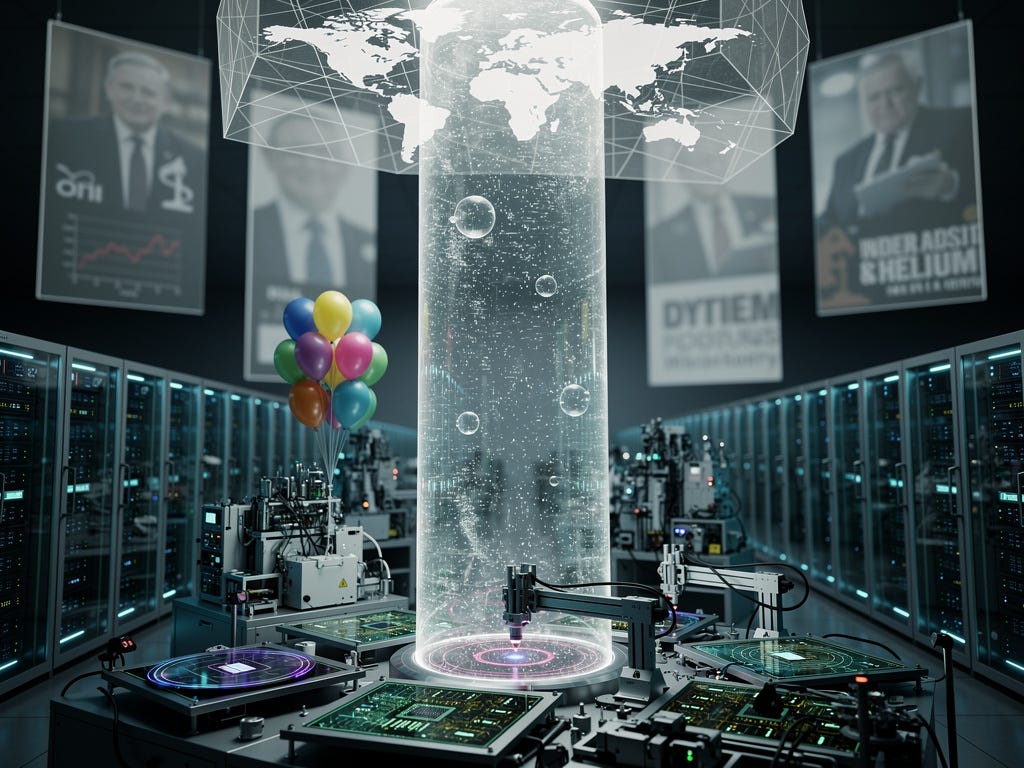
Nobody talks about helium.
That’s not quite true — people talk about it at birthday parties and in the context of balloons. What nobody talks about, with any seriousness, is helium as the invisible load-bearing wall of the global technology economy. The colourless, odourless, inert gas that makes children’s voices squeaky turns out to be one of the few irreplaceable inputs in semiconductor manufacturing, the feedstock of the AI transition, and the subject of a supply crisis so acute and so structurally revealing that its implications have been largely buried beneath the louder noises of oil prices, ceasefire negotiations, and the daily casualty counts of a war that has now killed thousands of people across three countries.
Helium has the lowest boiling point of any element — minus 269 degrees Celsius, four degrees above absolute zero. This makes it the only substance capable of cooling the superconducting magnets used in lithography machines to the temperatures at which they function. It’s also the preferred carrier gas for the etching processes that inscribe transistor structures onto silicon wafers, the preferred medium for the inert atmospheres required at multiple stages of fabrication, and the only reliable tool for leak detection in the precision equipment that chip fabs run continuously. There is no substitute at an industrial scale.
The US Geological Survey states it plainly: nothing replaces helium in cryogenic applications where temperatures below minus 429 degrees Fahrenheit are required. You cannot synthesise it. Once released into the atmosphere, it rises, escapes Earth’s gravitational field, and is gone permanently. It accumulates in natural gas reservoirs over geological time. You extract it. You use it once.
Global production is concentrated in four countries: the United States, Qatar, Russia, and Algeria. Russia’s supplies are sanctioned from Western markets, though China retains access — except Russia’s Amur Gas Processing Plant, intended eventually to supply a quarter of global demand, has been running well below capacity due to repeated technical failures and sanctions-related equipment shortages. Algeria produces at a modest scale. The United States is the largest producer but exports primarily to domestic users and long-term contract partners. Qatar, through its Ras Laffan Industrial City — the largest LNG complex on the planet — accounts for roughly one-third of global supply.
The dependency this creates runs across the entire semiconductor ecosystem, not only the Western portion of it. South Korea, home to Samsung and SK Hynix, sources sixty-five per cent of its helium from Qatar; these two companies supply chips to Apple, Nvidia, Tesla, and virtually every major AI infrastructure company on the planet. China, despite being framed as the autonomous rival semiconductor power that could eventually render Western chip advantages obsolete, imports eighty-five per cent of its helium, with Qatar supplying fifty-four per cent of those imports. When Ras Laffan stopped producing, Seoul and Shenzhen started rationing within the same week. The crisis does not discriminate between geopolitical blocs. It discriminates between countries that built their semiconductor industries on Qatari helium and countries that did not — which is to say, almost all of them.
On 28 February 2026, Iranian drones struck Ras Laffan. QatarEnergy declared force majeure, halted LNG production, and announced a fourteen per cent reduction in helium exports – an understatement of the actual disruption, since the Strait of Hormuz simultaneously closed to Western commercial shipping, stranding roughly two hundred specialised helium containers in the Gulf. Liquid helium degrades in its containers within forty-five days. The containers sitting in the Gulf were not delivering. The fabs in Seoul were counting weeks.
The technology press, predictably, missed it. The financial press caught it slowly, led by Fortune and Foreign Policy in late March and early April, before Moody’s issued a formal warning in late April estimating a $650 billion problem for the AI infrastructure build. By then, spot helium prices had doubled. Samsung and SK Hynix had entered rationing. Wafer starts—the metric that determines chip output eight to twelve weeks downstream—had begun to fall. Every wafer start that didn’t happen in March and April becomes a memory chip that doesn’t exist in the third quarter of 2026. Every chip that doesn’t exist is a constraint on the data centres being built to run the AI models that the technology industry has spent three years telling governments and investors represent the next stage of human civilisational progress.
The numbers involved are not modest. The five largest American hyperscalers — Microsoft, Google, Amazon, Meta, and OpenAI — committed over $650 billion to AI infrastructure in 2026. Saudi Arabia’s Public Investment Fund launched a $40 billion AI infrastructure company. The UAE committed $50 billion. The total global AI infrastructure build, public and private, sits somewhere north of a trillion dollars in active deployment. Half of the planned US data centre capacity for 2026 has already been delayed or cancelled — partly due to grid constraints, partly due to component shortages, and partly due to the helium crisis. Thirty per cent of planned capacity is expected to slip to 2028. The SK Hynix chairman believes the memory shortage will persist until 2030, when Qatari infrastructure repairs might be complete.
The repairs. That’s the detail that resets the timeline from months to years. Iranian missile strikes on 18 March 2026 reduced Qatar’s LNG production capacity by seventeen per cent — potentially for up to five years, according to the Qatar Financial Centre’s own analysis. This is not a supply disruption that ends with a ceasefire. Ras Laffan was not merely blockaded. It was damaged. The infrastructure that produces the helium extracted as a byproduct of LNG processing requires time, capital, and stable conditions to rebuild. The ceasefire of April 8th reopened the Strait partially. It did not rebuild Ras Laffan. Moody’s was explicit: Qatari helium production would not immediately resume even if the conflict fully de-escalated.
There is a detail buried in the supply chain analysis that deserves to be extracted and held up to the light, because it illuminates something more important than the immediate crisis. The grade problem.
Most commentary on the helium shortage focuses on volume – how many cubic metres are offline, how long before stockpiles run out, and which alternative producers might absorb the shortfall. These are legitimate questions. But they obscure something more intractable: semiconductor fabrication doesn’t require industrial-grade helium. It requires semiconductor-grade helium — purity levels of 99.9999999 per cent, nine nines, a specification so demanding that only two facilities in the world were capable of producing it at scale before the war. One of them was at Ras Laffan.
The United States produces helium in abundance. It cannot immediately redirect that production to fill the Qatari gap, because most American production reaches purities of 99.997 per cent — sufficient for MRI machines and welding but insufficient for the lithography processes that etch two-nanometre transistors onto silicon. You cannot simply turn a tap. The infrastructure for purification to semiconductor grade takes years to build. The expertise is concentrated. The supply chain, in other words, is itself concentrated in single points of failure.
This is the pattern that the 2026 crisis has made visible across multiple domains simultaneously. It was visible in fertiliser, where the Gulf provides twenty to thirty per cent of global supply and there is no rapid substitute. It was visible in oil and gas, where one chokepoint carries a fifth of global consumption. It was visible in aluminium, where Middle Eastern production represents twenty-two per cent of global supply, excluding China. And now it’s visible in helium, where the semiconductor-grade specification narrows the effective supply base to a handful of facilities, one of which has been damaged in a war that the people planning the AI economy did not factor into their infrastructure models.
The pattern has a name. Industrial economism builds for efficiency, not resilience. Just-in-time logistics, geographic concentration of production in lowest-cost locations, supply chains optimised for cost rather than redundancy, and strategic reserves eliminated as unnecessary capital overhead are not accidents or oversights. They are design principles, the logical expression of a worldview that treats the elimination of slack as progress and the concentration of production as rational. The slack is what absorbs shocks. When you eliminate it, the shocks propagate.
Here is the question that the $650 billion AI infrastructure build has not yet seriously asked: what is it actually being built on?
The standard answer is silicon, copper, electricity, and code. The more complete answer includes helium, neon, argon, rare earth elements, high-bandwidth memory, advanced packaging capacity, grid connections that take four to seven years to obtain, and water in quantities that are already generating community opposition across the American south-west and consuming twenty-six per cent of Virginia’s electricity grid. Each megawatt of data centre capacity requires approximately twenty-seven tonnes of copper. The AI economy’s appetite for physical resources is not diminishing as it scales. It is compounding — and it is compounding in the same geographic concentrations, drawing from the same fragile supply lines, as the extractive economy it is routinely described as replacing.
While fabs in Seoul ration helium and data centre timelines slip to 2028, the populations of Sudan, Yemen, and Bangladesh are absorbing the consequences of the same closed strait through a different mechanism — the fertiliser that does not reach their farmers, the remittances that do not flow from Gulf workers suddenly displaced, and the food prices that rise in markets where margins between sufficiency and hunger are already razor-thin. These two crises — the AI infrastructure constraint and the food security emergency in the Global South — emerge from an identical structural cause. One chokepoint, two populations, radically different exposure. The technology industry has not noticed the connection. It hasn’t needed to.
The AI transition is being narrated, both by its architects and by many of its critics, as a civilisational inflection point — the moment when human intelligence acquires a synthetic amplifier whose implications are as profound as the printing press, the steam engine, or the discovery of electricity. The narrative may well be correct about the scale of the change. What it consistently omits is the material substrate and who pays for its disruption. The printing press ran on paper and ink. The steam engine ran on coal. The electrical grid ran on copper and generation capacity. The AI economy runs on chips. The chips run on helium. The helium came from a facility in Qatar that Iranian drones struck on 28 February 2026, whose repair timeline extends, under optimistic assumptions, to 2030 and whose loss falls differently on a chip fab in Seoul than on a farming household in the Nile delta — though both, in their different registers, are downstream of the same thirty kilometres of contested water.
The purity problem has a solution in principle, though not at the speed or scale the current crisis demands. On-site purification capability — the capacity to upgrade industrial-grade helium to semiconductor specification at the fab itself — insulates chipmakers from single-source supply dependency. It requires investment in infrastructure that the industry consistently declined to make because just-in-time delivery from Qatar was cheaper. The logic is familiar. It is the same logic that eliminated strategic petroleum reserves, the same logic that concentrated antibiotic production in single Chinese facilities, and the same logic that built European energy dependency on Russian gas. Efficiency as a terminal value, optimisation as a substitute for resilience, and the elimination of redundancy dressed as rational management.
What 2026 has produced, in one compressed episode, is a demonstration that this logic has limits — and that those limits are not encountered gradually, through the slow accumulation of pressure, but suddenly, through the kind of shock that a system with no buffer cannot absorb. The buffer was eliminated. The shock arrived. The response is to scramble for alternatives that take years to develop, pay premiums for supply that was cheap until it wasn’t, and commission reports identifying the problem after the problem has already manifested. The US removed helium from its critical minerals list in 2025 on the grounds that it didn’t meet the criteria for supply vulnerability. It met those criteria two months later.
The helium shortage will ease. Qatari infrastructure will eventually be repaired, US production will be partially redirected, and alternative purification capacity will be built over years rather than months. The chip shortage it produced will work through the system. The AI build will continue, delayed and more expensive, but structurally intact. The fog merchants will move on to the next crisis.
What will not ease, unless it is directly addressed, is the pattern. The AI economy is being constructed on the same foundations as the petroleum economy — concentrated production, just-in-time logistics, geographic chokepoints, strategic reserves eliminated as inefficiencies, and resilience sacrificed to optimisation. The difference is that the petroleum economy took a century to reveal its brittleness. The AI economy has revealed its equivalent vulnerability within three years of its serious build-out through a crisis involving a gas that most people associate with balloons, extracted as a byproduct of LNG processing in a facility that nobody had designated as critical infrastructure because it produced helium rather than oil.
The question worth asking — and the one the industry is not asking — is whether that revelation produces a different kind of building. Not merely diversified supply chains, though those are necessary, but a different logic of construction altogether. One that treats resilience as a value rather than an overhead cost. One that builds redundancy into the system as a design principle rather than eliminating it as waste. One that asks, before committing a trillion dollars to an infrastructure build, not only what it can do but also what it runs on, where that it runs on comes from, and what happens to the people furthest from the machine when the place it comes from is struck by drones in a war that the infrastructure’s designers did not model because they were not in the business of modelling things that cannot be monetised.
That isn’t a technical problem. It’s a question about what kind of future we are building, for whom, and on whose account.