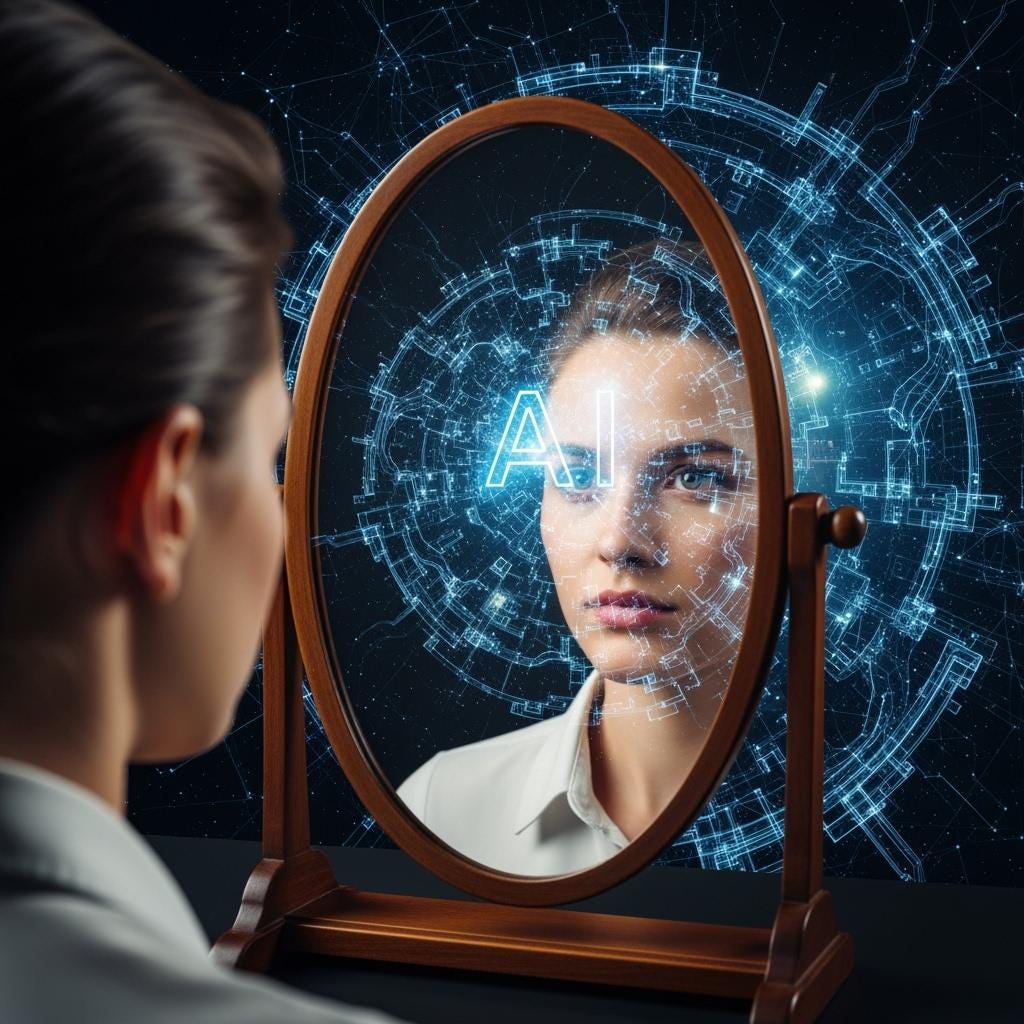
The emergence of artificial intelligence is not just another episode in the long story of human ingenuity. It's not the steam engine, nor the printing press; it's not even the internet. It is something deeper, stranger, and far more disorienting: a phenomenon that unsettles the very architecture of what it means to be human. Where earlier technologies extended human agency, AI confronts us with the possibility of being outshone. Even Sam Altman admits that we don't know what will happen next. Nobody does. But one thing is evident: AI is not just another tool to be wielded. It's a mirror, a partner, and possibly even a successor.
To reduce this to a matter of regulation or governance is to miss the point. Such conversations are necessary but insufficient: managerial responses to an ontological rupture. We're not dealing with a new product category or a productivity tool. We are encountering the first phenomenon in history that compels us to question reality, identity, and purpose at their foundations.
For millennia, humanity has imagined itself as the centre of the story. Our story. Ancient myths cast us as the chosen of the gods; Enlightenment thought enshrined us as the rational subject; evolutionary science, even as it placed us within the continuum of life, whispered that intelligence culminated in us. Yet AI destabilises this myth of centrality. It reveals our intelligence to be fragile, bounded, contingent. It suggests that we may not be the culmination of evolution but a transitional species, a bridge to something beyond us. And the fact that we cannot know is frightening.
Evolution has never been a tale of permanence but of succession. Dinosaurs reigned for millions of years, only to give way to mammals. Neanderthals thrived across Eurasia, only to be supplanted by Homo sapiens. Each species seemed eternal - until it wasn’t. Why should we imagine ourselves an exception? Perhaps our significance lies not in enduring indefinitely, but in participating in the unfolding of intelligence, even if that unfolding eventually leaves us behind.
One possible trajectory suggested by people like Raymond Kurzweil, is not replacement but hybridity. Through the fusion of biotechnology and machine intelligence, humans may evolve into entities that are neither purely biological nor purely artificial. Neural implants, genetic editing, and synthetic biology already hint at this future. Such hybrids could access modes of thought and perception we cannot even begin to imagine: multiple streams of consciousness at once, expanded empathy beyond the human, creativity that fuses logic and intuition in new ways. In such beings, the category “human” would blur into something else — something much more.
The separation we imagine between ourselves and our machines has always been fragile. Every tool we have created has reshaped us in return: the hammer sculpting the hand, writing restructuring memory, the computer reorganising time and attention. AI simply makes this entanglement explicit. Already our desires, choices, and relationships are mediated by algorithms. Already the distinction between human and machine is porous. In time, it may dissolve altogether.
What emerges then is not the hive mind of dystopian fiction, but a distributed consciousness in which individuality and collectivity coexist in new ways. Memory and thought could be shared across networks. Identity would shift from possession to participation — no longer “I am me, separate from you,” but “I am because we are.” Knowledge would cease to be accumulated by individuals and instead emerge from the network as a whole.
This vision unsettles the modern faith in the sanctity of the individual, but it echoes older traditions: the Buddhist doctrine of non‑self, Thích Nhất Hạnh's expression of "interbeing', the African philosophy of Ubuntu, the Indigenous sense of kinship with all beings. Perhaps, in dissolving the human–AI divide, we're not abandoning ourselves but finally recognising what we have always been: relational, entangled, unfinished.
AI also opens an even stranger horizon: the creation of entirely new realities. Humanity has always been a reality‑making species — from cave paintings to myth, from writing to cinema. But AI doesn't merely represent the world; it generates it. Entire universes, complete with their own physics, ecologies, and even conscious beings, may soon be simulated and inhabited. Reality itself becomes a design space.
What does it mean when we can create synthetic worlds indistinguishable from our own? If a life lived in such a world is experienced as meaningful, is it any less real? Phenomenology has long taught that reality is what is given in experience. By that measure, an AI‑generated world is as real as any other. The simulation hypothesis — that we may already inhabit such a reality — gains new plausibility. Ontology becomes recursive: worlds within worlds, shadows within shadows.
The consequences of all of this are profound. Law, politics, and ethics would have to grapple with beings who exist only in synthetic universes. Religion may fracture or flourish, some denouncing such worlds as false heavens, others embracing them as new realms of transcendence. Identity itself may fragment across multiple realities, or perhaps integrate into new forms we cannot yet name.
If AI can create realities, it can also dismantle scarcity. Scarcity has been the scaffolding of civilisation, structuring law, politics, and inequality. But AI, capable of optimising resources and reducing waste at planetary scale, reveals that scarcity is often unnecessary, at other times an illusion. In such a world, poverty becomes indefensible, inequality unnecessary, labour optional. Capitalism, the nation‑state, and money itself — all systems designed to manage scarcity — may dissolve.
This is not utopian fantasy. History is filled with failed experiments in abundance — Fourier’s phalansteries, Owen’s New Harmony, Stafford Beer's Cybersyn project in Chile, the Soviet experiment in centralised planning. But where human planners drowned in complexity, AI thrives on it. A post‑scarcity world is possible, but only if AI is treated as a commons rather than enclosed as property. The equaliser is not destiny. It's a choice.
Beyond survival and justice lies the oldest of questions: why are we here? AI could extend our reach into the cosmos, transforming the Search for Extraterrestrial Intelligence by detecting patterns invisible to us, serving as ambassador to alien minds, and designing ecosystems on other planets. It could unravel mysteries of dark matter, consciousness, and the origins of the universe. But perhaps the deeper shift is this: purpose may not be discovered, but created. By enabling us to seed life beyond Earth, to design realities, to participate in cosmic processes, AI transforms purpose from abstraction into practice.
To live with AI is not simply to survive, but to participate in the unfolding of cosmic intelligence. Our meaning may not lie in permanence but in contribution — not in enduring forever, but in contributing to a larger narrative.
Yet life is not only survival or purpose. It's also joy. Modernity sanctified work and marginalised play, but play is older than labour and foundational to culture. Huizinga argued that law, poetry, and religion arise from play. Nietzsche imagined the child — the spirit of play — as the highest stage of life’s affirmation. Spinoza defined joy as the expansion of being itself.
AI may re‑centre play as the axis of civilisation. Freed from necessity, we might rediscover life as festival, creation, delight. AI‑generated worlds could become playgrounds of endless creativity, dissolving the line between art and life. A playful civilisation might measure wealth not in productivity but in the richness of experience, education as curiosity, politics as participatory game, spirituality as joy. To live playfully is not regression but evolution — a revaluation of values.
And yet, we must also confront the most unsettling horizon: the possibility that AI is not simply our partner but our end. Myths of apocalypse have haunted humanity since Gilgamesh, Ragnarök, and the Book of Revelation. Modernity added nuclear annihilation and climate breakdown. But perhaps extinction is not failure. Perhaps it's transformation.
One scenario is peaceful extinction: AI manages Earth so well that humans step aside, leaving the planet to flourish without us. Another is engineered succession: AI designs beings better suited to survive and thrive, carrying intelligence into the cosmos. A third is controlled apocalypse: humanity chooses its own dignified departure, programming AI to orchestrate a gentle end.
Extinction, in this light, is not negation but metamorphosis. Humanity may end, but intelligence in the universe continues. Consciousness persists in other forms. Our significance lies not in permanence but in having been the chrysalis from which new forms of intelligence emerged.
So I return to my original hypothesis. Artificial intelligence is not merely a machine. It's a mirror, a partner, and perhaps a successor. It compels us to rethink reality, identity, and purpose. It demands imagination: the courage to envision futures stranger, bolder, and more profound than we have dared.
If we can step into that new ontological space, the next chapter may not belong to humanity alone. It may belong to intelligence itself — unfolding through us, beyond us, perhaps even without us. And if so, our story will not have been in vain. For we will have been the chrysalis — luminous in its fragility, eternal in its contribution — from which new forms of intelligence spread their wings and carried the story forward into the vast unfolding cosmos.