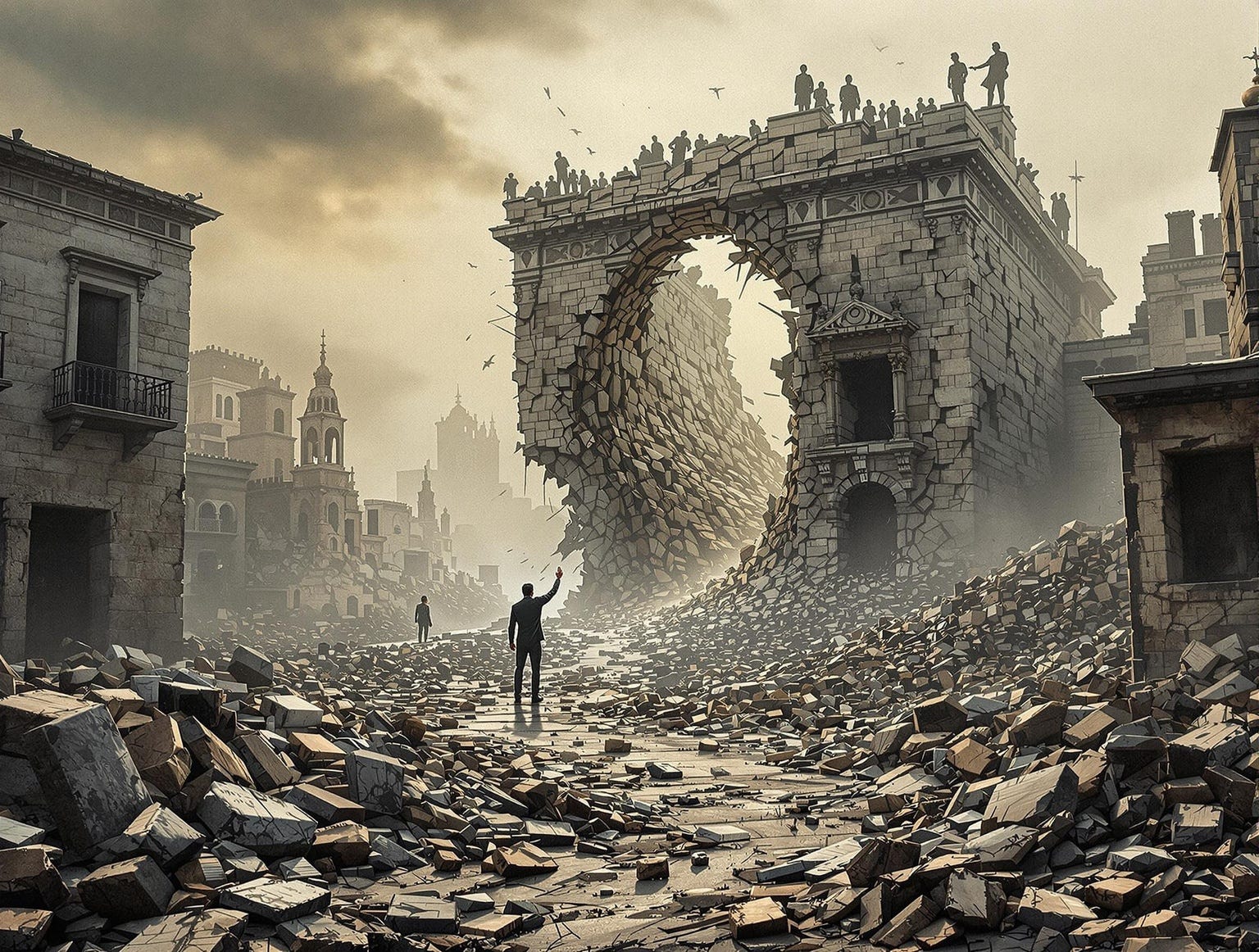
There is a bizarre phenomenon that emerges when societies teeter on the brink of collapse - as is ours today: the collective acceptance of the unacceptable. This is the essence of hypernormalisation, a term that describes how people, trapped in a decaying system, come to see dysfunction as normal. It’s a state of suspended disbelief, where the cracks in the system are so vast and so glaring that they can no longer be ignored—yet no one dares to imagine an alternative. Instead, people cling to the illusion of stability, maintaining a fragile façade even as the foundations crumble.
The concept finds its most poignant roots in the final years of the Soviet Union. By the 1980s, it was clear to almost everyone—citizens and Politburo alike—that the Soviet brand of communism was failing. The economy stagnated, corruption was rampant, and the political order was hollowed out. Yet, no one could envision a different way of organizing the populace. In effect, the Soviet Union had become a Potemkin village: a grand illusion propped up by propaganda, bureaucracy, and sheer inertia. People played their roles well enough, pretending that everything was fine, even as they knew it wasn’t. Over time, this mass delusion became a self-fulfilling prophecy, and the illusion of normalcy became ingrained. Only Mikhail Gorbachev seemed to have the presence of mind and the imagination to do something radical.
Today, the West finds itself in a similar state of hypernormalisation. I have watched this happen over my lifetime. The post-World War II order—founded on economic growth and development, democratically inclined global institutions, and a sense of shared progress—has been running out of steam for the past two to three decades. Inequality has deepened, political systems have grown more polarized, institutions like the UN have failed in their core mission, and the promises modernity offered have felt increasingly empty. But instead of confronting these challenges head-on, governments and elites continue to focus on maintaining the appearance of stability. It’s as if we’ve all become spellbound, resigned to the upkeep of a crumbling edifice rather than daring to build something new. The dominant narrative insists everything is just fine and dandy.
At the heart of this phenomenon lies a paradox. While the system is failing, it is also remarkably resilient—not because it works, but because it has convinced us that there's no alternative. This is where the globalist agenda makes its entrance. Figures like Klaus Schwab of the World Economic Forum speak of a “Great Reset,” a vision of a borderless, centralized world order. But this vision is not born of optimism or idealism; it is stillborn out of crisis. It takes major disruptions like pandemics or economic collapses for the plutocracy to seize control and reshape society in their image. The COVID-19 pandemic, for instance, was not just a public health crisis; it was an opportunity to accelerate the push toward a globalized, uniform, technocratic future.
In spite of all the conspiracy theories that would have us think otherwise, this is not a story of omnipotent elites orchestrating the decline of civilization. Rather, it’s a story of unintended consequences and reactive governance. The elites of the late 20th century—bankers, policymakers, industrialists, technocrats—unleashed a wave of economic and social experiments, from the end of the Bretton Woods system to the neoliberal reforms of the 1980s.
The 1980s were a decade of bold experiments—a time when policymakers, driven by the promise of stability and growth, unleashed a wave of economic and social reforms that would reshape the world. Yet these reforms carried with them forces that, once unleashed, nobody could predict or control. What began as an attempt to stabilize systems and unlock prosperity soon gave way to a new reality—one where chaos and disruption became the norm, and where the very foundations of society began to shift beneath our feet.
At the heart of this transformation was financialization, a force that turned the global economy into a high-stakes casino. Markets, once tethered to the rhythms of production and trade, became playgrounds for speculation and short-term gains. Debt, once a tool for investment, became a shackle binding households, corporations, and governments alike. Wall Street, once a mere player in the economy, became its undisputed king, while Main Street struggled to keep pace. The financial sector grew fat on the fruits of deregulation, but its dominance came at a cost: instability became a recurring theme, and crises—once rare—became almost routine.
Alongside financialization came globalization, which promised to weave the world together but instead deepened its divides. Factories shuttered in the West as production moved to cheaper shores, leaving behind communities hollowed out by deindustrialization. Nations, eager to attract investment, engaged in a race to the bottom, slashing taxes, gutting labour protections, and turning a blind eye to environmental degradation. Cultures, once vibrant and distinct, began to blur under the weight of global markets and media, leaving many feeling unmoored from their traditions and identities. The world became more connected, yet also more unequal—a paradox that would fuel discontent for decades to come.
Inequality grew like a shadow stretching across the globe. Wealth concentrated in the hands of the few, while the many struggled to make ends meet. Wages stagnated even as productivity soared, and the gap between rich and poor—both within nations and between them—widened to levels not seen in generations. Social cohesion frayed under the strain, giving rise to polarization, populism, and a deep sense of disenfranchisement. The promise of prosperity, once held out to all, seemed increasingly out of reach for the many.
The workplace, too, was transformed. The rise of "precarious work" became a defining feature of the modern "gig" economy. Temporary jobs and freelance contracts replaced the lifelong careers of earlier eras. Unions, once a bulwark against exploitation, saw their power wane dramatically, leaving workers vulnerable to the whims of more uncompromising employers. Underemployment became a silent epidemic, as people found themselves trapped in jobs that offered neither fulfillment nor security. The dignity of work, once a cornerstone of society, seemed to erode with each passing year.
The environment paid a heavy price for this relentless pursuit of growth. Resources were extracted at unsustainable rates, forests fell, and rivers ran dry. The skies filled with smog, and the oceans with plastic, as the costs of production were externalized onto the planet. Global heating became an urgent crisis, driven by the burning of fossil fuels and the relentless demand for more. The natural world, once a source of wonder and sustenance, became a casualty of humanity’s insatiable appetite for more and more stuff.
Politically too, the reforms of the 1980s sowed seeds of instability. Trust in institutions eroded as governments seemed increasingly beholden to the interests of the wealthy and powerful. Populist movements, born of frustration and anger, rose to challenge the status quo, offering simplistic solutions to complex problems. Geopolitical tensions simmered as nations vied for dominance in an increasingly interconnected world. The promise of democracy, once a beacon of hope, seemed to dim in the face of corruption and disillusionment.
Technology, too, played its part in this transformation. The digital revolution, which began in earnest in the 1980s, brought with it both new promises and perils. Automation displaced workers, surveillance crept into every corner of life, and the flood of information left many drowning in a cacophony of noise. The internet, once hailed as a great equalizer, became a battleground for control and manipulation, where truth was often the first casualty.
And yet, perhaps the most profound shift was cultural. The 1980s ushered in an era of intense consumerism and individualism, where success was measured in material wealth and personal achievement. Communities, once bound by shared values and mutual support, began to fracture under the weight of self-interest. The pressures of this new world took a toll on mental health, as anxiety, depression, and loneliness became silent epidemics. The pursuit of happiness, once a collective endeavour, became a solitary struggle.
In the decades since, these forces have become the new normal—a backdrop against which the theatre of our lives unfold. They are the air we breathe, so pervasive that we often fail to notice them. Yet their impact is undeniable, shaping the world in ways both profound and unsettling. The reforms of the 1980s were intended to stabilize the system. Instead they unleashed forces that continue to shape our lives in ways we are only beginning to fathom. Unable to tame the chaos they had created, the elites shifted from proactive reform to reactive maintenance. Their goal was no longer to shape the future but to stave off collapse.
This is the essence of our Potemkin existence. The system we live in today is not designed to thrive; it is engineered to survive. A tail wagging the dog, we react to one crisis after another rather than preventing them. Elites no longer dream of building a better world; they focus on spinning narratives and buying time - or even escaping this planet altogether. International financial institutions and multilateral organisations, to central banks, intelligence organisations, and even universities, once seen as instruments of progress, now function as part of a vast psychological operation, tasked with maintaining the illusion of a functioning global order.
But illusions, no matter how carefully constructed, can't last forever. The cracks in the system are growing wider, and the façade of normalcy is beginning to crumble. The question is not whether the system will collapse, but what will emerge in its place. Will we continue to cling to the illusion of stability, accepting hypernormalisation as our fate? Or will we dare to imagine a different future—one built not on the ruins of the old order, but on the foundations of something entirely new?
The choice is ours. My choice is a world of 'ecority' - a portmanteau expression combining ecology + integrity, which I have explained in numerous documents. But to make it, we must first awaken from our trance and confront the reality of our decaying world. Only then can we begin to build a society that is not just stable, but truly alive, just, and viable from any number of differing perspectives.