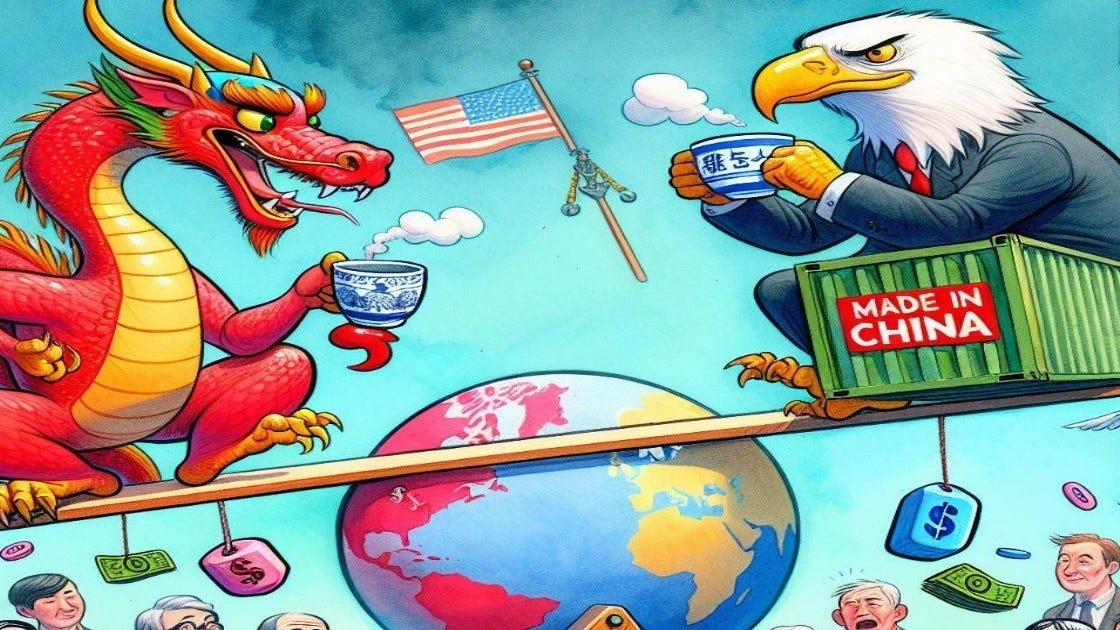
The Illusion of Agreement
The greatest illusion of power is the belief that others see the world as you do.
We are witnessing the slow unraveling of diplomacy as practised during the 20th century—not because the stakes are higher than ever before, but because the fundamental languages of power between East and West have diverged into mutually unintelligible dialects. The United States and China, two civilisations separated not just by geography and history but by entirely different cognitive architectures, are engaged in a dialogue of the deaf, where words are spoken but meanings melt in the chasm between two distinct worldviews.
Beneath the polished surfaces of summit meetings and carefully worded joint statements, a silent war of perception rages—one where the very architecture of thought differs so profoundly that mutual understanding becomes not just difficult, but at times impossible. We find ourselves navigating a world where two global powers speak in what appear to be the same diplomatic language, yet operate from entirely different dictionaries of meaning.
The United States, a young nation founded in 1776, has thrived on rapid growth, innovation, and diversity, shaped by modern ideals of democracy, individualism, and progress. In contrast, China, with over 5,000 years of continuous history, is deeply rooted in tradition, philosophy, and a reverence for its past. While the US embodies a forward-looking dynamism, prioritizing reinvention and the individual’s pursuit of happiness, China balances progress with a harmonious connection to its cultural heritage, collective well-being, and the wisdom of its enduring civilization. These are important distinctions and cannot be easily dismissed.
The American approach to statecraft, forged in the fires of the 18th century European Enlightenment and frontier pragmatism, treats international relations as a grand chessboard where pieces move according to predictable rules. The Chinese tradition, steeped in millennia of strategic thought and the subtle interplay of social harmony, views diplomacy as an endless game of weiqi—where territory is gained not through brute force but through patient encirclement, where what is left unsaid often carries more weight than what is spoken aloud.
At the heart of this disconnect lies the Western failure to comprehend that Chinese diplomacy operates on an entirely different emotional and psychological frequency. Where American negotiators come armed with spreadsheets and talking points, their Chinese counterparts bring an acute sensitivity to the invisible currents of respect and positioning. A slight that might pass unnoticed in Washington can derail months of careful negotiation in Beijing, not because of some oriental inscrutability, but because the basic building blocks of human interaction carry different values in different cultural contexts.
The tragedy of our current diplomatic impasse stems not from malice on either side, but from this acute epistemological divide. We're witnessing not just a clash of two national superpowers, but a collision of worldviews—one that demands not just better translators, but better anthropologists of power at every negotiating table. Until we recognise that our counterparts are not speaking the same language, even if using the same words, we condemn ourselves to endless cycles of frustration and missed opportunities.
The solution requires something far more challenging than policy adjustments—it demands nothing less than a fundamental reimagining of how we conceptualise international relations in an age where multiple civilizational paradigms must learn to coexist. The alternative is a future where our inability to truly hear one another leads not to misunderstanding, but to catastrophe.
This is not merely a failure of translation. It's a failure of imagination. The West clings to the fantasy that rationality is a universal currency, that all nations ultimately calculate costs and benefits in the same way. But this is a dangerous fiction. Diplomacy does not occur in a vacuum of pure reason—it is enmeshed in the sticky webs of history, the invisible codes of social exchange, and arcane psychological frameworks that dictate how power, and particularly social power, is perceived, granted, and contested.
At the heart of this dissonance lie two concepts that Western diplomats consistently underestimate: mianzi (面子), the intricate calculus of face, and guanxi (关系), the silent machinery of obligation and reciprocity. These are not mere cultural quirks—they are the operating system of Chinese statecraft. To ignore them is to guarantee misunderstanding.
But the problem runs deeper. Beyond these two pillars, there exists a labyrinth of unspoken assumptions, historical traumas, and philosophical divergences that render contemporary diplomacy a drama of mutual frustration. Furthermore, in China power alone can determine the outcome of negotiations. In the West, the concept of the rule of law has developed over centuries to constrain power - far from perfectly, but as a core ideal. In China, the rule of law is an ephemeral myth: what rules is the social power of guanxi.
Why Face Matters More Than Facts
In the West, diplomacy is often framed as a transactional exchange—a marketplace of interests where the strongest argument prevails. But in China, diplomacy is a performance, a high-stakes ballet where every gesture, every silence, every carefully nuanced phrase is an act of preservation—not just of national interest, but of dignity.
To lose face is not merely embarrassing; it's a geopolitical wound with lasting consequences. Consider this recurring pattern: The US, convinced of its moral and militaristic superiority, publicly condemns China in multilateral forums, imposes sanctions with theatrical bravado, and demands concessions under the glare of the global media. In doing so, it believes it is negotiating from strength. But what it fails to grasp is that this approach does not compel compliance—it guarantees resistance.
China’s leaders are playing a different game entirely—one where patience is power, apparent retreats are strategic feints, and the ultimate victory is not in forcing the opponent to kneel, but in making them kneel without realizing it. The West’s obsession with 'winning' the news cycle, with the immediate spectacle of diplomatic triumph, blinds it to the slow, inexorable currents of Chinese statecraft.
When the US publicly humiliates China during trade negotiations by leaking demands and setting artificial deadlines, it believes it's applying pressure. But from Beijing’s perspective, this is not just bad faith—it's an unforgivable breach of protocol. The result? Not capitulation, but hardening resolve. The lesson is clear. Public shaming doesn't work on a civilization that gauges power in centuries, rather than election cycles.
Guanxi: The Invisible Architecture of Power
If mianzi is the stage upon which diplomacy is performed, guanxi is the script—the unwritten rules that govern who owes what to whom, and why.
The US approaches diplomacy like a corporate merger because that is what it knows best: terms are set, lawyers draft clauses, and signatures seal the deal. China approaches diplomacy like a marriage: trust is built over banquets, over decades of small gestures, and over the quiet accumulation of unspoken debts. A handshake in Washington is a contract; a handshake in Beijing is a covenant.
This is why American attempts to 'isolate' China so often fail. While the US rallies allies with a mixture of threats and incentives—carrots and sticks that shift with each administration—China cultivates allegiance through patient, long-term investments: infrastructure projects that span generations, student exchanges that shape future elites, and the unshakable assurance that Beijing never forgets a friend—or an enemy.
This can lead to grave misreadings. For example, Washington looks at Cambodia’s refusal to abandon China and sees irrationality. It looks at Serbia’s defiance of Western pressure and sees ingratitude. The truth is far simpler: guanxi outlasts administrations. It transcends short-term gains. It's the slow, steady but constant accumulation of trust—something no amount of American aid or military partnerships can easily replicate.
There is an irony in all of this. The US prides itself on its alliance networks, but these are often brittle, held together by temporary interests rather than deep loyalty. China, meanwhile, builds relationships that endure precisely because they are not transactional.
Where Diplomacy Breaks Down
Western diplomats pride themselves on clarity. They believe in speaking plainly, in laying out demands without ambiguity, in treating negotiations like a business deal. In China, such directness is not just blunt or ineffective—it's actually rude.
Chinese statecraft is much more subtle: it's the art of implication, of reading between the lines, of grasping that 'we note your concerns' doesn't mean agreement—it means we reject your position, but we will not say so outright. When the US mistakes silence for assent, and indirect language for weakness, it commits a fatal error: it incorrectly assumes that the absence of a 'no' means 'yes'. Misconceptions then compound. Red lines are crossed without realisation. Conflicts escalate not because either side desires confrontation, but because the language of diplomacy is lost in translation.
Washington, London and Brussels want resolutions—yesterday. They operate on electoral cycles, on quarterly growth reports, on the relentless churn of 24-hour news reports. Beijing thinks in dynasties. The US mistakes China’s deliberate pace for indecision, not realizing that for Beijing, time is leverage. Why rush a negotiation when delay itself can be a weapon? Why concede today when waiting might yield a better deal tomorrow? American frustration mounts. Impatience leads to ultimatums, which backfire. Deadlines are set and ignored, reinforcing the perception that the US is erratic, unreliable—a power in decline.
To China, the very suggestion of external interference—whether on Taiwan, Xinjiang, or Hong Kong—is an anathema and an existential insult. The Century of Humiliation (百年国耻) is not ancient history; it is a living trauma, a reminder that sovereignty, once lost, is hard to reclaim.
To the West, 'global norms' justify pressure. Human rights, democracy, freedom of expression—these are universal values, or so Washington believes. But from Beijing’s perspective, this rhetoric is merely a fig leaf for hegemony. This is not a policy difference—it is a civilizational fault line. The West sees a rules-based order; China sees a Western-imposed hierarchy.
The Way Forward (If There Is One)
The current trajectory of US-China diplomacy is unsustainable. Sanctions, speeches, and summits will not bridge this gap—because the gap is not about policy. It's about psychology. A radical reimagining of diplomacy begins with a shift in how we prepare our envoys. Diplomatic training must extend beyond mere language proficiency to encompass cultural semiotics—the unspoken grammar of face, hierarchy, and indirect communication that shapes interactions across civilizations.
To foster genuine understanding, public ultimatums should give way to quiet, behind-the-scenes dialogue, recognising that some negotiations are best conducted in the shadows to safeguard mutual dignity.
Most importantly, diplomacy must embrace the truth that not all values are universal. The West’s fervent promotion of democracy is as unfamiliar and alien to Beijing as Confucian paternalism is to Washington. Only by acknowledging these fundamental differences can lasting bridges be built.
I genuinely believe that we're in a hiatus. Either the West adapts its diplomacy to the reality of cultural divergence, or we condemn ourselves to a future of perpetual friction—where every crisis is exacerbated by the arrogance of assuming the other side thinks like us. The dance of diplomacy is fractured, but it's not dying. Indeed, it is still very much evolving. The vital question is: who will learn the new steps first?