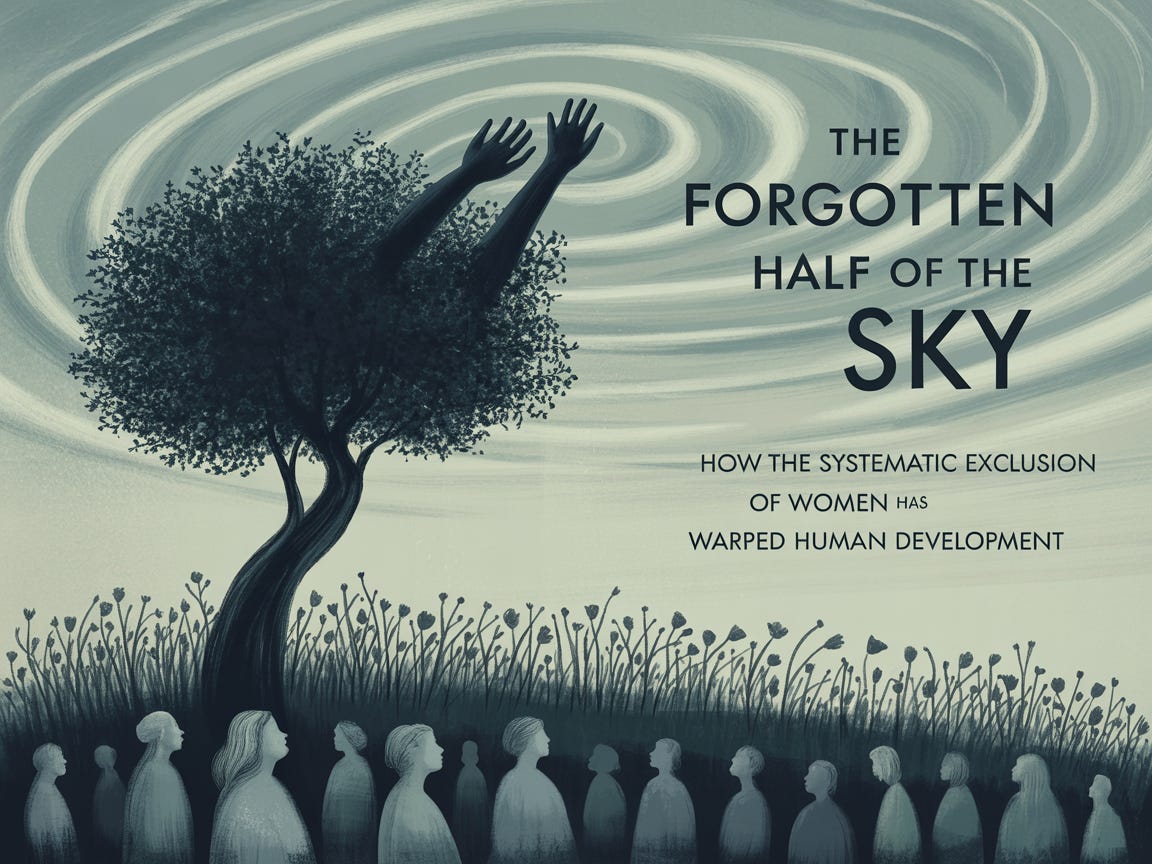
Walk through any museum of civilisation and count the names. Tally the inventors, philosophers, generals, scientists, artists whose achievements supposedly built the world we inhabit. The ratio tells its own story—not of natural order but of engineered absence. For most of recorded history, half of humanity’s cognitive capacity, creative potential and wisdom has been steadily suppressed, dismissed or erased after the fact. This is not only an injustice to women; it’s a species-level act of self-sabotage whose consequences ripple through everything from climate collapse to the architecture of artificial intelligence.
The distortion runs deeper than career opportunities or parliamentary seats. It has fundamentally skewed how we conceive of power, progress and even reality itself. When masculine perspectives monopolise the frameworks through which we interpret existence—from economic theory to urban planning and to medical research—we don’t just get imperfect answers. We get wrong ones. Sometimes dangerously wrong ones. Even omitting obvious factors like war, the crises confronting us today, from ecological devastation to the loneliness epidemic, can be read as the compound interest on millennia of excluding feminine ways of knowing, leading and being.
The Architecture of Absence
The erasure operates through interlocking mechanisms, each reinforcing the others. Begin with historiography itself. Until the past century, those who recorded events were overwhelmingly male, writing for male audiences about what they deemed significant: wars, conquests, dynasties. The texture of daily life—the networks of care that actually sustained societies, the botanical knowledge that fed communities, the conflict resolution that prevented much violence from occurring—vanished from the record. We know the names of generals who destroyed cities but not the midwives who delivered their populations.
This selective amnesia compounds generationally. Each cohort inherits a story of human achievement that renders women’s contributions invisible, making their continued exclusion seem natural rather than constructed. The young girl learning history absorbs the implicit message that people like her don’t shape events. The boy receives the opposite signal—that leadership and innovation are his birthright. These narratives become self-fulfilling, as talent is cultivated or neglected according to the mythologies we tell ourselves about who and what matters.
The economic architecture reinforces the historical one. By defining productive labour as that which generates monetary exchange while treating care work as a free resource, we’ve created accounting systems that literally cannot see most of what women do. The Global South feminist economists who’ve calculated the value of unpaid care work estimate it at between 10 and 50 percent of global GDP, depending on methodology. Yet this vast contribution remains external to our measurements of progress, policy decisions and resource allocation. It’s as if we’ve been navigating with maps that omit entire continents.
Cascading Consequences
The impacts of this systematic exclusion cascade through every domain of human enterprise and organisation. Take medicine. Because medical research historically treated the male body as the default, we’ve only recently discovered that heart attacks present differently in women, that drug dosages calibrated for men can be toxic or ineffective for female patients, that conditions like endometriosis affect one in ten women yet took decades to be taken seriously by a medical establishment that normalised female pain as hysteria.
Or consider urban planning. Cities designed by men for an imagined male user—someone who commutes linearly from suburb to office—fail to accommodate the complex daily trajectories of those who combine paid work with other responsibilities. The absence of safe public toilets, inadequate lighting in pedestrian areas, pushchair-hostile public transport—these aren’t oversights but predictable outcomes of excluding from planning decisions those who navigate cities differently.
The consequences scale up to civilisational level. Research by political scientists demonstrates that countries with greater gender parity in governance show markedly different policy priorities: more investment in education and health, stronger environmental protections, lower levels of corruption. The presence of women in peace negotiations increases the probability that agreements will last beyond two years by 35 percent. Yet women comprised only 13 percent of negotiators and 4 percent of signatories in major peace processes between 1992 and 2019.
Most tellingly, perhaps, the masculine-dominated frameworks through which we’ve organised societies have proven catastrophically inadequate for managing our relationship with the biosphere. The extractive male logic that treats nature as a commodity to be conquered rather than a web of relationships to be tended, is not humanity’s perspective but a particular, historically contingent mindset that gained dominance through explicit power arrangements. Indigenous societies with more balanced gender relations typically developed radically different ecological philosophies, many of which sustained themselves for millennia without triggering ecosystem collapse.
The Neuroscience of Domination
Recent neuroscientific research adds another dimension to understanding patriarchy’s persistence. Studies of power dynamics show that sustained dominance literally rewires the brain, reducing empathy and increasing sociopathic behaviour. The powerful become progressively less able to take others’ perspectives, to recognise their own limitations, or to accurately assess risk. This is not a moral failing but a neurobiological adaptation. When combined with cultural norms that concentrate power in masculine hands, we get governance structures that are systematically impaired in precisely the capacities—empathy, collaboration, foresight—that complex challenges require.
The exclusion of women has also impoverished men, though in ways that patriarchal culture makes difficult to acknowledge. The pressure to perform invincibly, to suppress emotional intelligence, to prove worth through fierce domination—these demands exact a toll visible in male suicide rates, addiction statistics and the epidemic of loneliness that particularly affects middle-aged men. The patriarchal bargain turns out to be a prison for everyone, though with vastly different sentences.
Technologies of Perpetuation
As we enter the age of artificial intelligence, the patterns of exclusion risk being automated and amplified. Machine learning systems trained on historical data absorb and reproduce gender biases, from recruitment algorithms that downgrade women’s profiles to translation programmes that default to male pronouns for doctors and female ones for nurses. The teams building these systems remain overwhelmingly male—women comprise only 22 percent of AI professionals globally—meaning the blind spots get coded into the infrastructure of the future.
Social media algorithms, optimised for engagement, have discovered that content that provokes outrage spreads fastest. In practice, this has created a systematic amplification system for misogynistic content, from everyday harassment to organised campaigns against female politicians, journalists and activists. Women report self-censoring online, withdrawing from public discourse rather than enduring the psychological tax of constant abuse. The digital public square, sold as democratising, has in many ways become more hostile to women’s voices than the physical forums it replaced.
Even the yardsticks we use to track progress were calibrated inside patriarchal institutions. Patent law, for example, celebrates the lone proprietor guarding a discrete breakthrough; it registers the “light-bulb moment” but rarely the slow, collective tinkering that keeps hospitals safer, code bases stable or ecosystems healthy. Because women are concentrated in sectors where this diffuse, unpatentable ingenuity flourishes—care, education, public health, community farming—their contributions slide off the statistical page, even though women who do enter formal R&D produce headline patents at rates comparable to men once resources are equalised.
GDP tells a parallel story. It counts the sale of disposable nappies but not the unpaid hours spent changing them, tallies revenues from bottled water but not the years women spend securing potable water in rural districts. Extraction and consumption appear as “growth”; maintenance and restoration as zero. In short, our civilisational scoreboards are tuned to notice what can be owned and sold, not what actually keeps societies alive. Rebalancing them is less about slotting women into the old columns than about rewriting the ledgers so that every form of creativity and sustenance is finally visible.
The Unexamined Assumptions
Perhaps most insidiously, patriarchal dominance has shaped our fundamental assumptions about human nature and social organisation. The notion that hierarchy is natural, that competition trumps cooperation, that independence is mature while interdependence is weakness—these are not universal truths but particular stories that gained currency through specific historical processes. Anthropological evidence suggests that many prehistoric societies were far more egalitarian, that warfare was not inevitable, that collaborative decision-making was common.
The standard narrative of civilisational progress—from primitive egalitarianism through necessary hierarchy to eventual democracy—obscures how much of that “necessity” was actually the violent suppression of alternative arrangements. The witch hunts that killed tens of thousands of women healers, midwives and holders of botanical knowledge. The colonial projects that destroyed Indigenous societies with more balanced gender relations. The industrial transformation that moved production from households where women had significant economic agency to factories where they had none.
Even our conception of excellence bears patriarchal fingerprints. The lone genius, the disruptive entrepreneur, the decisive leader—these archetypes celebrate forms of achievement that background the relational work that makes individual accomplishment possible. Behind every celebrated man stands not just one woman but entire networks of unacknowledged labour: the teachers who nurtured early curiosity, the partners who managed households, the assistants who handled logistics, the communities that provided stability. Not forgetting the actual pioneers who actually did the work for which their husbands took credit.
Emergence of the Alternative
Yet something is shifting. Not through the exhaustive research undertaken by Caroline Criado Perez for her 2019 bestseller Invisible Women: Exposing Data Bias in a World Designed for Men, not through a moral awakening either, but through practical necessity. The challenges confronting humanity—climate chaos, ecosystem collapse, radical inequality, the mental health crisis—cannot be solved through the frameworks that created them. They require ways of thinking and being that patriarchal culture has thoroughly devalued: long-term thinking, systemic perception, collaborative problem-solving, comfort with uncertainty, attention to relationship and process not just outcome.
Consider how female leaders navigated the COVID-19 pandemic. Countries led by women saw systematically better outcomes: lower case rates, fewer deaths, clearer communication, faster economic recovery. This wasn’t coincidence but the predictable result of different “leadership” styles—more willing to defer to expertise, more attentive to vulnerable populations, less invested in projections of strength that delayed necessary restrictions. The virus didn’t care about masculine performance; it responded to competence.
Or examine the regenerative agriculture movement, disproportionately led by women farmers who’ve recognised that soil health requires working with rather than against nature. Their approaches—cover cropping, integrated pest management, polyculture—are more labour-intensive but also more resilient, profitable over time and carbon-negative. They’re demonstrating that feeding humanity doesn’t require defeating nature but partnering with it.
Addressing patriarchy’s distortions isn’t about replacing male dominance with female dominance—that would simply perpetuate the monocultural ethos. We require something more radical: abandoning dominance itself as a fundamental organising principle. This means reimagining power not as something to be hoarded but as something that emerges from relationship, that grows when shared rather than diminishing.
Practically, this requires simultaneous intervention across multiple scales. Educational curricula that restore women’s contributions to visibility while also questioning the frameworks that erased them in the first place. Economic systems that value support work, relationship tending and regeneration alongside production and growth. Governance structures that don’t just include women but embody feminine principles—attention to process, comfort with complexity, prioritisation of wellbeing over abstractions like GDP.
The technological layer demands particular attention. We urgently need algorithms that amplify thoughtful discourse rather than inflammatory reaction. AI systems trained not just on historical data but on new possibilities. Research priorities set not by venture capitalists seeking quick returns but by communities identifying their actual needs. The democratisation of technology creation, ensuring those who’ll be affected by systems participate in designing them.
None of this requires men to lose for women to gain—that zero-sum thinking is itself a patriarchal frame. When societies achieve greater gender balance, male life expectancy increases, men report higher life satisfaction, and violence against men decreases. The dismantling of patriarchal structures liberates everyone from roles that constrict human potential into narrow channels. Men gain permission to feel, to care, to acknowledge vulnerability. Women gain space to think, to create, to lead. And humanity gains access to its full range of capabilities at the moment we need them most.
The Civilisational Wager
The converging crises of our time are symptoms of operating systems designed with half of humanity locked out of the design room. The solutions we desperately need likely already exist in the minds and communities that current structures overlook. Every girl whose potential gets diverted into fighting for basic recognition rather than solving problems, every woman whose insights get dismissed in meetings, every feminine approach that gets labelled “soft” and discarded—these represent innovations we cannot afford to lose.
The climate scientist Mary Robinson calls climate change “the greatest human rights issue of our time” precisely because those least responsible—women in the Global South—suffer its impacts most severely while being excluded from negotiations about response. This pattern repeats across domains: those with crucial knowledge about problems get shut out of conversations about solutions. It’s as if we’re trying to solve puzzles with half the pieces hidden.
The erasure of women from history was not a bug but a feature—a necessary component of maintaining systems that concentrated power in male hands. But those systems are failing, spectacularly and undeniably. Their failure creates a chance to imagine and build differently. Not to restore some mythical matriarchal past but to create something unprecedented: civilisations that draw on the full spectrum of human wisdom, that honour both competition and collaboration, and that balance the impulse to achieve with the imperative to sustain.
This is not a women’s issue but a species issue. The continued exclusion and erasure of feminine perspectives doesn’t just harm women—it impoverishes our collective intelligence at the precise historical moment when we need every neuron firing, every perspective available, every form of wisdom accessible. The pandemic showed us what happens when we ignore early warnings from nurses. The climate crisis shows us what happens when we ignore Indigenous women’s ecological knowledge. How many more system failures will it take before we recognise that excluding half of humanity from full participation is not just unjust but catastrophically impractical?
The great lie of patriarchy was that domination equals strength. But strength that requires the suppression of others is actually brittleness. True resilience comes from diversity, from multiple perspectives in dialogue, from power that circulates rather than concentrates. As the old systems crack under the weight of their own contradictions, we have a choice: shore them up for a little longer, or use this opening to build something that might actually sustain us. That choice will be made not in grand pronouncements but in millions of daily decisions about whose voices get heard, whose contributions get valued, whose perspectives get centred.
The future depends not on women replacing men at the helm of existing structures but on reimagining the structures themselves. Because the problem was never simply who held power but how power itself was conceived—as dominion rather than capacity, as hierarchy rather than network, as zero-sum rather than generative. Changing those deep patterns requires more than policy reform; it requires rewiring civilisation’s operating system.