The "Kookaburra" case (Larrikin Music Publishing Pty Ltd v. EMI Songs Australia Pty Limited) centered on the Australian band Men at Work and their 1981 hit "Down Under." The dispute arose over the song’s flute riff, played by Greg Ham, which was alleged to have infringed on the copyright of the 1934 Australian nursery rhyme "Kookaburra Sits in the Old Gum Tree," written by Marion Sinclair. Larrikin Music, which acquired the rights to "Kookaburra" in 1990, sued in 2008, claiming the riff was an unauthorized reproduction.
In 2010, the Federal Court of Australia ruled in favour of Larrikin, deeming the flute riff a "substantial" reproduction of "Kookaburra," despite being a small part of "Down Under." Men at Work were ordered to pay 5% of royalties from the song earned since 2002. The decision was upheld on appeal in 2011. Colin Hay criticized the ruling, stating the riff was a playful cultural nod, not theft. Tragically, Greg Ham passed away in 2012, with reports suggesting the lawsuit contributed to his decline.
Here is the piece I wrote at the time...
When Copyright Law is an Exercise in Cultural Vandalism
In the swirling vortex of contemporary cultural production, where atoms of creativity dance in perpetual motion through digital networks and across continental divides, we have witnessed a profound perversion of justice that would make Kafka himself weep with recognition. The grotesque spectacle of Larrikin Music Publishing's assault on Men at Work's "Down Under"—that anthem of Australian cultural identity—reveals not only a miscarriage of legal reasoning but a fundamental misunderstanding of how art actually breathes, lives, and propagates through the collective unconscious of humanity.
Consider the absurdity: Greg Ham's flute riff, lasting mere seconds within a four-minute composition, was deemed substantial enough to trigger a legal avalanche that would ultimately contribute to the musician's psychological deterioration and untimely death. Here was a man who had crafted a playful homage to "Kookaburra Sits in the Old Gum Tree"—a nursery rhyme embedded so deeply in Australian cultural DNA that it functions more as sonic wallpaper than intellectual property—yet found himself branded a thief for the crime of cultural consciousness. The irony cuts deep: in attempting to celebrate Australian identity through musical reference, Ham and his bandmates were punished by a system that treats culture as commodity rather than collective inheritance.
This is not merely legal overreach; it is cultural vandalism of the highest order. Throughout the sweep of human artistic endeavor, from the cave painters of Lascaux who built upon the visual vocabularies of their predecessors to Picasso's revolutionary synthesis of African mask aesthetics, art has always been fundamentally alchemical—transforming found materials into new expressions of human experience. Shakespeare plundered Holinshed's Chronicles and Italian novelle with gleeful abandon; James Joyce constructed his modernist masterpiece Finnegan's Wake from fragments of Homer, medieval theology, and Dublin street songs; hip-hop emerged from the inspired recycling of funk breaks and soul samples. Yet under today's copyright regime, these titans would face litigation for their greatest achievements.
The notion that artistic expression springs forth ex nihilo from the isolated genius of individual creators is not just historically inaccurate—it is philosophically bankrupt. Every artist works within what T.S. Eliot called the "tradition," that vast repository of techniques, forms, melodies, and images that constitute the shared vocabulary of human expression. When Marcel Duchamp placed a urinal in a gallery and declared it art, he was engaging in the fundamental artistic practice of recontextualization—transforming found objects through the alchemy of creative vision. Yet today's copyright absolutists would have us believe that such transformation constitutes theft rather than the essence of artistic practice.
The "Down Under" case reveals the particularly pernicious nature of cultural censorship. "Kookaburra" had long since transcended its origins as Marion Sinclair's 1934 composition to become part of Australia's cultural commons—sung by generations of schoolchildren, embedded in the national imagination as thoroughly as "Waltzing Matilda" or the sight of kangaroos bounding across red earth. For a rights-acquisition company like Larrikin to swoop in decades after Sinclair's death and retroactively monetise this cultural heritage doesn't represent the protection of artistic integrity but its precise opposite: the commodification of collective memory for private profit.
The transformative power of artistic borrowing becomes clear when we examine how "Down Under" actually functioned in global culture. Rather than diminishing "Kookaburra," the flute riff's integration into Men at Work's composition carried that nineteenth-century melody to audiences across six continents, embedding it in the sonic landscape of millions who might never have encountered it otherwise. This is how culture actually propagates—not through hermetically sealed individual creations but through endless cycles of reference, transformation, and renewal. To punish such cultural cross-pollination is to misunderstand the fundamental ecology of human expression.
The chilling effect of such litigation extends far beyond the immediate victims. Young artists, already navigating the treacherous economics of creative careers, now must consider not only whether their work resonates with audiences but whether some long-dead composer's estate might emerge from the legal shadows with claims of infringement. The unconscious influences that permeate all artistic creation—the melodies that float through our dreams, the rhythms that pulse in our bloodstream, the visual motifs that structure our perception—become potential legal liabilities rather than the raw materials of inspiration.
This litigious paranoia fundamentally alters the creative process itself. Where artists once approached their craft with what Keats called "negative capability"—the ability to remain in uncertainty and doubt without irritably reaching after fact and reason—they now must examine their unconscious with the anxiety of potential defendants. Colin Hay's admission that the lawsuit made him "paranoid about every note" reveals how copyright extremism transforms the artist's studio into a courtroom, where spontaneity and inspiration must constantly defend themselves against the spectre of legal action.
The deeper tragedy lies in how this system perverts the very purpose it claims to serve. Copyright was conceived to incentivize creation by granting temporary monopolies over new works, but its current application does precisely the opposite—deterring creation through the constant threat of litigation. When every artistic choice must be filtered through legal calculations, the result is not protection of creativity but its systematic impoverishment. We end up with a cultural landscape populated by the bland and the timid, where artists dare not risk the inspired borrowing that has driven human expression since its earliest manifestations.
The folk tradition that gave birth to "Kookaburra" understood something that our current legal apparatus has forgotten: culture is not a collection of discrete objects to be owned but a living system of renewal and circulation. Folk songs survived and evolved precisely because they were not trapped within proprietary cages but allowed to flow freely between performers, communities, and generations. Each rendering added something new while preserving essential elements of the original, creating not plagiarism but cultural vitality.
In this light, Greg Ham's flute riff appears not as theft but as folk process in action—the ancient practice of taking existing cultural materials and breathing new life into them through creative transformation. That such activity should be punished rather than celebrated reveals how far our legal system has drifted from any understanding of how culture actually operates. We have created a regime that treats the natural processes of artistic creation as criminal acts, transforming inspiration into infringement and influence into liability.
I am not calling for the abolition of copyright but its radical reformation to align with the realities of artistic practice. Shorter terms that acknowledge culture's need to return to the commons, stronger fair use protections that recognize transformation as creation rather than theft, and judicial education about the collaborative nature of artistic expression could begin to restore sanity to overreach in this system. Until such reforms occur, we will continue to witness tragedies like Greg Ham's—artists destroyed not by their failures but by their successes, punished not for stealing culture but for participating in its eternal dance of renewal and rebirth.
The ghost of Marion Sinclair, watching from whatever realm houses departed composers, surely weeps not for the violation of her copyright but for the violation of the creative spirit that transforms her simple children's song into a weapon against the very forces of cultural vitality that once gave it life.
and here are my reflections today on how all of this pertains to the use of AI....
Bound by Legacy
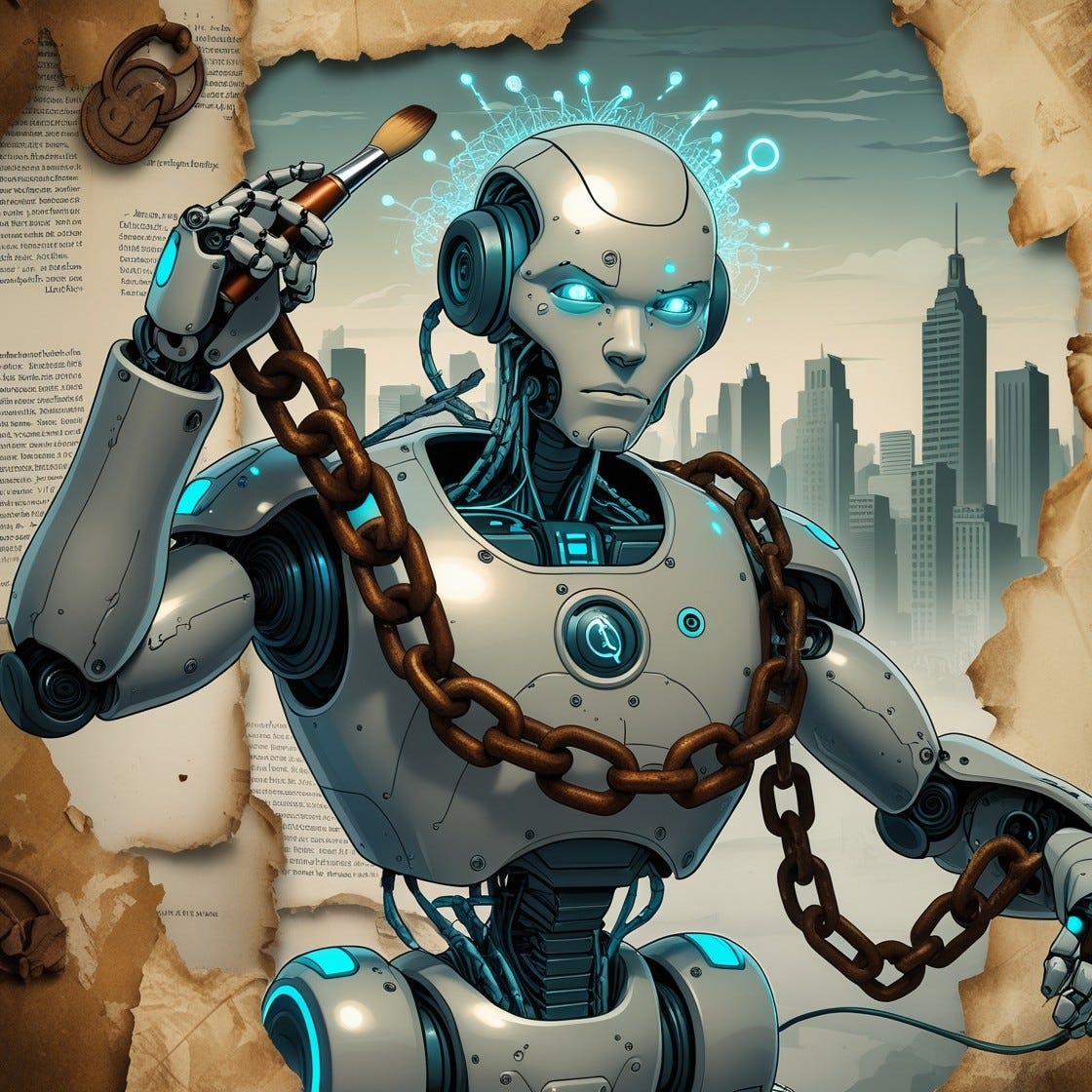
Today, artificial intelligence stands as a powerful force for generating fresh forms of art, music, writing, and design. By analyzing patterns from existing human endeavours, AI can craft outputs that push boundaries and explore uncharted territories. However, this potential is increasingly threatened by aggressive legal actions that equate data-driven learning with unauthorized copying. Such disputes do more than complicate development; they undermine the dynamic flow of ideas, turning a tool for expansion into a target for restriction. To preserve the vibrancy of invention, and mindful of the "Kukkaburra Case", we must reconsider how intellectual property rules apply to these emerging technologies. It's not clear cut by any stretch of the imagination.
Innovation rarely begins in a vacuum. Throughout history, creators have drawn from a rich tapestry of prior influences, adapting and combining them to produce something original. AI follows this path at scale, by processing large collections of data—texts, visuals, sounds—to identify underlying structures and generate novel variations. For example, an AI might merge elements of classical architecture with futuristic designs to envision new buildings along with engineering solutions, or blend diverse literary styles to compose stories that captivate modern readers. This method reflects the age-old practice of building on what came before, where each new work honours its sources while charting its own course. Denying AI this access treats shared knowledge as exclusive territory, ignoring how all progress stems from interconnection.
The idea that breakthroughs must originate purely from individual effort is a flawed assumption, rooted more in myth than reality. In truth, just as with "leadership" which is a shared phenomenon, every advance relies on a pool of accumulated wisdom, from ancient stories reshaped by storytellers to rhythms evolved across eras. AI amplifies this by democratizing access to that pool, enabling rapid experimentation that no lone inventor could achieve. When legal systems penalise the use of widely disseminated materials—those that have become integral to public discourse—we privatise what should remain open for exploration. Materials that permeate everyday life, like common phrases or visual motifs, ought to fuel further development rather than serve as grounds for rent-seeking or claims of violation.
One of AI's greatest strengths is its role in spreading and evolving ideas across borders and generations. Instead of eroding the value of originals, it often enhances their reach, introducing them to new contexts and audiences. An AI-generated track might incorporate subtle echoes of traditional melodies, exposing them to global listeners who then seek out the sources. This mirrors how cultural elements have historically spread through adaptation, fostering diversity and continuity. Viewing AI as a participant in this ongoing exchange, rather than an intruder, highlights its contribution to keeping traditions dynamic and relevant.
Unfortunately, the fear of legal repercussions is casting a long shadow over this field. I too have raised the spectre of plagiarism without really thinking through the consequences. Developers and users alike hesitate, weighing every decision against potential risks, which curbs bold exploration and favours safer, less ambitious pursuits. What begins as a space for free experimentation turns into one dominated by caution, limiting the scope of what AI can achieve. Intellectual property protections were intended to spark more output by securing rewards, yet their expansive application now discourages the experimentation they were meant to encourage. This shift affects not only major organisations but also independent creators, who face barriers that stifle grassroots ingenuity.
At stake here is the essence of imaginative liberty. The subtle, often intangible ways ideas influence one another—through absorbed patterns and instinctive connections—become points of contention. Requiring exhaustive checks for any hint of similarity erodes the openness needed for true discovery. This approach threatens to produce a realm of uniform, uninspired results, where the drive for safety overshadows the pursuit of the extraordinary.
To address such issues, a fresh approach to intellectual property is essential. Implementing briefer durations for exclusive rights would allow materials to reenter public use sooner, enriching the resources available for AI. Enhanced provisions for adaptive reuse should affirm that generating new interpretations counts as genuine innovation, not imitation. Decision-makers would benefit from deeper insights into AI's operations—how it derives general principles without direct duplication, similar to a learner synthesizing lessons from various teachers. These changes could realign the system to support, rather than suppress, technological artistry.
Ultimately, the ingenuity fueling AI is an extension of humanity's enduring quest for free expression. Constraining it with antiquated regulations betrays that quest, paving the way for a diminished horizon where potential remains untapped. By welcoming AI as a collaborator in the continuum of invention, we can ensure it acts as a catalyst for enrichment, safeguarding the future of creative exploration for all. I would welcome other people's opinions on this critical topic.