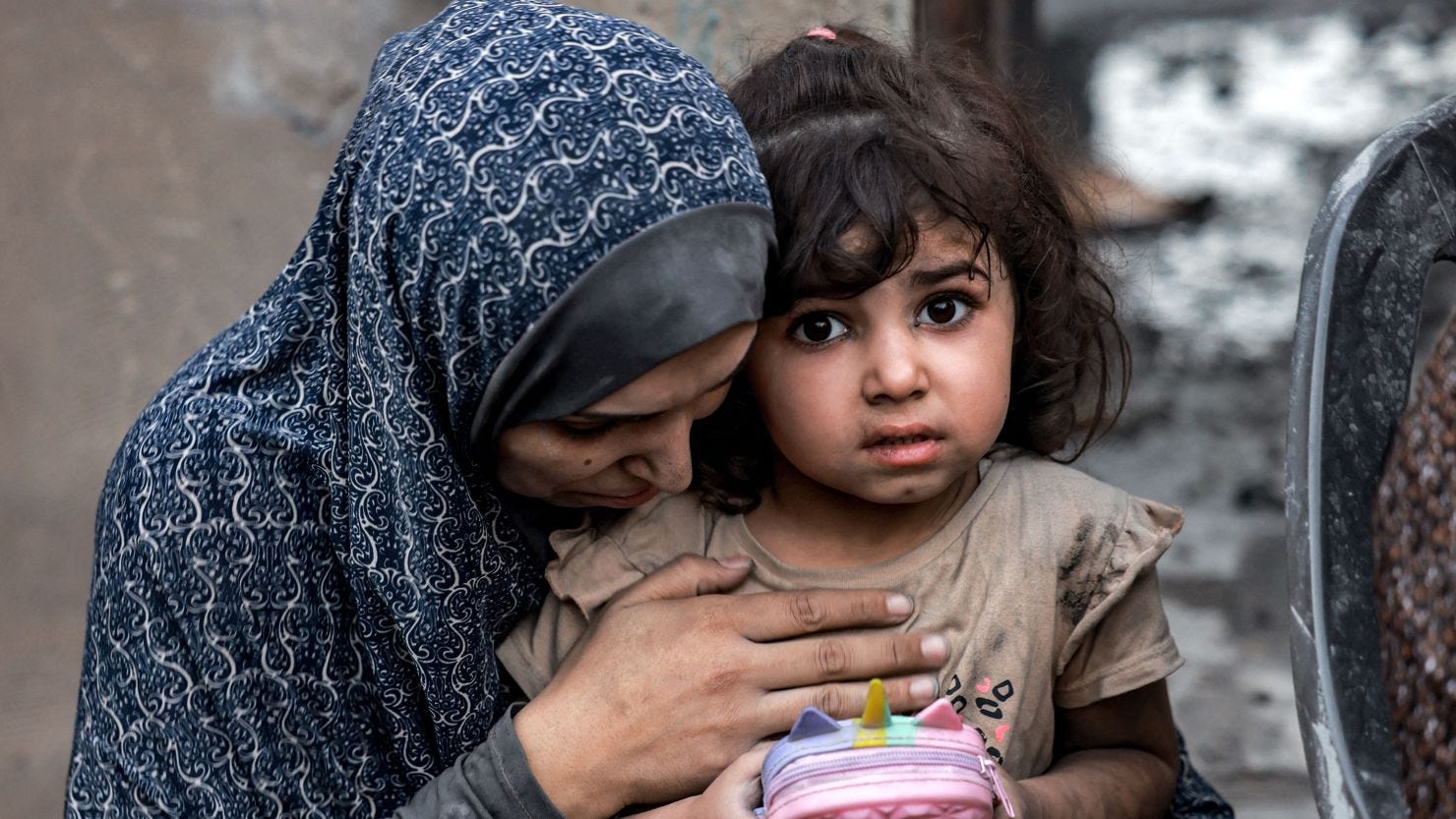
There are moments in history when events overwhelm the capacity of language. Gaza has become such a moment. It spills across screens with a relentlessness that induces a kind of cognitive vertigo—an unbroken current of shattered buildings, amputated limbs, dislocated families, and the small, silent bodies of children who will never grow old enough to remember what happened to them. And yet, the shock that once propelled millions into the streets has softened into a dull and weary ache. Familiarity breeds fatigue. Fatigue prepares the ground for indifference. And indifference is the one force more lethal than any weaponised drone.
This slow estrangement from reality—this intuitive retreat from the unbearable—is not accidental. It’s woven into the architectures that now mediate the global mind. We live inside a civilisation where almost everything is visible yet almost nothing is truly seen. Information circulates with such velocity that it cannot be absorbed with the depth required for moral recognition. The images of Gaza repeatedly displayed and effortlessly “swiped away,” lose their human gravity and settle into the sediment of daily noise. The horror persists, but our capacity to remain present wanes.
For decades I have written about the relationship between worldview, world-system, and mindset. Gaza offers a painful demonstration of how these three layers collide. A worldview that sacralises domination will eventually engineer a world-system that makes domination routine—its violence disguised as security, its cruelties rationalised as necessity. Within such a system, mindsets adapt. People learn to accept the intolerable as the background hum of civilisation. Gaza is not just a conflict zone; it’s a screen upon which the flaws of our collective consciousness are projected with unvarnished clarity.
What can be done when the imagination falters, and the will to remain awake collapses under the weight of repetition? If I am to remain faithful to my own methods, I must first interrogate the assumptions shaping this moment. One assumption—rarely spoken yet widely internalised—is that humanity can endure endless suffering at a distance without being fundamentally deformed. Is it possible that a species overwhelmed by daily atrocities becomes incapable of genuine empathy? Another assumption is that states act rationally, even when their actions extinguish the possibility of coexistence. Might it be that the rationality we attribute to states is an illusion, maintained by bureaucratic ritual and political theatre, while the deeper forces propelling them are ancestral fears never metabolised?
I ask these questions not to provoke despair but to draw attention to the deeper fault lines. If Gaza exhausts global attention, is this because compassion itself is limited, or because we have designed informational ecosystems that erode compassion more quickly than it can regenerate? Could it be that the modern psyche is no longer equipped to sustain engagement with lengthy emergencies—those crises that unfold slowly, remorselessly, across months or years? And if so, how does a species build moral endurance in a world where the flow of imagery outpaces the human capacity to respond?
The violence inflicted in Gaza, particularly against civilians, cannot be examined solely through the lens of geopolitics. That analytic frame, while convenient for diplomats and commentators, fails to explain the deeper pattern: a traumatised people establishing a state that, over time, has transformed its original narrative of survival into an apparatus that normalises the dispossession of another. This is not a claim about the Jewish people, nor a moral judgement on Judaism, but a meditation on trauma as a force capable of reproducing the conditions of its own inception if left unresolved.
Trauma, unexamined, becomes doctrine. Doctrine, normalised, becomes strategy. Strategy, implemented over generations, becomes identity. Identity, when fused with fear, becomes an engine of violence. None of this suggests inevitability. It simply recognises that unresolved collective pain may act through institutions long after the original wound has healed. One sees similar sequences in societies across the globe—from ethnic conflicts in parts of Africa to sectarian tensions in parts of Asia. The specifics differ. The pattern endures.
What sets Gaza apart is not only the scale of destruction but the clarity with which it exposes the mechanics of moral disengagement. The world watches, recoils, and then shifts its gaze. After the twentieth hospital is destroyed, the mind protects itself by turning away. After the hundredth scene of grieving parents, the nervous system numbs itself to the rawness of grief. This habituation—what I have previously described as the “anaesthetic of repetition”—is quietly exploited by those who wish to continue their operations without external interference. If the public loses interest, governments lose pressure, and policy defaults to inertia.
In this sense, Gaza raises a troubling question: has global society outsourced its conscience to algorithms? Platforms reward novelty, not persistence. They privilege spectacle over depth. They amplify outrage only until the next topic arrives. Could it be that we have built a digital ecosystem that renders meaningful moral attention impossible? If so, humanity faces a deeper crisis than any conflict. We face the erosion of witness itself.
Witness is not the passive accumulation of images; it’s the willingness to internalise the ethical claim contained within another’s suffering. It carries the weight of responsibility—an insistence that what happens to one group reshapes the meaning of what it means to be human. When witness collapses, the connective tissue binding societies begins to fray. The suffering of “others” becomes an abstraction. And abstraction is fertile territory for cruelty.
It is for this reason that Gaza cannot be viewed simply as a regional conflict. It’s a mirror reflecting the limitations of our current civilisation. It exposes the fragility of human empathy, the brittleness of political institutions that claim moral authority without any basis in reality, and the dangerous complacency that arises when information is abundant, but understanding is thin. In many ways, Gaza reveals how exhausted we have become as a species. Exhausted by crises that refuse to end. Exhausted by stories of injustice that repeat across generations. Exhausted by the sense that no amount of outrage translates into meaningful change. Yet this exhaustion itself becomes a form of complicity.
To break free from this pattern requires a shift in worldview. The tragedy is that such a shift rarely arises from comfort. It tends to emerge from the recognition that the old frames can no longer encompass the reality unfolding before us. What worldview can account for a species capable of extraordinary compassion yet so easily seduced into apathy? What worldview can explain why technologically advanced societies allow, and sometimes endorse, acts that extinguish the futures of entire populations? What worldview is necessary to help us see that the treatment of any community—whether in Gaza or elsewhere—is a rehearsal for what may eventually befall us all?
I have long argued that civilisations are not held together primarily by laws or borders but by shared beliefs about what is acceptable, and not, and what is possible. When those beliefs fracture, the civilisation enters a phase of incoherence. Gaza marks one such fracture. The violence is not only physical; it is epistemic. It damages the frameworks through which meaning is constructed. When a society or its elected representatives justify the destruction of densely populated civilian areas as self-defence, what does this reveal about its worldview? When global powers endorse or equivocate in the face of such destruction, what does that reveal about the world-system they co-create?
And what of the mindset of ordinary people? The mothers who switch off the news because the images are too painful. The fathers who mutter that “nothing will change.” The young who feel they inherit a civilisation bereft of moral courage. These mindsets do not emerge in isolation. They are shaped by the very systems they inhabit—systems that reward distraction, penalise dissent, and frame compassion as impractical. Yet mindsets can shift. They have done so before. They will do so again, although one might reasonably ask whether they can shift in time to prevent further descent into barbarity.
The challenge is not to persuade people to care about Gaza specifically, but to recognise that Gaza is a manifestation of a deeper civilisational disorder. If human beings cannot sustain attention on the suffering of others, if states are permitted to pursue brutality without consequence, if digital architectures fracture the very notion of shared truth, then the conditions for the survival of humane society weaken. Gaza is one place where this is visible. It will not be the last.
To write of Gaza is to write of the future of the human species: what we are becoming, what we are forgetting, what we may still choose to recover. The question that remains is whether we are capable of building a civilisation where witness is not eroded by repetition, where trauma does not metastasise into tyranny, and where worldviews evolve quickly enough to address the complexity of the world-systems they generate.
That task begins with a renewed commitment to look without flinching, to think without succumbing to inherited narratives, and to act without waiting for permission from institutions that have long since lost their moral bearings. It requires a recognition that what happens in Gaza—like what happens in any part of the world where power overwhelms the vulnerable—is not peripheral to human destiny. It is central to it. For in the fate of any community subjected to overwhelming force, we glimpse the limits of our compassion and the possibilities for its renewal.
What unfolds beyond this point cannot simply retrace the horrors already described. That would risk repeating the very dynamic I challenge: the dulling of attention through familiar imagery. Instead, the task now is to explore why attempts to examine these events with seriousness are met with an arsenal of rhetorical manoeuvres designed to neutralise critique. These manoeuvres—whataboutism, accusations of selective evidence, charges of misinterpretation or bias—are more than irritations. They are signals of a worldview under strain, struggling to maintain its internal coherence when confronted by realities it can no longer comfortably absorb.
Critiques of atrocity almost always provoke the same sequence of reactions. The first is deflection: “What about Sudan, or Syria, or Yemen, or Ukraine or Myanmar, or....?” Yet this is never a genuine request for broader context. It’s an escape route. A way of drowning one trauma beneath another so that no single case demands real reckoning. But a civilisation that cannot hold its gaze on any event long enough to understand its systemic causes is one that gradually loses its ability to learn. By refusing to be pulled into the centrifuge of competing grievances, we reclaim the right to attend to a single wound—because each wound carries clues about the pathology of the civilisation producing it.
Then comes the claim of cherry-picking evidence, as if any inquiry into structural violence should first be burdened with an impossibly comprehensive catalogue of history’s every grievance before daring to speak. But evidence, when viewed through a civilisational lens, is not a heap of facts waiting to be sorted; it is the residue of worldviews. The critic is not assembling an encyclopaedia. The critic is tracing patterns, discerning the logic that makes certain actions thinkable and others unspeakable. In this sense, selecting evidence is not a distortion but an act of diagnosis. One looks for the phenomena that illumine the system, not those that obscure it.
Accusations of misunderstanding inevitably follow. “You don’t understand the region.” “You don’t understand the culture.” “You don’t understand the history.” “You’re not there so how would you know what’s really going on?” These statements operate as a kind of epistemic border control, implying that only those sanctioned by a particular narrative have the right to interpret events. But no culture is hermetically sealed. No conflict is so self-enclosed that it cannot be examined by those outside it. And “understanding,” if it is to have any integrity, must always be partial. The question is not whether we have mastered every nuance but whether we recognise how interpretations themselves are shaped, circulated, and weaponised. When a state claims exclusive rights to its own narrative, this is rarely about accuracy. It is about power.
Bias is another accusation routinely deployed, as though a concern for human suffering is already proof of partiality. Yet bias is not eliminated by pretending to be neutral. It is mitigated by exposing the assumptions underlying one’s own perspective. A futurist lens acknowledges these assumptions openly: that every worldview is provisional; that power shapes perception; that suffering anywhere reverberates everywhere. If such assumptions constitute bias, then the real question becomes: what kind of civilisation insists that compassion needs to justify itself?
There’s a more subtle manoeuvre that often escapes notice. It’s the tendency to frame any call for moral accountability as idealistic, emotional, or detached from “reality.” This gesture not only delegitimises the ethical dimension of analysis; it reveals how narrow the accepted definition of reality has become. For many, “reality” means the logic of power—its calculations, its fears, its rituals of justification. But if that is reality, then humanity has surrendered any aspiration beyond mere survival. A civilisation unable to imagine moral alternatives becomes trapped in its own self-fulfilling prophecy: violence begets violence, fear begets fear, and the story repeats until the story itself becomes indistinguishable from fate.
I am often asked why I return to the triad of worldview, world-system, and mindset. Why not focus on diplomacy, law, or security? But diplomacy without worldview becomes theatre. Law without worldview becomes arbitrary. Security without worldview becomes a machine that eats its own children. The deeper crisis revealed by Gaza—and by every similar event, whether in Africa, Asia, or the Americas—is that we have built a civilisation thoroughly capable of generating suffering but structurally incapable of sustaining empathy. This is not a regional problem. It is a species-level predicament. The violence in one place becomes a rehearsal for the methods quietly normalised everywhere else.
To engage with this reality is to provoke resistance. Some will say my analysis is too sweeping, too philosophical, or insufficiently grounded in the grit of politics. But politics without philosophy is just administration. And the grit of politics is often the residue of unexamined mythologies masquerading as sober realism. Others will say the problem is too complex for moral language, as though complexity is an excuse for silence. But complexity does not absolve responsibility; it deepens it. The more entangled a crisis becomes, the more essential it is to illuminate the worldview sustaining it.
Still others will insist that the conflict has been provoked, that fear justifies excess, that history offers excuses for the present. But provocation does not rationalise obliteration. Fear does not absolve collective punishment. And history, far from providing justification, should serve as a warning against the cycles we now appear intent on repeating. When trauma is permitted to define identity, identity becomes a fence within which the seeds of future violence germinate.
This sequence of objections—deflection, accusation, dismissal—reveals something profound. It exposes the discomfort arising when a civilisation encounters the limits of its own narrative. Gaza forces the question: what if our dominant worldviews can no longer explain the consequences they produce? What if the systems built to ensure security instead manufacture perpetual insecurity? What if the mindsets shaped by constant exposure to suffering no longer register suffering as morally actionable?
These questions are not rhetorical. They point toward a civilisational threshold. The erosion of witness is not merely a psychological phenomenon; it’s a structural turning point. When the capacity to witness collapses, civilizations drift into forms of barbarity they no longer recognise or accept as such. Cruelty becomes procedural. Indifference becomes habitual. Violence becomes routine. The only safeguard against this drift is the cultivation of a worldview capable of seeing beyond its inherited narratives.
This requires courage—not the theatrical courage of military posturing but the quieter courage of sustained attention. The courage to refuse the easy comforts of deflection. The courage to acknowledge that compassion need not be selective. The courage to challenge the inherited myths that sanctify our violence while condemning that of others. Above all, it requires the courage to imagine a civilisation in which the suffering of any group is not an inconvenience but a call to re-examine the architecture of the world-system itself.
If this kind of courage seems difficult, perhaps that is because our civilisation has trained us to believe that only power and money shape the future. But futures arise from worldviews long before they materialise in institutions. If the worldview shifts, the world-system follows, and mindsets eventually align. The question is whether we possess the moral endurance to sustain such a shift before the erosion of witness becomes irreversible.
I sense an obligation for the next phase of my work to move beyond description. It must explore how attention can be reclaimed, how compassion can be restored, and how a civilisation exhausted by crisis might reconstruct its capacity for moral imagination. That inquiry, too, will trigger objections. But that’s no reason to retreat. Every objection is a clue. Every deflection reveals a fault line. Every dismissal illuminates the very worldview that must be transformed.
My work continues by continuing to ask: what kind of species do we wish to become? And what kind of civilisation will we need to build in order to sustain that answer?