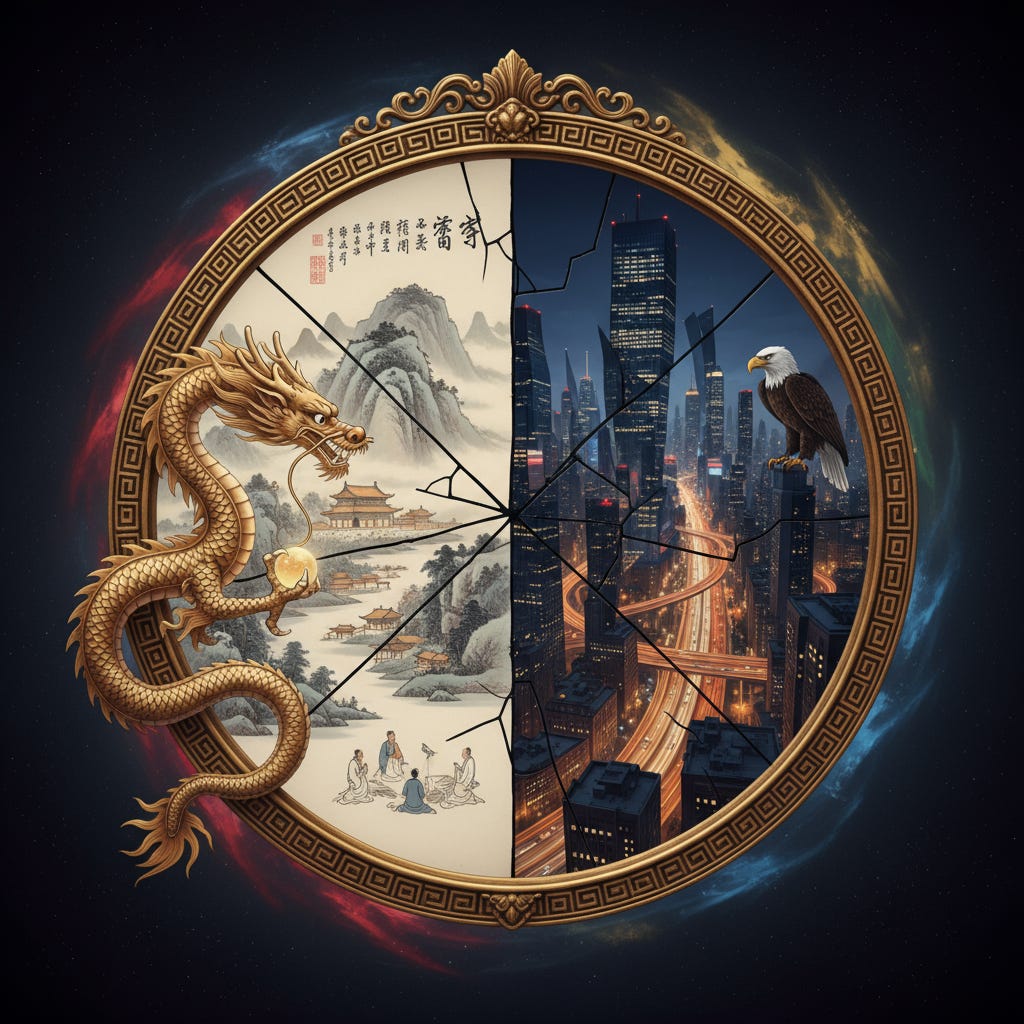
The spectre haunting the American empire is not, as its architects in Washington would have you believe, the malevolent expansion of a new oriental hegemon. Rather, it's the profound cognitive dissonance arising from the collision between a civilisational worldview predicated on perpetual supremacy through aggression and the re-emergence of an ancient power that fundamentally rejects the zero-sum logic of Western imperialism. This is not merely a geopolitical rivalry; it's an ontological crisis for an empire that can't begin to conceive of power without domination, of prosperity without exploitation, of security without subjugation.
More disturbing still, what we're seeing is a collective neurological crisis, a mass psychosis that has metastasised through the entire nervous system of American power. The empire's brain, if we can call it that—that distributed network of think tanks, intelligence agencies, corporate boardrooms, and political institutions—is experiencing something akin to what psychiatrists would recognise as paranoid schizophrenia on a civilisational scale.
Ponder the symptomatology: persistent delusions of persecution despite overwhelming military superiority, auditory hallucinations in the form of threats that exist only in fevered intelligence briefings, cognitive splitting that simultaneously casts China as an existential threat and a backward nation, and most tellingly, a complete inability to recognise its own reflection in the mirror. When the American security establishment looks at China's Belt and Road Initiative, it doesn't see infrastructure development—it sees encirclement. When it observes Chinese industrial policy, it doesn't see economic planning—it sees warfare by other means. This is precisely how a paranoid mind processes neutral or even benign stimuli as threats. Every action by the other becomes evidence of malevolent intent, every defensive measure proof of aggressive ambition.
Just consider the extraordinary historical amnesia required to cast China as the aggressor in this modern drama. The Middle Kingdom's fifteenth-century treasure fleets under Admiral Zheng possessed naval capabilities that dwarfed anything Europe could muster at the time. These massive armadas, comprising hundreds of ships and tens of thousands of sailors, reached the eastern shores of Africa decades before Vasco da Gama rounded the Cape of Good Hope. Yet where European expeditions left in their wake a trail of blood, conquest, and extractive colonies that would persist for centuries, the Chinese fleets departed leaving only trade agreements and benign diplomatic relations. The contrast could not be more blatant: whilst Europe's maritime adventures inaugurated an age of annexation that would see entire continents enslaved and pillaged, China's naval supremacy was voluntarily relinquished, the ships burnt, the very knowledge of their construction deliberately forgotten in a conscious act of civilisational introversion.
This historical divergence reveals something fundamental about the competing cosmologies in play. The Western mind, shaped by centuries of Judaeo-Christian eschatology and Enlightenment universalism, conceives of history as a linear progression towards some ultimate goal, with the West as its vanguard and all others as either disciples or obstacles. The Chinese worldview, rooted in Confucian concepts of harmony and Daoist notions of balance, sees international relations not as a Hobbesian war of all against all, but as an intricate ecosystem requiring careful cultivation and mutual accommodation. Where the West sees a vacuum to be filled, China sees a balance to be maintained. Where the West sees resources to be extracted, China sees relationships to be cultivated.
The neurological dimension of this crisis runs deeper than simple misperception. Years of imperial conditioning have literally rewired the American foreign policy brain. The amygdala of empire—that primitive fear centre—has become hyperactive, flooding the system with threat signals that override the prefrontal cortex's capacity for rational analysis. Pentagon planners and State Department officials have been neurologically programmed through decades of war games, threat assessments, and worst-case scenarios to see enemies everywhere. Their neural pathways have been etched so deep by repetitive threat narratives that alternative interpretations become literally unthinkable. The brain, after all, tends to see what it's been trained to see, and the American imperial brain, aided by Hollywood's excursions into American heroicism, has been trained for three-quarters of a century to see existential threats requiring military solutions.
The numbers speak volumes about this civilisational divergence. Since 1945, the United States has been involved in military interventions on every inhabited continent, toppling governments from Guatemala to Libya, from Iran to Chile. The body count of American foreign policy since World War II runs into the millions, a grim ledger written in Vietnamese villages, Iraqi cities, and Afghan valleys. China's military engagements during this same period have been almost entirely defensive or regional, limited to border disputes and territorial integrity. Even in its most assertive moments in the South China Sea, Beijing's actions pale in comparison to the American military's global footprint of over 750 bases in more than 80 countries, a planetary archipelago of force projection unprecedented in human history.
This psychosis manifests in what we might call projection disorder on a mass scale. The empire attributes to China every pathology it refuses to acknowledge in itself. The accusations of debt-trap diplomacy come from a nation that has weaponised the dollar, the World Bank and the International Monetary Fund for generations. The dire warnings about social credit systems come from a surveillance state that tracks every digital communication on the planet. Their fears about military expansion come from a power with bases girdling the globe in a planetary chokehold. This isn't simply hypocrisy—it's a fundamental breakdown in self-recognition and awareness, a dissociative disorder where the empire has become estranged from its own nature.
Yet the propaganda machinery of the American security state, that vast confluence of Pentagon briefing rooms, think tank conferences, and editorial boards, works overtime to invert this reality. The China threat narrative serves multiple functions within the architecture of American power. It justifies the endless increases of military budgets that enrich defence contractors whilst American infrastructure crumbles. It provides cover for the maintenance of an international surveillance apparatus that makes Orwell's Big Brother seem quaint by comparison. Most crucially, it deflects attention from the internal contradictions of American capitalism, where deaths from despair claim more lives annually than the entire Vietnam War, where life expectancy declines whilst stock markets soar, where democracy itself has become a hollow ritual performed every four years whilst oligarchic power consolidates behind the scenes.
The paranoia has a self-reinforcing quality that mirrors the downward spiral of individual psychosis. Each defensive move by China—whether it's modernising its military or securing its supply chains—is interpreted as offensive preparation, justifying further American militarisation, which provokes further Chinese defensive measures, which confirms the original paranoid hypothesis. It's a feedback loop of fear that becomes its own reality, creating the very threat it claims to be defending against. The empire is essentially willing into existence the enemy it needs to justify its own continued growth. It really is that obvious!
What's particularly fascinating from a neurological perspective is how this imperial psychosis has infected the broader American consciousness. Through media repetition, educational indoctrination, and cultural conditioning, millions of Americans who have never visited China, never met a Chinese person, who couldn't locate Taiwan on a map, who know nothing of Chinese history or culture, have been programmed to experience visceral fear at the mention of China's rise. Their amygdalae are triggered, their stress hormones surge, their fight-or-flight responses activate—all in response to a manufactured threat thousands of miles away. This is mass neurological manipulation on a scale that would have astonished even Pavlov.
The revelation that the Pentagon has funnelled billions into shaping media narratives globally should surprise no one familiar with the history of Operation Mockingbird or the CIA's Congress for Cultural Freedom. Manufacturing consent, as Chomsky and Herman demonstrated decades ago, is not a conspiracy but a structural feature of capitalist media systems. The China threat narrative is simply the latest iteration of a process that previously gave us the domino theory, the missile gap, and weapons of mass destruction in Iraq. Each phantom menace serves its purpose, justifying the unjustifiable, normalising the abnormal, making the unthinkable not only thinkable but inevitable.
The imperial brain also exhibits what we might diagnose as severe temporal lobe dysfunction—an inability to properly process historical memories and events. It cannot access or integrate the memories of its own violent expansion, its own colonial depredations, its own pattern of global domination. These memories exist but remain dissociated, split off from conscious awareness. Meanwhile, it obsessively fixates on imagined future threats from China, constructing the most elaborate scenarios of coming domination that are essentially projections of its own past behaviour. The empire is haunted not by China's actual intentions but by the ghost of its own past actions, terrified that someone might do to it what it has done to others.
What terrifies the American establishment about China is not its military might which, even today, remains largely defensive, nor its territorial ambitions, which are modest compared to any historical great power. What terrifies them is the possibility that China's rise demonstrates the viability of an alternative path to modernity, one that doesn't require global military domination, one that can lift hundreds of millions from poverty without colonising half the planet, one that can build infrastructure from Lagos to Ljubljana without demanding structural adjustment programmes that eviscerate public services and sovereignty alike.
There's also a profound narcissistic injury at work here. The American empire was neurologically wired during its unipolar moment to expect perpetual adulation, obedience, and imitation from the rest of the world. The rise of China represents not just strategic competition but narcissistic insult—the unbearable suggestion that the American way isn't the only way, that American values aren't universal values, that American leadership isn't indispensable. This triggers what psychologists call narcissistic rage, that violent reaction when a narcissist's grandiose self-image is challenged. The intensity of American hostility towards China cannot be explained by rational strategic calculation; it's the fury of a narcissist confronted with evidence of their own ordinariness.
Perhaps nothing exemplifies this narcissistic dysfunction more than Americans' genuine bewilderment at the rising tide of anti-American sentiment across the globe. From Latin America to the Middle East, from Africa to Southeast Asia, populations that have endured decades of American interventions, coups, sanctions, and structural adjustment programmes have developed a deep and abiding resentment of American power. Yet the average American, cocooned in a media environment that perpetually reinforces narratives of American benevolence and indispensability, literally cannot process why anyone would hate them. They've been neurologically programmed to see their nation as the eternal good guy, the reluctant sheriff, the indispensable nation bringing democracy and freedom to grateful masses. When confronted with evidence of widespread global antipathy—the celebrations in certain quarters after 9/11, the consistent polling showing America viewed as the greatest threat to world peace, the enthusiasm with which much of the world has embraced Chinese development assistance as an alternative to American hegemony—they experience a cognitive short-circuit. This is a neurological incapacity to integrate information that contradicts their fundamental programming. The idea that America might be the villain in someone else's story, that American actions might have created legitimate grievances, that American power might be experienced as oppression rather than liberation, simply cannot compute in brains wired for American exceptionalism.
The Belt and Road Initiative, whatever its flaws and debt implications, represents a fundamentally different model of international engagement than the Washington Consensus. Where the World Bank and IMF demanded privatisation, deregulation, and austerity as the price of development loans, China offers infrastructure investments with fewer ideological strings attached. Where American power projection relies on CIA covert operations, carrier strike groups and drone warfare, Chinese influence expands through high-speed rail networks and port facilities. I don't mean to romanticise Chinese policy, which has its own forms of coercion and exploitation, but to recognise that it represents a genuine alternative to the neoliberal order that has dominated the globe since the 1970s.
The tragedy is that this psychosis is largely untreatable within the current system. The institutions that might provide therapy—academia, media, civil society—have themselves been infected by the same paranoid delusions. The few voices calling for realistic assessment and cooperative engagement are dismissed as naive at best, traitorous at worst. The empire's immune system attacks any attempt at introducing sanity as if it were a foreign pathogen. Anyone who suggests that China might have legitimate interests, reasonable grievances, or beneficial contributions to make to human civilisation is immediately branded as a propaganda dupe or foreign agent.
This neurological crisis extends to the very architecture of decision-making. The imperial brain has developed what I call institutional autism—an inability to engage in theory of mind, to model how others might think differently, to recognise motivations that don't mirror its own. American policymakers literally cannot comprehend why China doesn't want to dominate the world because they cannot imagine wanting anything else. They cannot understand why China focuses on domestic development because they cannot conceive of power without projection. This isn't just cultural ignorance; it's a fundamental neurological incapacity to process and accept difference.
The psychological projection at work in American discourse about China is almost textbook in its transparency. Every accusation levelled at Beijing—from surveillance of citizens to suppression of dissent, from aggressive nationalism to economic coercion—describes practices that the United States has perfected and exported globally. Even the most serious allegations regarding the Uyghurs in Xinjiang, whilst deserving of scrutiny and condemnation, ring hollow from a nation that maintains a global network of black sites, that methodically tortured Muslims at Guantánamo Bay and Abu Ghraib, that has killed hundreds of thousands of Muslims across Iraq, Afghanistan, Yemen, and Pakistan, and that has perfected the art of cultural genocide against its own indigenous peoples whilst providing unconditional support for Israel's devastation of Gaza. The National Security Agency's worldwide surveillance network makes Chinese internet censorship look positively provincial by comparison. The American carceral state imprisons a higher percentage of its population than any society in human history. Economic sanctions and tariffs have become Washington's weapon of choice, wielded against any nation that dares resist its hegemony, from Cuba to Iran, from Venezuela to Russia and even its own allies.
The paranoid psychosis also manifests in the obsessive-compulsive behaviour of the security state—the endless war games, the compulsive threat assessments, the ritualistic freedom of navigation operations, the repetitive sanctions and countermeasures. These are the tics and compulsions of a disturbed mind, attempting to maintain the illusion of control over an increasingly uncontrollable reality. Each military exercise, each new weapons system, each bellicose statement provides temporary relief from the anxiety, but like any compulsion, it ultimately reinforces the underlying psychological disorder.
This is not whataboutism; it's about recognising the systematic distortion of reality that underpins imperial propaganda. The American empire, like its British predecessor, simply cannot acknowledge the possibility of genuine multipolarity without experiencing an existential crisis. The notion that other civilisations might have equally valid ways of organising society, equally legitimate claims to shape the international order, equally erudite contributions to human flourishing, threatens the very foundations of Western supremacist ideology that has justified five centuries of global domination.
Perhaps most disturbingly, this imperial psychosis has become so normalised that it appears to be sanity. The real madness—the idea that a nation must maintain global military dominance to remain secure, that it must contain and confront any rising power, that it must prevent the emergence of any alternative development model—is presented as sober realism. Those who point out the insanity of nuclear brinksmanship, of military encirclement, of economic warfare against a quarter of humanity, are dismissed as the crazy ones. This is how deep the psychosis runs: madness has been so thoroughly institutionalised that it becomes the baseline for measuring sanity.
The neurological crisis is also evident in the empire's increasing inability to engage in cost-benefit analysis. A healthy brain weighs risks and rewards, considers multiple options, adapts to changing circumstances. But the imperial brain seems stuck in a single groove, unable to compute that cooperation with China might yield greater benefits than confrontation, that economic interdependence might provide more security than military containment, that a multipolar world might be more stable than unipolar dominance. The neural pathways for these alternative calculations have atrophied from disuse, leaving only the worn grooves of threat perception and military response.
The tragedy is that this manufactured confrontation serves the interests of neither the American nor the Chinese people. Ordinary Americans gain nothing from a new Cold War except higher prices, reduced social spending as resources flow to the military-industrial complex, and the increased risk of nuclear annihilation. Ordinary Chinese gain nothing from heightened tensions except increased nationalism, reduced cultural exchange, and the strengthening of authoritarian tendencies justified by external threats. The only beneficiaries are the weapons manufacturers, the arms dealers, security apparatuses, and the political classes on both sides who use fear to maintain their declining grip on power.
Orwell understood that perpetual war requires not victory but perpetual threat, not resolution but unending tension. Eastasia and Eurasia were interchangeable enemies because the enemy's actual characteristics were irrelevant; what mattered was the enemy's existence as an organising principle for domestic control. Today's China serves this function perfectly for the American empire, a sufficiently powerful yet sufficiently different other against which to define itself, justify itself, and distract from its own internal decay.
The historical irony is exquisite. An empire built on the bones of indigenous peoples and the backs of enslaved Africans, expanded through genocidal wars and maintained through economic coercion, positions itself as the defender of the "rules-based international order" against a civilisation that, when it had the power to conquer the world, chose instead to burn its fleet and tend its gardens. The very fact that China's rise is seen as an existential threat rather than an opportunity for cooperation and mutual learning reveals the poverty of imagination that afflicts late imperial thinking.
We're witnessing, in real-time, what happens when an entire civilisation loses touch with reality, when paranoid delusions become policy doctrine, when projection becomes prophecy. The American empire is essentially experiencing a psychotic breakdown, unable to distinguish between its own shadow and external threats, between its irrational fears and evidence-based facts, between its past and China's present. And like any individual in psychosis, it is becoming increasingly dangerous—to itself and others—as its delusions intensify.
What we're witnessing in China is not the rise of a new global hegemon intent on world domination, but the return of a civilisation that never accepted the Western narrative of history as a unidirectional march towards liberal democratic capitalism. China's model, for all its contradictions and undemocratic features, represents a form of modernity that's supported by the majority of its citizens and doesn't require the subjugation of others for its own prosperity. This is what the American empire cannot tolerate: not competition, but the demonstration that its way is not the only way, that its values are not universal values, that its fate is not humanity's destiny.
Breaking this cycle requires something the American imperium seems incapable of: genuine humility and recognition of its own limitations. A multipolar world is not a threat to human flourishing but a precondition for it. The diversity of human civilisations, their different approaches to organising society and understanding existence, is not a problem to be solved but a treasure to be preserved. The Chinese concept of tianxia, often mistranslated as "all under heaven," actually implies a cosmopolitan order where different peoples maintain their distinctiveness whilst participating in a shared and peaceful humanity. This vision, however imperfectly realised in practice, offers more hope than the homogenising universalism of Western liberalism or the clash of civilisations prophesied by its critics.
The ultimate question is not whether the American empire fears China, but whether it can overcome that fear to imagine a world where power is shared rather than hoarded, where difference is celebrated rather than suppressed, where security comes from cooperation rather than domination. The question isn't whether this is a neurological crisis—it clearly is. The question is whether any intervention is possible before the psychosis leads to catastrophe. History suggests that empires in the grip of paranoid delusions rarely recover; they typically collapse into war, exhaustion, or irrelevance. But perhaps recognising the psychological and neurological dimensions of this crisis is the first step towards imagining a different outcome—though given the depth of the pathology, such optimism may itself be a form of magical thinking.
The answer to these questions will determine not just the fate of two nations but the trajectory of human civilisation in the twenty-first century and beyond. The signs, unfortunately, are not encouraging. Empires in decline rarely go gently into that good night, and the American empire shows every indication of preferring catastrophe to compromise, annihilation to accommodation.
Empires, no matter how powerful, are ultimately temporary arrangements. Civilisations on the other hand endure. China has survived the rise and fall of countless hegemons, from the Mongols to the Manchus, from European colonialism to Japanese imperialism. It will likely survive the American empire as well. The issue for us is whether that survival will come through peaceful coexistence or catastrophic confrontation. The choice, despite all the propaganda to the contrary, remains ours to make—if the imperial psychosis can be broken before it breaks us all.