The mighty Sequoia dendron giganteum, the largest trees in the world by volume, are to be found in the Sierra Nevada mountains of California. These massive, ancient trees, known for their enormous trunks and towering heights of up to 300 feet, are vital ecosystems, providing homes for wildlife and playing a crucial role in carbon sequestration.
The sequoia does not merely challenge our understanding of biological resilience—it ruptures the entire conceptual architecture upon which we have constructed our most sacred political fiction: sovereignty. For five centuries, we have organised human affairs around the Westphalian delusion that political communities must be bounded, discrete, and fundamentally autonomous entities, each claiming exclusive dominion over territory, resources, and peoples. This framework, born in the debris of European religious warfare, has become so thoroughly normalised that we can scarcely imagine governance without it. Yet the sequoia’s interwoven root system whispers a different possibility entirely, one that aligns not with the mechanistic logic of separation and control, but with the deeper patterns of love, light, and living systems.
To speak of sovereignty in terms of love may seem absurdly sentimental to those steeped in realpolitik, yet it is precisely this dismissal that reveals the impoverishment of our current political imagination. Love, properly understood, is not a soft emotion but a generative force—the capacity to recognise oneself in the other, to extend one’s circle of care beyond the arbitrary boundaries of self-interest. When the sequoia shares nutrients through its mycorrhizal networks with its neighbours, including those of different species, it enacts what can only be called an ecology of care. The tree does not calculate reciprocity or guard its resources jealously behind impermeable borders. It participates in a commonwealth of mutual flourishing because its own vitality is inseparable from the health of the entire grove.
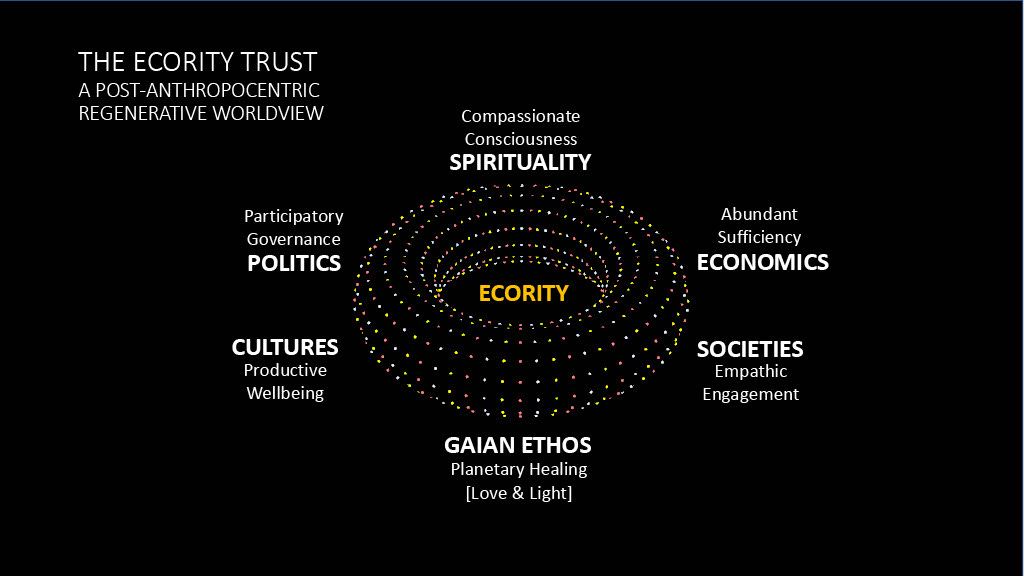
This is not metaphor but metabolic fact, and it points toward what I have tried to articulate as the ecority worldview—a fundamental reorientation from anthropocentric hierarchy to biocentric reciprocity, from dominion to participation, from the illusion of separation to the reality of radical interconnection. Ecority - a portmanteu word combining ecology + integrity - recognises that we’re not sovereign individuals or sovereign nations but permeable nodes in vast webs of relationship that extend through soil and atmosphere, through trading networks and information systems, through the molecular exchange of breath itself. Every inhalation contains atoms that once flowed through the lungs of distant others; every decision ripples through invisible channels of consequence that mock our pretensions to autonomous action.
The conventional notion of sovereignty rests on three pillars that ecority fundamentally undermines. First, territorial exclusivity—the claim that a nation-state exercises absolute authority within fixed geographical boundaries. Yet in an age of planetary ecological crisis, atmospheric carbon and ocean acidification establish the absurdity of imagining that what happens within bordered spaces, artificial lines drawn on a map, remains within those borders. The Amazon rainforest generates weather patterns that sustain agriculture thousands of kilometres away; deforestation in one nation becomes drought in another. The very concept of exclusive territorial sovereignty becomes incoherent when the biosphere itself is a single, interconnected system where cause and effect flow across all boundaries.
Second, the principle of non-intervention—the assertion that sovereign states should not meddle in each other’s internal affairs. This doctrine has provided convenient cover for atrocities while simultaneously failing to describe the actual condition of radical interdependence we inhabit. When global financial systems can transmit economic contagion across continents in milliseconds, when supply chains weave through dozens of jurisdictions to produce a single smartphone, when pandemics demonstrate that a pathogen respects no passport, the fiction of non-interference reveals itself as dangerous nostalgia. We are always already interfering in each other’s affairs through the simple fact of our metabolic existence on a shared planet.
Third, the monopoly on legitimate violence—the state’s claimed exclusive right to coercive force within its territory. This Hobbesian foundation assumes that order emerges only through centralised domination, that without a “sovereign” to impose discipline, we collapse into chaos. Yet ecosystems achieve extraordinary order without any centre of command, through distributed intelligence and emergent self-organisation. The sequoia grove does not need a sovereign tree to dictate resource allocation; it achieves dynamic equilibrium through myriads of local relationships that collectively generate systemic stability. The question this raises is whether human communities might organise governance through similar principles of distributed coordination rather than centralised control.
What then might a reinvented sovereignty look like when reimagined through the lens of ecority, a worldview of love and light? Light here is not mere illumination but the fundamental medium of energetic exchange—photosynthesis captures solar radiance and converts it into the biochemical currency that flows through all living systems. In human terms, light represents the transparency and awareness necessary for conscious participation in the larger systems that sustain us. A sovereignty of light would replace the opacity and secrecy of traditional statecraft with radical transparency about resource flows, decision processes, and systemic impacts. It would illuminate the hidden connections that bind us, making visible the supply chains, the ecological footprints, the channels of influence that current political boundaries obscure in partnership with industrial economism: capitalism.
Such transparency serves love—not as sentiment but as recognition of our profound entanglement. When we see clearly how our consumption patterns affect distant others, how our waste streams poison downstream communities, how our energy systems alter atmospheric chemistry that impacts all life, we can no longer sustain the illusion of separation. Love, in this sense, is the emotional and ethical response appropriate to our actual condition of interdependence. It’s choosing to organise our collective affairs in ways that honour the wellbeing of the whole system rather than maximising advantage for one part at the expense of others.
This reimagined sovereignty would function less like fortified castles and more like permeable membranes—structures that maintain coherence and identity while remaining open to exchange with their environment. Biological cells demonstrate this principle beautifully: they have boundaries that preserve their integrity while allowing selective passage of materials and information. They are simultaneously distinct and connected, autonomous and interdependent. A community organised on principles of ecority would likewise cultivate a strong sense of place-based identity and culture while remaining radically open to collaboration, exchange, and mutual influence across traditional boundaries.
The practical architecture of governing through ecority might draw inspiration from how ecosystems achieve coordination without hierarchy. In a forest, there’s no central planning authority dictating which species should grow where or how resources should be allocated. Instead, order emerges from countless local interactions governed by simple local rules—chemical signalling, nutrient exchange, competitive and cooperative dynamics that self-organise into stable yet adaptive patterns. Similarly, human governance could evolve toward more distributed, participatory structures where decision-making authority resides at the most local level capable of addressing a given issue, with coordination mechanisms that connect these local nodes into larger networks of collaboration.
This is not a utopian fantasy of dissolving all political boundaries into an homogenous global parliament—a prospect that would replicate the errors of sovereignty at a larger scale. Rather, it suggests nested, overlapping jurisdictions organised around functional needs rather than fixed territories. Watershed councils making decisions about water management that crosses municipal and national borders. Bioregional assemblies coordinating land use and ecological restoration according to ecosystem boundaries rather than political ones. Global protocols for atmospheric management that recognise our shared responsibility for climate stability. Local communities maintaining strong cultural autonomy while participating in multiple overlapping networks of cooperation.
What makes this transition toward ecority sovereignty not merely desirable but necessary is that the crises we face—ecological collapse, climate disruption, mass extinction, resource depletion and alienating technologies —are fundamentally systemic in nature and cannot be addressed through the fragmented, competitive logic of traditional sovereignty. When nations treat atmosphere and oceans as commons to be exploited without accountability, when they externalise costs onto others and future generations, when they compete for advantage rather than cooperating for shared survival, they guarantee a collective catastrophe. The sequoia’s wisdom is that resilience emerges through connection, not isolation; through sharing, not hoarding; through distributed strength, not centralised control.
The obstacles to this metamorphosis are not primarily technical but psychological and ideological. We have been so thoroughly conditioned by centuries of sovereignty discourse that imagining alternatives requires a profound shift in consciousness—from seeing ourselves as separate, competing units to recognising our nature as nodes in living networks. This is where practices of love and light become essential. Contemplative traditions across cultures have long understood that the experience of separation is, at its deepest level, an illusion maintained by the limited perspective of ego. Meditation, ceremony, artistic practice, direct encounter with wild nature—these can all function as technologies for dissolving the psychological boundaries that make the Westphalian model of sovereignty seem natural and inevitable.
When we stand in the presence of the ancient sequoia grove, we’re offered an initiation into a different way of being. We can sense, if we allow ourselves, that the distinction between self and other, between human and forest, between individual and ecosystem, is far more permeable than our habits of thought assume. The oxygen we breathe was exhaled by these trees; the carbon in our bodies once flowed through their roots; we are quite literally kin, woven from the same elemental threads. To organise our political affairs as if we were separate and sovereign is to live in contradiction to our actual nature as relational beings embedded in living systems.
The sovereignty of the future, then, will not be a sovereignty at all in the traditional sense. It will be what we might call “responsive autonomy”—communities maintaining their unique character and agency while remaining exquisitely attuned to their effects on the larger systems they inhabit. Like cells in a healthy body, they will be simultaneously distinct and cooperative, maintaining boundaries while participating in larger metabolic flows. They will exercise power not through dominion over territory but through skilful participation in networks of mutual aid and collective intelligence.
This transformation invites us to become different kinds of political beings—to cultivate a “futures consciousness,” an awareness that extends through time as well as space, recognising our responsibility not only to distant others but to generations yet unborn. It requires developing new capacities for systemic thinking, for holding multiple perspectives simultaneously, for acting from wholeness rather than fragmentation. It demands that we learn to love not just our immediate tribe but the entire community of life, to extend our circle of care to encompass soil microbes and salmon runs, forest canopies and coral reefs, all the myriad beings whose flourishing is inseparable from our own.
The genius of the sequoia is that it has already solved the problem we struggle with—how to be both strong and supple, both rooted and responsive, both individual and collective. Its shallow, interwoven roots create resilience far exceeding what any deep taproot could achieve alone. This is the template for twenty-first century governance: not sovereign fortresses but collaborative networks; not competition for dominance but cooperation for mutual thriving; not the brittle strength of isolation but the flexible power of interconnection. We are being summoned to become like the grove—distinct beings woven into a living whole, our roots entangled in projects of shared becoming, our crowns reaching toward the light together.
The transformation toward an “ecority” worldview invites us to fundamentally rethink not only governance but also the core logics that underpin economic activity. Just as the sequoia grove thrives through interwoven roots and shared vitality, so too must businesses transition from the isolating frameworks of industrial capitalism to models that embrace interdependence, regeneration, and cooperation. This shift requires moving beyond the extraction-based, competitive, and short-term focus of traditional systems, replacing them with principles rooted in reciprocity, distributed coordination, and a long-term commitment to shared flourishing.
By realigning with the wisdom of ecosystems, businesses can become active participants in sustaining the health of the whole—balancing autonomy with interconnectedness, individuality with collective resilience, and profit with planetary care. The logic of ecority offers not only a way forward but also a necessary response to the systemic crises that demand a more integrated, holistic approach to human enterprise:
From Competition to Collaboration
Industrial Capitalism: Driven by competition, businesses aim to maximise individual gain, often at the expense of others or the environment. The focus is on market dominance and resource hoarding.
Ecority: Emphasises mutual flourishing and cooperation. Businesses operate as part of interconnected ecosystems, prioritising shared well-being and collective resilience over zero-sum competition.
From Extraction to Regeneration
Industrial Capitalism: Built on the logic of extraction, treating natural resources as commodities to be exploited for profit. Externalities like pollution and ecosystem damage are ignored or minimised.
Ecority: Centres on biocentric reciprocity and regeneration. Businesses aim to repair and sustain ecosystems, recognising their dependence on healthy, thriving environments.
From Hierarchical Control to Distributed Coordination
Industrial Capitalism: Relies on centralised control, top-down management, and hierarchical structures to dictate resource allocation and decision-making.
Ecority: Inspired by ecosystems, governance and business decisions are decentralised, relying on local nodes, navigational management, and distributed networks for self-organisation and real-time adaptive responses.
From Short-Term Gains to Long-Term Responsibility
Industrial Capitalism: Prioritises short-term profits and shareholder returns, often disregarding future consequences for people and the planet.
Ecority: Operates with a “futures consciousness,” taking into account the long-term impacts of business activities on future generations and the broader ecological web.
From Individualism to Interdependence
Industrial Capitalism: Rooted in the Westphalian model of sovereignty, viewing businesses and nations as isolated entities pursuing self-interest.
Ecority: Recognises radical interconnection, where businesses acknowledge their role as permeable nodes in global systems, with accountability for how their actions affect others and the planet.
These shifts represent a profound reimagining of business logic, aligning human activity with the principles of ecological integrity and systemic interdependence.