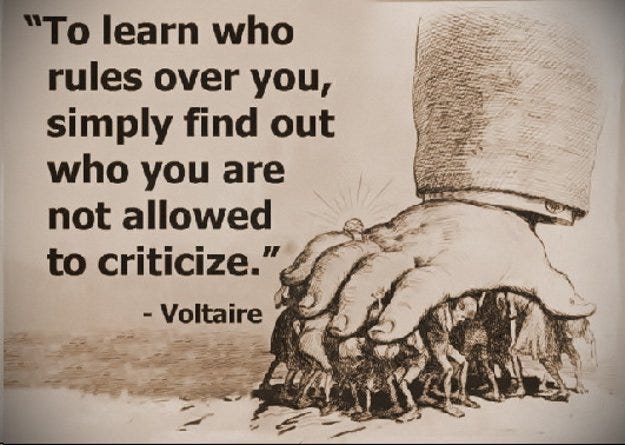
Noam Chomsky’s assertion that the smart way to keep people passive and obedient is to strictly limit the spectrum of acceptable opinion, but allow very lively debate within that spectrum offers a profound critique of the mechanisms through which power structures maintain control over contemporary public discourse. I want to put his statement to the test, reviewing it through a number of philsophical lenses, and reflecting on the impacts of such controls on societal evolution.
Health Warning: The following essay is pretty dense - so save it for a time when you’re ready to reflect deeply on the human condition.
I. The Paradox of Manufactured Consent
Chomsky’s observation exposes a sophisticated paradox at the heart of modern democracies; one that should give us pause for thought. Essentially he is poitning out that freedom and control are not opposites but can be mutually reinforcing in ways that fundamentally undermine the emancipatory project of modernity itself. This represents an evolution from Orwell’s crude totalitarianism to what we might more accurately characterise as soft totalitarianism, where the chains binding us are invisible precisely because they have been internalised, woven into the synapses of our consciousness.
From a Foucauldian perspective, this represents the historical transition from sovereign power, which prohibits and punishes through spectacular displays of force, to disciplinary power, which shapes subjects who regulate themselves through internalised norms and surveillance. The genius of this system lies in its elegant economy: rather than expending vast resources suppressing every divergent thought through brute coercion, incumbent power operates by constructing the exact categories through which we think, the conceptual apparatus we employ to make sense of the world. We become, in effect, accomplices in our own intellectual imprisonment.
This raises profound epistemological questions that strike at the heart of human knowledge itself: How can we possibly recognise the boundaries of acceptable thought when those self-same boundaries constitute our framework for recognition? It’s rather like asking a fish to notice water, the medium of constraint becomes invisible through its very ubiquity, its totalising presence.
II. The Hegemonic Function of Bounded Discourse
Antonio Gramsci’s concept of cultural hegemony illuminates the mechanisms Chomsky describes with remarkable precision. Hegemony operates not through overt force but through the naturalisation of certain worldviews, making them appear as common sense - the natural order of things - rather than as ideological constructs serving particular interests. The spectrum of acceptable opinion becomes hegemonic when alternative frameworks become literally unthinkable rather than simply unpopular, when the boundaries themselves become invisible, perceived as the natural limits of rationality itself rather than political constructions, and when debate within the spectrum creates the subjective experience of freedom, effectively inoculating participants against recognising their constraint.
This creates what Herbert Marcuse so presciently termed repressive tolerance, a system that tolerates diverse opinions within a framework that ultimately serves domination. The tolerance is real enough, people genuinely can debate, voices are raised, passions inflamed, but it functions repressively by channelling dissent into safe avenues, into cul-de-sacs that pose no genuine threat to existing power arrangements.
Ponder the philosophical implications here: if our actual categories of thought are pre-structured by the systems we inhabit, then the Enlightenment promise of reason liberating humanity becomes deeply problematic, perhaps even a cruel joke. Reason itself can become an instrument of control when the premises upon which it operates are predetermined, when the questions we’re permitted to ask already contain their own answers.
III. The Phenomenology of Constrained Freedom
From a phenomenological standpoint, individuals within this system experience themselves as genuinely free agents, autonomous subjects making meaningful choices. This is not false consciousness in any simple sense, the freedom is real within its domain; it’s palpable and felt. The deception lies in mistaking freedom within a cage for freedom itself, in confusing the ability to move freely about one’s cell with genuine liberty.
This relates intimately to Isaiah Berlin’s crucial distinction between negative and positive liberty. Negative liberty, freedom from interference, may be abundant within an acceptable spectrum. One can vigorously argue for policy A versus policy B, marshal evidence, deploy rhetoric, feel the rush of intellectual debate. But positive liberty, the capacity for genuine self-determination and authentic choice, is fundamentally compromised when the range of possibilities has been predetermined by forces beyond our awareness or control.
In the Westminster tradition this trap is ritualised. The adversarial theatre at the despatch box confers a palpable sense of negative liberty: members may denounce ministers, trade blows at Prime Minister’s Questions, table amendments, brief the lobby, and argue strenuously for policy A over policy B. Yet the range of admissible possibilities is pre-curated by party machines and whips, by a first-past-the-post duopoly, by Treasury orthodoxy and media gatekeeping, and by an executive that controls the parliamentary timetable. Committees can scrutinise but rarely set direction; backbench rebellions are episodic and costly; proposals that stretch the frame are dismissed as “not credible” by reference to market sentiment and headline tropes. Thus positive liberty—the capacity to determine the horizons of choice—is attenuated. Citizens are invited to revel in the combative pageantry and to select between manifestos every few years. But deeper constitutional, ecological, and ownership matters remain largely off-limits. The effect is demeaning: a politics of perpetual adolescence in which performative conflict masks the absence of authority to redesign the game itself.
The existentialist perspective adds yet another dimension to this analysis: authentic existence requires confronting the full range of human possibility, including and perhaps especially those deemed unacceptable by conventional society. When society pre-filters these possibilities, it infantilises citizens, protecting them from the anxiety of genuine choice whilst simultaneously denying them the dignity of authentic decision-making. We are kept in a state of perpetual adolescence, permitted to argue about which flavour of ice cream we prefer whilst the adults decide whether we shall have dessert at all.
IV. Epistemic Closure and the Illusion of Completeness
The bounded spectrum creates an epistemic closure where the system appears complete and self-justifying, a hermetically sealed universe of discourse that seems to account for all reasonable positions. Within the acceptable range, every position has its counter-position, thesis meets antithesis, creating the comforting illusion that all possibilities have been considered, that we have genuinely explored the full landscape of potential responses to our collective challenges. This resembles what Thomas Kuhn described as paradigmatic science, where normal science operates productively within unquestioned assumptions, with anomalies either ignored entirely or forced uncomfortably into existing frameworks like square pegs hammered into round holes.
The philosophical danger here is the conflation of comprehensiveness with completeness, a subtle but catastrophic confusion. A debate may be comprehensive within its parameters, exhaustively exploring every permutation of acceptable positions, whilst remaining radically incomplete from a broader perspective. This is the crucial difference between internal validity, where arguments are rigorous within the accepted framework, and external validity, where the framework itself corresponds to reality’s full complexity and the genuine range of human possibility.
The system Chomsky describes excels at internal validity whilst systematically obscuring questions of external validity. Critics who point to excluded possibilities are dismissed as unrealistic, utopian, or dangerous, not because their ideas have been examined and found wanting through rigorous analysis, but because they operate outside the Overton Window of acceptable discourse. They are ruled out of court before the trial begins, their testimony deemed inadmissible not on its merits but on procedural grounds.
V. The Mechanisms of Symbolic Violence
Pierre Bourdieu’s concept of symbolic violence helps explain how this system maintains itself without obvious coercion, without the need for jackboots and midnight arrests. Symbolic violence occurs when dominated groups accept and internalise the categories and hierarchies that structure their domination, when the oppressed come to see their oppression as natural, inevitable, perhaps even just. The spectrum of acceptable opinion functions as symbolic violence when those excluded from it accept their exclusion as legitimate, when radical alternatives are dismissed not just by elites but by ordinary citizens who have learned to police the boundaries of their own thinking.
This is power at its most efficient and insidious. Rather than suppressing dangerous ideas through censorship, which creates martyrs and draws attention to forbidden knowledge, the system renders certain ideas literally unspeakable within polite discourse. They become social taboos, violations of conversational norms rather than political positions worthy of debate. The result is a form of pre-emptive self-censorship where individuals regulate their own speech and thought without conscious awareness of doing so.
What makes this particularly pernicious is that it operates beneath the threshold of conscious recognition. We don’t experience ourselves as constrained because the constraints have become part of our cognitive architecture, the invisible scaffolding that structures our perception of what’s possible, reasonable, and worth considering. This is what Michel Foucault meant when he spoke of power producing subjects rather than merely repressing them. We are not simply prevented from thinking certain thoughts; we’re constructed as subjects for whom those thoughts never arise in the first place.
VI. The Media Ecology of Manufactured Consensus
The media’s role in this process can’t be overstated, functioning as it does as the primary mechanism through which the spectrum of acceptable opinion is established and policed. Mainstream news outlets, deeply embedded within corporate structures and dependent upon access to government sources, curate the narratives that dominate public discourse with remarkable consistency. By selectively highlighting certain viewpoints whilst downplaying or ignoring others, the media shapes public perception of reality itself, determining not just what we think but constraining what we think about.
This results in a society where critical issues such as wealth inequality that would have shocked even the robber barons of the nineteenth century, environmental degradation that threatens the habitability of our planet, and the corrupting influence of corporate money on democratic processes, are either trivialised or reframed within acceptable parameters that preclude genuinely transformative responses. Consider, for example, Tesla’s contested remuneration package for Elon Musk—valued at roughly USD 56 billion, the largest in corporate history—debated largely through the lens of shareholder value while its democratic and ethical implications were treated as secondary. Thus individuals may passionately debate the merits of various policies, arguing with great sophistication about marginal adjustments to existing arrangements, whilst remaining oblivious to the broader structural issues that in a remotely sane world would necessitate fundamental change.
The phenomenon of acceptable opinion is dramatically exacerbated by social media, which despite its revolutionary promise has largely functioned to narrow rather than expand the range of public discourse. Algorithms prioritise content that aligns with prevailing narratives and user preferences, creating echo chambers that reinforce existing beliefs whilst limiting exposure to genuinely diverse or deviant perspectives. This creates a curious paradox: we have access to more information than any previous generation in human history, yet we may be less exposed to genuinely challenging ideas, cocooned as we are within filter bubbles that reflect our existing prejudices back to us with reassuring consistency.
Social media platforms facilitate discussions that can appear dynamic and engaging, giving users the subjective experience of participating in vibrant democratic discourse. Yet they often do so within a narrow bandwidth that excludes dissenting voices through a combination of algorithmic curation and user-driven moderation. Consequently, individuals may feel empowered to express their opinions within the confines of this digital arena, experiencing themselves as active participants in public debate, yet remain unaware of the broader implications of their engagement, of the ways in which their very participation reinforces the boundaries they imagine themselves to be challenging.
VII. Education as Liberation or Indoctrination
Chomsky’s insight raises profound questions about the role of education in either perpetuating or challenging this system of controlled dissent. An educational system that prioritises rote memorisation, standardised testing, and conformity to established norms will inevitably produce a populace ill-equipped to question authority or challenge prevailing orthodoxies. Such a system treats students as vessels to be filled with approved knowledge rather than as critical thinkers capable of interrogating the foundations of what they are taught.
In this model education is not learning; rather it becomes a mechanism of social reproduction, ensuring that each generation internalises the categories and assumptions that serve existing power structures. Students learn not just specific content but the meta-lesson that legitimate knowledge comes from authorised sources, that their role is to absorb and regurgitate rather than to question and create afresh. They are trained in the art of thinking within acceptable boundaries, becoming sophisticated operators within a predetermined framework whilst losing the capacity to step outside that framework and examine it critically.
Conversely, an education that prioritises critical inquiry, that fosters intellectual curiosity and encourages students to question everything including the educational process itself, can help individuals recognise the limits placed upon them and develop the courage to transgress those boundaries. Such an education would treat uncertainty not as a problem to be solved but as the condition needed for genuine inquiry. It would encourage students to seek out ideas outside the mainstream, to engage seriously with perspectives deemed dangerous or impractical, to develop what C. Wright Mills called the sociological imagination - the capacity to connect personal troubles to public issues and to see the constructed nature of what otherwise may appear natural.
This kind of education is inherently threatening to world-systems that depend upon passive obedience because it produces citizens capable of recognising manipulation, and of seeing through the illusion of choice to the reality of constraint. It cultivates what Paulo Freire termed critical consciousness, the ability to perceive contradictions and to take action against oppressive elements of reality.
VIII. The Ontology of Possibility and the Foreclosure of Futures
At a deeper ontological level, the limitation of acceptable opinion represents a foreclosure of possible futures, a narrowing of the horizon of human becoming. Every society operates within an ontology of possibility, a sense of what futures are imaginable, achievable, and worth pursuing. When the spectrum of acceptable opinion is artificially restricted, entire categories of possible futures are rendered unthinkable, expelled from the realm of serious consideration.
This is an existential problem. It touches upon the essence of human freedom and agency. If we accept that human beings are fundamentally creatures of forethought, oriented towards possibilities not yet realised, then constraining the range of imaginable futures is tantamount to constraining human nature itself. We become less than we might be, not through any inherent limitation but through the artificial limits imposed upon our collective imagination.
The philosopher Ernst Bloch spoke of the principle of hope as fundamental to human existence, the capacity to envision and work towards a better world. Yet hope demands genuine alternatives, real possibilities that transcend the given. When acceptable opinion is bounded, hope is domesticated, reduced to minor tweaks to existing themes rather than genuine metamorphosis. We’re permitted to hope for incremental improvements within the system but forbidden to hope for the system’s transcendence. This produces what Mark Fisher brilliantly termed capitalist realism, the widespread sense that not only is capitalism the only viable political and economic system, but also that it’s now impossible even to imagine a coherent alternative to it.
This foreclosure of possibility has profound psychological and spiritual consequences. When people cannot imagine genuine alternatives to present arrangements, when the horizon of opportunity contracts to encompass only minor variations on current themes, a peculiar form of despair sets in. It’s not the dramatic despair of tragedy but the quiet misery of resignation, the sense that things will never fundamentally change, that we’re trapped in an eternal present with no exit. This despair masquerades as realism, as mature acceptance of the way things are, but it represents a profound failure of imagination.
IX. The Dialectics of Control and Resistance
Yet we must be careful not to paint too deterministic a picture. I don’t want to suggest that this system of controlled dissent is totalising and therefore inescapable. History demonstrates repeatedly that no system of control, however sophisticated, can completely contain human ingenuity and resistance. In itself, the act of establishing boundaries creates the possibility of transgression, of crossing those boundaries and discovering what lies beyond.
There exists a dialectical relationship between control and resistance, where each move by power generates counter-moves by those subject to it. The establishment of a spectrum of acceptable opinion inevitably produces those who recognise that spectrum as artificial and who work assiduously to expand or explode it. These individuals and movements operate at the margins, in the spaces not yet colonised by dominant discourse, creating what Hakim Bey called temporary autonomous zones where alternative possibilities can be explored.
Moreover, the contradictions within the system itself create openings for resistance. A system that claims to value freedom and democracy whilst actually constraining both must engage in constant ideological labour to maintain the illusion. These efforts inevitably produce gaps and inconsistencies that critical thinkers can exploit. When reality persistently fails to conform to official narratives, when lived experience contradicts approved explanations, space opens for alternative understandings to emerge.
The key question becomes: how do we cultivate the capacity to recognise these boundaries and to transgress them productively? This requires a practice of cognitive estrangement, the deliberate cultivation of distance from the familiar, the ability to see the constructed nature of what appears natural. This is the function that art, philosophy, and critical theory can serve, making the familiar strange, and the strange familiar, thereby revealing its contingency, its openness to transformation.
X. Towards an Expanded Democratic Imagination
If we take Chomsky’s critique seriously, and I believe we must, then the task before us is nothing less than the expansion of democratic imagination itself, the creation of spaces where genuinely diverse perspectives can encounter one another and where futures currently deemed impossible can be thoroughly investigated. This requires institutional changes, certainly, reforms to media structures, educational systems, and political processes that would allow for greater diversity of perspective and more genuine participation.
But it also requires something more fundamental, a transformation in consciousness itself, a willingness to sit with uncertainty and to entertain ideas that initially strike us as absurd or dangerous. We must cultivate what Keats called negative capability, the capacity to sit with uncertainties, mysteries, and doubts without lunging for premature certainty. This does not mean abandoning reason but rather recognising its limits, understanding that rationality itself operates within frameworks that must periodically be questioned and reconstructed.
This expanded democratic imagination must be grounded in a radical hospitality towards the other, towards perspectives and possibilities that challenge our most cherished assumptions. Too often, we approach difference as something to be tolerated at best or assimilated at worst, rather than as a genuine resource for collective learning and transformation. Yet it’s precisely in the encounter with genuinely foreign perspectives that our own assumptions become visible to us, that the boundaries of acceptable opinion reveal themselves as boundaries rather than as the natural limits of thought itself.
We need to create what sociologist Jürgen Habermas called ideal speech situations, contexts in which communication can occur free from domination, where the force of the better argument rather than the argument of force determines outcomes. Whilst Habermas’s vision may be impossibly utopian as a complete description of achievable reality, it serves as a regulative ideal, a standard against which we can measure existing discursive practices and identify their limitations and distortions.
XI. The Practice of Epistemological Humility
Central to this project must be the cultivation of epistemological humility, a recognition that knowledge is always partial, situated, and potentially mistaken. The bounded spectrum of acceptable opinion derives much of its power from epistemological arrogance, from the assumption that we already know the range of viable options, that history has delivered its verdict and we need only implement the approved solutions. This arrogance masquerades as sophistication, as hard-headed realism, but it represents a profound intellectual and moral failure.
Epistemological humility does not mean relativism or the abandonment of truth claims. Rather, it means holding our convictions provisionally, remaining open to evidence and arguments that challenge them, and recognising that the map is never the territory, that our conceptual schemes always simplify and distort the complexity they attempt to capture. It means acknowledging that those we disagree with might be seeing something we have missed, that perspectives we find incomprehensible or repugnant might contain insights necessary for our collective flourishing.
This humility must extend to our understanding of history and social change. The modern world is characterised by what I call manufactured normalcy, where the pace and scale of change exceed our capacity to predict or control outcomes. In such a context, the pretence that we can definitively rule out certain possibilities as unworkable or undesirable becomes not only intellectually suspect but dangerous too. We need to maintain what the systems theorist C.S. Holling called adaptive capacity, the ability to respond creatively to unexpected challenges and opportunities.
The bounded spectrum of acceptable opinion represents a catastrophic reduction in adaptive capacity, a narrowing of our collective repertoire of responses precisely when we face challenges like ecological collapse, technological disruption, social fragmentation, and widespread corruption, that demand unprecedented flexibility. By foreclosing alternatives before they have been seriously explored, we leave ourselves vulnerable to systemic failures that could have been avoided or mitigated through greater openness to diverse possibilities.
XII. Reclaiming the Commons of Thought
What we’re ultimately discussing here is the enclosure of the intellectual commons, the privatisation and control of the shared space in which collective thinking occurs. Just as the historical enclosure of physical commons transferred control of shared resources and land to private interests, the enclosure of the intellectual commons transfers control of shared meaning-making processes to powerful institutions that benefit from limiting our range of thinkable thoughts.
Reclaiming this commons requires both defensive and constructive strategies. Defensively, we must resist further enclosure, challenging the mechanisms through which acceptable opinion is policed and boundaries are enforced. This means developing critical media literacy, learning to recognise propaganda and manipulation, and creating alternative information infrastructures that operate outside corporate and state control. It means protecting and expanding spaces, in education, in civil society, in our personal lives, where genuine dialogue can occur without the distorting influence of power.
Constructively, we must actively work to expand the commons, to create new spaces and practices for collective thinking that transcend the limitations of acceptable opinion. This might involve establishing what Ivan Illich called convivial institutions - structures that enhance rather than inhibit human autonomy and creativity. It requires building what the political theorist Chantal Mouffe calls agonistic pluralism, a democratic culture that recognises conflict as productive rather than something to be eliminated, where adversaries engage robustly whilst respecting one another’s legitimacy.
The digital realm offers both perils and possibilities in this regard. Whilst social media platforms have largely functioned to narrow discourse through algorithmic control, the underlying technologies of networked communication contain genuine potential for creating decentralised, distributed, non-hierarchical spaces for collective deliberation. The challenge of course lies in wresting these technologies from corporate control and reimagining them as genuine public goods, as infrastructure for democratic participation rather than as mechanisms for surveillance and manipulation.
XIII. The Courage to Think Dangerously
Ultimately, expanding the spectrum of acceptable opinion requires the courage to think dangerously, the willingness to entertain ideas that threaten comfortable assumptions and established interests. This is not courage in any heroic sense but rather the everyday resolution to question what everyone around us takes for granted, to speak inconvenient truths, to imagine alternatives that others dismiss as impossible or undesirable.
This courage must also be distinguished from the adolescent pleasure of shocking the bourgeoisie. Thinking dangerously means taking seriously the possibility that our most fundamental assumptions about how society should be organised, about what constitutes progress or justice or the good life, might be mistaken or incomplete. It means being willing to follow arguments wherever they lead, even when they lead to conclusions that threaten our identities, our privileges, or our sense of security.
The philosopher Gilles Deleuze spoke of thought as fundamentally violent, as something that happens to us rather than something we do, that disrupts our comfortable certainties and forces us into new configurations. The bounded spectrum of acceptable opinion represents an attempt to tame thought, to render it safe and predictable, to eliminate this violence. But in doing so, it eliminates thought’s transformative potential, its capacity to genuinely change us and our world.
What we need, then, is not simply more debate within existing parameters but a fundamental questioning of those parameters. This requires developing what the Frankfurt School theorists called immanent critique, the ability to identify contradictions within existing systems and to use those contradictions as leverage points for transformation. Every system contains the seeds of its own transcendence, possibilities that exceed and potentially undermine its current configuration. Our task is to identify and nurture these possibilities, to widen the cracks in the edifice of acceptable opinion until genuinely new light can enter.
XIV. The Ethical Dimensions of Bounded Discourse
There are profound ethical implications to the limitation of acceptable opinion that we must confront directly. When we constrain the range of thinkable thoughts, we’re not engaging in a neutral technical operation but rather making decisions about whose perspectives count, whose suffering matters, whose futures are worth considering. The spectrum of acceptable opinion always reflects existing power relations, privileging the perspectives of those who benefit from current arrangements whilst marginalising the voices of those who suffer under them.
This represents epistemic injustice, the wrong done to someone specifically in their capacity as a knower. When certain perspectives are ruled out of bounds before they can even be articulated, when entire communities find their experiences and insights dismissed as unrealistic or extremist, they suffer a distinctive form of injustice that compounds and reinforces material forms of oppression. They are denied the capacity to make sense of their own experience and to have that sense-making recognised by others.
Debate about the treatment of Palestinians by Israel illustrates these dynamics. Testimony from Palestinians about displacement, military rule, siege, and everyday restrictions is often discounted as partisan or securitised out of bounds; the admissible vocabulary is tightly policed in mainstream forums, with terms such as Nakba or apartheid treated as beyond the pale in many venues even as leading human-rights organisations deploy them. Civil society knowledge-makers have been delegitimised—notably when six Palestinian NGOs were designated “terrorist” organisations in 2021, a move widely contested by international partners and rights groups—and access for journalists and monitors has frequently been constrained. Rights organisations have also documented disproportionate takedowns of Palestinian content on social media, while anti‑BDS measures in numerous jurisdictions narrow the space for advocacy by attaching legal or contractual penalties. These patterns amount to testimonial and hermeneutical injustice: a community’s accounts are pre‑emptively discredited, and the interpretive frameworks needed to make sense of their experience are marginalised. None of this settles the conflict’s moral or legal questions; it shows that the spectrum of acceptable opinion is shaped by power in ways that deny some people standing as knowers, and thus foreclose genuinely transformative debate.
The ethical imperative, then, is to create conditions under which all voices can be heard, not merely tolerated but genuinely attended to and taken seriously. This requires what the philosopher Emmanuel Levinas called an ethics of the face, a fundamental responsibility to the “other” that precedes and grounds all other ethical considerations. We must approach perspectives outside the acceptable spectrum not with suspicion or condescension but with genuine openness to the possibility that they might reveal dimensions of reality we have so far failed to perceive.
This is particularly urgent when we consider the global dimensions of bounded discourse. The spectrum of acceptable opinion in Western democracies often excludes not just radical alternatives within those societies but entire worldviews and epistemologies from non-Western cultures. Indigenous knowledge systems, non-capitalist economic arrangements, alternative conceptions of personhood and community, different legal frameworks, all dismissed not because they have been examined and found wanting but because they fall outside the conceptual models through which acceptable opinion is defined.
XV. Conclusion: The Unfinished Project of Democracy
Chomsky’s observation serves as a profound cautionary reminder of the complexities inherent in public discourse and the ways in which incumbent power operates through the construction of consent rather than through crude coercion. Whilst robust debate is essential for a healthy democracy, it becomes a mechanism of control rather than liberation when it operates within a tightly controlled spectrum of acceptable opinion. The liveliness of debate within constrained boundaries creates the illusion of freedom whilst foreclosing the genuine possibilities that democracy supposedly promises.
To cultivate a truly participatory society, one worthy of the name democracy, we must continuously expand the boundaries of discourse to challenge the narratives that shape our understanding of the world, and to nurture an environment where dissent is not just tolerated but actively celebrated as essential to our collective flourishing. This requires institutional reforms, certainly, but more fundamentally it requires a transformation in consciousness, a willingness to embrace uncertainty and to engage seriously with perspectives that challenge our deepest assumptions.
We must come to terms with the fact that democracy is not a static achievement but an ongoing project, one that’s imperfect as it stands, and that requires constant vigilance against the enclosure of the intellectual commons and the domestication of reason. I genuinely believe that the struggle to expand the spectrum of acceptable opinion is nothing less than the struggle for human freedom, for the capacity to imagine and create futures that transcend the limitations of the “here and now”.
Only through this expansion can we empower individuals to think critically and engage meaningfully with the most pressing issues of our time, breaking free from the confines of indifference and obedience that so often pervade contemporary society. That’s daunting. It requires courage, humility, and persistence. But it’s also exhilarating, for in expanding the boundaries of acceptable opinion, we expand the boundaries of human possibility, opening space for futures we cannot yet imagine but which might represent our collective salvation.
The question that confronts each of us, then, is deceptively simple: Will we remain comfortable within the cage of acceptable opinion, enjoying the illusion of freedom that vigorous debate within predetermined boundaries provides? Or will we develop the audacity to recognise those boundaries, to question them, and ultimately to transgress them in pursuit of a more expansive and authentic freedom? The answer we give, individually and collectively, will determine not just the character of our democracies but the possibilities available to future generations.