India’s Great Famine of 1876–1878 was not a natural calamity but an artefact of governance. Exports rose as harvests failed; cash taxes were enforced as incomes vanished; relief was rationed to deter “dependency” while officials refused price controls or imports lest they “distort” free trade. Grain moved under guard to foreign markets as the poor were disciplined unto death, their disappearance rationalised as a cleansing of the labour market. The scale of mortality was inseparable from the ideology that sanctioned it: markets before lives, doctrine before evidence.
That is the operating rule we need to interrogate. Why? Because it persists—updated and sanitised—in today’s debt management, food‑system governance and climate policy frameworks.
This is not a history lesson but a systems brief for the present. The Great Indian Famine is the control case in a larger experiment—what happens when states elevate market doctrine over human survival. Name the ideology that turned drought into mass death - industrial economism - or you will not recognise it when it reappears, updated and sanitised, in adjustment conditionalities, carbon accounting and supply‑chain compliance. The lesson is not a memorial to grief; it’s a warning label for today.
Strip away the costumes and you see the same choreography. In the 1870s, exports rose as bodies fell; taxes were enforced as harvests failed; relief was rationed to deter “dependency”. Today, debt service is enforced amid floods and drought; subsidies are withdrawn as food prices spike; multilateral programmes celebrate “courageous reforms” while households skip meals. Then, grain ships left Madras under guard. Now, letters of intent from finance ministries travel to Washington under duress. In both cases, the ideology is explicit: discipline must be maintained, and survival is not a sufficient reason to break the rules.
Today over three billion people cannot afford a healthy diet, while about 280 million face acute food insecurity. Energy and fertiliser price shocks after the pandemic and during the war in Ukraine cascaded into input costs farmers could not absorb and retail prices consumers could not pay. More than fifty low‑ and middle‑income countries now spend more on external debt service than on health. International Monetary Fund programmes in Pakistan, Ghana, Zambia, Sri Lanka and elsewhere have required steep tax rises and subsidy removals in the middle of crisis. In Pakistan in 2022–2023, energy tariffs were lifted while flood victims still lived in tents. In Ghana in 2022–2023, food inflation surged past 50 per cent as the cedi collapsed. In Sri Lanka in 2022, food inflation peaked near 95 per cent. In Argentina, austerity framed as credibility turned recession into implosion in 2001 and again under the 2018 programme, with inflation exploding and real wages eroding. Each time, the brief is identical: prove to lenders that you will not put your people before your bonds.
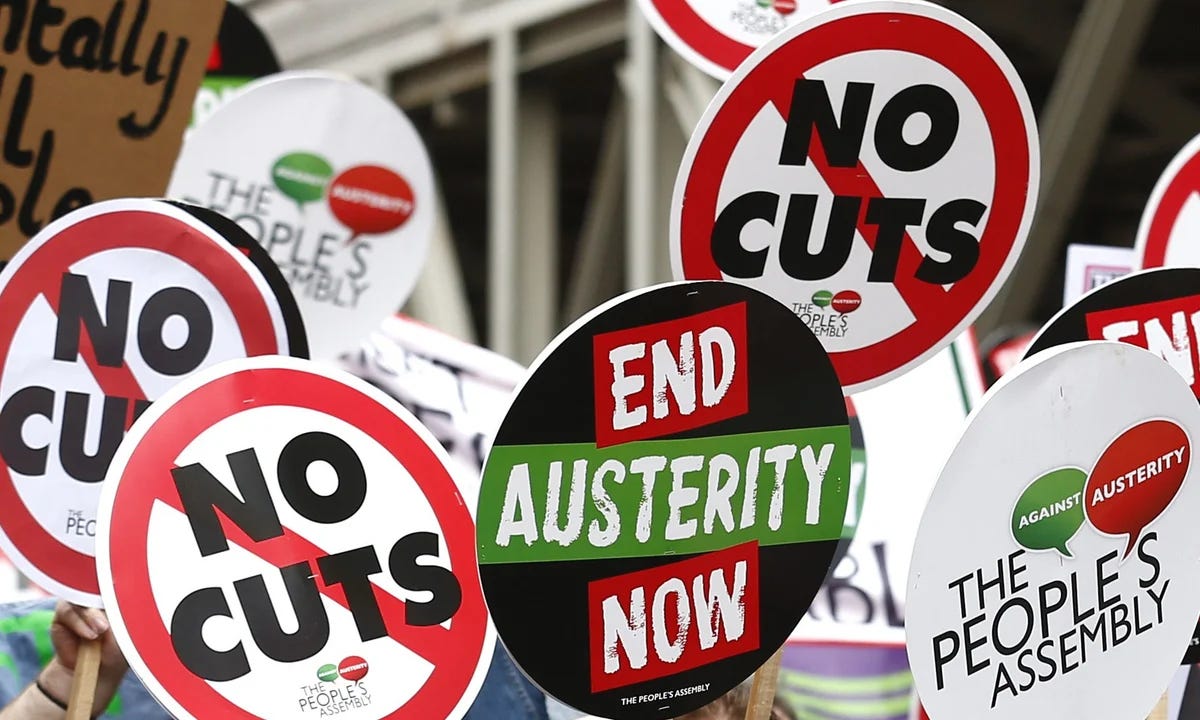
We’re told this is science. It’s actually a worldview. The numbers that govern adjustment are not neutral; they encode priorities. Fiscal targets that ignore hunger, nutrition and livelihoods as “off‑balance‑sheet externalities” reproduce the logic that turned a drought into a slaughter in the 1870s. Austerity sends the invoice for errors made by the elite to those least able to pay. That’s not good economics. It’s administrative violence administered with a spreadsheet. Models decide what counts. What they omit—nutrition, informal livelihoods, ecological repair—becomes disposable. Industrial economism optimises a single variable and calls the collateral “externalities”. In complex, coupled systems that move at different tempos, that’s not policy. It’s licensed harm and it creates lock‑ins that normalise avoidable suffering.
The same pattern contaminates the “green” agenda. Targets matter. But so do the pathways chosen to meet them. Where climate policy is imposed as technocratic fiat, the predictable outcome is a transfer of risk from corporations and creditors to farmers and consumers. Methane compacts, nitrates caps, deforestation rules, carbon border taxes, ESG screens and digital traceability can all be justified on paper. Implement them without sequencing, support, or alternatives, however, and you fracture local food systems. Push costly compliance down to smallholders and you extinguish farmer autonomy. Pretend that a feed additive like 3‑NOP is a silver bullet and you ignore cost pass‑throughs, productivity trade‑offs and regional variation. Treat “precision agriculture” as an inevitable upgrade and you tighten dependence on proprietary seeds, data platforms and input bundles controlled by a handful of firms. The result is not resilience but fragility masquerading as progress.
There’s a huge difference between prudent innovation and reckless experiment. Cloud seeding and proposals for solar radiation management sit in a governance vacuum with uncertain, and potentially uneven effects. Claims that such interventions cause droughts are not supported by robust evidence, but deploying climate manipulations without consent, transparency or oversight invites the same hubris that justified exporting grain past starving crowds. We will not engineer our way out of ecological breakdown by outsourcing risk to the poor.
Nor can we ignore market power. Four trading houses—Cargill, ADM, Bunge and Louis Dreyfus—mediate a large share of the world’s grain. A handful of firms dominate nitrogen, phosphate and potash. Pesticide and seed markets are likewise oligopolistic. Price spikes and scarcity rents in 2021–2023 showed how easily shocks are amplified in a system designed for throughput rather than care. When governments are told that food subsidies “distort” markets but are given no tools to counter oligopoly in grain trading, inputs and logistics, the doctrine reveals itself: discipline the consumer, pamper the intermediary, and call it efficiency.
This is the through‑line from Victorian Treasury doctrine to today’s technocracy: the conviction that suffering is a purgative, that scarcity educates, and that shielding the vulnerable only delays necessary adjustment. In the nineteenth century, that conceit was dressed in natural law. In the twenty‑first, it comes wrapped in model outputs and debt sustainability analyses. The morality is unchanged. Protect the system; let the people adapt - or starve.
We should be clear where the evidence bites. Countries that liberalised agriculture under duress routinely became more import‑dependent and more exposed to price volatility. Removing strategic grain reserves because they offend market purity is a category error that repeatedly proves lethal. Cutting energy or transport subsidies in food‑importing states without compensating transfers is a machine for turning macro targets into empty plates. Surcharging desperate borrowers for access to IMF finance is an ethical failure disguised as precedent. None of this is accidental. These are choices.
We should be equally clear on what does not withstand scrutiny. Agenda 21 and the 2030 Agenda are non‑binding frameworks, not global edicts. The World Economic Forum does not set law. But soft power can still produce hard outcomes when governments internalise targets while ignoring their duty of care. Sustainability is not the problem. A narrow, corporate‑centric view and execution of sustainability is. If climate policy strips livelihoods faster than it reduces emissions, it will fail on its own terms and, in the process, widen the zone of hunger.
What, then, must replace the catechism that starves in the name of order? We could begin by inverting the metric. The purpose of an economy is nourishment, human dignity and ecological integrity. If a policy improves a debt ratio while raising child wasting, it fails. If a reform attracts capital while collapsing local food webs, it fails. If a programme stabilises a currency while forcing people to choose between light and bread, it fails. That’s the test. Make it operational: track child wasting and stunting, minimum dietary diversity, the food share of household expenditure, and farmer insolvency rates. Gate fiscal and financial decisions against this dashboard.
From there the design becomes obvious. Treat the right to food as binding, with automatic stabilisers that trigger when prices spike or harvests fail. Build automatic triggers into fiscal frameworks: when staple prices, wasting rates or farmer insolvencies breach thresholds, transfers rise, tariffs pause and reserves release by rule, not by discretion. Rebuild public grain reserves and regional safety nets to smooth shocks rather than exporting them. Sequence climate policy with generous transition finance, floor prices for regenerative production, and farmer‑led innovation instead of top‑down mandates. Break up choke‑point monopolies in grain, inputs and logistics; mandate transparent stock and trade data so hoarding cannot hide behind opacity. Replace pro‑cyclical austerity with counter‑cyclical support and embed disaster clauses into sovereign and private debt so floods and droughts don’t translate into budgetary strangulation. End IMF surcharges and suspend conditionality that withdraws basic protections during declared emergencies. Use SDR reallocations and development bank balance sheets to finance food‑system resilience in local currency, not just private megaprojects. Align trade rules with food security by allowing targeted, time‑bound measures that protect staples without triggering beggar‑thy‑neighbour spirals.
There are contemporary exemplars. Where governments maintained strategic grain reserves and wide‑coverage public distribution, as under India’s National Food Security Act, price shocks translated into fewer empty plates. Where scalable safety nets such as Ethiopia’s Productive Safety Net Programme were deployed early, droughts did not become famines. Natural‑disaster “pause” clauses in some Caribbean sovereign bonds show how debt contracts can be redesigned so calamity does not trigger fiscal strangulation. These are not panaceas, but they do prove the system can be rewired.
We simply cannot continue to outsource moral judgement to a spreadsheet. The famine administrators insisted that markets were natural and therefore neutral. They were wrong. Markets are designed, policed and privileged by law and policy. When a design results in hunger and starvation, it must be changed. When a policy kills, it must be stopped. When an institution insists that survival can wait until confidence is restored, it forfeits its authority to counsel.
History’s value is precision, not nostalgia. The Great Indian Famine was not an act of God. It was an artefact of governance. So is the food insecurity stalking the present. This is a civilisational design problem: single‑purpose optimisation—of debt ratios, of export earnings, of investor confidence—will always misfire in complex systems because it externalises the self-same conditions that sustain life. Keep optimising balance sheets and you get a brittle future—efficient on paper, broken in practice. Redesign for nourishment and you get a system that can take a hit without turning it into a funeral.
The alternative demands different questions. What would fiscal credibility look like if the right to eat were itself non‑negotiable? What would climate policy look like if farmer autonomy and biodiversity sat at its core? What would global finance look like if debt service paused the moment disaster struck? Answer those questions without flinching, and the parallels with the past begin to dissolve. Fail, and the same story will be told about us—that we saw the pattern, understood the consequences, and chose the theory over the people.