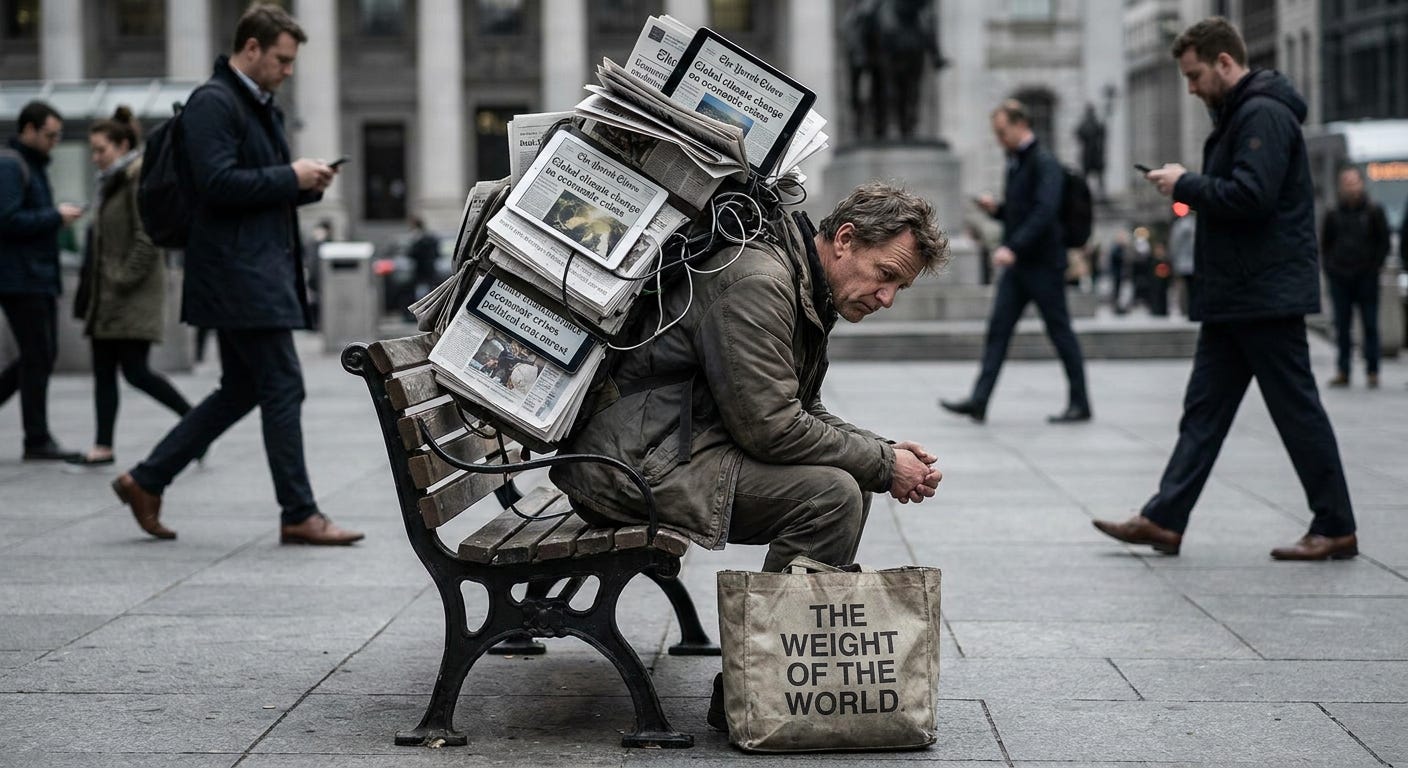
When I am not travelling or on Zoom calls with clients, each morning begins much the same way. A shower. Coffee with a madeleine still warm from the oven. Answering any emails that need an immediate response. Then the news headlines — which is to say, observing the daily inventory of a civilisation doing precisely what I have spent five decades saying it would do, with no satisfactory answer for why that should be the case.
Most of the time I live in a condo on the edge of a golf course in Bangkok. From where I sit, I can’t see the course itself, although I know it’s busy — it always is. What I can see is the city in the distance, the skyline of a place that has grown faster than any institution designed to govern it. What I can hear, oddly, is birdsong. The sound of traffic doesn’t reach here. But the planes do — Suvarnabhumi is only a short distance away, and all day the aircraft pass overhead, the sound of the global economy in transit, carrying its cargo of embedded assumptions from one part of the world to another. I watch the headlines. I listen to the birds. The planes are climbing overhead. This is how my day begins.
There’s a particular kind of solitude that has no obvious name. It’s not the loneliness of isolation — of being without company or love. I have never had, by any reckoning, an embarrassment of either. Four women I have loved gave me everything I have become. Nine children. Seventeen grandchildren. A life threaded across three continents, through governments and corporations and universities. I am not, by any measure, alone.
And yet the weight that arrives with the headlines doesn’t lift with the day. It has been there for decades. It’s heavier now than it was. I have come to understand it, after much resistance, as the weight of knowing what’s coming and being unable to make the world hear it in time.
I have spent the better part of five decades being what the world likes to refer to as a futurist — though I have always found that title faintly absurd. I try not to make predictions, although prediction has its place. I read patterns. I sit at the intersection of systems — ecological, political, economic, and psychological — examining how they interact with one another and cause consequences that might have been averted. I have done this long enough, and in enough meetings with people who actually make decisions, to understand with some precision what the convergence of those patterns means.
The Western civilisation I was born into in 1945 is not reforming. It is ending. Not in a catastrophic Hollywood-like implosion, but in the way an old building deteriorates – slowly at first, the structure failing in places nobody thought to inspect because they assumed the foundations still held.
I felt this, in embryonic form, lying on the South Downs above Cuckmere Haven the day before my thirteenth birthday. I couldn’t have named it then – I was a boy watching cumulus clouds and smelling salt air – but the seed of it was there: the sense that almost everything I had been taught was an invention, that the reality arranged around me was contingent rather than inevitable, and that arrangements purporting to be permanent were nothing of the kind. It took decades of work and reading and witnessing to give that intuition its full weight. But the intuition was there at thirteen, and it has never left.
The problem — and this is where the loneliness becomes structural — is the gap between what the evidence shows and what the world is capable of receiving. Not because people are deaf or reckless. But because the operating system we inhabit — the interlocking logic of economic growth, institutional continuity, electoral cycles, and daily necessity — constitutes a horizon beyond which it is genuinely difficult to see and actively punishing to look.
When I write about the end of industrial economism, about planetary boundaries breached, about democratic erosion and civilisational succession, I am not writing from imagination. It isn’t fiction. I am interpreting — imperfectly, always imperfectly — what is already visible to anyone who has spent long enough looking at the world-system rather than its parts. Translation is the work. And translation is where the burden is most evident.
Because language fails. Not occasionally. Structurally in its lack of a lexicon that can express both the unknowable and the ineffable. The precision required to describe what’s actually happening demands a density of argument and a patience with complexity that the attention economy has systematically destroyed. The essay adequate to the moment is the essay that loses the reader who most needs it. I have never resolved this. I have only learned to live with it.
There’s also the problem of being eighty-one now. I don’t raise this for sympathy and least of all for drama. I mention it because it changes the calculus of the burden in a way I couldn’t anticipate. For most of my working life, the urgency I felt about civilisational transition was forward-facing — there was still time, there were still levers, and the window hadn’t yet closed. That remains technically true. But it no longer feels true in the same way.
When I consider the generations coming after me — children, grandchildren, people I love at a distance that has become its own kind of impulse — the urgency acquires a different quality. It becomes specific without becoming intimate. The faces are real. The distance between us is also real. And that distance is itself part of what the burden costs. A man who has spent his life trying to communicate what he knows to the world, and who finds the people closest to him are among those he can’t reach, learns something about the nature of the human project that no amount of professional success can soften.
Khwan is half my age. She didn’t ask to be the partner of a man carrying five decades of civilisational analysis like luggage he can’t set down. That she will outlive me by many years and inhabit the future I have spent my career trying to describe is something I think about in the mornings, with the coffee and the headlines and the planes going over. Similarly with Nico, my youngest son, who is only fifteen.
The village is different. Ban Tha Rae, in the far northeast, operates on a different frequency entirely. Not just quieter — though it is that — but constituted differently in terms of scale. Smaller in the best sense: human-sized, land-proportioned, and organised around relationships rather than transactions. When I am there, the burden doesn’t fade. But it sits differently, like a stone carried in the other hand. The question of what civilisation is doing to itself feels more urgent yet somehow less claustrophobic when you’re inside a way of living that the dominant paradigm has not yet fully consumed.
This is what I mean by scale. Bangkok is not loud, at least from where we live. But it is vast, and its vastness is of a particular kind — the vastness of an urban system that has outgrown the human purposes it was built to serve. Ban Tha Rae is the opposite of that. A reminder, visceral rather than theoretical, of what any successor grammar might actually feel like from the inside, if we ever manage to build it.
People sometimes ask me — usually after a keynote or in response to a Hames Report article that’s landed somewhere uncomfortable — whether it’s exhausting to see things in such a dystopian manner. To have spent a lifetime at the intersection of what is and what is coming, and to have watched, again and again, the gap between them widen rather than close. The honest answer is yes, and no.
Exhausting, because the translation never feels adequate. Because the essay that would be precise enough is always longer and more dense than anyone wants to sit with. Because I have watched governments receive accurate analyses and file them, corporations commission foresight work and ignore it, and intelligent people absorb the civilisational argument and retreat to inaction and private grief. Because I am eighty-one and the window, while still open, is not open indefinitely.
Not exhausting, because the alternative — not knowing, not looking, not trying to interpret — has never been available to me. The instinct that arrived on the South Downs at the age of thirteen has not loosened its grip in sixty-eight years. I am constitutionally incapable of pretending the facade holds when I can see the structure failing behind it. And because there are the people and communities and ways of thinking and living that carry within them the pattern of what might come next. I have met enough of them, across enough cultures and contexts, to know that the metamorphosis is possible, even if by no means inevitable. That knowledge does not dissolve the burden. But it makes the carrying of it feel less solitary.
In Thailand there’s a small ceremony — sai sin, the white thread blessing. A monk or elder breathes a prayer into cotton thread and ties it around the wrist. Right for men, left for women. You don’t cut it; you wear it until life rubs it away of its own accord, as if the blessing knew when its work was done.
I think of my writing in the same way. Not as a performance of certainty or a claim to authority. Not as the work of someone who has the answers. But as the continued tying of a thread – between what I can see and what I can say, between the precision the situation demands and the patience the reader can offer, and between the world as it is and the world as it remains possible for it to become.
The burden of knowing is not, in the end, the knowing itself. It’s the combination of knowing, caring, and continuing — in the face of a system designed to make that continuation feel futile, a medium designed to make precision feel pedantic, and a timeline that is, for someone of my age, no longer abstract.
I have no resolution to offer. The window is still open. That is the only certainty I can honestly claim. And it’s not enough. It’s never enough.