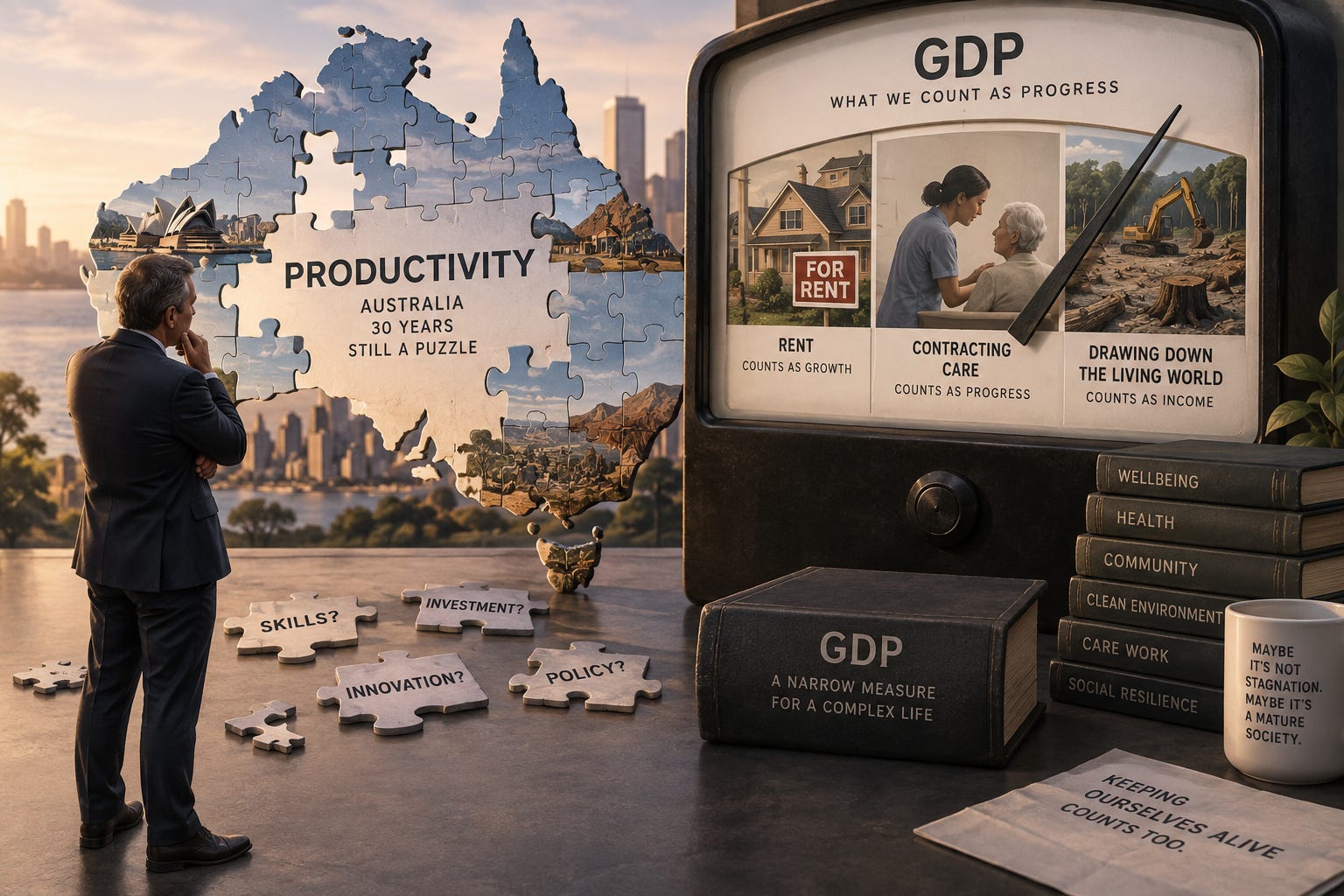
Synopsis: Australia has spent three decades puzzling over its stalled productivity. The puzzle may lie less in the economy than in the instrument measuring it — an instrument that rewards rent over production, scores the contracting of care as progress, and books the drawing down of the living world as income. What reads as stagnation may be a mature society doing the work of keeping itself alive.
A support worker in outer Melbourne is allotted eleven minutes to shower an old man who used to be a fitter and turner. The app on her phone did the apportioning. She is quick and she is kind, and when the visit is logged complete she drives to the next one. In the national accounts this morning that work registers as an improvement on the same morning five years ago, when the visit ran twenty minutes and included a cup of tea. The man is bathed either way. The rest had never been counted as an asset — only as a cost, and costs are there to be cut.
Australia has spent three decades asking why its productivity has stalled. The inquiries multiply, the tax incentives rotate, the automation arrives on schedule, and yet the numbers simply refuse to move. The explanations rotate too: business will not invest, governments over-regulate, competition has gone soft, the public sector is lethargic and can’t change.
Lately a more subtle suggestion has entered the debate — that everyone is behaving rationally and the sum of all that rationality is the problem. The public servant adds an assurance step after a failure. The manager automates the process but keeps old controls in place. The firm protects its margin rather than bet on a long redesign. Each decision defensible. The aggregate is an economy running faster and faster in order to stay in the same spot.
There’s something in this argument. But the woman and her eleven minutes expose a crack in the logic, because in her case the numbers didn’t stall. They actually improved. The enigma, examined closely, is not in the economy. It’s in the arithmetic.
Let’s start with weak investment, which is the puzzle on which most diagnoses founder. Capital deepening — the equipment, systems and structures behind each hour of work — is estimated to have slowed from around four per cent a year in the decade to 2015 to a fraction of that since. The standard analysis blames soft competition: unthreatened firms choose margin over risk.
Follow the money still further and a less comfortable interpretation emerges. For twenty years the most reliably rewarded economic activity available to an Australian household or company board was not transforming a business. It was holding residential land, holding bank shares in a carved-up market, or holding a claim on minerals in the ground. Tax settings made property the highest-performing, lowest-effort asset in the country, so capital did what capital does.
Under those conditions, weak productive investment is not a mystery awaiting explanation. It is arbitrage — the evidence that the incentives are working precisely as designed. The variant differs by country: a land bank outside one city, a port concession in another, a banking oligopoly in a third. But wherever rent beats production, an economy will be owned, not built.
A productivity debate that never touches this is an inquiry into why the channels run dry, conducted without reference to where the water is going.
A deeper fault runs through the eleven minutes. Australia’s employment is migrating, irreversibly, into health, disability support, aged care and education — sectors whose output is, in large part, presence. An old observation in economics deserves retrieval here: a string quartet requires the same four musicians for the same forty minutes it did two centuries ago, and a nurse’s shift remains a nurse’s shift. These activities resist acceleration because the time is the service. Ageing, wealthy societies become care-heavy by definition, so their aggregate productivity slows by design — even as the work of keeping people alive, accompanied and educated becomes more necessary, not less.
Apply the industrial ruler to care and the service degrades in proportion to its measured improvement. Australia ran this experiment in full view. Years of task-timed visits, reduced contact minutes and casualised rosters in aged care lifted throughput per hour and ended in a royal commission whose interim report was titled, with terrible economy, Neglect. The metric succeeded but the care failed. Shortening the visit raises productivity exactly the way speeding up the quartet does — more notes per hour, and fewer of them mattering.
The conversion problem is real. Technology purchased without redesigned work practices, savings that shift costs onto customers and call the shift efficiency, controls laid down after some long-ago failure and never lifted again — these are its forms. An economy facing an energy transition, a housing shortfall and a demographic wave indisputably needs to do more with less — where more-with-less is a coherent idea. The error is the single ruler, laid across mining and nursing alike, as though presence and ore were the same kind of thing awaiting the same discipline.
If human presence is invisible on one side of the accounts, depletion is invisible on the other. The ore sold counts as income. But the ore body drawn down counts as nothing, because national accounting treats natural capital as free. The aquifer pumped past its recharge rate, the soil carbon spent, the fishery worked past recovery — output, all of it, with no depreciation anywhere. A household that sells its tools and books the proceeds as earnings is not prospering. It is becoming poorer faster, with quarterly figures to prove it.
The seam between the two forms of blindness has a perversity of its own. The spill is growth. The clean-up after the spill is also growth. Only the unspoiled river counts as nothing at all. A system of measurement that scores the maintenance of the living world at zero, and the repair of its damage as gain, will produce the economy it measures. It has.
Put the two sides together and the picture inverts. Much of the work that registers as an economy straining to stand still is maintenance — the care of the old and the ill, the education of the young, the repair of what wears out, the absorption of risks that compound. A mature civilisation, like a mature organism, devotes most of its metabolism to keeping itself going. That this reads as stagnation says more about the instrument than about the organism.
Meanwhile the arithmetic grinds forward, and it can keep improving for a long time yet. Visits can be shortened further. The estate can be drawn down faster. Every figure can be burnished by sensible actors doing exactly what the rewards instruct.
Somewhere an old man who once turned steel by hand waits for the knock that comes, and leaves, on schedule — and is left washed, alone, correctly processed. In the accounts, the morning was a success. The cup of tea and human company appear in no column, and no inquiry has been asked to find it.