A child dies in a house fire three streets from where you live. The evening news leads with it. There is footage of the charred window frame, interviews with neighbours, a photograph of the child smiling. The anchor’s voice carries that particular register of sorrow reserved for local tragedy. You feel it. Everyone feels it.
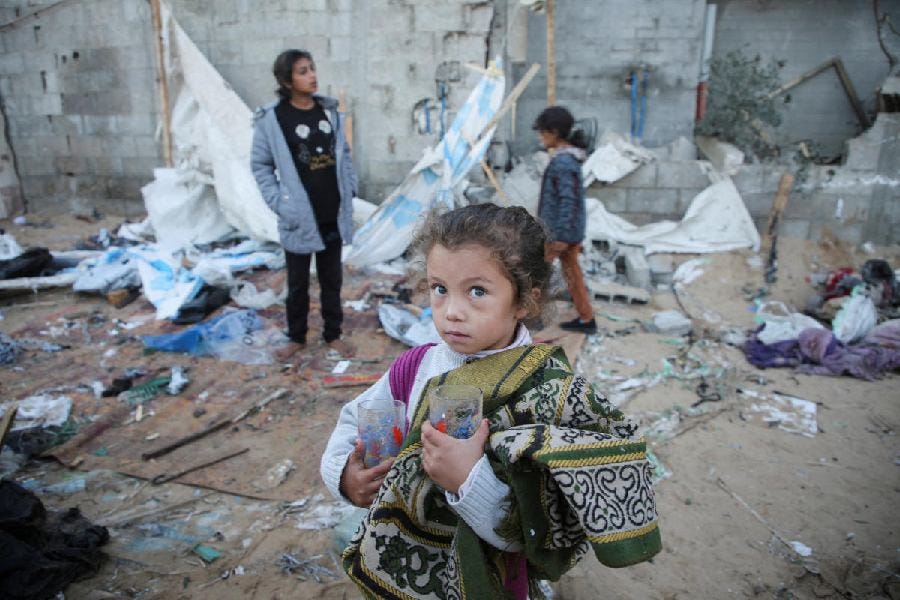
That same evening, buried in the international segment or absent altogether, three hundred people — many of them children — die in a bombing raid eight thousand kilometres away. The report, if it comes at all, lasts forty seconds. No names. No faces. A number, a location, a context too complicated to parse between the weather and the sports. You register it, perhaps. You do not feel it the same way. Nobody does.
This isn’t an accusation. It’s an observation about how human attention actually works, which is to say: badly, narrowly, and in ways that make a mockery of our stated belief that all human life holds equal value.
We could call this hypocrisy and be done with it. That would be easier. But the truth is both more uncomfortable and more curious. What we are watching is not a failure of morality so much as a collision between our evolutionary inheritance and a world that’s outgrown the scale at which that inheritance makes sense.
The Geometry of Empathy
The human brain didn’t evolve to grieve for strangers. It evolved to grieve for kin, for the tribe, for the people whose survival was intertwined with your own. Empathy, in its original evolutionary context, was a local technology. It worked at the scale of a few dozen people, a few hundred at most. Everyone had a face. Everyone had a name. Loss was specific, immediate, and within the radius of action.
We are now asked to extend that same empathy across a planet of eight billion people, most of whom we will never meet, whose languages we don’t speak, whose daily realities bear no resemblance to our own. And we wonder why the mechanism jams.
The psychologists have a term for this: the identifiable victim effect. We respond to the particular — the girl in the photograph, the name, the story — in ways we cannot sustain when the suffering becomes statistical. One death is a tragedy. A thousand deaths is a number. This is not callousness. It’s the way the emotional architecture of the human mind encounters scale it was never designed to process.
When we see the footage of the house fire, we can imagine it. We can place ourselves, or our children, into that scenario. The street looks like streets we know. The house could be ours. The neural pathways of empathy light up because the tragedy is legible within the grammar of our own lives.
The bombing eight thousand kilometres away exists in a different register entirely. The location is unfamiliar. The geopolitical context is tangled. The victims are not like us in ways we have been taught, implicitly and explicitly, to notice. And so the empathy doesn’t fire, or fires weakly, or is overridden by something closer and louder. This is where proximity does its quiet, relentless work.
The Economics of Attention
News is not, despite its pretensions, a neutral transmission of information. It’s a business, and like all businesses it responds to incentives. What holds attention? What generates engagement? What keeps people watching through the commercial break?
The answer, it turns out, is not the thing that matters most. It’s the thing that feels most relevant.
Relevance is constructed along axes of geography, culture, and perceived threat. A death nearby feels relevant because it suggests something about the safety of our own environment. A death far away, unless it involves our own nationals or threatens our interests, registers as tragic but abstract — the kind of thing that happens over there, in places we think of, if we think of them at all, as inherently more chaotic, more violent, more unfortunate.
This is not an accident. It’s the result of decades of editorial decisions about what counts as news, which in turn reflect deeper assumptions about whose lives are considered normal and whose are considered exceptional. A single death in London or Sydney is newsworthy because it disrupts the expected order. Three hundred deaths in Gaza or Khartoum or Kabul are contextualised within an existing narrative of conflict, which is to say: they are already expected, already part of the landscape, already less disruptive to our sense of how the world is supposed to work.
The news doesn’t create this bias. But it inherits it, amplifies it, and profits from it. And we, the audience, are complicit. We change the channel when the suffering becomes too distant, too frequent, too difficult to hold. We have to. The alternative — to feel, fully and continuously, the weight of all the world’s grief — would break us. This is the trap. We are not built for the moral scale we now inhabit.
The Narcotic of the Local
There’s a certain comfort in the local tragedy. Not comfort in the death itself, but in the knowability of it. The house fire has a cause: faulty wiring, perhaps. There will be an investigation. There may be accountability. The community will rally. There will be a fund for the family. Something can be done.
The distant atrocity offers no such satisfaction. The causes are historical, structural, geopolitical — which is to say, they exceed the boundaries of individual agency. What are you supposed to do about a bombing raid eight thousand kilometres away? Sign a petition? Donate to a charity whose effectiveness you cannot verify? Feel bad? The local death invites action. The distant death invites only helplessness. And so we turn toward the former, not because we are monsters, but because we are human, and humans are wired to solve problems they can see and touch.
This is where the news completes its circuit. It gives us the tragedy we can metabolise: close enough to feel, small enough to comprehend, specific enough to imagine ourselves within. It spares us the tragedy that would otherwise paralyse us. And in doing so, it quietly teaches us that some lives are more narratable than others.
The Hierarchy of Grief
Let me be precise about what is happening here. When a single death in a wealthy, stable country receives more attention than mass death in a poorer, conflict-affected region, we’re not simply witnessing a failure of empathy. We’re witnessing the reproduction of a global hierarchy that assigns differential value to human life based on geography, race, religion, and proximity to power.
This hierarchy is rarely stated explicitly. It doesn’t need to be. It’s embedded in the structure of news coverage itself: in the length of the segment, the tone of the anchor, the presence or absence of names, the decision to send a correspondent or rely on wire footage, the choice to lead with the story or bury it after the sport.
The US philosopher Judith Butler calls this “differential grievability” — the notion that some lives are considered more worthy of public mourning than others. It is not that the distant dead are not grieved at all. It’s that they are grieved differently, more abstractly, more briefly, in ways that don’t demand the same emotional labour or moral reckoning.
This is the subsurface current beneath every news broadcast. It is what allows us to feel deeply for the child three streets away while scrolling past the report of three hundred dead with only a flicker of recognition. It’s what permits the coexistence of intense local mourning and distant indifference within the same moral universe. And it is, to be blunt, obscene.
The Limits of Scale
But here’s the difficulty: even if we recognise this hierarchy, even if we name it and condemn it, we’re still left with the problem of scale.
You can’t mourn three hundred people the way you mourn one. Our emotional machinery doesn’t work that way. Grief is specific. It attaches to particulars: a voice, a face, a memory, a habit that will never recur, a chair that stays empty at a particular table. Scale is grief’s enemy. When the number grows, something in us does not expand to meet it — it contracts, retreats into abstraction, reaches for the anaesthetic of statistics.
This is why the most devastating war reporting is never about the war. It’s about one family in one house on one street. It’s about the colour of a door, a child’s shoe in the rubble, a woman describing what her husband used to cook on Friday evenings. The journalist who understands this is not manipulating you. They are working with the grain of what you are — finding the particular that unlocks the general, the one face that briefly makes the three hundred real.
But that technique, powerful as it is, runs up against its own limits. It can open a window. It can’t keep it open. The next news cycle closes it. The next tragedy competes for the same narrow aperture of attention. And the structural conditions that produced the rubble — the arms trade, the geopolitical calculus, the economic interests that find war in certain regions more tolerable than war in others — continue undisturbed beneath the surface of any individual story.
Scale is grief’s enemy. It is also accountability’s enemy. The larger the atrocity, the more diffuse the responsibility, the harder to assign, the easier to absorb into a narrative of tragic inevitability. Wars don’t just happen. They are made, by specific decisions, taken by specific people, often with full knowledge of who will bear the cost. But that knowledge lives at a scale the evening news is structurally disinclined to illuminate, and that we, its audience, are psychologically ill-equipped to sustain.
So where does this leave us? Not, I think, with solutions — the word implies a tidiness that this situation doesn’t possess. But perhaps with something more useful: a clearer view of what we are actually looking at when we watch the news.
We’re looking at a mirror that has been shaped by commerce, by politics, by the deep grooves of culture and proximity, and by the genuine limitations of human empathy operating at civilisational scale. What it shows us is not the world. It’s a particular rendering of the world, one in which some deaths are tragedies and others are little more than weather — ambient, regrettable certainly, but beyond the scope of what we’re invited to feel.
To see that is not a solution. But it’s a different kind of seeing. And different seeing, over time, is how the things we have agreed to stop noticing begin to become visible again. The child in the photograph three streets away deserved to be mourned. Yes. So did every single one of the three hundred.
The first mourning came naturally, wired into us by a million years of living close. The second mourning has to be chosen — deliberately, effortfully, against the current of everything the media environment is designed to make easy. It requires us to hold, however briefly, the knowledge that the number was once, to someone, a name. That the name was once, to someone, a whole world.
That’s not a comfortable thing to carry. But it is, perhaps, the minimum that moral seriousness requires in a century when the distance between us and the consequences of our world-system has been reduced to the length of a news segment — and we keep choosing not to look.